
Key Takeaways
- Norway is the world's most prosperous country. It scores 91.6 of 100 on the Atlantic Council's 2026 Prosperity Index, leading a top tier dominated by the Nordics and small, wealthy European states.
- Freedom and prosperity rise together. Across all 164 countries the two indexes correlate at 0.72 — a country's freedom score alone explains just over half the variation in its prosperity.
- Some autocracies are rich anyway. The UAE, Qatar, Saudi Arabia, Turkmenistan, Belarus and Russia all rank far higher on prosperity than on freedom — resource wealth without political opening.
- And some free countries are still poor. Cape Verde, Ghana, South Africa, Namibia and Senegal post strong freedom scores their economies have yet to match.
- South Sudan sits last at 32.6. Nine of the ten least-prosperous countries are in Sub-Saharan Africa, which averages 49.1 against Europe's 81.3 and North America's 82.0.
When the Atlantic Council published its 2026 Atlas of Freedom and Prosperity in April, the headline was bleak: by its measure the rule of law is weakening, political freedoms are under pressure, and protections for minorities have eroded across much of the world. But the same dataset holds a more hopeful — and more mappable — story about prosperity: where it has accumulated, where it hasn’t, and how tightly it tracks the freedoms a country affords its people. The Indexes score 164 countries on a 0–100 Prosperity Index and a parallel Freedom Index, drawing on data through 2024. This map ranks every one of them by prosperity.
Crucially, prosperity here is not just GDP. It folds wealth together with how long and how healthily people live, how evenly the gains are shared, and how well the environment and minorities are protected. That makes it a broader gauge of national well-being than a per-capita income figure — and it reshuffles the league table in ways a pure wealth ranking does not.
The world’s prosperity, mapped
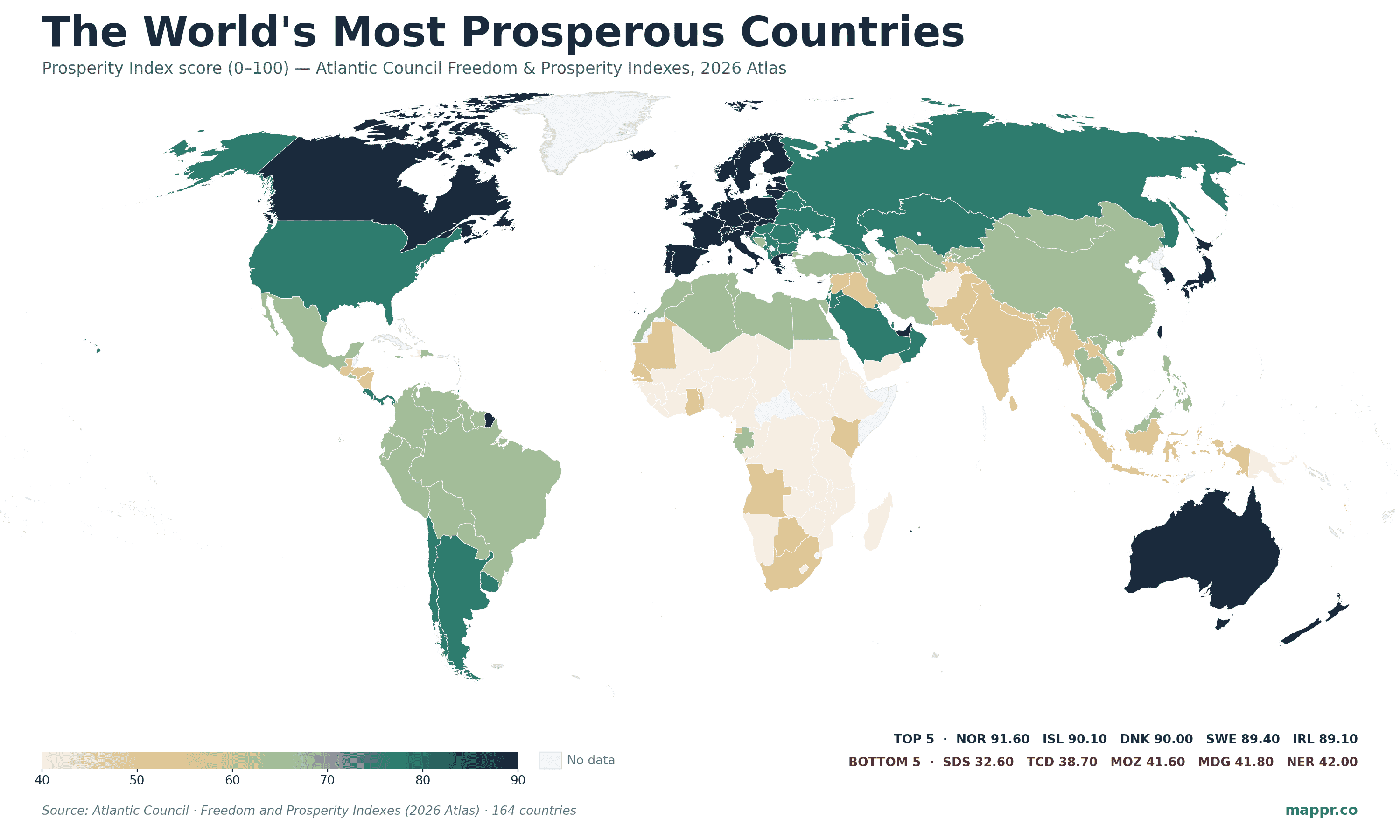
The spread is enormous: Norway’s 91.6 is nearly three times South Sudan’s 32.6 at the foot of the table. The deepest tones cluster in northern and western Europe and in North America; the palest band runs across the Sahel and central Africa, with a long moderate middle through Latin America, the Balkans, and East and Southeast Asia.
The most prosperous countries in the world
The 15 most prosperous countries
Atlantic Council Prosperity Index, 0–100 (Freedom Index shown alongside).
| Country | Rank | Prosperity | Freedom |
|---|---|---|---|
| Norway | 1 | 91.6 | 89.7 |
| Iceland | 2 | 90.1 | 88.2 |
| Denmark | 3 | 90.0 | 93.8 |
| Sweden | 4 | 89.4 | 91.6 |
| Ireland | 5 | 89.1 | 91.2 |
| Switzerland | 6 | 88.9 | 91.4 |
| Belgium | 7 | 88.7 | 88.1 |
| Finland | 8 | 88.4 | 91.1 |
| Netherlands | 9 | 88.1 | 90.2 |
| Slovenia | 10 | 87.9 | 81.8 |
| Luxembourg | 11 | 87.3 | 92.7 |
| Czech Republic | 12 | 87.2 | 86.6 |
| Germany | 13 | 87.1 | 88.9 |
| Australia | 14 | 86.7 | 90.1 |
| New Zealand | 15 | 85.9 | 89.9 |
Norway takes the top spot at 91.6, trailed by a tight pack of Nordic and small European states — Iceland (90.1), Denmark (90.0), Sweden (89.4) and Ireland (89.1). What stands out is the company prosperity keeps: every country in the top 15 also lands in the Free tier of the Freedom Index. At the very top of the world, high prosperity and high freedom are effectively inseparable.
Where prosperity is scarcest
The 10 least prosperous countries
Atlantic Council Prosperity Index, 0–100 (Freedom Index shown alongside).
| Country | Rank | Prosperity | Freedom |
|---|---|---|---|
| Burundi | 155 | 43.6 | 40.0 |
| Democratic Republic of the Congo | 156 | 43.1 | 43.5 |
| Haiti | 157 | 43.0 | 43.5 |
| Eritrea | 158 | 42.5 | 23.2 |
| Mali | 159 | 42.2 | 48.8 |
| Niger | 160 | 42.0 | 55.4 |
| Madagascar | 161 | 41.8 | 54.6 |
| Mozambique | 162 | 41.6 | 51.7 |
| Chad | 163 | 38.7 | 40.3 |
| South Sudan | 164 | 32.6 | 39.1 |
At the other end, South Sudan (32.6), Chad (38.7) and Mozambique (41.6) anchor the table. Nine of the bottom ten are in Sub-Saharan Africa; Haiti is the only exception. The regional gap is the single starkest pattern in the data: Sub-Saharan Africa averages just 49.1 on the Prosperity Index, against 60.2 for South and Central Asia, 65–68 across Latin America, the Middle East and East Asia, and 81.3 for Europe and 82.0 for North America.
Does freedom buy prosperity?
Across all 164 countries, prosperity and freedom move together with a Pearson correlation of 0.72 — meaning a country’s freedom score alone explains just over half the variation in its prosperity. That is the Atlantic Council’s central argument: fair institutions and individual liberties are, in its words, “the strongest foundations for a country’s population to achieve well-being and lasting prosperity.” For the political-rights-and-civil-liberties side of the ledger, see our companion map of Freedom in the World by country — which uses Freedom House’s scoring, distinct from the Atlantic Council’s own Freedom Index used here.
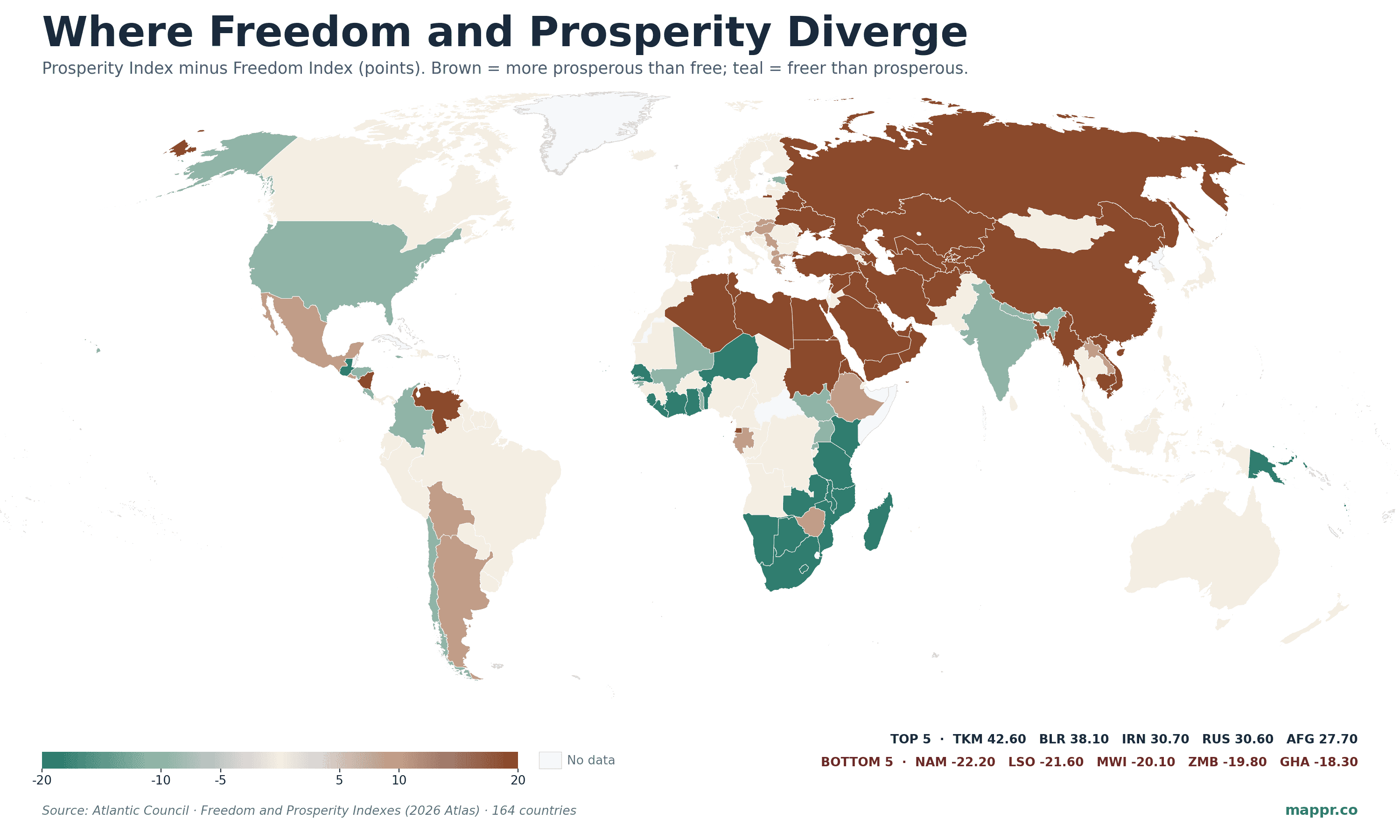
But a 0.72 correlation still leaves plenty of room for exceptions, and the countries that break the pattern are the most revealing. The map below shows the gap between each country’s prosperity and freedom: brown where prosperity outruns freedom, teal where freedom outruns prosperity.
Prosperity without freedom
Prosperous, but not free
Countries ranking far higher on prosperity than on freedom.
| Country | Prosperity | Prosperity rank | Freedom | |
|---|---|---|---|---|
| United Arab Emirates | 80.0 | #35 | 55.3 | Freedom #107 |
| Qatar | 76.0 | #45 | 49.7 | Freedom #125 |
| Saudi Arabia | 70.8 | #62 | 43.7 | Freedom #137 |
| Turkmenistan | 67.0 | #77 | 24.4 | Freedom #162 |
| Belarus | 75.5 | #46 | 37.4 | Freedom #154 |
| Russian Federation | 72.7 | #58 | 42.1 | Freedom #145 |
A cluster of resource-rich autocracies has bought prosperity without loosening its grip. The United Arab Emirates ranks 35th in the world for prosperity but only 107th for freedom — a 72-place gap. Qatar, Saudi Arabia and Turkmenistan tell the same story: oil, gas and sovereign wealth funding high incomes, healthcare and infrastructure while political and legal freedoms stay tightly constrained. Belarus and Russia round out the group, their middling prosperity propped up far above their freedom ranks. (Turkmenistan is the extreme case in the whole dataset — 67.0 on prosperity against just 24.4 on freedom.)
Freedom without prosperity
Free, but not yet prosperous
Countries ranking far higher on freedom than on prosperity.
| Country | Prosperity | Prosperity rank | Freedom | |
|---|---|---|---|---|
| Cape Verde | 59.3 | #104 | 76.1 | Freedom #42 |
| Ghana | 54.9 | #115 | 73.2 | Freedom #46 |
| South Africa | 54.6 | #119 | 72.6 | Freedom #50 |
| Namibia | 49.2 | #133 | 71.4 | Freedom #58 |
| Senegal | 51.2 | #126 | 69.5 | Freedom #63 |
| Botswana | 59.7 | #102 | 72.0 | Freedom #55 |
The mirror image runs through southern and west Africa. Cape Verde, Ghana, South Africa, Namibia and Senegal all post strong freedom scores their economies have not yet matched — open elections and functioning courts without the income, health and infrastructure that convert freedom into prosperity. In the Atlantic Council’s framing these are the encouraging cases: the institutions are in place, and prosperity, in theory, should follow.
What the Prosperity Index actually measures
Unlike a GDP-per-capita ranking, the Prosperity Index is a composite of six sub-indexes: income, health, inequality, education, environment and minority rights. A country can post a high income score and still be dragged down by weak health outcomes, sharp inequality or poor environmental protection — which is why the prosperity table does not line up perfectly with the familiar wealthiest-nations lists. It is closer in spirit to a national quality-of-life measure than to a balance sheet, and it is why a country like Slovenia (10th) outranks several richer economies.
The bottom line
The 2026 Atlas paints a world where freedom is retreating even as the link between freedom and prosperity holds firm. Most countries sit close to the diagonal — free and prosperous together, or neither. The interesting action is in the exceptions: the petrostates banking prosperity without political opening, and the young democracies banking freedom while they wait for prosperity to arrive. Which of those two bets pays off over the next decade is, in many ways, the central question the Atlantic Council’s data is asking.
This post uses the Atlantic Council Freedom and Prosperity Indexes (2026 Atlas, published April 2026, covering data through 2024). Per-country Prosperity Index and Freedom Index scores and ranks, the sub-index breakdowns, and the freedom–prosperity correlation are computed from the Indexes' published country dataset. Both choropleths are Mappr originals built from that dataset.
Primary Data Source:
- Atlantic Council — 2026 Atlas: Freedom and Prosperity Around the World – The 2026 edition of the Atlas. Methodology, headline findings, and the index framework used throughout this post.
- Atlantic Council — Freedom and Prosperity Indexes (rankings explorer) – Interactive rankings and full per-country dataset for all 164 countries — the source of every score and rank cited here.
Image Sources:
- Featured photo by MAO YUQING on Unsplash – Fjord village in Norway — the world's most prosperous country in the 2026 Index.