Key Takeaways
- 20th straight year of global decline. 54 countries deteriorated in 2025; 35 improved. The longest sustained drop in freedom Freedom House has ever recorded.
- Finland alone scores a perfect 100. New Zealand, Norway, and Sweden tie at 99/100; Ireland 98; Canada, Denmark, Luxembourg, Netherlands, San Marino, Slovenia, and Uruguay all at 97.
- The U.S. fell 3 points to 81. Total American decline since 2005 = -12 points — the steepest drop of any country still rated Free except Nauru and Bulgaria. Cited drivers: executive overreach, free-expression pressure, and weakened anti-corruption safeguards.
- Three Free upgrades: Bolivia, Fiji, Malawi. All three moved from Partly Free to Free thanks to competitive elections, peaceful transfers of power, and stronger judiciaries — proof democracies can still expand.
- Bottom of the world: South Sudan 0, Turkmenistan 1, Sudan 1. Three countries effectively score zero on Freedom House's 100-point scale. North Korea (3), Eritrea (3), Myanmar (4), and the Gaza Strip (2) round out the most-repressive jurisdictions.
Freedom House published Freedom in the World 2026 in March 2026, covering events of the 2025 calendar year. The headline finding is brutal in its consistency: global freedom declined for the 20th consecutive year. 54 countries lost ground on political rights and civil liberties; 35 improved. The world’s autocracies have become more numerous, more repressive at home, and more aggressive abroad.
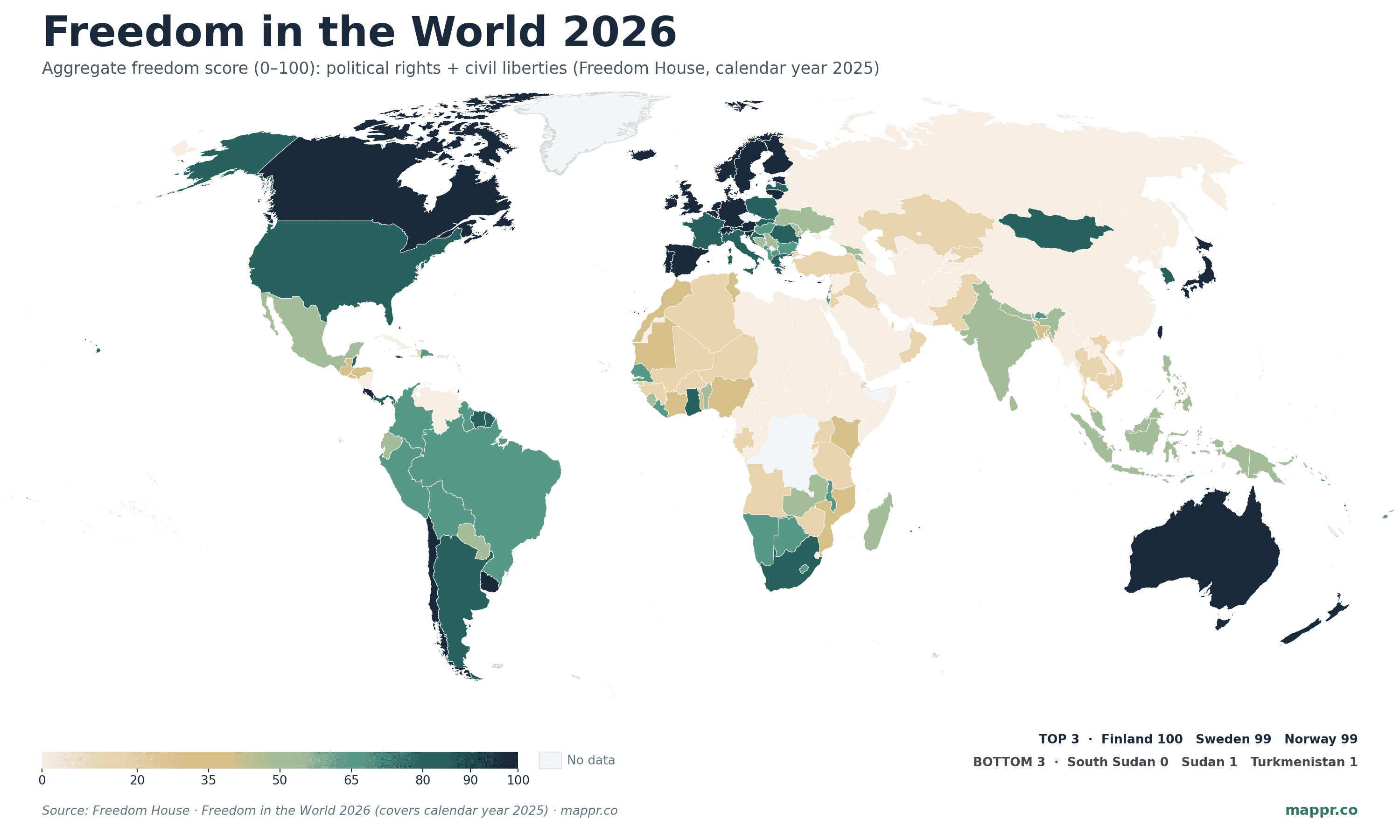
Freedom House scores 195 countries plus 13 territories on a 100-point composite of political rights (0–40) and civil liberties (0–60), then assigns each a status of Free, Partly Free, or Not Free. The map below shows the 2025 aggregate score for every country and territory in the dataset.
A Two-Decade Decline
The 2025 numbers don’t sit in isolation. Freedom House documents two decades of net deterioration. Since the global peak in 2005:
- 19 countries have dropped from Partly Free to Not Free — swelling the global autocracy population.
- Most rights have eroded, but the steepest declines have been in media freedom, freedom of personal expression, and due process.
- Democracies remain resilient: 76 of the 87 countries rated Free in 2005 are still Free today — more than 85%.
- But Free-rated countries are sliding within their status: declines among Free countries are the headline of 2025, led by the U.S., Bulgaria, and Italy.
Freedom House attributes the long decline to four overlapping drivers: military coups, armed conflicts, attacks on democratic institutions by elected leaders, and intensified repression by authoritarian regimes. The 2025 year-in-brief flags an additional concern that wasn’t as visible in earlier reports — democracies themselves are pulling back from defending freedom abroad, with European democracy-aid budgets contracting and the U.S. administration in 2025 abandoning long-standing principles around elections monitoring and conditional aid.
The 20 Freest Countries in 2025
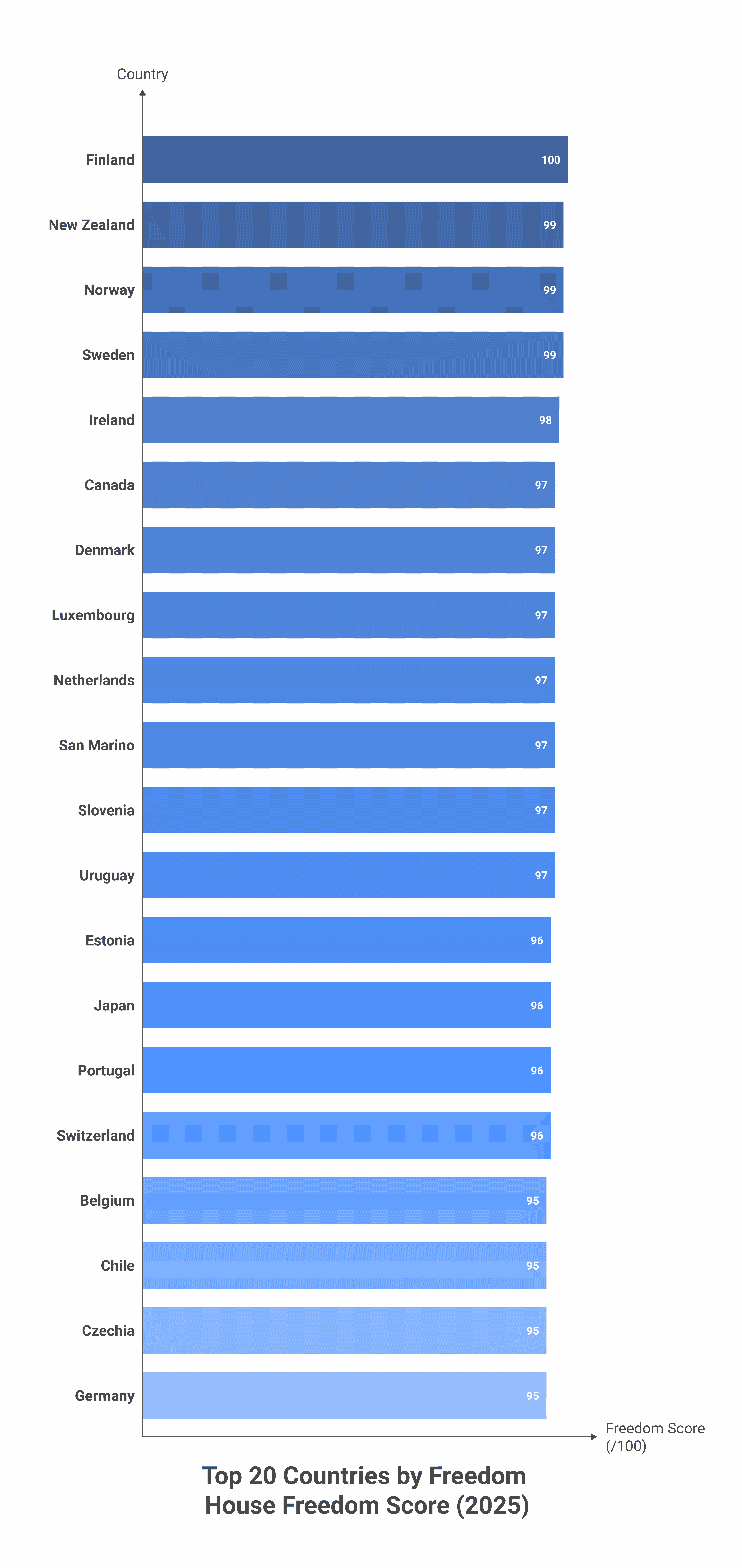
Finland stands alone at a perfect 100/100. The full top 20 is dominated by Nordics, the Anglosphere, small wealthy European states, and a handful of Latin American and Asian democracies:
| Rank | Country | Score (/100) |
|---|---|---|
| 1 | 🇫🇮 Finland | 100 |
| 2 | 🇳🇿 New Zealand | 99 |
| 3 | 🇳🇴 Norway | 99 |
| 4 | 🇸🇪 Sweden | 99 |
| 5 | 🇮🇪 Ireland | 98 |
| 6 | 🇨🇦 Canada | 97 |
| 7 | 🇩🇰 Denmark | 97 |
| 8 | 🇱🇺 Luxembourg | 97 |
| 9 | 🇳🇱 Netherlands | 97 |
| 10 | 🇸🇲 San Marino | 97 |
| 11 | 🇸🇮 Slovenia | 97 |
| 12 | 🇺🇾 Uruguay | 97 |
| 13 | 🇪🇪 Estonia | 96 |
| 14 | 🇯🇵 Japan | 96 |
| 15 | 🇵🇹 Portugal | 96 |
| 16 | 🇨🇭 Switzerland | 96 |
| 17 | 🇧🇪 Belgium | 95 |
| 18 | 🇨🇱 Chile | 95 |
| 19 | 🇨🇿 Czechia | 95 |
| 20 | 🇩🇪 Germany | 95 |
Uruguay (97) is the highest-scoring country outside Europe and the Anglosphere. Japan (96) and Chile (95) are the only two non-European entries in the top 20. The United States — at 81 — does not appear in the top 20 for the first time in the report’s modern history; the decline of the last twenty years has dropped it below 20 European democracies plus Japan, Chile, and Uruguay.
The U.S. Story: 12 Points in 20 Years
The U.S. lost 3 points in 2025 alone, bringing its current score to 81/100 — and its cumulative decline since 2005 to 12 points. Freedom House’s writeup is unsparing about the proximate causes for 2025:
- Escalating legislative dysfunction and executive dominance over Congress’s traditional powers.
- Growing pressure on free expression, including federal moves against media organisations and individual speakers.
- Moves to undermine anticorruption safeguards, including weakening the Foreign Corrupt Practices Act enforcement and dismantling watchdog offices.
By Freedom House’s count, only Nauru and Bulgaria have declined faster among countries that remain Free. The U.S. is now a Free country with a clear downward trajectory rather than a settled high-functioning democracy. The report leans hard on this point in its “Twenty Years Later” section: the loss of confidence in the United States as the standard-bearer of democratic governance is itself one of the structural causes of decline elsewhere.
The Bottom: Effective Score-Zero States
At the other end of the index sit jurisdictions where political rights and civil liberties are essentially absent:
- 🇸🇸 South Sudan — 0/100
- 🇸🇩 Sudan — 1/100
- 🇹🇲 Turkmenistan — 1/100
- 🟰 Gaza Strip — 2/100
- 🇪🇷 Eritrea — 3/100
- 🇰🇵 North Korea — 3/100
- 🇲🇲 Myanmar — 4/100
- 🟰 Western Sahara — 4/100
- 🇹🇯 Tajikistan — 5/100
- 🇬🇶 Equatorial Guinea — 5/100
Three of those (South Sudan, Sudan, Myanmar) are in the active phases of civil conflict. Three more (Turkmenistan, North Korea, Eritrea) are long-running closed autocracies that have effectively eliminated independent political activity. The Gaza Strip’s score reflects what Freedom House documents as the collapse of basic governance under wartime conditions.
Improvers: Three Countries Moved Up to Free
2025 wasn’t only bad news. Three countries improved enough to upgrade from Partly Free to Free status:
- 🇧🇴 Bolivia — competitive general elections in which the opposition won; peaceful transfer of power after voters and institutions rebuffed an attempted interference by a former president’s faction.
- 🇫🇯 Fiji — completion of a years-long recovery from the 2006 coup, peaceful rotation of power after 2022 elections, eased civil-liberty restrictions, and gains in judicial independence.
- 🇲🇼 Malawi — successful general elections in which the incumbent accepted defeat; the main opposition party won a legislative plurality; peaceful transfer of power.
The largest single-year score gains were posted by Syria (from a low base, after the fall of the Assad government), Sri Lanka, Bolivia, and Gabon. None of these become Free overnight — but each represents a measurable opening that wasn’t present a year earlier.
Methodology
Freedom House’s methodology is derived from the Universal Declaration of Human Rights. Each country is scored on 25 indicators — 10 covering political rights (electoral process, political pluralism, functioning of government) and 15 covering civil liberties (freedom of expression and belief, associational and organisational rights, rule of law, personal autonomy). Each indicator gets 0–4 points. The maximum aggregate is 100 (40 political rights + 60 civil liberties).
The status thresholds are: Free = political-rights score ≥ a certain band (roughly equivalent to 70+ overall), Partly Free = mid-range, Not Free = bottom band. The same standard is applied to all 195 countries and 13 territories irrespective of geography, religion, or income. Freedom in the World 2026 covers events from 1 January through 31 December 2025.
Conclusion
Twenty straight years of decline is no longer a fluke. The map of freedom in 2026 looks worse than the map of freedom in 2005 in almost every region — Latin America and parts of Africa are partial exceptions, but the trend lines for Europe, the U.S., and most of Asia point in the wrong direction. The improvers — Bolivia, Fiji, Malawi, and to a smaller degree Syria, Sri Lanka, Gabon — show that the slide isn’t irreversible. But Freedom House’s reading is unsparing: in the absence of democracies actively defending freedom (their own and others’), the global drift is toward the autocrats.
This post uses data from Freedom House's Freedom in the World 2026 report (released March 2026, covering events of calendar year 2025). Country-level aggregate freedom scores (0–100, political rights plus civil liberties) come from the report's complete dataset, mirrored in machine-readable form by Our World in Data.
Primary Data Sources:
- Freedom House — Freedom in the World 2026: The Growing Shadow of Autocracy – Full 2026 report (March 2026, covers calendar year 2025). All score declines, status changes, methodology details, and narrative quotes used in this post come from this report.
- Freedom House — Countries and Territories scores – Per-country pages with full score breakdowns and 20-year historical scores.
- Our World in Data — Freedom Score (Freedom House) – Machine-readable CSV of all Freedom House country-year scores. Used here for the choropleth and ranking visualisations.
Image Sources:
- Voting at a polling station — Arnaud Jaegers on Unsplash – Featured image.