Key Takeaways
- Indonesia tops the world at 8.47. Highest composite flourishing score across the 23 countries surveyed — well ahead of every wealthy Western nation in the study.
- Wealth ≠ flourishing. The US (7.18), Germany (7.10), Sweden (7.04), Australia (7.02), and the UK (6.88) all sit in the bottom half. Japan ranks last at 5.93.
- Six dimensions averaged. Happiness + life satisfaction, mental + physical health, meaning + purpose, character + virtue, close relationships, financial stability.
- Religious participation drives flourishing. In 21 of 23 countries, regular religious-service attendance correlates with higher flourishing scores — strongest in the Philippines, Türkiye, US, and Egypt.
- Age-flourishing curves differ by country. In Australia, Sweden, and the US, flourishing rises with age. In India, Tanzania, and the Philippines, it falls. Japan and Hong Kong show a J-shape with a midlife dip.
A research collaboration between Gallup, Baylor University, Harvard’s Human Flourishing Program, and the Center for Open Science has just published the first wave of the Global Flourishing Study (GFS) — a multi-year, multi-country survey of human well-being involving roughly 200,000 adults across 23 countries and territories. The headline finding upends a common assumption: the richest countries are not the most flourishing.
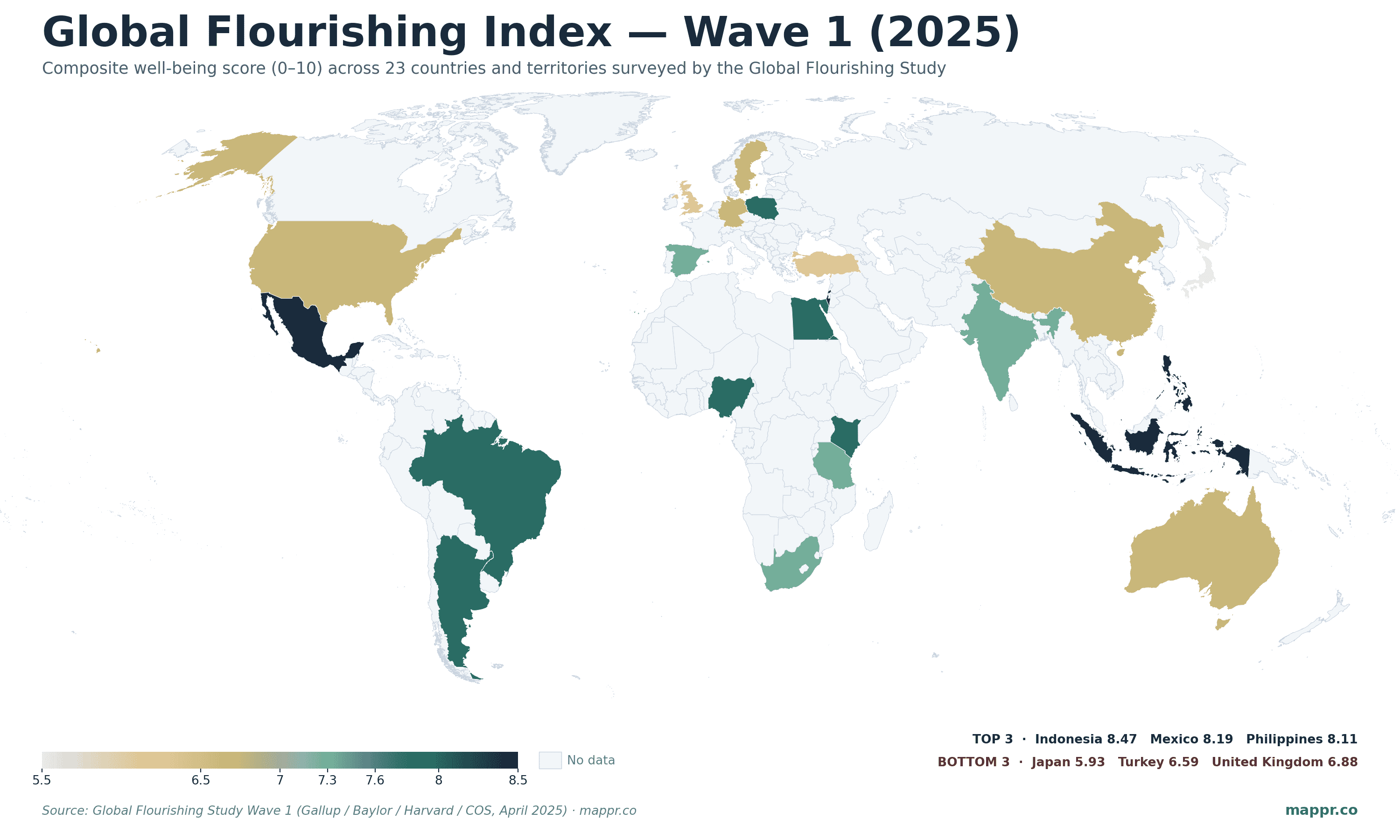
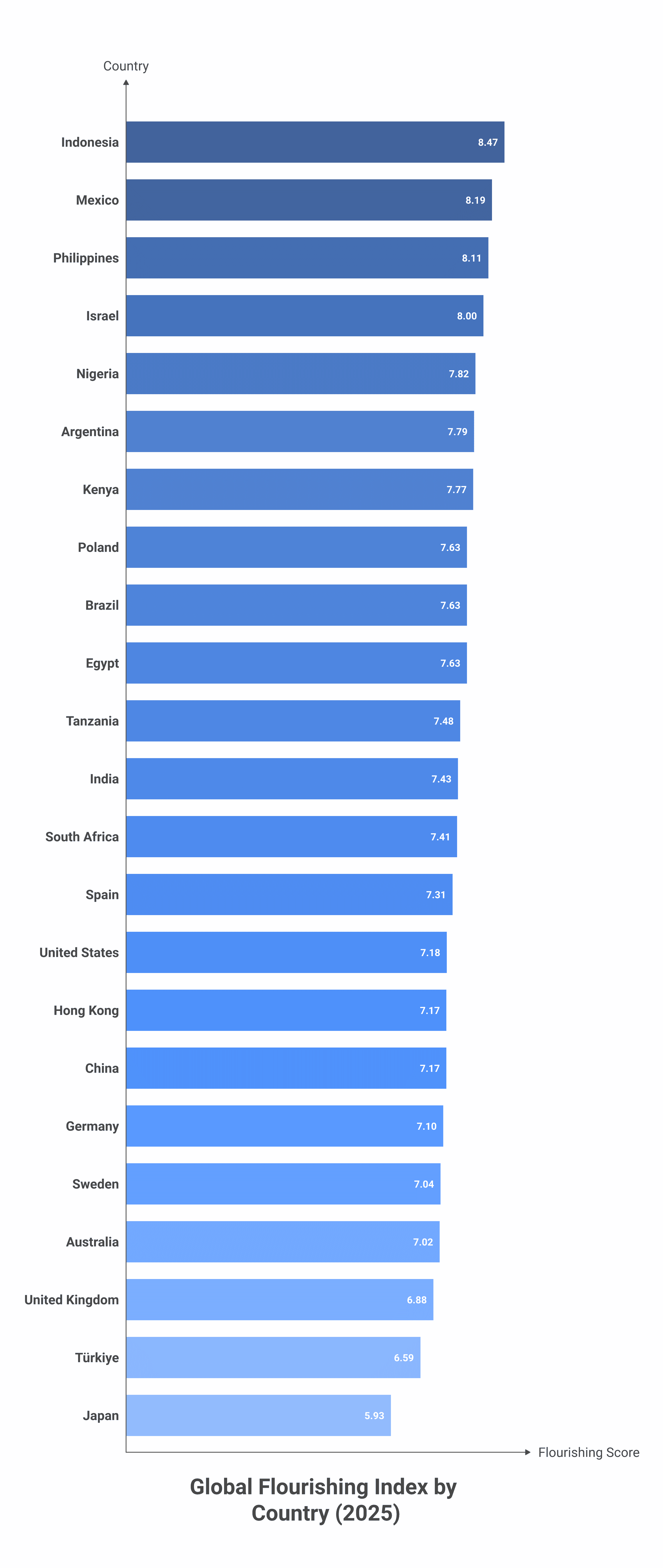
Indonesia tops the world at 8.47 on the 0–10 Flourishing Index, followed by Mexico (8.19), the Philippines (8.11), Israel (8.00), and Nigeria (7.82). Sweden, Germany, the United States, the United Kingdom, and Japan — five of the wealthiest economies in the survey — all sit in the bottom third. Japan is last at 5.93.
What “Flourishing” Means in This Study
The Global Flourishing Index is a composite built from ten survey items covering five domains, each measured on a 0–10 scale, then averaged:
- Happiness and life satisfaction — how respondents feel about their life overall
- Mental and physical health — self-rated, current
- Meaning and purpose — sense that life is worthwhile and direction-oriented
- Character and virtue — moral self-perception and behaviour toward others
- Close social relationships — quality of family and friendship ties
A sixth domain — financial and material stability — is tracked separately because researchers disagree on whether it is a component of flourishing or an input to it. Either way, it’s measured and reported alongside the composite.
The methodology distinguishes the GFS sharply from the better-known World Happiness Report, which relies on a single life-evaluation question (Cantril’s ladder). The WHR ranking puts Finland first; the GFS ranking puts Indonesia first. Same continent of concept — very different methodology, very different result.
Full Ranking: All 23 Countries
The 2.54-point spread between Indonesia (8.47) and Japan (5.93) is roughly the same magnitude as the gap between Australia and Türkiye — sizeable, but smaller than the WHR’s 6+ point spread from Finland to Afghanistan. That’s partly because the GFS doesn’t yet survey the lowest-scoring countries in the WHR, and partly because averaging across six domains compresses the range.
| Rank | Country | Flourishing Index (0–10) |
|---|---|---|
| 1 | 🇮🇩 Indonesia | 8.47 |
| 2 | 🇲🇽 Mexico | 8.19 |
| 3 | 🇵🇭 Philippines | 8.11 |
| 4 | 🇮🇱 Israel | 8.00 |
| 5 | 🇳🇬 Nigeria | 7.82 |
| 6 | 🇦🇷 Argentina | 7.79 |
| 7 | 🇰🇪 Kenya | 7.77 |
| 8 | 🇵🇱 Poland | 7.63 |
| 9 | 🇧🇷 Brazil | 7.63 |
| 10 | 🇪🇬 Egypt | 7.63 |
| 11 | 🇹🇿 Tanzania | 7.48 |
| 12 | 🇮🇳 India | 7.43 |
| 13 | 🇿🇦 South Africa | 7.41 |
| 14 | 🇪🇸 Spain | 7.31 |
| 15 | 🇺🇸 United States | 7.18 |
| 16 | 🇭🇰 Hong Kong | 7.17 |
| 17 | 🇨🇳 China | 7.17 |
| 18 | 🇩🇪 Germany | 7.10 |
| 19 | 🇸🇪 Sweden | 7.04 |
| 20 | 🇦🇺 Australia | 7.02 |
| 21 | 🇬🇧 United Kingdom | 6.88 |
| 22 | 🇹🇷 Türkiye | 6.59 |
| 23 | 🇯🇵 Japan | 5.93 |
Why Indonesia, Mexico, and the Philippines Lead
The top of the GFS ranking is not where conventional well-being surveys typically put them. The dominant explanation, both in the GFS team’s own writeup and in adjacent research, is that the composite gives heavier weight to meaning, relationships, and character than indices built primarily on life-evaluation questions do.
Indonesia, the Philippines, Nigeria, and Egypt — all high-religiosity countries — post particularly strong scores on the meaning and purpose dimension. The GFS team found that religious-service attendance is statistically associated with higher flourishing in 21 of the 23 countries studied. The effect is strongest in the Philippines, Türkiye, the United States, and Egypt, and largely absent only in Hong Kong and Sweden.
Mexico and the Philippines also score well on close social relationships, while several wealthy nations show notable mental-health deficits for younger respondents — the GFS calls out the United States, Sweden, and the United Kingdom in particular for the gap between older and younger adults on this measure.
The Bottom of the Index: Wealthy and Stuck
The four lowest-ranked countries are the UK (6.88), Türkiye (6.59), and Japan (5.93), with Australia, Sweden, Germany, China, Hong Kong, and the US filling the next nine slots. The pattern reverses long-running assumptions about the relationship between GDP per capita and well-being.
Japan’s bottom-place finish (5.93) is consistent with other studies showing low self-reported life satisfaction despite high material standards. Many Japanese respondents register surplus scores on physical health and material stability but pronounced deficits on happiness, meaning, and social connection.
The UK’s position is more surprising — it ranks below every country in the survey except Türkiye and Japan, despite being a high-income, high-education nation with stable institutions. The GFS data show below-average scores on happiness, mental health (for younger respondents especially), and meaning. The 2026 World Happiness Report flagged a similar pattern: young-adult well-being in the UK has fallen further than in almost any peer economy over the last decade.
Age and Flourishing
One of the most striking patterns in the GFS data is that the well-known “U-shape” between age and well-being — wellbeing high in youth, dipping in midlife, rising in old age — does not hold globally. Instead, the GFS finds:
- Rising with age: Argentina, Australia, Brazil, Germany, Mexico, Spain, Sweden, UK, US. (The US gap is the largest — average flourishing 6.36 for ages 18–29 vs 7.68 for ages 60–69.)
- Falling with age: Egypt, India, Kenya, Philippines, Tanzania.
- J-shape (midlife dip, then recovery): Hong Kong, Japan.
- Decreasing throughout: Israel, Poland.
- No clear pattern: Nigeria, South Africa, Türkiye.
The implication: well-being trajectories are shaped by national context as much as by life stage. Whatever is dragging down young-adult wellbeing in the US, UK, Sweden, and Australia is not a universal feature of being young — it appears tied to specific cohorts and conditions in those countries.
What the Study Doesn’t Cover (Yet)
The grey areas of the map above are a feature of the study, not the map. Wave 1 of the Global Flourishing Study includes 23 countries and territories selected to span major world regions, but the coverage gap is real: most of Africa, most of Latin America beyond Mexico/Brazil/Argentina, most of Asia beyond the included six, and almost all of Europe outside Spain, Germany, Sweden, the UK, Poland, and Türkiye are not yet in the dataset.
The 23 included are: Argentina, Australia, Brazil, China, Egypt, Germany, Hong Kong (S.A.R. of China), India, Indonesia, Israel, Japan, Kenya, Mexico, Nigeria, the Philippines, Poland, South Africa, Spain, Sweden, Tanzania, Türkiye, the United Kingdom, and the United States. Future waves are planned, and the GFS is one of the few major well-being projects with a longitudinal design — the same respondents will be surveyed again over multiple years, allowing researchers to identify what changes drive changes in flourishing rather than just snapshot correlations.
Conclusion
Add the Global Flourishing Index to the growing list of cross-country well-being measures that don’t match the GDP league table. Indonesia, the Philippines, Mexico, and Israel come out on top; the United States, Sweden, Germany, and Australia sit in the lower half; Japan ranks last. The result fits a pattern in recent well-being research: measures that emphasise relationships, meaning, and religious or civic engagement tend to reward countries that wealth indices don’t, while measures built only on life evaluation tend to reward the Nordic-plus-Switzerland cluster instead. Both are real; they just measure different things. Wave 2 will let researchers test how stable any of this is over time — that’s where the GFS gets really interesting.
This post uses data from the Global Flourishing Study (GFS) Wave 1 — a collaboration between Gallup, Baylor University, Harvard's Human Flourishing Program, and the Center for Open Science, surveying approximately 200,000 adults across 23 countries and territories in 2022–2023. Composite Flourishing Index scores by country were taken from Figure 2 of the Gallup-Baylor report 'The Global Flourishing Study: What Contributes to a Life Well-Lived?' (April 2025).
Primary Data Sources:
- Gallup / Baylor — The Global Flourishing Study: What Contributes to a Life Well-Lived? – April 2025 report containing Figure 2 composite flourishing scores by country and the age, mental-health, and group-participation findings cited.
- Baylor / Harvard — The Heart of Flourishing – Companion report from the Human Flourishing Program (August 2025) covering deeper analysis of GFS Wave 1 findings.
- Global Flourishing Study — Open Access Data – Public Wave 1 and Wave 2 datasets hosted by the Center for Open Science.
- Global Flourishing Study — Study homepage – Project landing page with methodology, country list, and publication index.
Image Sources:
- Sasak wedding in Lombok, Indonesia — Maximus Beaumont on Unsplash – Featured image.