
Key Facts: The Danish Krone
- ISO 4217 code: DKK · Symbol: kr. The krone circulates alongside the Faroese króna (also called DKK in practice, same value, issued locally) and Greenlandic króna. Subdivided into 100 øre.
- Central bank: Danmarks Nationalbank (est. 1818). Copenhagen-based. Governor Christian Kettel Thomsen since 1 February 2023. Mandate: maintain the krone/euro peg.
- Pegged to the euro: 7.46038 DKK = 1 EUR. Via ERM II since 1 January 1999. Formal band ±2.25%; in practice held within ±0.5% of the central rate. This peg has been unbroken for a quarter-century.
- Policy rate: 1.60% · Inflation: 1.8% (2026f). Tracks the ECB's 2.00% deposit rate with a structural negative spread. Denmark effectively imports euro-area monetary policy.
- Denmark is not in the Eurozone — by choice. The country rejected the euro in two referendums (1992, 2000) and holds a formal Treaty opt-out. It is the only EU member legally exempt from eventual euro adoption.
What Is the Currency of Denmark?
Denmark’s currency is the Danish krone (symbol kr, ISO 4217 code DKK). The krone (plural kroner, literally “crowns”) has been Denmark’s currency since 1 January 1875, when it replaced the rigsdaler under the Scandinavian Monetary Union. It is subdivided into 100 øre, although the 25-øre coin was withdrawn in 2008 and øre-level prices are rarely quoted today.
The krone is issued by Danmarks Nationalbank, Denmark’s central bank since 1818 and one of the oldest continuously operating central banks in the world. The bank’s primary task since 1999 has not been inflation targeting but defending the krone’s peg to the euro at 7.46038 DKK per 1 EUR, via the ERM II mechanism. Denmark is an EU member (since 1 January 1973) but has a formal opt-out from the euro obligation — the only such opt-out in the Union.
Danish Krone to US Dollar — 1-Year Chart
Because the krone is pegged to the euro, the chart below effectively tracks USD/EUR inverted. Day-to-day volatility in DKK/USD is driven by the euro’s own moves against the dollar; Danmarks Nationalbank rarely has to intervene to defend the narrower krone/euro band.
Line chart. Daily close, DKK per 1 USD · Source: Yahoo Finance · Updated nightly. Data table with 2 rows and 132 columns follows.
| Oct 21 | Oct 23 | Oct 28 | Oct 30 | Nov 03 | Nov 05 | Nov 07 | Nov 11 | Nov 13 | Nov 17 | Nov 19 | Nov 21 | Nov 25 | Nov 27 | Dec 01 | Dec 03 | Dec 05 | Dec 09 | Dec 11 | Dec 15 | Dec 17 | Dec 19 | Dec 23 | Dec 26 | Dec 30 | Jan 02 | Jan 06 | Jan 08 | Jan 12 | Jan 14 | Jan 16 | Jan 20 | Jan 22 | Jan 26 | Jan 28 | Jan 30 | Feb 03 | Feb 05 | Feb 09 | Feb 11 | Feb 13 | Feb 17 | Feb 19 | Feb 23 | Feb 25 | Feb 27 | Mar 03 | Mar 05 | Mar 09 | Mar 11 | Mar 13 | Mar 17 | Mar 19 | Mar 23 | Mar 25 | Mar 27 | Mar 30 | Apr 01 | Apr 05 | Apr 07 | Apr 09 | Apr 13 | Apr 15 | Apr 19 | Apr 21 | Apr 23 | Apr 27 | Apr 29 | May 03 | May 05 | May 07 | May 11 | May 13 | May 17 | May 19 | May 21 | May 25 | May 27 | May 31 | Jun 02 | Jun 04 | Jun 08 | Jun 10 | Jun 14 | Jun 16 | Jun 18 | Jun 22 | Jun 24 | Jun 28 | Jun 30 | Jul 02 | Jul 06 | Jul 08 | Jul 12 | Jul 14 | Jul 16 | Jul 20 | Jul 22 | Jul 26 | Jul 28 | Jul 30 | Aug 03 | Aug 05 | Aug 09 | Aug 11 | Aug 13 | Aug 17 | Aug 19 | Aug 23 | Aug 25 | Aug 27 | Aug 31 | Sep 02 | Sep 06 | Sep 08 | Sep 10 | Sep 14 | Sep 16 | Sep 20 | Sep 22 | Sep 24 | Sep 28 | Sep 30 | Oct 04 | Oct 06 | Oct 08 | Oct 12 | Oct 14 | Oct 18 | Oct 20 | Oct 22 | |
|---|---|---|---|---|---|---|---|---|---|---|---|---|---|---|---|---|---|---|---|---|---|---|---|---|---|---|---|---|---|---|---|---|---|---|---|---|---|---|---|---|---|---|---|---|---|---|---|---|---|---|---|---|---|---|---|---|---|---|---|---|---|---|---|---|---|---|---|---|---|---|---|---|---|---|---|---|---|---|---|---|---|---|---|---|---|---|---|---|---|---|---|---|---|---|---|---|---|---|---|---|---|---|---|---|---|---|---|---|---|---|---|---|---|---|---|---|---|---|---|---|---|---|---|---|---|---|---|---|---|---|---|
| DKK per USD | 6.44 | 6.43 | 6.41 | 6.44 | 6.48 | 6.5 | 6.46 | 6.46 | 6.44 | 6.43 | 6.45 | 6.47 | 6.48 | 6.44 | 6.44 | 6.42 | 6.41 | 6.42 | 6.38 | 6.36 | 6.36 | 6.37 | 6.35 | 6.34 | 6.34 | 6.36 | 6.38 | 6.4 | 6.43 | 6.42 | 6.44 | 6.42 | 6.4 | 6.3 | 6.21 | 6.24 | 6.33 | 6.33 | 6.32 | 6.28 | 6.29 | 6.3 | 6.34 | 6.31 | 6.34 | 6.33 | 6.39 | 6.42 | 6.48 | 6.43 | 6.49 | 6.5 | 6.52 | 6.46 | 6.43 | 6.48 | 6.52 | 6.45 | 6.49 | 6.39 | 6.39 | 6.35 | 6.33 | 6.37 | 6.36 | 6.39 | 6.37 | 6.4 | 6.37 | 6.38 | 6.37 | 6.34 | 6.38 | 6.43 | 6.44 | 6.43 | 6.42 | 6.43 | 6.42 | 6.43 | 6.44 | 6.48 | 6.48 | 6.44 | 6.44 | 6.52 | 6.54 | 6.58 | 6.56 | 6.55 | 6.54 | 6.53 | 6.54 | 6.55 | 6.54 | 6.53 | 6.55 | 6.55 | 6.56 | 6.56 | 6.49 | 6.5 | 6.47 | 6.47 | 6.48 | 6.48 | 6.45 | 6.4 | 6.4 | 6.4 | 6.41 | 6.43 | 6.45 | 6.44 | 6.43 | 6.44 | 6.47 | 6.52 | 6.51 | 6.53 | 6.57 | 6.57 | 6.6 | 6.64 | 6.64 | 6.67 | 6.7 | 6.68 | 6.66 | 6.66 | 6.64 |
Over the past 12 months the krone has strengthened slightly against the dollar — 1 USD bought roughly 6.49 DKK a year ago and about 6.36 DKK today — mirroring the euro’s own ~2% gain against USD over the same period.
Danish Krone Banknotes and Coins
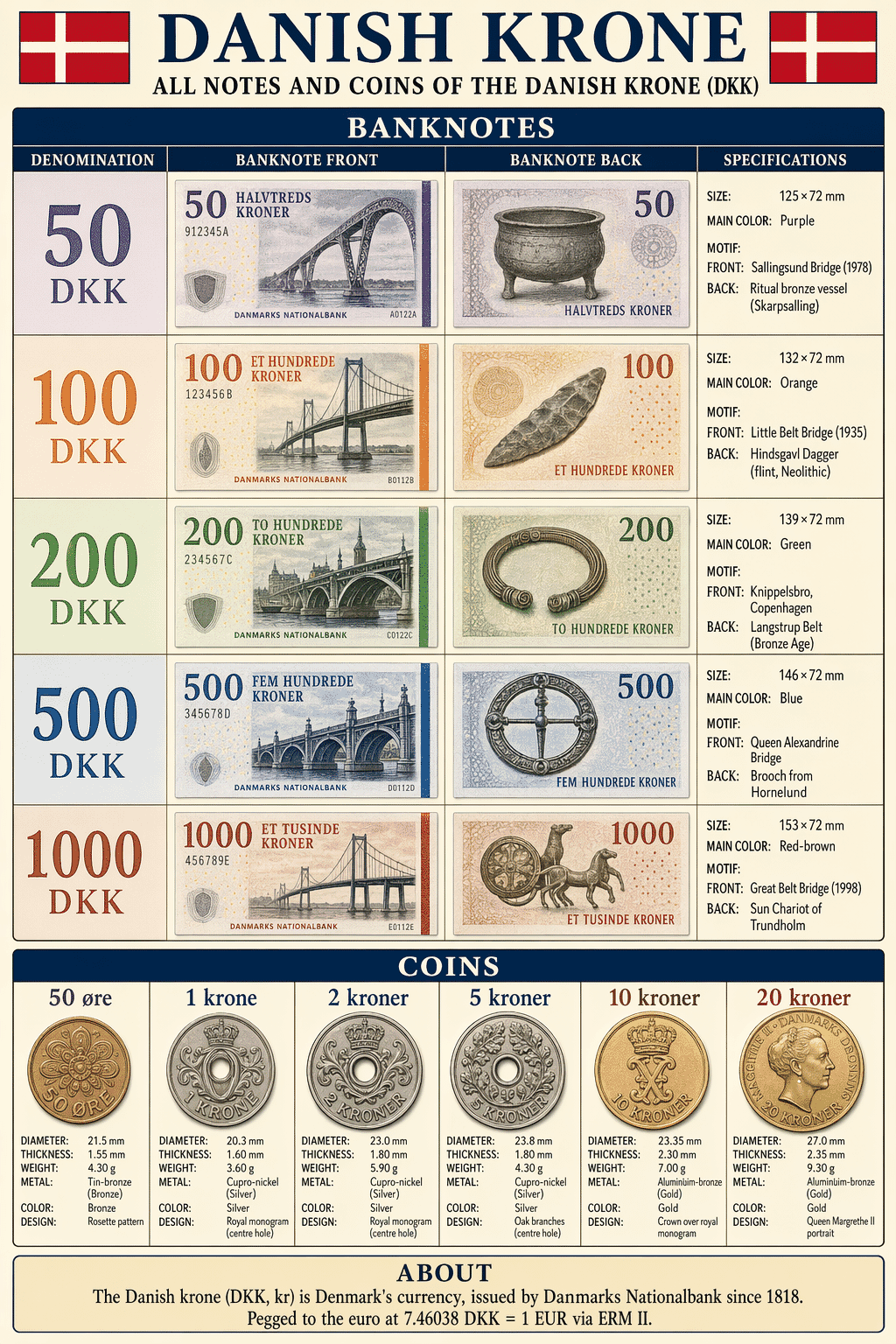
Denmark’s current banknote series, introduced between 2009 and 2011, features Danish bridges on the front and archaeological finds (prehistoric artefacts from Denmark’s Bronze and Iron Age) on the back. The series deliberately avoided monarchs and historical figures — a break with earlier Danish notes and with most European note traditions.
| Denomination | Bridge | Context | Colour |
|---|---|---|---|
| 50 DKK | Sallingsund Bridge | 1978-built cable bridge linking Mors and Salling | Purple |
| 100 DKK | Little Belt Bridge | 1935 steel arch bridge between Fyn and Jutland | Orange |
| 200 DKK | Knippelsbro | Copenhagen’s bridge between Slotsholmen and Christianshavn | Green |
| 500 DKK | Queen Alexandrine Bridge | Bridge between Zealand and Møn | Blue |
| 1,000 DKK | Great Belt Bridge | World’s third-longest suspension bridge, opened 1998 | Red-brown |
Coins carry the royal monogram of the reigning monarch. After Queen Margrethe II’s abdication on 14 January 2024 in favour of her son King Frederik X, new coins bearing the King’s monogram (F X) began entering circulation alongside Margrethe II’s existing coins — all of which remain legal tender.
| Denomination | Design | Series Notes |
|---|---|---|
| 50 øre | Bronze, rosette design | Smallest coin still in limited use; phased out in 2008 was discussed but retained |
| 1 krone | Cupro-nickel, Queen Margrethe II crowned monogram | Since 2002 |
| 2 kroner | Cupro-nickel, crowned monogram | Since 2002 |
| 5 kroner | Cupro-nickel with centre hole, oak branches | Since 1989 |
| 10 kroner | Aluminium bronze, crown over M2R | Since 1989 |
| 20 kroner | Aluminium bronze, crown over royal monogram | Since 1990 |
History of the Danish Krone
The krone has one of Europe’s oldest continuous currency names still in use. It emerged from a 19th-century monetary union and has survived two world wars, the collapse of the gold standard, the Bretton Woods system, and three separate attempts to join the euro — two of them rejected by referendum. The constant since 1999 has been the ERM II peg, the longest continuously held currency peg in EU history.
| Year | Event |
|---|---|
| 1873 | Scandinavian Monetary Union — Denmark, Sweden, and Norway adopt a common krone tied to gold. |
| 1914 | World War I ends gold convertibility; SMU effectively dissolves. |
| 1931 | Denmark leaves the restored gold standard on 27 September, following the UK. |
| 1945 | Denmark rebuilds post-war with a pegged krone under Bretton Woods. |
| 1972 | Denmark joins the European Economic Community on 1 January 1973 (referendum 2 October 1972). |
| 1992 | Maastricht referendum on 2 June rejects the euro; Denmark secures an official opt-out. |
| 1999 | Krone joins ERM II on 1 January at a central rate of 7.46038 DKK = 1 EUR, band ±2.25%. The peg has held ever since. |
| 2000 | Second euro referendum on 28 September; Danes again reject adoption. |
| 2015 | Nationalbanken cuts the CD (certificates of deposit) rate to −0.75% to defend the peg during the Swiss-franc shock; becomes the world’s first sub-zero central-bank rate at scale. |
| 2023 | Christian Kettel Thomsen takes office as Governor on 1 February. |
| 2024–2026 | Interest-rate cuts follow the ECB’s cutting cycle; policy rate at 1.60% in Q1 2026 to maintain the peg. |
The Danish Economy and the Krone
Denmark is a small, highly open, services-heavy economy with an enviable external position — persistent current-account surpluses since the 1990s and sovereign debt rated AAA by all three major agencies. Those fundamentals plus the ERM II peg make the krone one of the world’s most stable currencies, which is precisely the point.
Because the peg effectively outsources monetary policy to Frankfurt, Nationalbanken’s policy rate tracks the ECB’s with a structural negative spread. The current account rate sits at 1.60%, paired against the ECB’s 2.00% deposit facility. Danish inflation tends to track euro-area HICP closely — the 2026 forecast is 1.8%, essentially in line with ECB projections of 2.6% for the full euro area. Denmark was the first country in the world to run a negative central-bank rate at scale, cutting the CD rate to −0.75% in February 2015 during the Swiss-franc peg break.
Using the Krone in Denmark
Denmark is one of the most cashless societies in Europe. Roughly 85% of point-of-sale transactions are now by card or mobile app, led by the domestic Dankort scheme and the MobilePay real-time payment app (used by over 90% of Danish adults). Visa and Mastercard are accepted essentially everywhere — cafés, restaurants, hotels, parking meters, and even in Copenhagen’s small independent shops.
Typical prices in kroner (2026): espresso in a Copenhagen café 35–50 DKK; smørrebrød (open sandwich) 85–140 DKK; a set menu at a mid-range restaurant 300–550 DKK; a single Copenhagen metro ticket (2 zones) 24 DKK; a mid-range Copenhagen hotel room 1,200–2,000 DKK. ATMs (hæveautomater) exist but are genuinely hard to find in central Copenhagen — Nordea, Danske Bank, and Jyske Bank operate what’s left of the network. Most visitors simply tap their card and skip withdrawing cash altogether.
The Krone Among Scandinavian and Nordic Currencies
Denmark, Sweden, and Norway all use a currency called the krone (or krona/kruna) — the legacy of the 19th-century Scandinavian Monetary Union — but the three currencies have been fully independent since 1914 and trade against each other like any other pair. Finland and Estonia, by contrast, joined the euro.
| Country | Code | Regime | Inflation | Policy rate |
|---|---|---|---|---|
| 🇩🇰 Denmark | DKK | ERM II peg: 7.46038 DKK/EUR (since 1999) | 1.8% (2026f) | 1.60% |
| 🇸🇪 Sweden | SEK | Free float (Riksbank inflation target) | 2.0% | 2.25% |
| 🇳🇴 Norway | NOK | Free float (Norges Bank inflation target) | 2.5% | 4.50% |
| 🇮🇸 Iceland | ISK | Managed float (Central Bank inflation target) | 4.0% | 7.50% |
| 🇫🇮 Finland | EUR (since 1999) | Eurosystem (free float) | 2.3% | 2.00% |
| 🇪🇪 Estonia | EUR (since 2011) | Eurosystem (free float) | 3.0% | 2.00% |
Frequently Asked Questions
What is the currency of Denmark?
The currency of Denmark is the Danish krone (symbol kr or DKK, ISO 4217 code DKK). The krone is subdivided into 100 øre, although øre coins below 50 øre have been withdrawn. Denmark has been using the krone since 1 January 1875, when the Scandinavian Monetary Union was fully operational.
Does Denmark use the euro?
No. Denmark is an EU member (since 1973) but rejected the euro in two referendums — 1992 (the Maastricht referendum as a whole) and 2000. Denmark holds a formal Treaty opt-out, making it the only EU member legally exempt from the obligation to adopt the euro. Sweden has no formal opt-out but has kept its krona through political decisions.
Why is the Danish krone linked to the euro?
Since 1 January 1999, the krone has been pegged to the euro via the ERM II mechanism at a central rate of 7.46038 DKK per 1 EUR, with a formal tolerance band of ±2.25%. In practice, Danmarks Nationalbank has kept the krone within a much tighter ±0.5% of the central rate. The peg means Denmark effectively imports ECB monetary policy: when the ECB cuts or hikes, Nationalbanken follows.
Who manages Danish monetary policy?
Danmarks Nationalbank, founded 1818, is Denmark’s central bank. Its current Governor is Christian Kettel Thomsen, who took office on 1 February 2023. The bank’s primary mandate is to maintain the DKK/EUR peg; domestic inflation follows euro-area inflation closely as a consequence. The bank’s website is nationalbanken.dk.
What is Denmark’s current policy rate?
Danmarks Nationalbank’s main policy rate — the current account rate — stood at 1.60% in February 2026, in line with the ECB’s 2.00% deposit facility rate after accounting for the structural spread needed to maintain the peg. The rate is adjusted whenever the ECB moves, or when pressure on the peg requires it.
How many kroner is one US dollar worth?
At the latest daily close, 1 USD = approximately 6.36 DKK. Because the krone is pegged to the euro, USD/DKK almost exactly mirrors USD/EUR inverted — the pair trades in tight correlation with EUR/USD. The chart above shows the past year’s movement.
Who are on Danish banknotes?
Denmark’s current banknote series is unusual in featuring bridges rather than monarchs or historical figures. The five denominations each depict a major Danish bridge — Sallingsund on the 50 DKK, Little Belt on the 100, Knippelsbro on the 200, Queen Alexandrine on the 500, and the Great Belt Bridge on the 1,000 DKK. The series was introduced between 2009 and 2011.
All data current to April 2026 — Nationalbanken and ECB releases.

