
Key Facts: The Colombian Peso
- ISO 4217 code: COP · Symbol: $ (or COL$). The Colombian peso uses the peso sign $ domestically; outside Colombia, COL$ or the code COP disambiguates it from the US dollar and other peso currencies.
- Central bank: Banco de la República (est. 1923). Colombia's monetary authority since 11 July 1923. Current governor: Leonardo Villar Gómez (since January 2021). The Board of Directors sets the monetary-policy rate and manages the peso's free float.
- Policy rate: 11.25% · Inflation target: 3%. Banco de la República raised the benchmark rate 100 bp to 11.25% on 31 March 2026, the second consecutive 100-bp hike. Inflation is forecast at 6.3% in 2026, with the target of 3% now projected for end-2027.
- 1 USD ≈ 3,576 COP. Spot rate as of the latest daily close. The peso has appreciated roughly 16% against the US dollar over the past 12 months after peaking above 4,300 in mid-2025.
- 100 centavos = 1 peso (centavo use is long discontinued). The decimal subunit is obsolete in circulation. Every-day prices are quoted in whole pesos; the smallest denomination in active use is the 50-peso coin, with the 20-peso coin withdrawn in 2018.
What Is the Currency of Colombia?
The currency of Colombia is the Colombian peso (ISO 4217 code COP, symbol $ — or COL$ abroad to distinguish it from the US dollar and other peso currencies). It has been the country’s sole legal tender since independence and has been issued by Banco de la República — Colombia’s central bank since 11 July 1923. The peso floats freely against other currencies; Banco de la República does not maintain a peg, an exchange-rate band, or a crawling target.
Formally, one peso is divided into 100 centavos, but centavo coins were withdrawn from circulation decades ago and day-to-day pricing is always in whole pesos. The smallest denomination in active use is the 50-peso coin; the smallest banknote is 2,000 pesos, roughly US$0.56 at the current rate. Seven banknote denominations and five coin denominations circulate as of 2026.
Colombian Peso to US Dollar — 1-Year Chart
The chart below shows the daily close of 1 US dollar in Colombian pesos over the past twelve months. The peso is free-floating, so the rate reacts to oil prices (Colombia’s largest export), the Banco de la República policy rate, Colombian political risk, and global US-dollar strength. Data is refreshed nightly from Yahoo Finance.
Line chart. Daily close, COP per 1 USD · Source: Yahoo Finance · Updated nightly. Data table with 2 rows and 131 columns follows.
| Oct 12 | Oct 14 | Oct 16 | Oct 20 | Oct 22 | Oct 27 | Oct 29 | Oct 31 | Nov 04 | Nov 06 | Nov 10 | Nov 12 | Nov 14 | Nov 18 | Nov 20 | Nov 24 | Nov 26 | Nov 28 | Dec 02 | Dec 04 | Dec 08 | Dec 10 | Dec 12 | Dec 16 | Dec 18 | Dec 22 | Dec 24 | Dec 29 | Dec 31 | Jan 05 | Jan 07 | Jan 09 | Jan 13 | Jan 15 | Jan 19 | Jan 21 | Jan 23 | Jan 27 | Jan 29 | Feb 02 | Feb 04 | Feb 06 | Feb 10 | Feb 12 | Feb 16 | Feb 18 | Feb 20 | Feb 24 | Feb 26 | Mar 02 | Mar 04 | Mar 06 | Mar 10 | Mar 12 | Mar 16 | Mar 18 | Mar 20 | Mar 24 | Mar 26 | Mar 29 | Mar 31 | Apr 02 | Apr 06 | Apr 08 | Apr 12 | Apr 14 | Apr 16 | Apr 20 | Apr 22 | Apr 26 | Apr 28 | Apr 30 | May 04 | May 06 | May 10 | May 12 | May 14 | May 18 | May 20 | May 24 | May 26 | May 28 | Jun 01 | Jun 03 | Jun 07 | Jun 09 | Jun 11 | Jun 15 | Jun 17 | Jun 21 | Jun 23 | Jun 25 | Jun 29 | Jul 01 | Jul 05 | Jul 07 | Jul 09 | Jul 13 | Jul 15 | Jul 19 | Jul 21 | Jul 23 | Jul 27 | Jul 29 | Aug 02 | Aug 04 | Aug 06 | Aug 10 | Aug 12 | Aug 16 | Aug 18 | Aug 20 | Aug 24 | Aug 26 | Aug 30 | Sep 01 | Sep 03 | Sep 07 | Sep 09 | Sep 13 | Sep 15 | Sep 17 | Sep 21 | Sep 23 | Sep 27 | Sep 29 | Oct 01 | Oct 05 | Oct 07 | Oct 12 | |
|---|---|---|---|---|---|---|---|---|---|---|---|---|---|---|---|---|---|---|---|---|---|---|---|---|---|---|---|---|---|---|---|---|---|---|---|---|---|---|---|---|---|---|---|---|---|---|---|---|---|---|---|---|---|---|---|---|---|---|---|---|---|---|---|---|---|---|---|---|---|---|---|---|---|---|---|---|---|---|---|---|---|---|---|---|---|---|---|---|---|---|---|---|---|---|---|---|---|---|---|---|---|---|---|---|---|---|---|---|---|---|---|---|---|---|---|---|---|---|---|---|---|---|---|---|---|---|---|---|---|---|
| COP per USD | 3,872.23 | 3,923.5 | 3,860.75 | 3,881.75 | 3,909.45 | 3,838.46 | 3,887.47 | 3,858.45 | 3,855 | 3,832.75 | 3,737.11 | 3,756.78 | 3,746.82 | 3,754.5 | 3,712.25 | 3,717.59 | 3,802.9 | 3,743.88 | 3,808.4 | 3,768.15 | 3,755.67 | 3,856.63 | 3,801.5 | 3,818.07 | 3,863.75 | 3,817.51 | 3,754.33 | 3,695.25 | 3,740.46 | 3,731.33 | 3,711.29 | 3,713.51 | 3,713.64 | 3,671.79 | 3,647.15 | 3,674.7 | 3,610.73 | 3,681.19 | 3,668.61 | 3,627.57 | 3,644.71 | 3,698.65 | 3,668.26 | 3,669.53 | 3,618.33 | 3,663.75 | 3,698.79 | 3,691.94 | 3,697.69 | 3,716.57 | 3,801.26 | 3,788.48 | 3,761.83 | 3,703.43 | 3,638.61 | 3,699.39 | 3,690.95 | 3,709.57 | 3,698.92 | 3,672.28 | 3,681.83 | 3,660.71 | 3,681.45 | 3,645.43 | 3,643.71 | 3,595.01 | 3,613.03 | 3,578.64 | 3,572.98 | 3,552.73 | 3,610.2 | 3,655.08 | 3,727.88 | 3,725.06 | 3,748.71 | 3,786.26 | 3,787.98 | 3,797.62 | 3,724.85 | 3,679.93 | 3,672.19 | 3,651.3 | 3,565.52 | 3,575.07 | 3,604.26 | 3,574.94 | 3,500.13 | 3,489.7 | 3,458.8 | 3,445.19 | 3,428.94 | 3,445.79 | 3,443.25 | 3,387.24 | 3,344.92 | 3,338.15 | 3,294.18 | 3,235.96 | 3,231.45 | 3,268.77 | 3,227.45 | 3,212.65 | 3,204.34 | 3,200.66 | 3,133.53 | 3,207.46 | 3,158.61 | 3,139.44 | 3,146.16 | 3,130.05 | 3,106.02 | 3,074.6 | 3,063.7 | 3,127.86 | 3,201.45 | 3,169.44 | 3,152.18 | 3,126.29 | 3,109.51 | 3,091.66 | 3,122.37 | 3,166.69 | 3,203.46 | 3,287.05 | 3,303 | 3,333.42 | 3,318.53 | 3,207.85 | 3,246.74 | 3,187.49 |
Over the past 12 months the peso has strengthened against the dollar — 1 USD bought roughly 4,279 COP in April 2025 and about 3,576 COP today, a move of roughly 16% in the peso’s favour. The sustained high policy rate (11.25%), a narrowing current-account deficit, and recovering oil receipts have all supported the peso since the second half of 2025.
Banknotes and Coins in Circulation
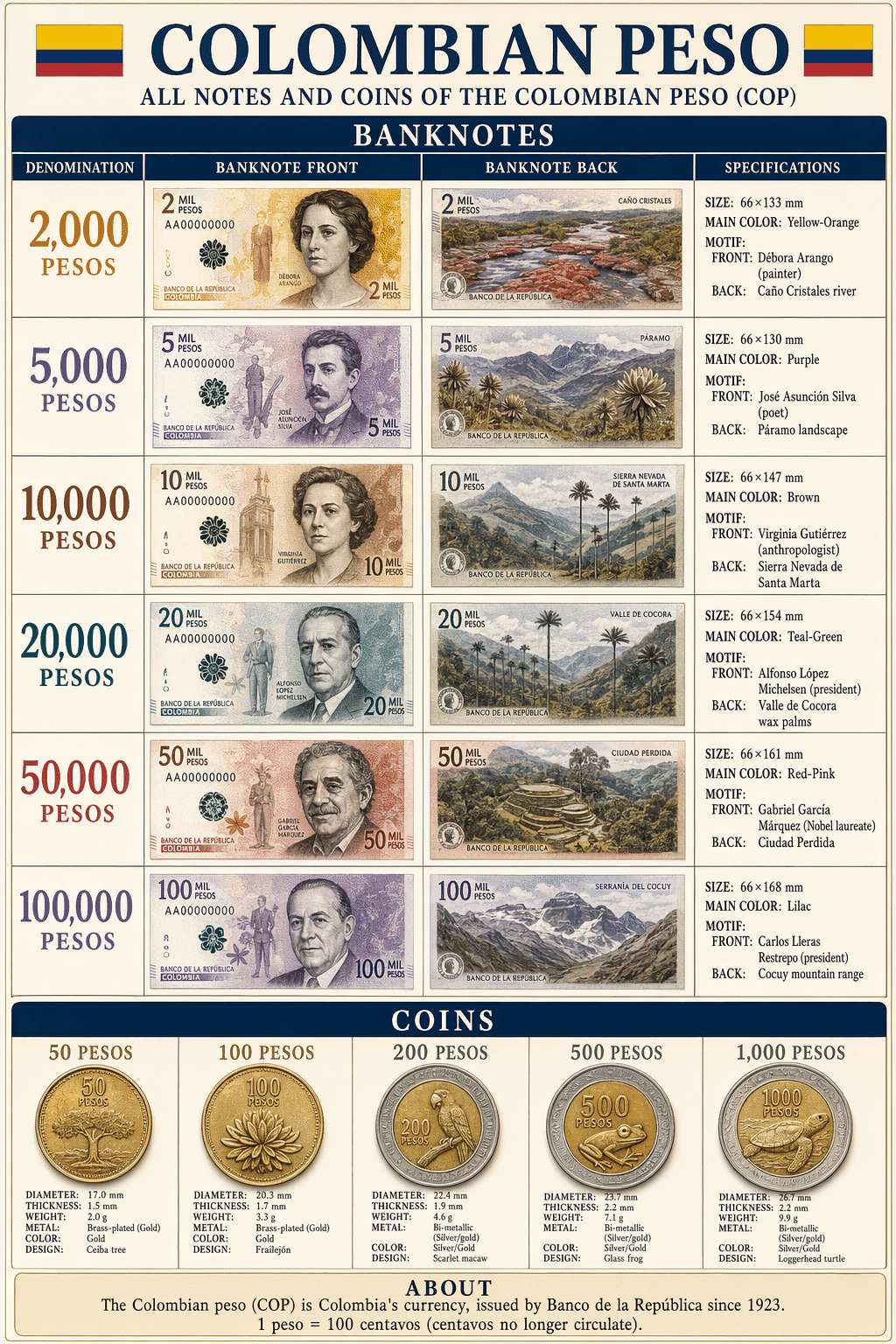
Colombia’s current banknote series is “Biodiversity and Culture”, introduced on 31 August 2016. Each denomination honours a 20th-century Colombian cultural figure on the obverse, paired with an iconic landscape or ecosystem on the reverse. The series replaced the older “presidents” notes and upgraded security features — including an intaglio-printed denomination, a colour-shifting ink band, and a see-through register window.
| Denomination | Figure | Known for | Colour & Scene |
|---|---|---|---|
| 2,000 pesos | Débora Arango | Painter | Yellow/orange, Caño Cristales river |
| 5,000 pesos | José Asunción Silva | Modernist poet | Purple, páramo landscape |
| 10,000 pesos | Virginia Gutiérrez de Pineda | Anthropologist | Brown, Sierra Nevada de Santa Marta |
| 20,000 pesos | Alfonso López Michelsen | Former president | Blue-green, Valle de Cocora |
| 50,000 pesos | Gabriel García Márquez | Nobel laureate in literature | Red, Ciudad Perdida / Macondo motif |
| 100,000 pesos | Carlos Lleras Restrepo | Former president, central-bank reformer | Lilac, Cocuy snow-capped range |
Coins are issued in five denominations from 50 to 1,000 pesos. The 20-peso coin was withdrawn from active circulation in 2018 and is no longer produced; older 1, 2, 5, and 10-peso coins remain curios with no practical purchasing power.
| Denomination | Composition & Design | Series |
|---|---|---|
| 50 pesos | Bronze, Ceiba tree on reverse | 2012 series |
| 100 pesos | Bronze, Frailejón (páramo plant) | 2012 series |
| 200 pesos | Bi-metallic, Scarlet macaw (guacamaya) | 2012 series |
| 500 pesos | Bi-metallic, Glass frog (rana de cristal) | 2012 series |
| 1,000 pesos | Bi-metallic, Loggerhead turtle (tortuga caguama) | 2012 series |
History of the Colombian Peso
The Colombian peso’s history runs unbroken through two centuries of political and economic upheaval. Its key inflection points — decimalisation, the founding of Banco de la República, the abandonment of the gold standard, and the 1999 move to a free float — mirror the broader history of Latin American monetary policy.
| Year | Event |
|---|---|
| 1810 | First pesos issued during Colombia’s independence struggle, denominated in 8 reales (Spanish colonial system). |
| 1836 | Decimal peso of 10 reales introduced by decree, replacing the colonial division. |
| 1847 | Full decimalisation: 1 peso = 100 centavos — the structure still formally in use. |
| 1857 | Peso pegged to the French franc via a Latin Monetary Union–style silver standard. |
| 1886 | The peso papel moneda (paper peso) introduced during the civil war; eventually depreciates heavily. |
| 1923 | Banco de la República founded on 11 July after the Kemmerer Mission’s fiscal reforms. Sole note-issuing authority. |
| 1931 | Colombia leaves the gold standard following sterling’s devaluation; peso floats against the dollar briefly before re-pegging. |
| 1967 | Introduction of a crawling-peg exchange rate (devaluación gota a gota), a hallmark of 1970s–80s policy. |
| 1991 | New constitution enshrines central-bank independence; inflation targeting begins to take shape. |
| 1999 | Crawling peg and exchange-rate band abandoned on 25 September; peso formally free-floats, still the current regime. |
| 2016 | New ‘Biodiversity and Culture’ banknote family introduced — current notes, each featuring a 20th-century Colombian cultural figure. |
| 2021 | Leonardo Villar Gómez takes office as governor (January) amid post-COVID inflation shock. |
| 2024–2026 | Banco de la República holds then restarts rate hikes; benchmark reaches 11.25% in March 2026 as inflation re-accelerates. |
The Colombian Economy Behind the Peso
Colombia is the fourth-largest economy in Latin America by nominal GDP, behind Brazil, Mexico, and Argentina. The peso’s behaviour reflects an economy whose export mix is unusually exposed to commodity prices — petroleum accounts for roughly 30% of export earnings, followed by coffee, coal, gold, and cut flowers. That mix creates strong FX-to-oil correlation: the peso typically weakens when Brent falls and strengthens on rallies, independent of US-dollar dynamics.
On the monetary side, Banco de la República has run an inflation-targeting regime since 1999, with a point target of 3% (±1 pp). Post-COVID inflation peaked at 13.3% in March 2023 and has since been declining, but the January 2026 monetary-policy report flagged a re-acceleration driven by labour-cost pressure and excess demand; inflation is now forecast at 6.3% for 2026, with the 3% target not expected until end-2027. The Board responded with back-to-back 100-bp rate hikes in January and March 2026, bringing the benchmark rate to 11.25% — among the highest in Latin America and a key anchor for peso strength.
Using the Peso in Colombia — What Travellers and Expats Should Know
Cash and cards both work, but the balance shifts sharply once you leave the major cities. In Bogotá, Medellín, Cali, Cartagena, and Barranquilla, Visa and Mastercard are accepted almost everywhere — restaurants, supermarkets, pharmacies, tour agencies, and ride-hailing apps. American Express works in higher-end hotels. Tap-to-pay is near-universal in chains. In smaller towns, the coffee region (outside the main plazas of Armenia, Pereira, and Manizales), the Pacific coast, and the Amazon, cash dominates; many rural establishments have no card terminal at all.
Typical prices in pesos (2026): a tinto (small black coffee) 3,000–5,000 COP; a set lunch (menú del día) 15,000–25,000 COP in a popular restaurant, 30,000–60,000 COP in a mid-range venue; a short Uber or taxi ride 10,000–18,000 COP; a bus ticket in Bogotá (TransMilenio) 3,200 COP; a mid-range hotel room 180,000–400,000 COP per night. ATMs are abundant in cities — Bancolombia, Davivienda, BBVA, and Banco de Bogotá operate the largest networks. Withdrawal limits per transaction are typically 400,000–600,000 COP; expect a foreign-card fee of 10,000–20,000 COP.
How the Peso Compares With Its Neighbours
Among major South American currencies, the Colombian peso sits in the middle of the Latin American free-float pack. Brazil, Peru, Mexico, Chile, and Colombia all operate inflation-targeting regimes with floating exchange rates; Argentina runs a crawling peg against the US dollar and is the regional outlier.
| Country | Code | Regime | Inflation | Policy rate |
|---|---|---|---|---|
| 🇨🇴 Colombia | COP | Free float | 6.3% (2026f) | 11.25% |
| 🇧🇷 Brazil | BRL | Free float (inflation targeting) | 4.2% | 11.25% |
| 🇵🇪 Peru | PEN | Free float | 2.1% | 4.75% |
| 🇲🇽 Mexico | MXN | Free float | 3.9% | 9.00% |
| 🇦🇷 Argentina | ARS | Crawling peg (USD) | ~120% (2025) | ~35% |
| 🇨🇱 Chile | CLP | Free float | 3.8% | 4.75% |
Frequently Asked Questions
Is the Colombian peso the same as the Mexican peso?
No. Colombia and Mexico both use a currency called the peso, but they are different currencies with different exchange rates. The Colombian peso uses ISO code COP; the Mexican peso uses MXN. At current rates, 1 MXN ≈ 180 COP. Several other Latin American countries also have pesos (Argentine ARS, Chilean CLP, Cuban CUP, Dominican DOP, Philippine PHP, Uruguayan UYU) — the word simply means ‘weight’ in Spanish and was the standard silver unit across the colonial Spanish world.
Where can I exchange money in Colombia?
In Colombia, authorised money changers (casas de cambio) operate in major airports, shopping malls in Bogotá, Medellín, Cartagena, and Cali, and in the historic centres of tourist cities. Bank branches — Bancolombia, Banco de Bogotá, Davivienda, and BBVA Colombia — also handle currency exchange but typically at worse rates than dedicated cambistas. Avoid street changers.
Is the US dollar accepted in Colombia?
Generally no. Unlike Ecuador or Panama, Colombia is not dollarised. Hotels and tour operators in highly touristic areas (Cartagena, San Andrés, Leticia) may quote prices in USD and accept them, but day-to-day transactions, including supermarkets, restaurants, and taxis, require Colombian pesos.
Can I use cards instead of cash?
Cards are widely accepted in Bogotá, Medellín, Cali, Barranquilla, Cartagena, and larger cities — Visa and Mastercard are near-universal; American Express is accepted in mid-to-higher-end hotels and restaurants. Cash is still essential for taxis in most cities, small tiendas, rural travel, and the coffee region outside Armenia/Pereira.
What is a safe amount to carry as cash?
For a day in the city, 200,000–300,000 COP (~US$55–85) covers meals, transport, and incidentals. For trips to rural areas, the Pacific coast, or the Amazon, 500,000+ COP per day is sensible because ATM access is limited.
Does Colombia plan to adopt the US dollar or a regional currency?
There are no active plans to dollarise or to join a regional monetary union. Banco de la República’s independence is constitutionally guaranteed (1991), and the free-floating peso since 1999 is the country’s settled exchange-rate regime.
What historical figures appear on Colombian peso banknotes?
The current ‘Biodiversity and Culture’ series (2016) features Débora Arango on the 2,000-peso note, José Asunción Silva on the 5,000, Virginia Gutiérrez de Pineda on the 10,000, Alfonso López Michelsen on the 20,000, Gabriel García Márquez on the 50,000, and Carlos Lleras Restrepo on the 100,000.
All data reflects the latest available releases from Colombia's central bank and multilateral data providers. Monetary-policy figures current to the March 2026 Board meeting.
