
Key Facts: The Polish Złoty
- ISO 4217 code: PLN · Symbol: zł. Subdivided into 100 groszy. Name means 'golden' in Polish; historically referred to gold coinage.
- Central bank: Narodowy Bank Polski (est. 1945, re-established 1989). Warsaw-based. Governor Adam Glapiński since June 2016, reappointed 2022. Inflation-targeting mandate at 2.5% (±1 pp).
- Reference rate: 4.00% · Inflation near target. NBP cut to 4.00% in December 2025 after inflation returned to target. Market expects ~3.50% by mid-2026.
- 1 USD ≈ 3.61 PLN. Latest close. The złoty has strengthened ~2.5% against the US dollar over the past 12 months.
- Poland is in the EU but not the Eurozone. Member since 1 May 2004. Treaty-bound to eventually adopt the euro but no target date; not in ERM II. Current government has stated no plans for adoption during this term.
What Is the Currency of Poland?
The currency of Poland is the Polish złoty (symbol zł, ISO 4217 code PLN). The name złoty means ‘golden’ and originally referred to gold coinage in the medieval Kingdom of Poland. The modern złoty is subdivided into 100 groszy, both coins and notes in active circulation. The current ‘fourth’ złoty series was introduced on 1 January 1995 following a 1:10,000 redenomination that erased the hyperinflation of 1989–1990.
The złoty is issued by Narodowy Bank Polski (NBP) in Warsaw. Although Poland has been an EU member since 1 May 2004 and is treaty-bound to eventually adopt the euro, successive Polish governments have declined to set a target date. The złoty is freely floating and one of the most actively traded Central-European emerging-market currencies.
Polish Złoty to US Dollar — 1-Year Chart
The chart tracks USD/PLN daily close over the past year. The złoty’s main drivers: NBP–Fed policy-rate differential, EU-fund inflows, Eurozone growth (Poland’s exports go overwhelmingly to Germany), and regional risk sentiment around the war in Ukraine.
Line chart. Daily close, PLN per USD · Source: Yahoo Finance · Updated nightly. Data table with 2 rows and 132 columns follows.
| Jul 27 | Jul 29 | Jul 31 | Aug 04 | Aug 06 | Aug 10 | Aug 12 | Aug 14 | Aug 18 | Aug 20 | Aug 24 | Aug 26 | Aug 28 | Sep 01 | Sep 03 | Sep 07 | Sep 09 | Sep 11 | Sep 15 | Sep 17 | Sep 21 | Sep 23 | Sep 25 | Sep 29 | Oct 01 | Oct 05 | Oct 07 | Oct 09 | Oct 13 | Oct 15 | Oct 19 | Oct 21 | Oct 23 | Oct 28 | Oct 30 | Nov 03 | Nov 05 | Nov 07 | Nov 11 | Nov 13 | Nov 17 | Nov 19 | Nov 21 | Nov 25 | Nov 27 | Dec 01 | Dec 03 | Dec 05 | Dec 09 | Dec 11 | Dec 15 | Dec 17 | Dec 19 | Dec 23 | Dec 26 | Dec 30 | Jan 02 | Jan 06 | Jan 08 | Jan 12 | Jan 14 | Jan 16 | Jan 20 | Jan 22 | Jan 26 | Jan 28 | Jan 30 | Feb 03 | Feb 05 | Feb 09 | Feb 11 | Feb 13 | Feb 17 | Feb 19 | Feb 23 | Feb 25 | Feb 27 | Mar 03 | Mar 05 | Mar 09 | Mar 11 | Mar 13 | Mar 17 | Mar 19 | Mar 23 | Mar 25 | Mar 27 | Mar 30 | Apr 01 | Apr 05 | Apr 07 | Apr 09 | Apr 13 | Apr 15 | Apr 19 | Apr 21 | Apr 23 | Apr 27 | Apr 29 | May 03 | May 05 | May 07 | May 11 | May 13 | May 17 | May 19 | May 21 | May 25 | May 27 | May 31 | Jun 02 | Jun 04 | Jun 08 | Jun 10 | Jun 14 | Jun 16 | Jun 18 | Jun 22 | Jun 24 | Jun 28 | Jun 30 | Jul 02 | Jul 06 | Jul 08 | Jul 12 | Jul 14 | Jul 16 | Jul 20 | Jul 22 | Jul 26 | Jul 28 | |
|---|---|---|---|---|---|---|---|---|---|---|---|---|---|---|---|---|---|---|---|---|---|---|---|---|---|---|---|---|---|---|---|---|---|---|---|---|---|---|---|---|---|---|---|---|---|---|---|---|---|---|---|---|---|---|---|---|---|---|---|---|---|---|---|---|---|---|---|---|---|---|---|---|---|---|---|---|---|---|---|---|---|---|---|---|---|---|---|---|---|---|---|---|---|---|---|---|---|---|---|---|---|---|---|---|---|---|---|---|---|---|---|---|---|---|---|---|---|---|---|---|---|---|---|---|---|---|---|---|---|---|---|
| PLN per USD | 3.61 | 3.7 | 3.74 | 3.69 | 3.66 | 3.64 | 3.64 | 3.65 | 3.64 | 3.64 | 3.63 | 3.66 | 3.65 | 3.64 | 3.65 | 3.63 | 3.63 | 3.62 | 3.61 | 3.6 | 3.63 | 3.6 | 3.66 | 3.64 | 3.63 | 3.63 | 3.65 | 3.68 | 3.68 | 3.65 | 3.64 | 3.65 | 3.64 | 3.63 | 3.65 | 3.69 | 3.71 | 3.68 | 3.66 | 3.65 | 3.64 | 3.66 | 3.67 | 3.67 | 3.65 | 3.65 | 3.64 | 3.63 | 3.64 | 3.61 | 3.6 | 3.58 | 3.58 | 3.58 | 3.58 | 3.59 | 3.58 | 3.59 | 3.6 | 3.62 | 3.62 | 3.63 | 3.63 | 3.61 | 3.55 | 3.49 | 3.51 | 3.58 | 3.57 | 3.56 | 3.55 | 3.55 | 3.55 | 3.58 | 3.56 | 3.58 | 3.58 | 3.62 | 3.66 | 3.73 | 3.67 | 3.7 | 3.7 | 3.73 | 3.69 | 3.67 | 3.7 | 3.74 | 3.7 | 3.71 | 3.65 | 3.63 | 3.61 | 3.58 | 3.6 | 3.61 | 3.63 | 3.62 | 3.64 | 3.62 | 3.62 | 3.61 | 3.6 | 3.62 | 3.66 | 3.66 | 3.65 | 3.63 | 3.64 | 3.63 | 3.64 | 3.65 | 3.68 | 3.68 | 3.65 | 3.65 | 3.71 | 3.73 | 3.77 | 3.76 | 3.76 | 3.75 | 3.75 | 3.77 | 3.79 | 3.78 | 3.78 | 3.79 | 3.79 | 3.79 | 3.8 |
Over the past 12 months the złoty has strengthened from roughly 3.71 to 3.61 PLN per USD — a ~2.5% move in the złoty’s favour, supported by NBP Governor Adam Glapiński’s declaration of ‘victory over inflation’ and steady EU-fund receipts.
Banknotes and Coins
Poland’s current banknote series honours the rulers of the Piast, Jagiellonian and Vasa dynasties, from the 10th to the 17th century. The 200 złoty note (Sigismund I the Old) and 500 złoty note (John III Sobieski) were added to the series in 2015 and 2017 respectively.
| Denomination | Figure / Motif | Context | Colour |
|---|---|---|---|
| 10 zł | Mieszko I | First historically documented ruler of Poland, baptised 966 | Brown |
| 20 zł | Bolesław I the Brave | First king of Poland (1025) | Purple-pink |
| 50 zł | Casimir III the Great | Last Piast king; founded Jagiellonian University 1364 | Blue |
| 100 zł | Władysław II Jagiełło | Victor of Grunwald (1410) against the Teutonic Order | Green |
| 200 zł | Sigismund I the Old | Renaissance king of Poland-Lithuania | Yellow-brown |
| 500 zł | John III Sobieski | Victor of Vienna (1683) against the Ottomans | Red-orange |
Coins come in nine denominations from 1 grosz to 5 złotys. The grosz coins are small and inexpensive to produce; there is ongoing political discussion about withdrawing the 1 and 2 grosz coins.
| Denomination | Composition & Design | Notes |
|---|---|---|
| 1 gr, 2 gr, 5 gr | Brass-plated steel; eagle of Poland | Since 1990 |
| 10 gr, 20 gr, 50 gr | Cupro-nickel; crowned eagle | Since 1990 |
| 1 zł, 2 zł, 5 zł | Bi-metallic; crowned eagle on reverse | 1 and 2 zł since 1994, 5 zł since 1994 |
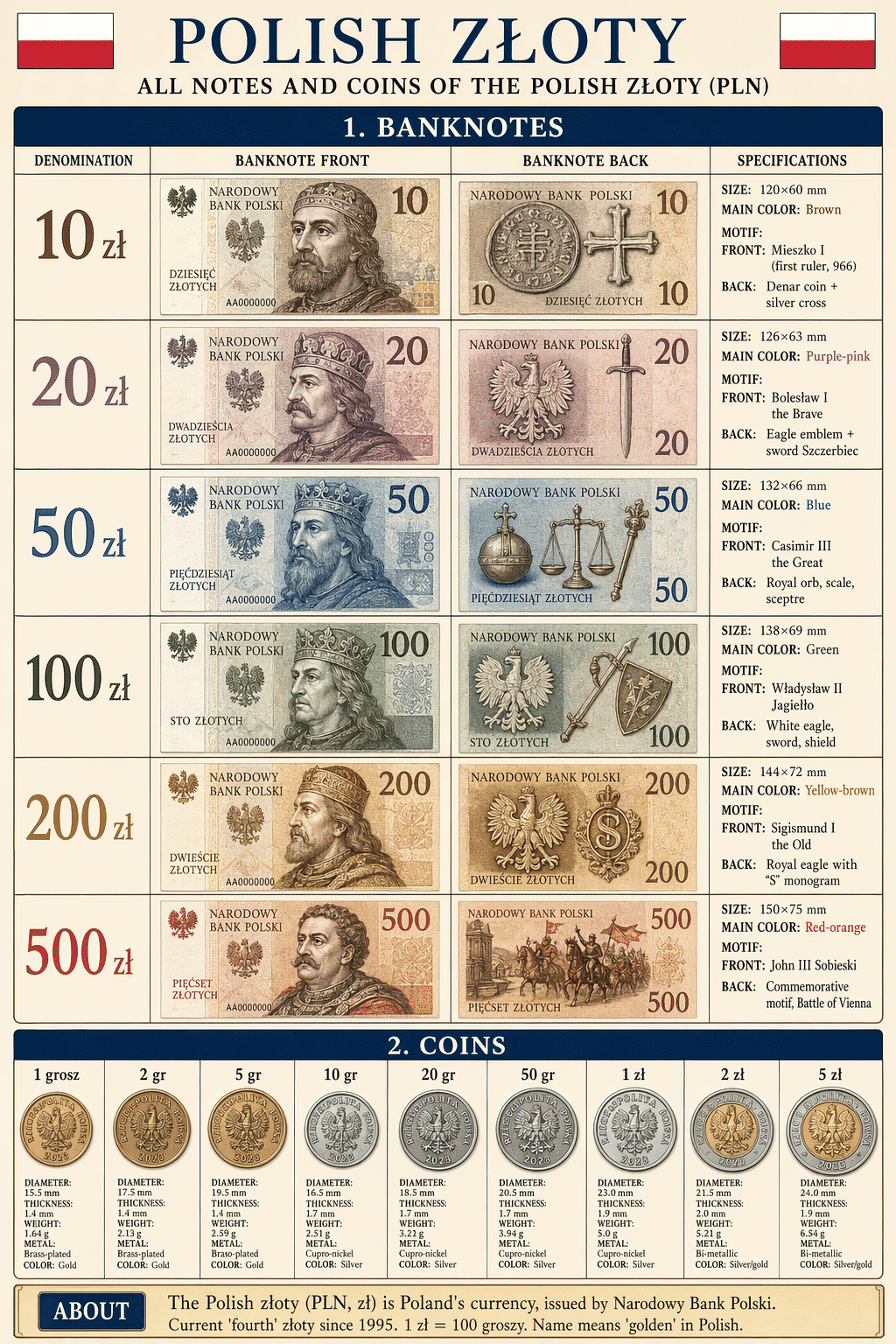
History of The Złoty
The złoty’s modern history is a sequence of crises and restorations. The inter-war złoty (1924) collapsed after Hitler’s invasion; the post-war ‘second złoty’ ran until the 1989–1990 hyperinflation that peaked at 585% annual inflation; and the current ‘fourth złoty’ was launched in 1995 after a 1:10,000 redenomination.
| Year | Event |
|---|---|
| 14th c. | Medieval złoty emerges as the Polish name for the gold florin. |
| 1924 | Modern złoty introduced by Finance Minister Władysław Grabski to end post-WWI hyperinflation. |
| 1939 | Nazi and Soviet occupations force parallel currencies; złoty effectively ends. |
| 1945 | Narodowy Bank Polski established; post-war ‘second złoty’ issued. |
| 1989–1990 | Hyperinflation peaks at 585% during the post-Communist transition. |
| 1994 | Leszek Balcerowicz’s stabilisation plan paves the way for the 1:10,000 redenomination. |
| 1995 | Fourth złoty introduced on 1 January; one new zł = 10,000 old zł. |
| 2004 | Poland joins the EU; begins meeting Maastricht criteria on paper. |
| 2022–2023 | Post-pandemic inflation peaks at 18.4% in February 2023. |
| 2024–2025 | NBP cutting cycle brings reference rate from 6.75% down to 4.00%. |
| 2026 | Glapiński declares inflation ‘back to target on a lasting basis’; markets price rate toward 3.50% by year-end. |
The Polish Economy and the Złoty
Poland is the EU’s sixth-largest economy and its fastest-growing over the past three decades — real GDP per capita has grown roughly 260% since 1990, more than any other transition economy. The export mix is diversified: motor vehicles and parts, electronics, machinery, and furniture all feature in the top five. Germany absorbs roughly 28% of Polish exports, tying the złoty’s cycle tightly to the German manufacturing cycle.
On monetary policy, the NBP runs an inflation-targeting regime with a 2.5% (±1 pp) target, in place since 1998. After CPI peaked at 18.4% in February 2023, inflation has fallen steadily and is now at or near target. The Monetary Policy Council cut the reference rate from a peak of 6.75% down to 4.00% in December 2025; FRA contracts imply a further cut to around 3.50% by mid-2026. Glapiński has framed the easing cycle as a definitive victory over the post-pandemic inflation episode.
Using Złotys in Poland
Poland is heavily cashless in Warsaw, Kraków, Wrocław, Poznań, and Gdańsk. Visa, Mastercard, and contactless (including BLIK — the domestic mobile-payment app with over 15 million users) work everywhere from chain cafés to tram-ticket machines. Cash usage persists in smaller towns, rural bar mleczny (milk bar) diners, some outdoor markets, and at weekly targ produce markets.
Typical prices in złotys (2026): espresso in a Kraków café 12–18 zł; pierogi lunch set 25–40 zł in a milk bar, 45–70 zł in a mid-range restaurant; a single Warsaw metro ticket 4.40 zł; a mid-range Kraków hotel room 350–650 zł. ATMs — PKO BP, Santander Bank Polska, Pekao, ING Bank Śląski, and mBank all operate extensive free networks for foreign cards. Avoid Euronet ATMs in tourist areas; their conversion rates are consistently poor.
The Złoty in Regional Context
Poland sits in the Central European non-euro group alongside Hungary and the Czech Republic, with materially different inflation and rate profiles. Slovakia and Slovenia on the other side of the border have been in the euro since 2009 and 2007 respectively.
| Country | Code | Regime | Inflation | Policy rate |
|---|---|---|---|---|
| 🇵🇱 Poland | PLN | Free float (NBP inflation target) | ~2.5% | 4.00% |
| 🇨🇿 Czech Republic | CZK | Free float | 1.9% | 3.50% |
| 🇭🇺 Hungary | HUF | Free float | 2.1% | 6.25% |
| 🇸🇰 Slovakia | EUR (since 2009) | Eurosystem | 2.9% | 2.00% |
| 🇩🇪 Germany | EUR | Eurosystem | 2.6% | 2.00% |
| 🇷🇴 Romania | RON | Managed float | 3.9% (2026f) | 6.50% |
Frequently Asked Questions
What is the currency of Poland?
The currency of Poland is the Polish złoty (symbol zł, ISO 4217 code PLN), subdivided into 100 groszy. It has been Poland’s currency since 1924 in its original form, with the current ‘fourth’ złoty in circulation since 1 January 1995 following a 1:10,000 redenomination that erased the 1989–1990 hyperinflation.
Is Poland in the Eurozone?
No. Poland is an EU member (since 1 May 2004) and legally bound to eventually adopt the euro, but successive governments have declined to set a target date. Poland is not in ERM II, and no active preparation for euro adoption is under way as of 2026.
Who manages Polish monetary policy?
The Narodowy Bank Polski (NBP) in Warsaw, founded 1945 and re-established as a modern inflation-targeting central bank in 1989. Its current Governor is Adam Glapiński, who took office on 21 June 2016 and was reappointed in 2022. The Monetary Policy Council sets the reference rate to meet a 2.5% (±1 pp) CPI inflation target.
What is the current NBP reference rate?
The NBP reference rate is 4.00% as of early 2026, down from a peak of 6.75% in September 2022. The MPC cut rates steadily through 2024–2025 as inflation returned to target. FRA contracts imply a further cut to around 3.50% by mid-2026.
How many złotys is one US dollar worth?
At the latest daily close, 1 USD ≈ 3.61 PLN. The złoty has strengthened roughly 2.5% against the dollar over the past 12 months, consistent with a narrower NBP–Fed rate gap and ongoing EU-fund inflows.
Who are on current Polish banknotes?
The current series features six Polish monarchs: Mieszko I on the 10 złoty (first baptised ruler, 966); Bolesław I the Brave on the 20; Casimir III the Great on the 50; Władysław II Jagiełło on the 100; Sigismund I the Old on the 200; and John III Sobieski on the 500. All notes use dynasty portraits on the obverse and architectural/heraldic motifs on the reverse.
Can I use euros or dollars in Poland?
Not really. Poland does not accept foreign currency for day-to-day transactions — restaurants, supermarkets, and transport all require złotys. A very small number of international hotel chains will quote and accept euros, but change comes in złotys at a poor rate. Use a Polish ATM or a Revolut/Wise card instead.
All data reflects the latest releases from NBP and GUS (Central Statistical Office), current to April 2026.

