Key Takeaways
- 130 countries now back a binding treaty on killer robots. Per the Stop Killer Robots campaign's research tracker, 130 states support negotiating a legally binding instrument on autonomous weapons, 53 have no declared position, and just 12 oppose it, among them the US, Russia, the UK, India and Japan.
- The UN vote was 164 to 6. UN General Assembly Resolution 80/57 on lethal autonomous weapons passed in December 2025 with 164 votes in favour. The six against: Belarus, Burundi, North Korea, Israel, Russia and the United States. China abstained.
- The decision falls this week in Geneva. The CCW Seventh Review Conference runs 16 to 20 November and must decide whether to open treaty negotiations. The CCW works by consensus, so any single state party can block the mandate.
- Support has quintupled since 2018. In 2018, 26 states backed a ban. By 2020 it was 30. Today 130 states support binding rules, yet the states developing these weapons fastest are the ones holding out.
Should a machine be allowed to decide, on its own, to kill a human being? This week in Geneva, the world’s governments are closer than they have ever been to answering that question with a binding rule of international law, and a handful of military powers are working to make sure they never do.
The Seventh Review Conference of the Convention on Certain Conventional Weapons (CCW) runs from 16 to 20 November 2026 at the Palais des Nations. On the table: whether to open formal negotiations on a legally binding instrument on lethal autonomous weapons systems, often called killer robots. We mapped where every country stands.
The Map: Who Backs a Treaty on Killer Robots?
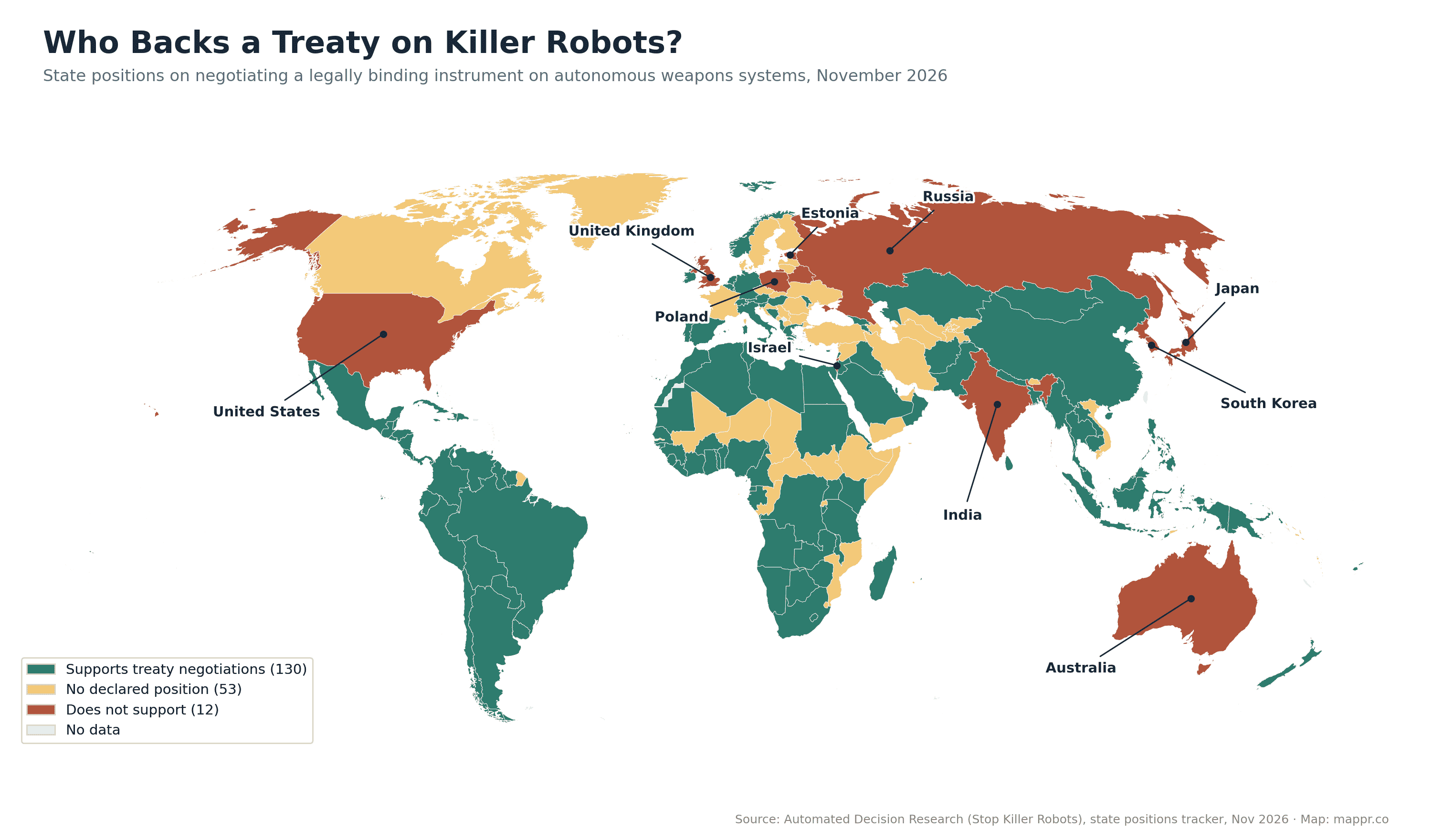
The pattern is stark. Per Automated Decision Research, the monitoring arm of the Stop Killer Robots campaign, 130 states support negotiating a legally binding instrument, counting positions expressed individually or through regional groups such as the African Group and the Non-Aligned Movement. Nearly all of Africa, Latin America and the Caribbean is on board, as are China, Germany, Italy and Spain.
53 states have taken no clear position. That group includes a surprising number of Western countries: Canada, France, Sweden, Denmark, Finland and Ukraine among them.
And 12 states oppose a treaty outright. They are not a random dozen: the list reads like a ranking of the world’s most advanced military-AI programmes.
The Hold-Outs
The hold-outs
The 12 States That Do Not Support a Treaty
States that oppose negotiating a legally binding instrument on autonomous weapons
| Country | UNGA 80/57 vote | CCW state party |
|---|---|---|
| United States | Against | Yes |
| Russia | Against | Yes |
| Israel | Against | Yes |
| Belarus | Against | Yes |
| North Korea | Against | No |
| United Kingdom | In favour | Yes |
| India | In favour | Yes |
| Japan | In favour | Yes |
| South Korea | In favour | Yes |
| Australia | In favour | Yes |
| Estonia | In favour | Yes |
| Poland | Abstained | Yes |
The hold-outs fall into two camps. Five of them, the United States, Russia, Israel, Belarus and North Korea, also voted against the UN resolution. The other seven, including the United Kingdom, India, Japan and Australia, voted for the UN resolution or abstained: they accept that the issue matters, but do not want binding rules, preferring voluntary principles that leave their weapons programmes untouched.
One curiosity runs the other way: Burundi is counted as a treaty supporter through the African Group, yet it was one of the six states that voted against the UN resolution.
The UN Vote: 164 to 6
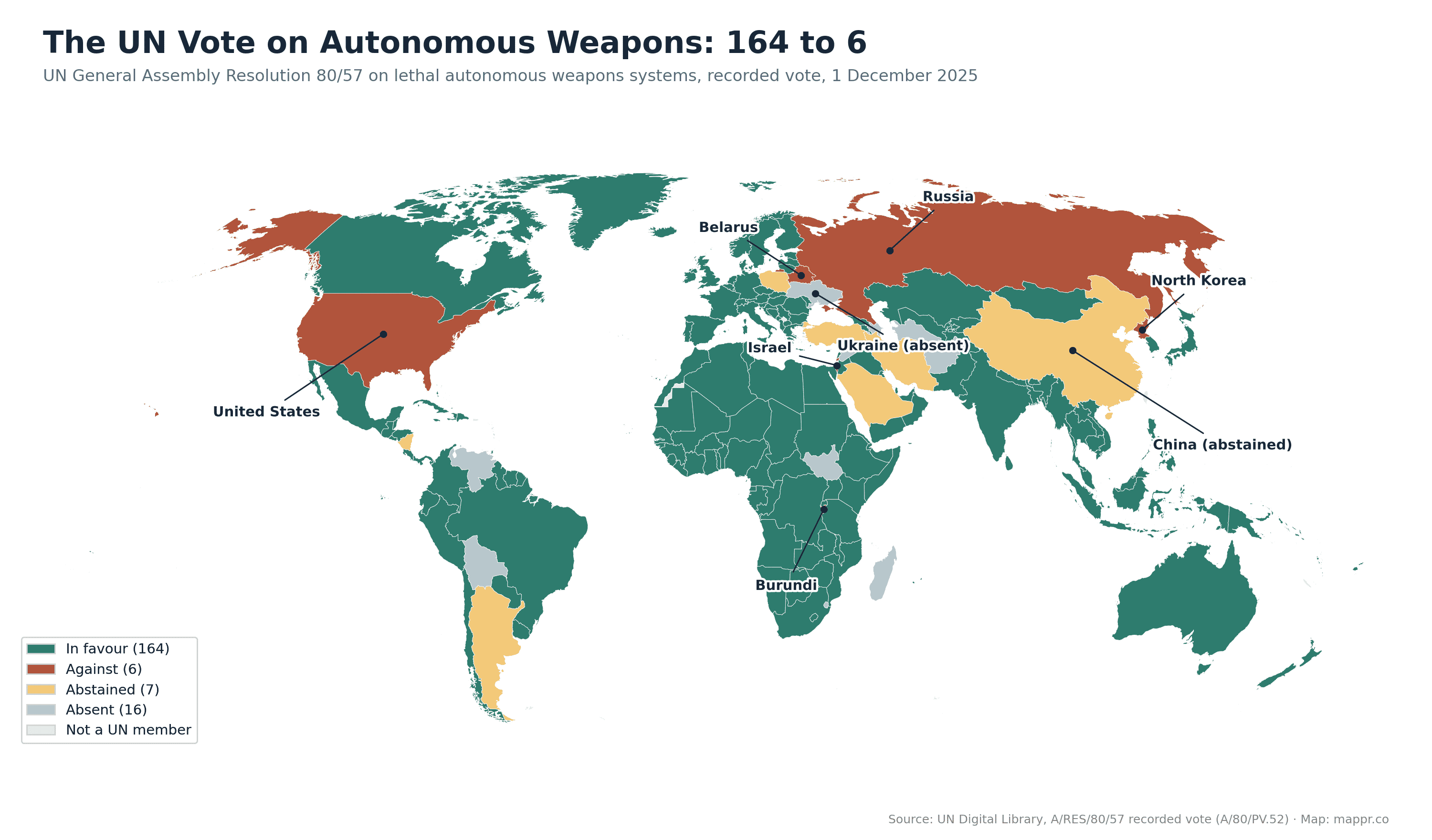
Press coverage tends to round these numbers off, with reports of “nearly 130” supporters or “163” votes. The UN record is exact. On 1 December 2025, the General Assembly adopted Resolution 80/57 on lethal autonomous weapons systems by 164 votes to 6, with 7 abstentions, at its 52nd plenary meeting.
The six votes against: Belarus, Burundi, Israel, North Korea, Russia and the United States. The seven abstentions: Argentina, China, Iran, Nicaragua, Poland, Saudi Arabia and Türkiye. Sixteen states were absent, including Ukraine, Venezuela, Syria and Afghanistan.
China’s abstention is the one to watch. Beijing says it supports negotiating binding rules, and Automated Decision Research counts it as a supporter, but it abstained on the UN resolution and has pushed for a narrow definition of autonomous weapons that would leave most of its own systems outside any ban.
What Is Happening in Geneva This Week
The CCW’s expert group on autonomous weapons has been talking since 2014 without producing a single binding rule. Its mandate expires at the end of 2026, which is why this week’s Review Conference is the decision point: continue talking, or start negotiating.
In September 2026, the expert group adopted its final report recommending that the conference formulate “elements of an instrument”. Human Rights Watch counted 76 states explicitly calling for negotiations at those talks. On the table in Geneva are a draft mandate from the chair that would set aside 30 negotiating days and target a new protocol by 2028, a seven-country proposal for 25 negotiating days in 2027, and a US paper backing five more years of non-binding discussions.
The final expert session also showed how the end-game is being played. According to reporting by the Washington Post, citing three people familiar with the talks, US and Russian diplomats spent roughly 15 hours on the final day stripping language from the draft, including a requirement that humans review targets selected by AI, standards for “predictable” and “reliable” operation, and a provision on weighing ethical aspects. The revised text still refers to human control, but campaigners called the cuts a gutting of the draft’s core safeguards.
The structural problem is the CCW itself: it decides by consensus, so any one of its 128 state parties can block a negotiating mandate, and nearly all 12 treaty opponents are CCW members. That is how the 2021 Review Conference ended with nothing. If this one fails the same way, campaigners say the issue will move outside the CCW, to a stand-alone treaty process like the ones that banned landmines and cluster munitions, or to the UN General Assembly, where there are no vetoes and, as the 164 to 6 vote shows, the majority is not in doubt.
From 26 to 130 in Eight Years
The trend
Support for a Killer Robots Treaty Over Time
States backing a ban or legally binding rules on autonomous weapons
| Year | States in support | Source |
|---|---|---|
| 2018 | 26 | Human Rights Watch |
| 2020 | 30 | Human Rights Watch |
| 2026 | 130 | Automated Decision Research |
When Human Rights Watch first tallied positions in 2018, 26 states backed a ban. By 2020 it was 30. The tracker now counts 130 states supporting binding rules, a five-fold increase in eight years, driven above all by the African Group, the Non-Aligned Movement and Latin America signing on as blocs.
What changed is that autonomous weapons stopped being hypothetical. UN investigators reported as early as 2021 that an autonomous drone had attacked fighters in Libya, and the war in Ukraine has accelerated the use of AI-enabled targeting on both sides. The technology is moving faster than the diplomacy, which is precisely the argument both camps make: supporters say that is why rules are urgent, opponents say that is why they will not be bound.
The Review Conference ends on Friday 20 November. We will update this post with the outcome.
Sources: