Key Takeaways
- A direct weekly train will link Ayodhya and Janakpur from 23 November. India's PM Narendra Modi and Nepal's PM Balendra Shah are due to inaugurate the service during Shah's state visit to India, connecting the birthplaces of Ram and Sita.
- Only 28 km of the 604 km route is in Nepal. The train runs east across Uttar Pradesh and Bihar through Gorakhpur, Raxaul, Sitamarhi and Madhubani, then crosses the border at Jaynagar for the final stretch to Janakpur.
- It is electric in India, diesel in Nepal. The Indian network is electrified up to Jaynagar, but the Nepali section is not. Nepal plans to request Indian grant aid to electrify it.
- The line is meant to reach Kathmandu one day. Nepal's railway runs to Bijalpura, with 17 km still under construction to Bardibas. An extension to Kathmandu is planned but has no timeline.
Two of Hinduism’s most sacred towns are about to get a direct rail link. From 23 November 2026, a weekly train will run between Ayodhya in India, revered as the birthplace of Lord Ram, and Janakpur in Nepal, the birthplace of Sita. India’s Prime Minister Narendra Modi and Nepal’s Prime Minister Balendra Shah are expected to inaugurate it together during Shah’s state visit to India, which begins on 22 November.
The 604 km route is almost entirely Indian: only 28 km runs through Nepal. We traced it on the rail network to show where it goes, where the electric wires end, and how far Nepal still is from its dream of a railway to Kathmandu.
The Map: From Ram’s Birthplace to Sita’s
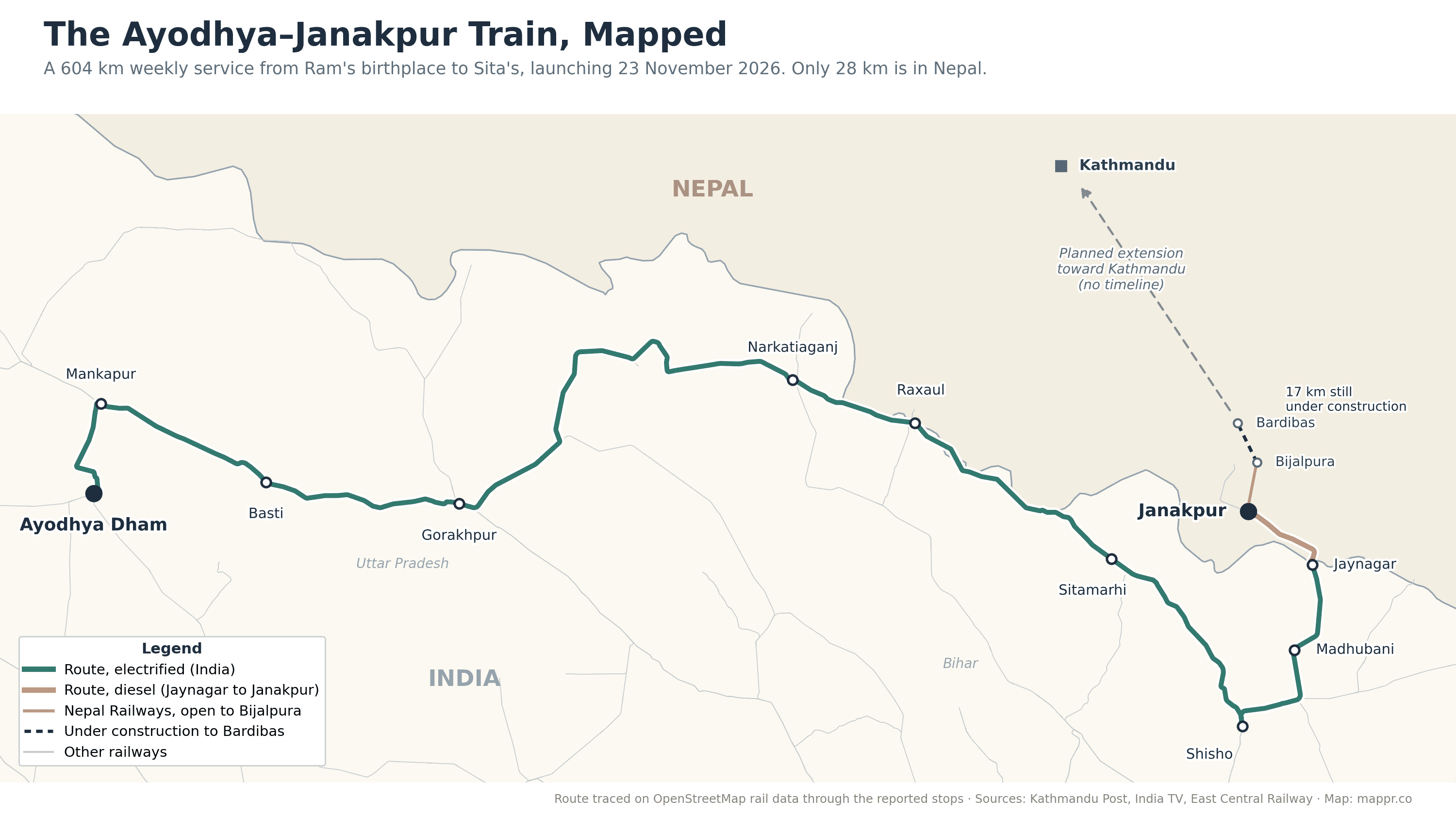
The train heads east from Ayodhya Dham, north to Mankapur and then along the main line through Basti and Gorakhpur. From Gorakhpur it turns north toward the Nepal border, entering Bihar near Bagaha, and runs through Narkatiaganj and Raxaul, the busy border town opposite Nepal’s Birgunj.
It then cuts southeast through Sitamarhi, which Indian tradition also venerates as Sita’s birthplace, bypasses Darbhanga via Shisho, and heads north through Madhubani to Jaynagar, the last station in India. The final 28 km cross the border to Janakpur.
Every Stop on the Route
The route
Stops on the Ayodhya–Janakpur Train
Reported stops, with approximate distance from Ayodhya traced on the rail network
| Station | State / country | Approx. km | Note |
|---|---|---|---|
| Ayodhya Dham | Uttar Pradesh | 0 | Start: Ram's birthplace, home of the Ram temple |
| Mankapur | Uttar Pradesh | 39 | Junction on the Gonda line |
| Basti | Uttar Pradesh | 101 | n/a |
| Gorakhpur | Uttar Pradesh | 165 | Major rail hub of eastern UP |
| Narkatiaganj | Bihar | 315 | Enters Bihar via Bagaha |
| Raxaul | Bihar | 357 | Border town opposite Birgunj, Nepal |
| Sitamarhi | Bihar | 437 | Revered as Sita's birthplace in Indian tradition |
| Shisho | Bihar | 509 | Bypasses Darbhanga |
| Madhubani | Bihar | 548 | Home of Madhubani painting |
| Jaynagar | Bihar | 579 | Last Indian station; electrification ends here |
| Janakpur | Nepal | 610 | End: Sita's birthplace, home of the Janaki Mandir |
Reported stops may still change before launch, and timetable and fares have not yet been published. Some earlier reports listed Darbhanga as a stop; the latest railway information routes the train around it.
Electric in India, Diesel in Nepal
Indian Railways has electrified almost its entire network, and the train can run under wires all the way to Jaynagar, roughly 575 km. Nepal’s short section is not electrified, so the last stretch runs on diesel. Nepal says it will ask India for grant assistance to electrify it.
The service will be operated and managed by India, with the operator paying for use of the Nepali infrastructure from Jaynagar. According to the Kathmandu Post, this is because Nepal has no train of its own for the service. It will start with an 18-coach train once a week in each direction, with more frequent services possible if demand is strong.
Nepal’s Railway: 52 Km Down, 17 to Go
The Indian-built Jaynagar–Bardibas line is Nepal’s only regular passenger railway. Of its planned 69 km, the 52 km section from Jaynagar through Janakpur to Bijalpura is open, and the last 17 km to Bardibas is still under construction, with land acquisition and compensation still being settled.
Bardibas sits on Nepal’s East-West Highway, and railway officials want the line to continue north to Kathmandu eventually. For now that is an ambition rather than a plan: no timeline has been set.
Why Ayodhya and Janakpur Matter
In the Ramayana, Prince Ram of Ayodhya married Princess Sita of Janakpur, then known as Mithila. The two towns have been linked by pilgrimage for centuries, and the bond between them is often cited as a symbol of the close cultural ties between India and Nepal. Ayodhya’s profile has soared since the consecration of its Ram temple in January 2024, and pilgrims travel in both directions: Nepali devotees to Ayodhya, Indian visitors to Janakpur’s Janaki Mandir.
Until now, that journey meant changing trains or taking the road. A direct service turns it into a single journey, and gives Nepal’s tiny rail network its first regular cross-border passenger link to India’s heartland.
We will update this post with the timetable and fares once they are published.
Sources: