Key Takeaways
- The UK is the best-prepared country to prevent disease. The first Preventive Health Readiness Index ranks the United Kingdom first with 78.3 out of 100, ahead of Finland (77.6) and Australia (75.0). No country scores above 80.
- Only 16 of 114 countries reach the Advanced tier. Twenty countries are Established, 28 Developing and 50, almost half, are in the lowest Emerging tier, most of them in sub-Saharan Africa.
- Thailand beats much richer countries. Thailand ranks 16th and reaches the Advanced tier, ahead of Japan, Spain and Belgium. The index's authors argue that system design matters more than national wealth.
- The US leads on data but ranks only 14th overall. The United States scores best in the world for health data and surveillance, but weaker prevention policy and funding pull it down to 14th.
Health systems are usually judged by how well they treat illness. A new index asks a different question: how well can a country stop people from getting sick in the first place?
The Preventive Health Readiness Index, published in November 2026 by the FII Institute and FTI Consulting, scores 114 countries on 27 indicators, from tobacco taxes and vaccination programmes to disease registries and access to screening. We mapped every country’s readiness tier.
The Map: Who Is Ready to Prevent Disease?
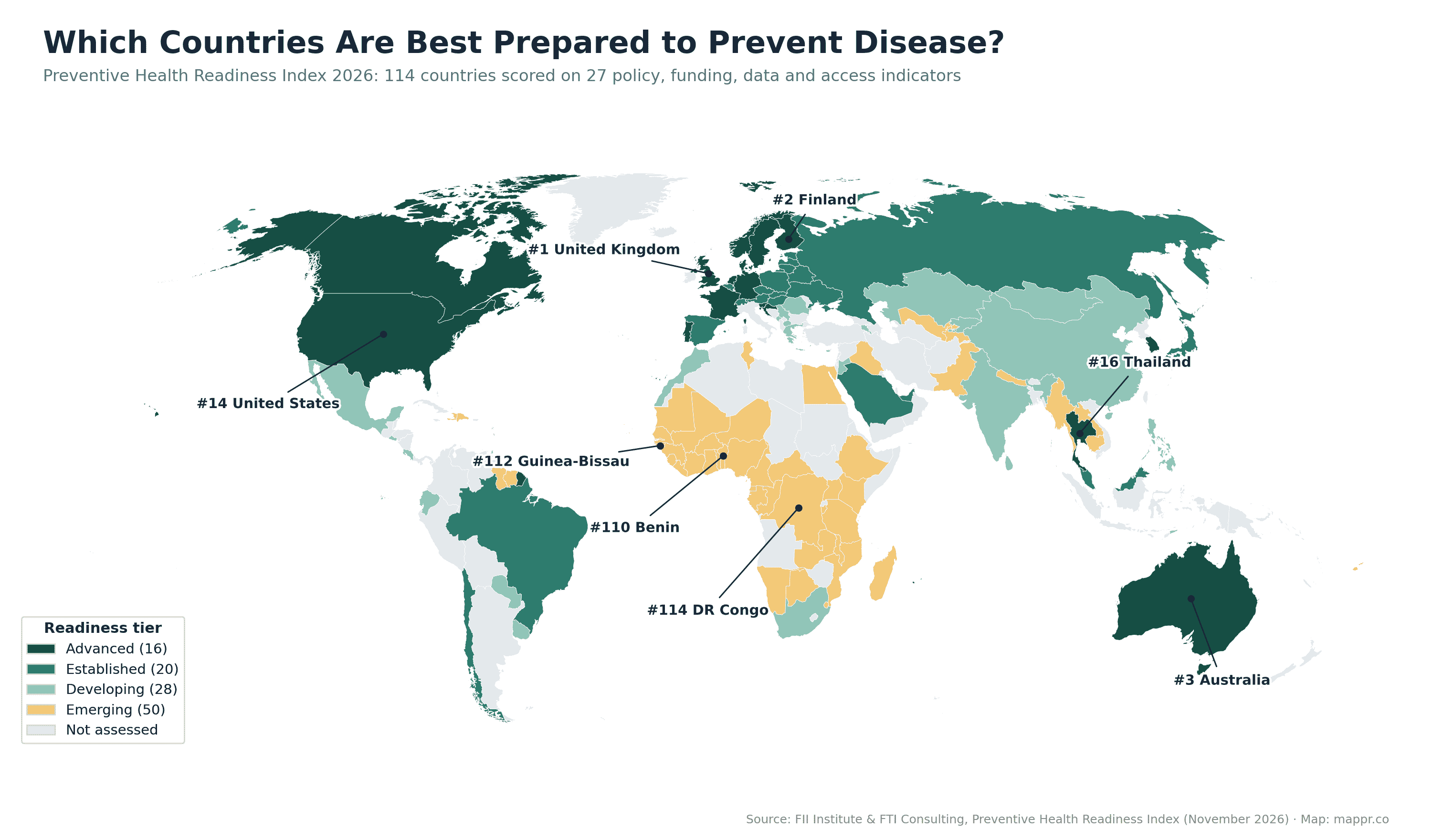
The pattern broadly follows wealth. Europe and Central Asia have the highest average readiness, followed by East Asia and the Pacific, Latin America and the Caribbean, and the Middle East and North Africa. Sub-Saharan Africa is lowest, and almost the whole region falls into the Emerging tier.
Some large countries are missing entirely: Italy, Indonesia, Turkey, Iran, Vietnam, Bangladesh, Argentina and Colombia are among those not scored in this first edition.
The Top 20
The leaders
Top 20: the Best-Prepared Countries
Overall preventive health readiness score
| Country | Score (out of 100) | Rank | Tier |
|---|---|---|---|
| United Kingdom | 78.3 | #1 | Advanced |
| Finland | 77.6 | #2 | Advanced |
| Australia | 75 | #3 | Advanced |
| Norway | 74.1 | #4 | Advanced |
| Sweden | 73.2 | #5 | Advanced |
| Germany | 73.1 | #6 | Advanced |
| Portugal | 72.8 | #7 | Advanced |
| France | 72.5 | #8 | Advanced |
| South Korea | 72.5 | #9 | Advanced |
| Netherlands | 72.1 | #10 | Advanced |
| Denmark | 71.6 | #11 | Advanced |
| Canada | 71.4 | #12 | Advanced |
| Slovenia | 70.9 | #13 | Advanced |
| United States | 70.5 | #14 | Advanced |
| Croatia | 70.3 | #15 | Advanced |
| Thailand | 70 | #16 | Advanced |
| Latvia | 69 | #17 | Established |
| Lithuania | 68.7 | #18 | Established |
| Spain | 68.1 | #19 | Established |
| Belgium | 67.7 | #20 | Established |
The United Kingdom tops the index with 78.3 out of 100. It ranks first in the world for tobacco policy and taxation and gets full marks for nutrition and physical-activity policy, helped by measures such as its sugar tax on soft drinks and the NHS Health Check programme for adults aged 40 to 74.
Finland (77.6) and Australia (75.0) follow, then Norway, Sweden, Germany, Portugal, France, South Korea and the Netherlands. Even the leaders fall short: no country scores above 80, and the report stresses that every top performer still has material gaps.
The Four Dimensions
The index combines four dimensions, and different countries lead each one:
Policy and Governance: Finland ranks first.
Funding and Incentives: South Korea ranks first.
Digital and Data: the United States is first, with some of the world’s strongest surveillance, laboratory and registry systems.
Access and Capacity: Australia leads on actually delivering preventive services to people.
The US Paradox
The United States is the index’s most striking case. It ranks first in the world on Digital and Data and does well on access, yet it is only 14th overall with 70.5. The report says it is held back by Policy and Governance and Funding and Incentives: fiscal and regulatory prevention tools are applied less consistently, and most of its enormous health spending goes to treatment rather than prevention. Its health outcomes also sit below those of countries with similar readiness.
Thailand and the Wealth Myth
The report’s central argument is that system design matters more than national wealth. Thailand is the clearest example: a middle-income country ranked 16th and in the Advanced tier, ahead of Japan, Spain and Belgium. Chile, Malaysia and Brazil also reach the Established tier, ahead of several richer countries.
What they share, according to the report, is dedicated prevention financing, delivery platforms built to carry preventive services, and national health data systems. Countries such as Sri Lanka, Jordan and Armenia score higher on readiness than their current health outcomes would suggest, which may signal investments that have not yet paid off.
Major Economies
Middle of the pack
Selected Major Economies
Where the world’s largest countries rank
| Country | Score (out of 100) | Rank | Tier |
|---|---|---|---|
| Japan | 66.6 | #22 | Established |
| Russia | 65.4 | #26 | Established |
| Saudi Arabia | 64.3 | #30 | Established |
| Brazil | 61.3 | #35 | Established |
| Mexico | 57.9 | #42 | Developing |
| India | 57.1 | #45 | Developing |
| China | 56.4 | #48 | Developing |
| South Africa | 51.1 | #62 | Developing |
| Egypt | 46.3 | #71 | Emerging |
| Nigeria | 40.8 | #82 | Emerging |
| Pakistan | 39.8 | #86 | Emerging |
Among the world’s largest countries, China ranks 48th and India 45th, both in the Developing tier. Saudi Arabia, home of the FII Institute, ranks 30th, while the UAE is the Middle East’s best performer at 23rd. Iraq is the region’s lowest at 90th.
The Bottom of the Index
Bottom of the index
The 15 Least-Prepared Countries
Overall preventive health readiness score
| Country | Score (out of 100) | Rank | Tier |
|---|---|---|---|
| Guinea | 33.3 | #100 | Emerging |
| Niger | 32.4 | #101 | Emerging |
| Gabon | 32.1 | #102 | Emerging |
| Togo | 32.1 | #103 | Emerging |
| Burundi | 31 | #104 | Emerging |
| Comoros | 30.1 | #105 | Emerging |
| Haiti | 29.2 | #106 | Emerging |
| Madagascar | 28.8 | #107 | Emerging |
| Mauritania | 27.7 | #108 | Emerging |
| Republic of the Congo | 27.5 | #109 | Emerging |
| Benin | 27.2 | #110 | Emerging |
| Equatorial Guinea | 26.5 | #111 | Emerging |
| Guinea-Bissau | 25 | #112 | Emerging |
| Central African Republic | 24.5 | #113 | Emerging |
| DR Congo | 23.8 | #114 | Emerging |
The three lowest-ranked countries are all in Africa: Benin (110th), Guinea-Bissau (112th) and the Democratic Republic of the Congo, last at 114th with 23.8 points. Half of all countries assessed sit in the Emerging tier, which the authors call the clearest statement the index makes about how unevenly prevention capacity is spread around the world.
Does Readiness Make People Healthier?
The index measures readiness separately from health outcomes, then compares the two. The relationship is strong: readiness explains about 62% of the variation in countries’ health outcomes, which combine exposure to risk factors, total disease burden and life expectancy. Countries that have built prevention systems tend to have measurably healthier populations, though outcomes also reflect decades of history, income and factors outside the health system.
About the Index
The Preventive Health Readiness Index was developed by the FII Institute, the Saudi-based nonprofit behind the Future Investment Initiative conference, with FTI Consulting, building on a June 2026 white paper. Its 27 indicators are drawn from international sources and grouped into four dimensions. Countries are placed in four tiers based on rank: Advanced (1st to 16th), Established (17th to 36th), Developing (37th to 64th) and Emerging (65th to 114th).
Sources: