Key Takeaways
- Stroke is the world's #2 cause of death. and a leading cause of long-term disability. World Stroke Day falls on 29 October, which in 2026 also marks 20 years of the World Stroke Campaign.
- The rate has roughly halved, yet deaths keep rising. The age-standardised stroke death rate fell from about 157.2 per 100,000 in 1990 to 75.8 in 2023, but the absolute number of stroke deaths has risen with ageing and population growth.
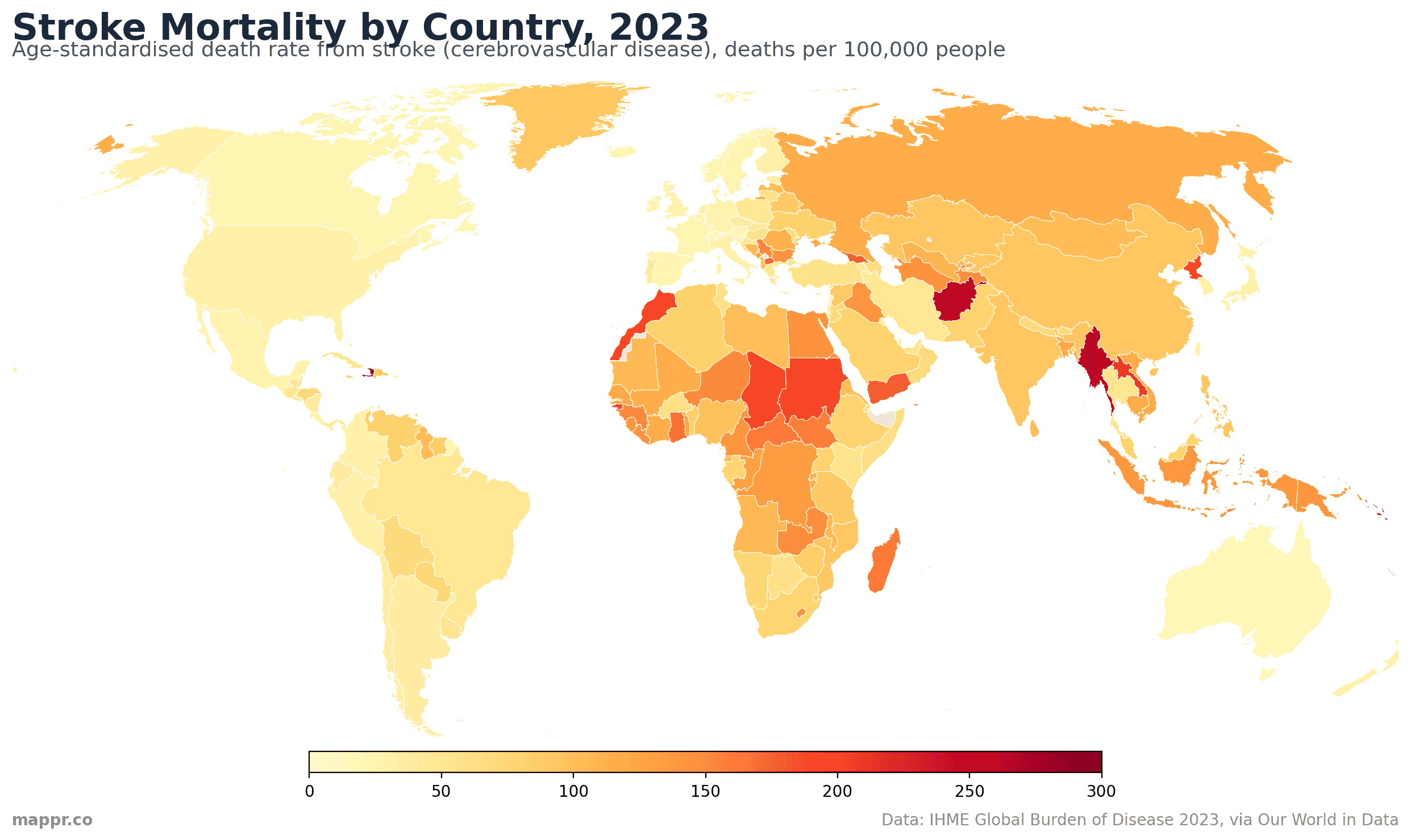
- The burden has shifted to the poorer world. Rates are highest in Pacific island nations, South and Southeast Asia, Haiti and Afghanistan, and lowest in wealthy Western Europe, high-income Asia-Pacific and North America.
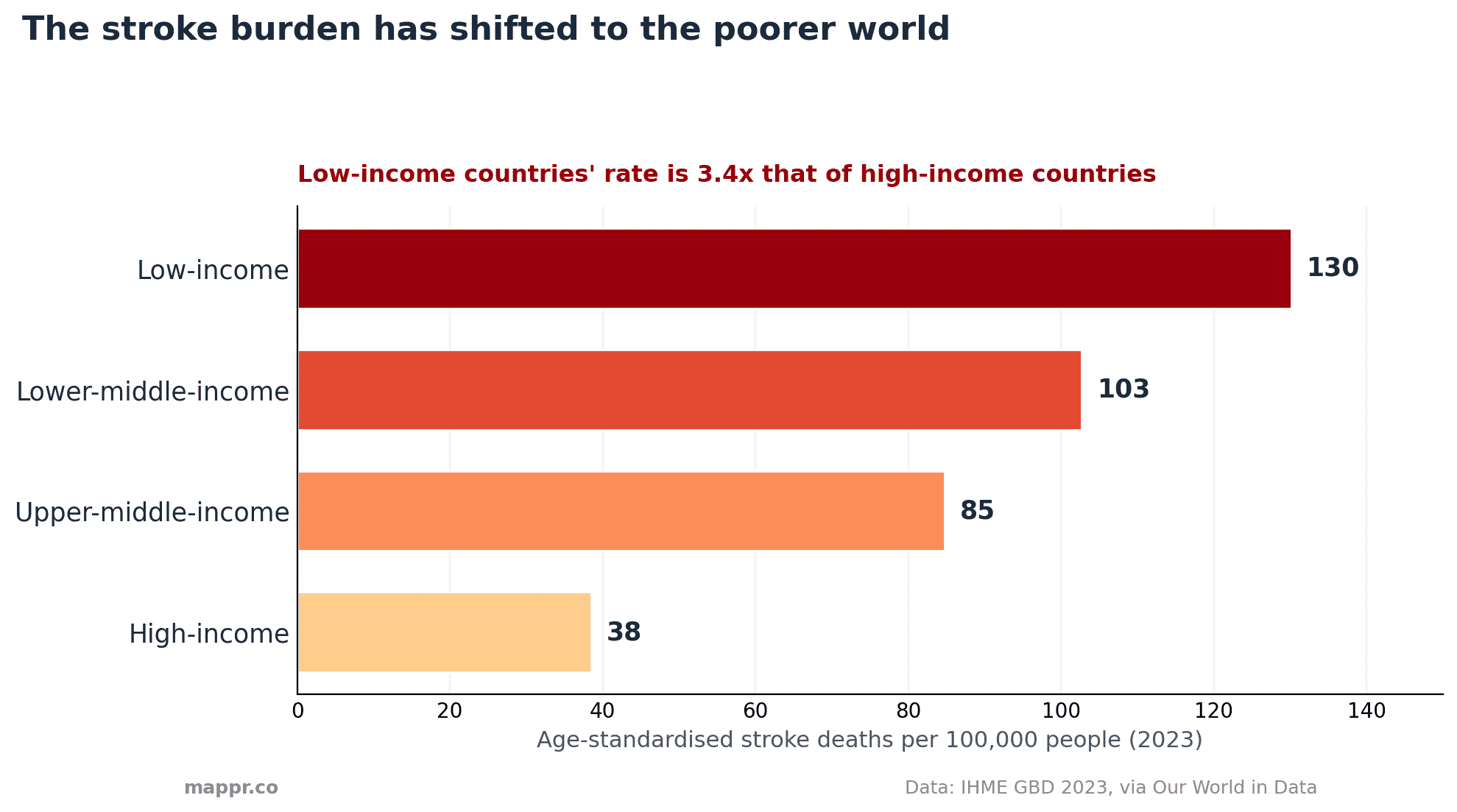
- A stark income gap. The stroke death rate in low-income countries (130 per 100,000) is about 3.4 times that of high-income countries (38). The WSO estimates 87% of stroke deaths now fall in low- and middle-income countries.
Stroke is the second-leading cause of death in the world and one of the biggest causes of long-term disability. With World Stroke Day on 29 October, and 2026 marking the 20th anniversary of the World Stroke Campaign, it is a good moment to map where strokes kill the most people, and where they have become rare.
The map below shows the age-standardised stroke death rate for every country, measured as deaths from cerebrovascular disease per 100,000 people. Age-standardising strips out the effect of different age structures, so a young country and an old one can be compared fairly.
The big picture: fewer deaths per person, but more deaths
Globally, the risk of dying from a stroke has fallen sharply. The age-standardised rate dropped from roughly 157 per 100,000 in 1990 to about 76 in 2023, thanks to better blood-pressure control, less smoking and improved acute care. Yet the total number of stroke deaths has still gone up, because populations are both growing and ageing, and stroke is overwhelmingly a disease of older age.
Where stroke kills the most
The highest age-standardised rates cluster in Pacific island nations, South and Southeast Asia, parts of Sub-Saharan Africa, and the Caucasus and Central Asia. The five highest in 2023 are Nauru (319), Haiti (286), Marshall Islands (281), Tuvalu (277), Solomon Islands (273) per 100,000. Myanmar, Afghanistan and Laos also rank near the top, alongside a band of high rates across Eastern Europe and Central Asia.
STROKE DEATHS 2023
Highest and lowest stroke death rates
Age-standardised stroke (cerebrovascular) deaths per 100,000 people, 2023. The 15 highest, then the 5 lowest.
| Country | Deaths / 100k | Global rank |
|---|---|---|
| Nauru | 319 | #1 |
| Haiti | 286 | #2 |
| Marshall Islands | 281 | #3 |
| Tuvalu | 277 | #4 |
| Solomon Islands | 273 | #5 |
| Myanmar | 263 | #6 |
| Afghanistan | 262 | #7 |
| Laos | 210 | #8 |
| Guinea-Bissau | 196 | #9 |
| Sudan | 195 | #10 |
| North Korea | 194 | #11 |
| Chad | 192 | #12 |
| Morocco | 191 | #13 |
| Yemen | 178 | #14 |
| Georgia | 176 | #15 |
| Australia | 19 | #200 |
| Switzerland | 18 | #201 |
| Andorra | 18 | #202 |
| Puerto Rico | 16 | #203 |
| Singapore | 12 | #204 |
The income divide
Stroke has quietly become a disease of the poorer world. The World Stroke Organization estimates that 87% of stroke deaths and 89% of the years of healthy life lost to stroke now occur in low- and middle-income countries. The pattern shows up clearly when countries are grouped by income: the rate in low-income countries is about 3.4 times that in high-income countries.
Richer countries have pushed their stroke rates down with decades of investment in hypertension treatment, anti-smoking policy and fast stroke care (clot-busting drugs and specialist stroke units). Much of the low- and middle-income world has not yet had that, so a condition that is highly preventable and increasingly treatable still kills at several times the rate.
Where stroke is rarest
At the other end, the lowest rates are in high-income Asia-Pacific, wealthy Western Europe and North America. Singapore has the lowest age-standardised stroke death rate in the world at about 12 per 100,000, followed by places such as Puerto Rico, Andorra, Switzerland, Australia and Israel, all under 20.
Why it matters now
This year’s World Stroke Day lands as the WSO-convened Global Stroke Action Coalition launches its “The time is now” push toward a World Health Assembly resolution on stroke. The message of the map is the same as the campaign’s: stroke is largely preventable and increasingly treatable, but the gains so far have been very unevenly shared. Closing that gap is mostly about the basics, controlling blood pressure, cutting smoking and salt, and building the systems to treat a stroke fast.
Figures in this article are drawn from the following sources.