Key Takeaways
- 4 in 10 adults with diabetes don't know it. 42.8% of the world's 589 million diabetic adults — about 252 million people — have never been diagnosed.
- 86.9% of undiagnosed cases are in low- and middle-income countries. Low-income countries: 58.7% undiagnosed. Middle-income: 45.5%. High-income: 28.9%. A steep income gradient runs through every region.
- Burkina Faso tops the world at 90.4%. Nine of ten Burkinabé adults living with diabetes are unaware. Benin (89.8%), Mozambique (88.6%), Zambia (86.0%), and Rwanda (85.6%) round out the global top five.
- China carries the largest absolute burden. 73.5 million Chinese adults have undiagnosed diabetes — more than the population of France. India (38.6M) and Indonesia (15.0M) follow.
- U.S. screening is good — but 9.6 million still slip through. American undiagnosed rate (24.8%) is among the lowest globally, but in absolute terms still equals the population of Sweden, undiagnosed and unmanaged.
The International Diabetes Federation released the 11th edition of its Diabetes Atlas in October 2025, with a corresponding peer-reviewed analysis published in Diabetes Care in March 2026. The Atlas estimates global diabetes prevalence at 589 million adults aged 20–79 in 2024 — roughly 1 in 9 of the world’s adult population. Of those, 251.7 million (42.8%) are undiagnosed: they have the disease, but neither they nor their healthcare system knows it.
“Undiagnosed” is not a euphemism for “mild.” Most undiagnosed diabetics have had elevated blood glucose for years, are accumulating microvascular damage to their kidneys, eyes, and peripheral nerves, and face elevated cardiovascular risk — without any of the medical surveillance, lifestyle intervention, or medication that early diagnosis would unlock. The geographic distribution of this gap is where the story gets sharp.
The Income Gradient
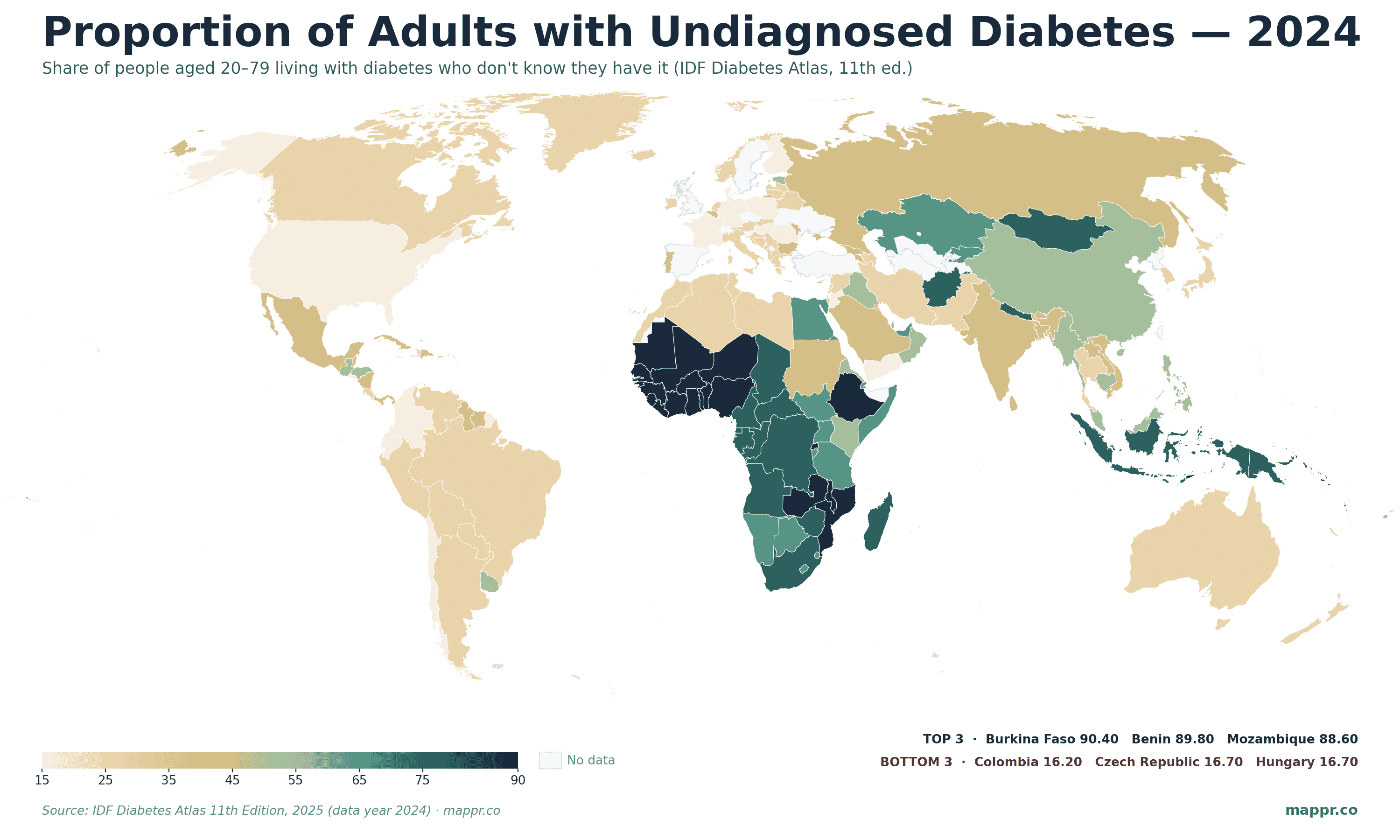
The map shows in shape what the IDF report states in numbers: nearly all of sub-Saharan Africa, parts of Southeast Asia, and several Pacific Island nations carry undiagnosed rates above 60%, while most of Europe, North America, and the wealthier slice of Latin America sit below 35%.
| World Bank income group | % of adults with diabetes who are undiagnosed | People undiagnosed (millions) |
|---|---|---|
| Low-income countries | 58.7% | 12.8 |
| Middle-income countries | 45.5% | 206.0 |
| High-income countries | 28.9% | 32.9 |
The math under those percentages: low-income countries have far fewer total diabetes cases (so 12.8M sits behind that 58.7%), middle-income countries are where the absolute burden lives (206M undiagnosed), and high-income countries have both lower diabetes prevalence and better screening. 86.9% of all undiagnosed diabetes globally is in low- and middle-income countries — home to four-fifths of the world’s population but a disproportionate share of the screening gap.
The 10 Countries with the Most Undiagnosed Diabetics
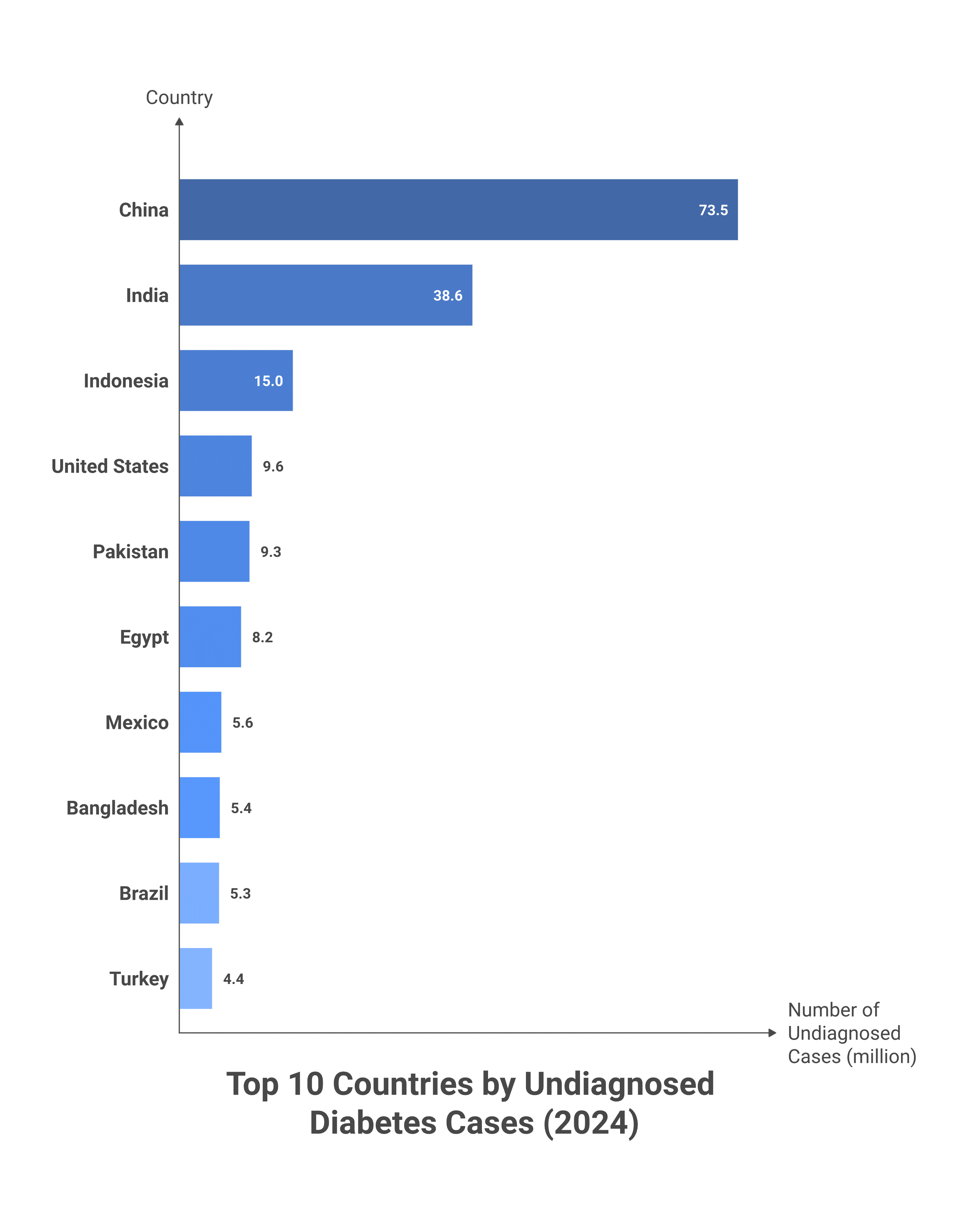
Where the world’s largest absolute numbers of undiagnosed diabetes live is a different question from where the highest rates are. The top of the absolute list is dominated by the most populous countries — but the rates within those countries vary widely.
| Rank | Country | Undiagnosed adults (millions) | % undiagnosed |
|---|---|---|---|
| 1 | 🇨🇳 China | 73.5 | 49.7% |
| 2 | 🇮🇳 India | 38.6 | 43.0% |
| 3 | 🇮🇩 Indonesia | 15.0 | 73.2% |
| 4 | 🇺🇸 United States | 9.6 | 24.8% |
| 5 | 🇵🇰 Pakistan | 9.3 | 26.9% |
| 6 | 🇪🇬 Egypt | 8.2 | 62.0% |
| 7 | 🇲🇽 Mexico | 5.6 | 41.3% |
| 8 | 🇧🇩 Bangladesh | 5.4 | 39.1% |
| 9 | 🇧🇷 Brazil | 5.3 | 31.9% |
| 10 | 🇹🇷 Turkey | 4.4 | 45.5% |
China is the headline. 73.5 million Chinese adults — more than the entire population of France or the UK — have diabetes and don’t know it. The Chinese rate (49.7%) is roughly in line with other middle-income peers, but the population size makes the absolute number staggering.
Indonesia is the surprise. Despite being far smaller than China or India, Indonesia sits third in the absolute ranking because its rate is extreme: 73.2% of Indonesian diabetic adults are undiagnosed, the highest among any top-10-by-absolute-numbers country. Egypt (62.0%) and Turkey (45.5%) round out the unexpectedly high rates in this group.
The U.S. and Pakistan are near-mirror cases by absolute number (9.6M vs 9.3M) despite enormous differences in healthcare systems and per-capita income — Pakistan’s 26.9% undiagnosed rate is similar to America’s 24.8%, but applied to a much larger diabetic population.
Where the Rates Are Highest
The highest undiagnosed shares are concentrated in sub-Saharan Africa:
- Burkina Faso — 90.4% undiagnosed
- Benin — 89.8%
- Mozambique — 88.6%
- Zambia — 86.0%
- Rwanda — 85.6%
- Liberia — 85.1%
- Togo — 80.1%
These rates would translate to a “9 of every 10 diabetic adults have never been screened” story if you read the figures literally. The Atlas methodology footnote is important here: for many sub-Saharan African countries, the IDF lacked nationally representative survey data and applied regional fallback estimates. The 78.7% figure that recurs across West Africa is essentially that regional average. So the precise country-level numbers should be read as “this country sits in the West African band, where direct measurement is rare and the typical undiagnosed share is north of 75%.”
The Atlas estimates were generated using 193 data sources from 109 countries; the remaining 106 countries received extrapolated regional estimates. That’s a real coverage gap — and a reminder that “undiagnosed diabetes” is, definitionally, hard to measure.
Where Screening Catches Almost Everyone
At the other end, several countries report undiagnosed rates below 20%:
- Colombia — 16.2%
- Czechia — 16.7%
- Hungary — 16.7%
- Chile — 17.1%
- Jordan — 18.6%
- Finland — 18.8%
- Poland — 18.9%
What’s striking here is the geography: this is not the Nordic-plus-Switzerland cluster that tops most wealth-and-wellbeing rankings. Several upper-middle-income countries (Colombia, Chile, Jordan, Poland, Hungary, Czechia) outperform some Western European and high-income peers on screening. National diabetes-screening programmes, universal-healthcare coverage, and (in Eastern Europe especially) historically strong primary-care infrastructure show up in the data as finding the cases that exist, regardless of overall income.
Why It Matters
Type 2 diabetes is largely asymptomatic in its early years. Without screening, the typical patient presents only after a complication has already developed — a heart attack, a foot ulcer that doesn’t heal, vision loss, or kidney function below the threshold for dialysis. By that point, the underlying disease has often been active for 5–10 years.
The IDF’s policy framing is straightforward: in countries where the undiagnosed share is above 40–50%, the highest-leverage intervention is not new diabetes medication but basic screening. A point-of-care HbA1c test costs roughly $1–3 in bulk; a single glucose meter strip is pennies. The infrastructure to deploy them at primary-care level — trained community health workers, supply chains, follow-up referral pathways — is what’s missing, and that’s the gap the global undiagnosed number quantifies.
Methodology
The IDF Atlas 11th edition combines population-based survey data, national health surveys, and demographic modelling to estimate diabetes prevalence and the share that is undiagnosed for 215 countries and territories. Country-level proportions came from 193 underlying data sources across 109 countries; for the remaining 106 countries, regional fallback estimates were applied. The reference year for all figures in this post is 2024 (the Atlas was released in October 2025 with 2024 as its primary data year).
“Undiagnosed diabetes” is defined as elevated fasting glucose or HbA1c above the diagnostic threshold in a person who, when surveyed, reports no prior diabetes diagnosis from a healthcare provider. The methodology is described in detail in the IDF Atlas itself and in the companion peer-reviewed paper in Diabetes Care (March 2026).
Conclusion
One in nine adults globally has diabetes. Two of every five of those have never been diagnosed. The undiagnosed gap is one of the cleanest measurable signals of an underperforming primary-care system — and the map of it is a near-perfect inversion of national income. Closing it doesn’t require new drugs or new science: it requires screening to reach the 252 million people the world’s health systems are currently missing.
This post uses data from the International Diabetes Federation (IDF) Diabetes Atlas, 11th Edition (October 2025), reference year 2024. Country-level proportions of adults with undiagnosed diabetes were parsed from the Atlas's regional country-summary tables (Africa, Europe, Middle-East & North Africa, North America & Caribbean, South & Central America, South-East Asia, Western Pacific). Absolute numbers were computed by combining each country's diabetes prevalence with its undiagnosed share.
Primary Data Sources:
- IDF Diabetes Atlas, 11th Edition (2025) – Full-text PDF of the IDF Atlas 11th edition. Country-by-country tables (pages 107–122 of the print PDF) are the source for all per-country values in this post.
- IDF Atlas — Proportion of adults with undiagnosed diabetes (data by indicator) – Interactive IDF page on the undiagnosed-diabetes indicator, with global, regional, and country-level breakdowns.
- Diabetes Care — Global, Regional, and National Estimates of Undiagnosed Diabetes in Adults – Peer-reviewed companion analysis (Diabetes Care, March 2026) of the underlying IDF Atlas methodology and findings.
Image Sources:
- Person testing blood sugar — Sweet Life on Unsplash – Featured image.