Key Takeaways
- Switzerland rejected the population cap on 14 June 2026. Voters threw out the SVP's "No to a Switzerland with 10 million!" initiative by 54.8% to 45.2% — and it failed the cantonal majority too, so the 10-million constitutional ceiling will not be introduced.
- A clear but not crushing No. 1,808,916 voted against and 1,492,603 in favour, on a turnout of about 58.9%. A majority of cantons (11.5 to 8.5) also rejected it, meeting the double-majority rule.
- The population is ~9.1 million and climbing. Switzerland passed 9 million in 2024 and grew about 1% in 2025 — growth driven almost entirely by net immigration (about 75,000 in 2025).
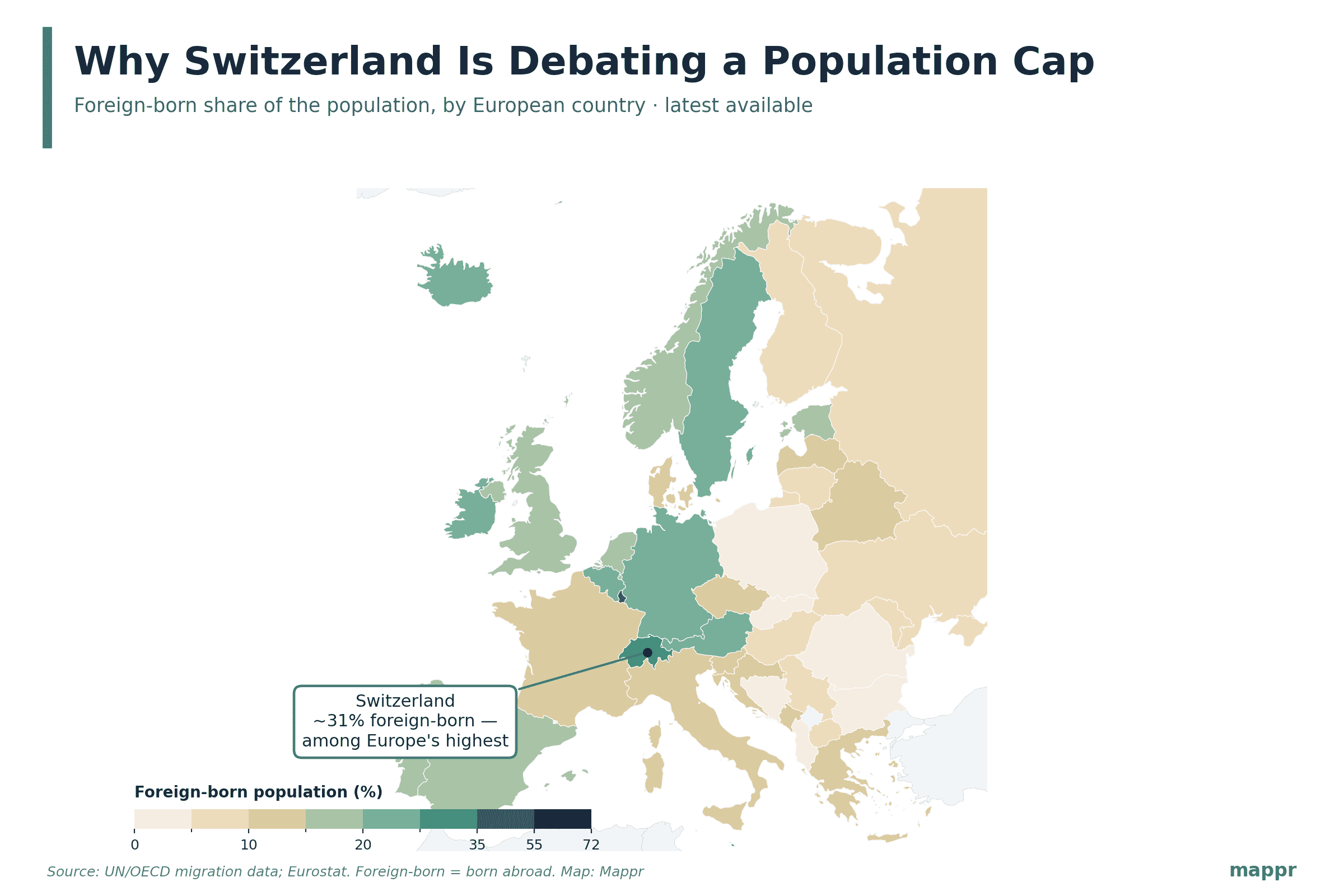
- Among Europe's most foreign-born countries. Roughly 31% of residents were born abroad — behind only Liechtenstein and Luxembourg in Europe, and more than a quarter hold a foreign passport.
- EU free movement stays — for now. A Yes would have forced Switzerland to end free movement with the EU if the population hit 10 million. The rejection keeps the bilateral framework intact, but 45% backing shows the immigration debate is far from over.
How many people is too many for one country? Switzerland put the question to a vote on 14 June 2026 — and the answer was a clear No. Voters rejected a proposal to cap the resident population at 10 million, a constitutional brake on growth that, had it passed, would have forced the government to curb immigration and could have unravelled its closest ties to the European Union.
The “No to a Switzerland with 10 million!” initiative — formally the Sustainability Initiative, launched by the right-wing Swiss People’s Party (SVP) — taps a real anxiety: the country’s population has been rising fast, almost entirely through immigration, and Switzerland already has one of the highest shares of foreign-born residents in Europe. Here’s what’s on the ballot, and the data behind it.
The Result: Voters Said No
On 14 June 2026, Swiss voters rejected the initiative by 54.8% to 45.2%, on a turnout of about 58.9%. Swiss constitutional amendments need a double majority — of the national vote and of the cantons — and the initiative lost on both: a majority of cantons (11.5 to 8.5) also voted No. The 10-million ceiling will not be written into the constitution.
| 14 June 2026 referendum | Share | Votes | Cantons |
|---|---|---|---|
| Against (No) — rejected | 54.8% | 1,808,916 | 11.5 |
| In favour (Yes) | 45.2% | 1,492,603 | 8.5 |
| Turnout | 58.9% | — | — |
What the Initiative Would Do
The initiative would add a “sustainable population development” clause to the Swiss constitution, fixing a ceiling of 10 million permanent residents until 2050. It builds in two tripwires. If the population reaches a 9.5-million warning level, the Federal Council and parliament would be obliged to act — tightening rules on asylum, family reunification and settlement permits. And if the population actually passes 10 million, Switzerland would be required to terminate its free-movement-of-persons agreement with the EU within two years.
That second trigger is the explosive part. Free movement is one of the bilateral agreements that bind non-member Switzerland to the EU single market, and unwinding it could drag down a web of related deals. Supporters frame the cap as protecting infrastructure, housing and the environment from runaway growth; opponents see it as a backdoor to ending the EU relationship that underpins the Swiss economy.
Why Now: A Country Growing Fast
Switzerland crossed the 9-million mark in 2024 and stood at about 9.05 million at the end of that year, reaching roughly 9.1 million by the end of 2025. Population grew around 1% in 2024 — and the engine is migration, not births. Net immigration ran to about 74,675 people in 2025, and while that was down more than 10% on the previous year, it still accounts for the bulk of the country’s growth.
Layer in the stock of past arrivals and the picture is striking: roughly 31% of residents were born abroad, and more than a quarter are foreign nationals. As the map above shows, that puts Switzerland near the very top of Europe — behind only tiny Liechtenstein and Luxembourg — and well above the EU average, where about one in ten residents is a foreign citizen. For comparison, Austria sits near 22%, Germany around 20%, and France and Italy closer to the European middle.
What’s at Stake With the EU
The Federal Council and both houses of the Swiss parliament have come out against the initiative, and they declined to offer a counter-proposal — meaning voters face a straight yes-or-no choice. Their objection is largely economic: Switzerland’s low unemployment, aging workforce and export industries lean heavily on access to EU labor, and a hard cap that could end free movement is seen as a threat to the bilateral framework Bern spent years negotiating. Business groups warn a “Yes” would inject years of uncertainty into the country’s relationship with its largest trading partner.
A Test of Swiss Direct Democracy
Switzerland’s system of direct democracy means a successful signature drive can put almost any question — even a hard limit on the nation’s size — directly to the people. The June vote was, in effect, a referendum on how Switzerland wants to grow: whether to slam on the brakes with a constitutional number, or keep the open-border arrangement that has helped make it one of the wealthiest and most international countries on the continent. Voters chose to keep it — but with 45% backing the cap, the result was close enough that the anxiety over growth and immigration is far from settled, and it will keep reshaping politics well beyond the Alps.
Figures reflect Swiss Federal Statistical Office (BFS) data and official initiative texts as of 2026; the referendum was held on 14 June 2026 and rejected (54.8% No).