
Key Takeaways
- About 3 in 4 countries allow it. Roughly 75% of UN member states now permit some form of dual citizenship — and the share keeps rising as more countries drop renunciation rules.
- The Western Hemisphere is almost all-in. The United States, Canada and nearly every country in Latin America allow dual citizenship, as do the UK, Australia and most of Europe.
- The trend is toward acceptance. Germany opened up in June 2024, Norway in 2020, and Ukraine recognized multiple citizenship in 2025 — each abandoning long-standing bans.
- Asia is the big holdout. China, India, Japan, Singapore, Indonesia, Malaysia, Saudi Arabia and most of Central Asia still require citizens to hold just one nationality.
- India's OCI card is NOT dual citizenship. A common misconception: India's Overseas Citizen of India card is a lifelong visa with privileges, but it confers no citizenship or voting rights — India bans dual nationality outright.
Holding two passports was once rare and often illegal. Today it’s increasingly the norm: most of the world now lets its citizens carry the nationality of more than one country at the same time. But the rules still vary enormously — what’s a routine paperwork exercise in Canada or Argentina can mean automatically losing your citizenship in China or Japan.
So which countries actually allow dual citizenship, and which still force you to choose? Roughly three in four countries now permit some form of it — but the holdouts cluster in a clear pattern. Here’s the world mapped.
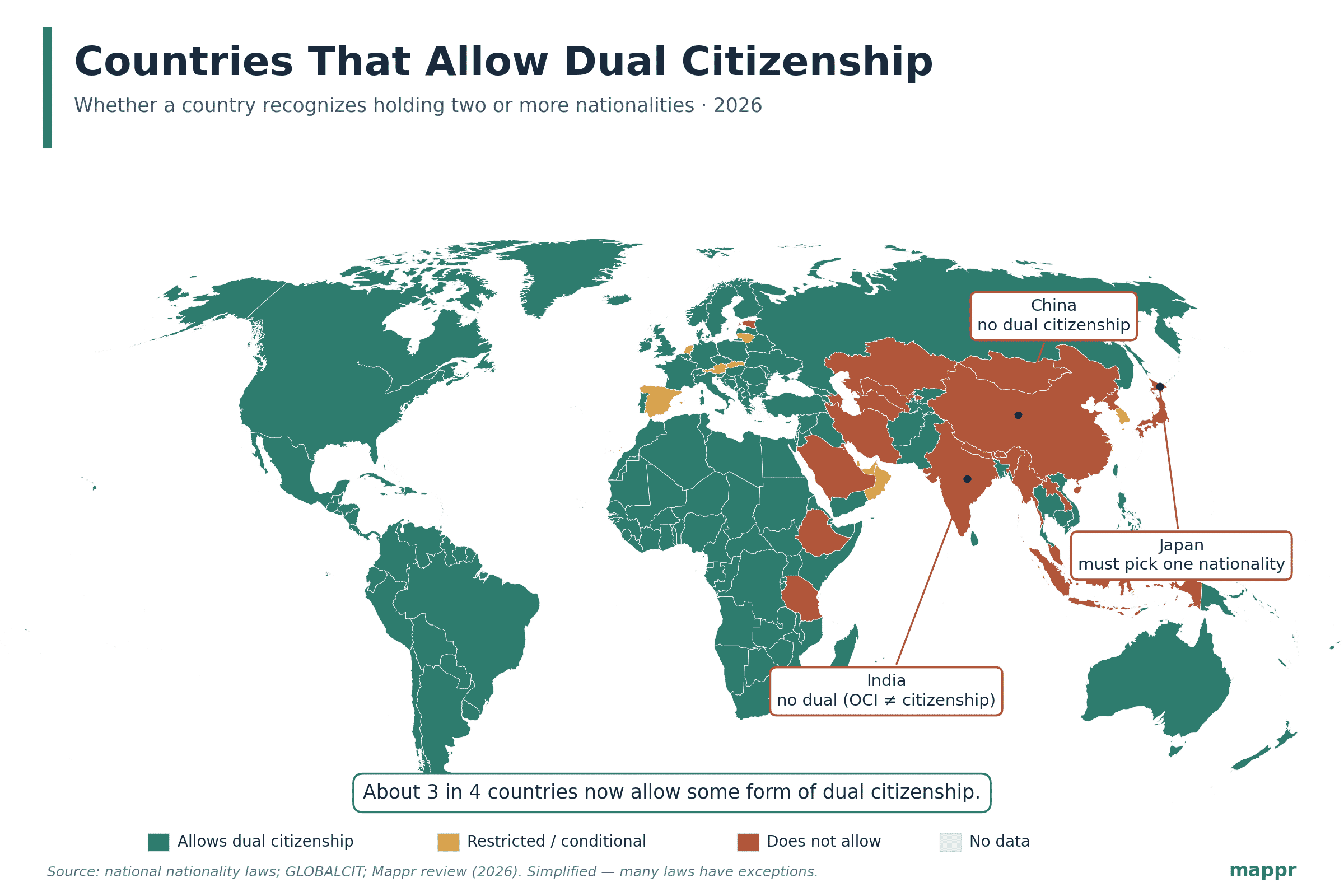
Prefer to explore it yourself? The interactive map below is colour-coded by status — click any country to see where it stands.
How Many Countries Allow Dual Citizenship?
Estimates converge on roughly 75% of the world’s countries permitting some form of dual (or multiple) citizenship — well over 140 of the 193 UN member states. That’s a dramatic shift from the 20th century, when most states treated a second passport as incompatible with loyalty to the first. The long-term trend is firmly toward acceptance: country after country has quietly dropped the rule that naturalizing elsewhere costs you your original nationality.
Where Dual Citizenship Is the Norm
The Western Hemisphere is almost entirely open. The United States, Canada and nearly every Latin American country — Mexico, Brazil, Argentina, Colombia and the rest — recognize dual citizenship without requiring you to renounce anything. The same is true across most of Europe, plus the United Kingdom, Ireland, Australia and New Zealand.
And the club keeps growing. Germany ended its restrictive regime with a sweeping reform that took effect in June 2024, now allowing multiple citizenship in principle. Norway began permitting it in 2020, and Ukraine moved to recognize multiple citizenship in 2025. Each abandoned a long-standing ban — a sign of how the global default has flipped.
Where It’s Restricted or Conditional
A middle group allows dual citizenship only under specific conditions. The Netherlands generally requires people who naturalize to give up their other nationality, with exceptions (such as marriage or where renunciation is impossible). Spain recognizes dual citizenship only with a set of treaty countries — mostly its former Latin American colonies, plus Portugal and a few others — and asks everyone else to renounce. South Korea permits it only for narrow groups, such as elderly returnees and the exceptionally talented. The United Arab Emirates opened a limited path in 2021 for select foreigners and Emiratis. Austria is stricter still: it generally bars dual citizenship and requires advance permission to keep Austrian nationality when naturalizing abroad — though citizenship held from birth, and recent exceptions such as descendants of victims of Nazi persecution, can create dual status.
Where Dual Citizenship Is Banned
The clearest holdouts are in Asia. China flatly does not recognize dual nationality for any of its citizens. India bans it too — its widely held Overseas Citizen of India (OCI) card is often mistaken for dual citizenship, but it’s a lifelong visa, not a nationality. Japan requires those who acquire another citizenship to choose one, and a Tokyo court upheld that rule in 2024. Singapore, Indonesia, Malaysia, Myanmar, Nepal and Bhutan are similarly restrictive.
The pattern extends across the Gulf and Central Asia — Saudi Arabia, Kuwait, Iran, Kazakhstan, Uzbekistan and Azerbaijan generally prohibit it — and a handful of European states remain strict — notably Estonia, which bars dual citizenship for adults who naturalize. Indonesia is studying a limited reform that could loosen its ban for people of “national interest.”
| Status | Countries (selected) |
|---|---|
| Does not allow | China, India, Japan, Singapore, Indonesia, Malaysia, Myanmar, Nepal, Bhutan, Brunei, Laos, Mongolia, North Korea, Kazakhstan, Uzbekistan, Turkmenistan, Azerbaijan, Saudi Arabia, Kuwait, Iran, Ethiopia, Tanzania, Estonia, Andorra |
| Restricted / conditional | Netherlands, Spain (treaty countries only), South Korea, Slovakia, Lithuania, Austria, UAE, Qatar, Bahrain, Oman |
| Allows | The U.S., Canada, the UK, Ireland, Australia, New Zealand, most of Europe and almost all of Latin America — about 140 countries in all |
Why Countries Are Loosening the Rules
The drift toward acceptance is driven by practicality. Large diasporas want to keep ties to home without giving up the passport of the country they live in; governments increasingly see dual citizens as a way to retain talent, investment and remittances rather than lose them. Germany framed its 2024 reform explicitly around integration and competing for skilled workers. The remaining bans tend to rest on older ideas of singular national loyalty — ideas that, country by country, are giving way.
Dual-citizenship law is nuanced and frequently reformed; this map and article reflect national nationality laws and reputable summaries as of 2026, and simplify cases that carry exceptions.