Key Takeaways
- About a dozen countries restrict Telegram. Roughly 11 governments currently block, ban or restrict the app — from long-standing bans in China and Iran to a wave of new ones in 2025–2026.
- Russia is back on the list. After lifting its 2018–2020 ban, Russia began re-blocking Telegram in 2026 under a sweeping crackdown on foreign-owned apps.
- India's temporary nationwide block. India restricted Telegram across the country until 22 June 2026, citing fraudulent ads and an exam-leak investigation.
- Why governments target it. Encryption, massive public channels and Telegram's history of refusing data requests make it a tool for both protest and crime — and a magnet for censors.
- The Durov effect. Founder Pavel Durov's 2024 arrest in France pushed Telegram to cooperate more with law enforcement — but the bans have kept coming.
With around a billion monthly users, Telegram is one of the world’s most popular messaging apps — and one of the most frequently blocked. Its encryption, sprawling public channels and long resistance to government data requests make it invaluable to activists and journalists, and a headache for censors. The result: a growing list of countries where Telegram is banned, blocked or restricted.
As of 2026, roughly a dozen governments restrict the app. Some bans are permanent fixtures, others flare up around protests or elections, and a few are brand new — including a fresh crackdown in Russia and a temporary nationwide block in India. The map below shows where Telegram is off-limits.
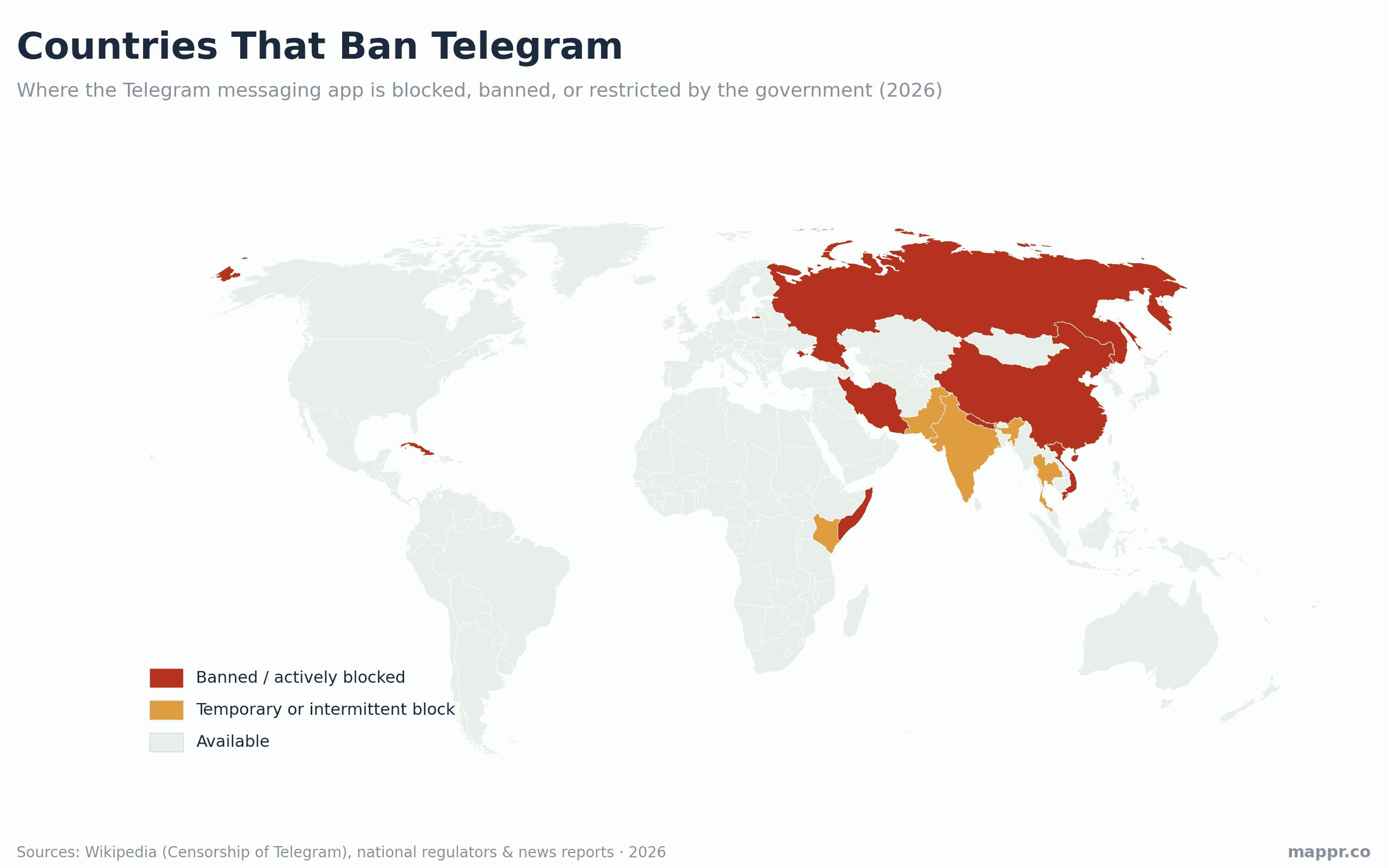
Here is the country-by-country picture.
| Country | Status | Since | Reason |
|---|---|---|---|
| 🇨🇳 China | Banned | 2015 | Blocked behind the Great Firewall as a censorship-evasion tool |
| 🇮🇷 Iran | Banned | 2018 | Blocked after Telegram refused state access during protests |
| 🇷🇺 Russia | Blocking again | 2026 | Re-blocking under a new crackdown on foreign apps (after a 2018–20 ban it had lifted) |
| 🇻🇳 Vietnam | Banned | 2025 | Ordered ISPs to block it, citing ‘malicious’ channels and non-compliance |
| 🇨🇺 Cuba | Banned | 2021 | Blocked during anti-government protests |
| 🇸🇴 Somalia | Banned | 2023 | Banned over alleged use by militant groups |
| 🇳🇵 Nepal | Banned | 2025 | Banned citing online fraud and money-laundering |
| 🇮🇳 India | Temporary block | 2026 | Restricted nationwide until 22 June 2026 over fraud ads and an exam-leak probe |
| 🇵🇰 Pakistan | Intermittent | 2017– | Periodically blocked over content and compliance disputes |
| 🇹🇭 Thailand | Intermittent | 2020 | Blocked during anti-government protests as a coordination tool |
| 🇰🇪 Kenya | Intermittent | 2024– | Blocked during national exams and periods of unrest |
Where Telegram Is Banned
The longest-standing bans are in China, where Telegram has been blocked behind the Great Firewall since 2015, and Iran, which blocked it in 2018 after the app was used to organise protests. Both treat encrypted messaging as a direct threat to information control. More recently, Vietnam ordered providers to block Telegram in 2025, Nepal banned it the same year over fraud concerns, and Somalia blocked it in 2023, citing use by militant groups. Cuba has restricted it since the 2021 anti-government protests.
Russia’s 2026 U-Turn
Russia is the highest-profile addition. It first tried to ban Telegram in 2018 when the company refused to hand over encryption keys — a chaotic, ultimately failed effort that it abandoned in 2020. But in 2026, under a sweeping new push to control foreign-owned apps (and a law requiring services to store user messages for years), Russian regulator Roskomnadzor began throttling and re-blocking Telegram. It is a striking reversal in a country where the app became deeply embedded in daily life and wartime communication.
Temporary and Intermittent Blocks
Not every block is permanent. India imposed a temporary nationwide restriction running until 22 June 2026, tied to fraudulent advertising and an exam-leak investigation. Pakistan has blocked Telegram on and off since 2017 over content-moderation disputes. Thailand moved against it during the 2020 protests, and Kenya has repeatedly blocked it during national exams and periods of unrest — a reminder that many ‘bans’ are really short-term switches flipped during sensitive moments.
Why Governments Ban Telegram
Three features make Telegram a recurring target. First, encryption and privacy: governments can’t easily monitor conversations. Second, broadcast channels: a single Telegram channel can reach millions instantly, making it powerful for organising protests — and for spreading scams, extremist content and disinformation. Third, Telegram’s historic refusal to cooperate with data requests. That last point shifted after founder Pavel Durov was arrested in France in August 2024 and the company began cooperating more with law enforcement — but for many governments, blocking the app outright remains the simpler tool.
The Bottom Line
Telegram is legal and freely available across most of the world, including all of the Americas (bar Cuba), Europe and most of Africa. But in a cluster of authoritarian and crisis-hit states — and, increasingly, in democracies reaching for emergency controls — it is blocked. As the 2026 cases of Russia and India show, the list is not shrinking. It is growing.
Telegram blocking status compiled from Wikipedia's 'Censorship of Telegram', national telecom regulators and contemporary news reporting. Bans change frequently — several are intermittent or tied to specific events.
Primary Sources:
- Wikipedia — Censorship of Telegram – Country-by-country blocking history and current status.
- Reuters / AP — Russia & India Telegram restrictions (2026) – Reporting on Russia's 2026 re-block and India's temporary nationwide restriction.
Image Sources:
- Map by Mappr – World map of Telegram blocking status created by Mappr.