
The United States is the third most populous country in the world, with a 2025 population estimate of about 341,784,857 (U.S. Census Bureau). China and India each have far greater populations that exceed one billion, and Indonesia is the next most populous country after the US.
Most of the population in the USA lives near the coast, and the country has a relatively low population density of about 37 people per square kilometer (96 per square mile). Some states are far more populated than others, and we’ll look at the states with the highest populations here, using the Census Bureau’s latest Vintage 2025 estimates (July 1, 2025).
USA Interactive Population Map
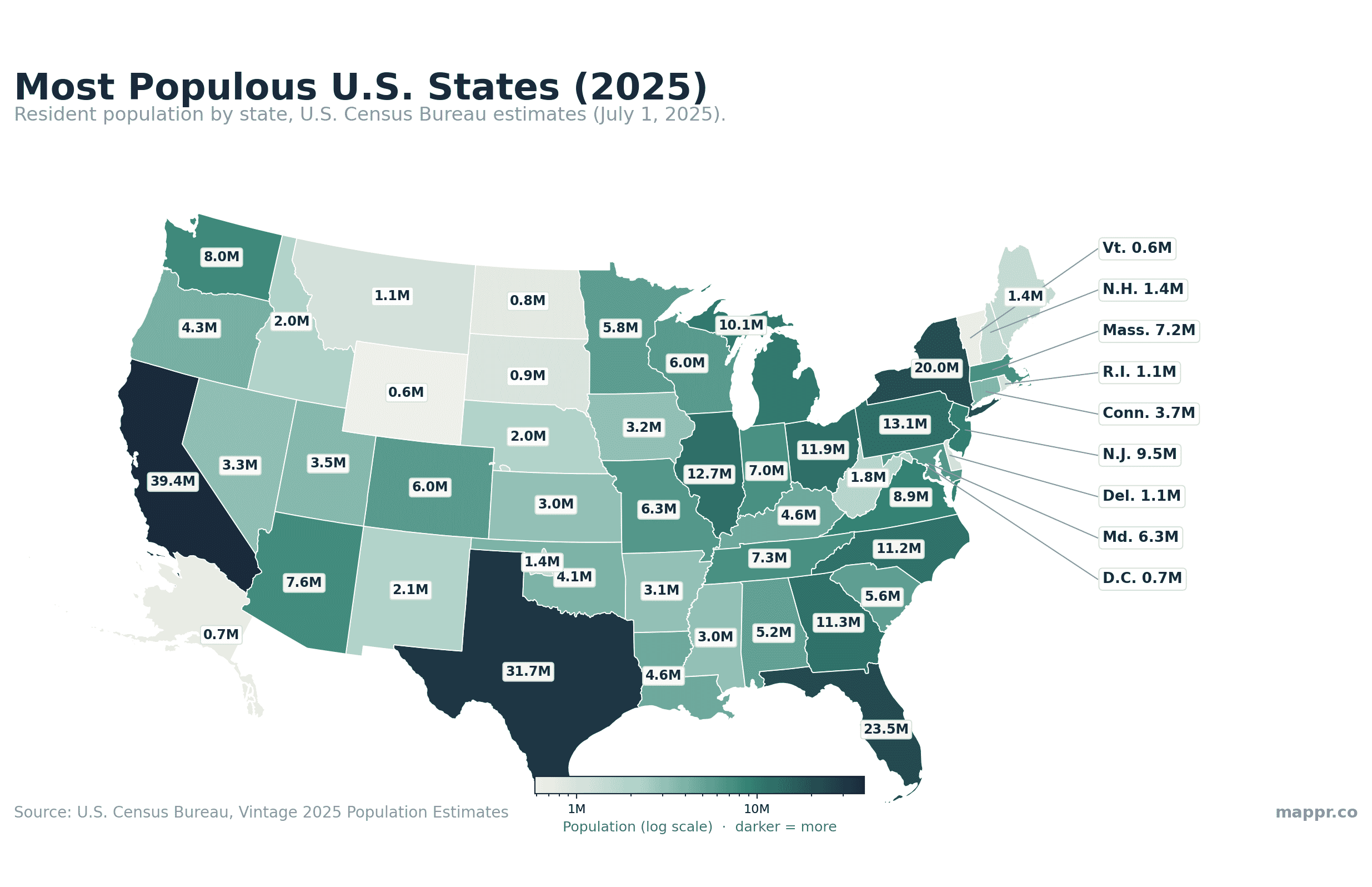
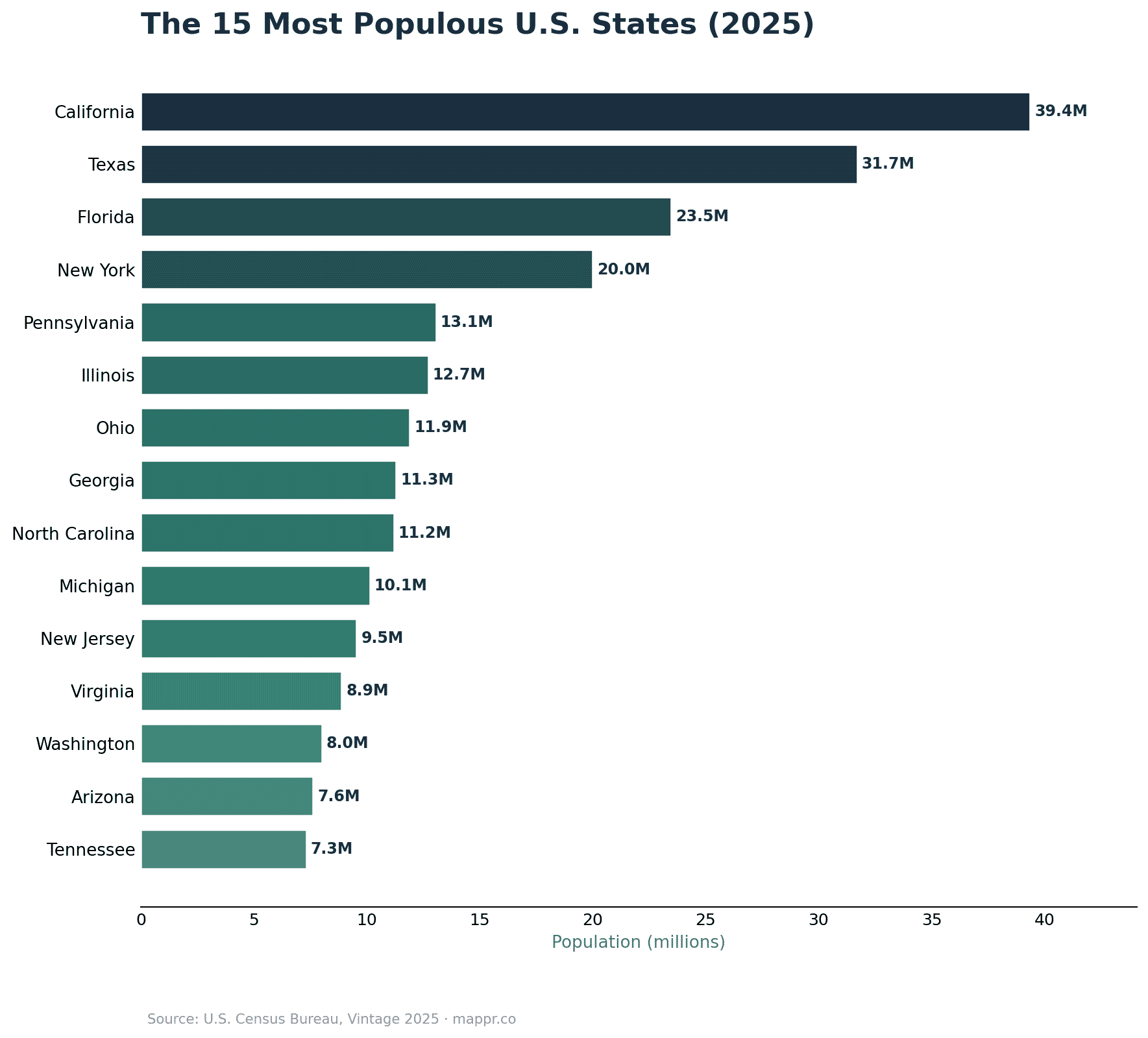
Below are the top 10 most populous states in the USA (2025):
- California
- Texas
- Florida
- New York
- Pennsylvania
- Illinois
- Ohio
- Georgia
- North Carolina
- Michigan
See the full list with population numbers.
Most Populous States of the US
California
With more than 7.6 million people separating it from second place, California is the most populous state in the USA and has held that distinction since 1962. Its population of about 39,355,309 (2025) is now essentially flat, having edged down very slightly over the past year, but it remains the clear number one. It is also the third-largest state by area and accepts more immigrants than any other.
Located in the Western United States, California owes its large population to decades of high immigration, drawn by the state’s climate, job market, universities, and access to both the ocean and the mountains.
Texas
Texas is the second most populous state, with a population of about 31.7 million as of 2025, and it remains the country’s fastest-growing large state (up about 1.3% in the past year). It is also the second-largest state by area, behind only Alaska, and is bigger than any European country.
Despite ranking second in total population, Texas doesn’t crack the top 25 states for population density thanks to its vast size, at roughly 108 people per square mile.
Florida
The third most populous state is Florida, with a population of about 23,462,518 (2025), tucked into the far southeastern corner of the contiguous United States. It continues to grow steadily, drawing retirees and new residents alike.
Like California, Florida is known for sunny weather and beaches, which help make it a popular retirement destination. Comparatively lower taxes and, historically, more affordable housing have also attracted permanent residents, though the state also faces hurricanes and rising insurance costs.
New York
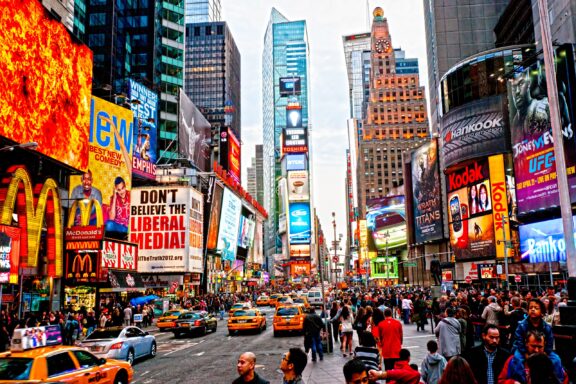
New York is one of the most internationally recognizable states in the US, and it’s the fourth most populous. The state is home to the Statue of Liberty and has one of the highest numbers of foreign-born residents in the country.
While it isn’t the most populous state, New York City is by far the most populous US city, with around 8.5 million residents. The next largest US city, Los Angeles, has close to 4 million.
The state of New York has a population of 20,002,427 (2025), edging back above 20 million after losing residents earlier in the decade. More than 18 million people live in the wider New York City metropolitan area, one of the most populous urban regions in the world.
Pennsylvania
The fifth most populous state is Pennsylvania, in the Northeastern United States, sharing borders with six other states. Of the roughly 13,059,432 people living there, the largest city is Philadelphia.
Typical of the region, Pennsylvania is relatively small by area and densely populated. Its capital is Harrisburg, and it was one of the original 13 states, where the Declaration of Independence and Constitution were signed.
Illinois
Its population of about 12,719,141 (2025) makes Illinois the sixth most populous state. The largest city is Chicago, with roughly 2.7 million residents, and most of the state’s population is concentrated in the northeast around the city.
Ohio
With around a million fewer people than Illinois, Ohio is the seventh most populous state, with a population of about 11,900,510 (2025). It borders Lake Erie to the north, and its largest city is also its capital, Columbus.
Ohio has had slow population growth over the past decade but remains one of the more densely populated states in the country.
Georgia
With a population of about 11,302,748 (2025), Georgia is the eighth most populous state. It was one of the original thirteen states, and Atlanta is its capital and largest city, with the Atlanta metro area accounting for more than half of the state’s residents.
Georgia is one of the faster-growing states in the Southeast, though its lead over ninth-place North Carolina has narrowed to around 100,000 people.
North Carolina
North Carolina is the ninth most populous state, with about 11,197,968 people (2025), and it is one of the fastest-growing states in the entire country, up roughly 1.3% in the past year. On current trends it is closing in on Georgia for the number-eight spot.
Long a mostly rural state, North Carolina has urbanized rapidly. Most residents now live in urban or suburban areas, and its largest city is Charlotte, a major banking hub.
Michigan
Rounding out the top ten is Michigan, with a population of about 10,127,884 (2025). The state is defined by the Great Lakes that surround it and by Detroit, its largest city, long associated with the American auto industry. The capital is Lansing.
Michigan has one of the slower-growing populations in the country, though its growth has ticked back up modestly as the wider Great Lakes economy has stabilized.
Below is the full list of all US states and their estimated populations in 2025:
| State | Population (2025) |
|---|---|
| California | 39,355,309 |
| Texas | 31,709,821 |
| Florida | 23,462,518 |
| New York | 20,002,427 |
| Pennsylvania | 13,059,432 |
| Illinois | 12,719,141 |
| Ohio | 11,900,510 |
| Georgia | 11,302,748 |
| North Carolina | 11,197,968 |
| Michigan | 10,127,884 |
| New Jersey | 9,548,215 |
| Virginia | 8,880,107 |
| Washington | 8,001,020 |
| Arizona | 7,623,818 |
| Tennessee | 7,315,076 |
| Massachusetts | 7,154,084 |
| Indiana | 6,973,333 |
| Missouri | 6,270,541 |
| Maryland | 6,265,347 |
| Colorado | 6,012,561 |
| Wisconsin | 5,972,787 |
| Minnesota | 5,830,405 |
| South Carolina | 5,570,274 |
| Alabama | 5,193,088 |
| Louisiana | 4,618,189 |
| Kentucky | 4,606,864 |
| Oregon | 4,273,586 |
| Oklahoma | 4,123,288 |
| Connecticut | 3,688,496 |
| Utah | 3,538,904 |
| Nevada | 3,282,188 |
| Iowa | 3,238,387 |
| Arkansas | 3,114,791 |
| Kansas | 2,977,220 |
| Mississippi | 2,954,160 |
| New Mexico | 2,125,498 |
| Idaho | 2,029,733 |
| Nebraska | 2,018,006 |
| West Virginia | 1,766,147 |
| Hawaii | 1,432,820 |
| New Hampshire | 1,415,342 |
| Maine | 1,414,874 |
| Montana | 1,144,694 |
| Rhode Island | 1,114,521 |
| Delaware | 1,059,952 |
| South Dakota | 935,094 |
| North Dakota | 799,358 |
| Alaska | 737,270 |
| District of Columbia | 693,645 |
| Vermont | 644,663 |
| Wyoming | 588,753 |
US Population Growth
US population growth has swung sharply in recent years. The nation grew about 1.0% in 2024, its fastest rate since 2001, but that pace roughly halved to 0.5% in the year to July 2025 (an increase of about 1.78 million people). The Census Bureau attributes the slowdown to a historic decline in net international migration, which had been the main driver of the earlier surge.
Population growth is shaped by three forces: births, deaths and migration. With births only modestly outpacing deaths nationally, migration now makes the difference between fast and slow growth. The fastest-growing states in 2025 were South Carolina (+1.5%), Idaho (+1.4%), North Carolina (+1.3%), Texas (+1.2%) and Utah (+1.0%); only five states lost population, led by Vermont, Hawaii and West Virginia.
Refugee Admissions
The United States has historically been one of the world’s largest refugee-resettlement countries, but the program has changed dramatically. In January 2025, an executive order indefinitely suspended the US Refugee Admissions Program, halting most new arrivals. Litigation has kept a narrow channel open for refugees who had already been approved and cleared for travel, but general processing remains paused as the cases work through the courts.
The numbers reflect the shift. The US admitted roughly 11,500 refugees in fiscal year 2025, down about 89% from the previous year’s total of just over 100,000, which had been a three-decade high. The ceiling for fiscal year 2026 was set at 7,500, the lowest in the program’s 45-year history. Historically, a handful of states, led by Texas, California and New York, resettle a large share of arrivals, but on today’s much smaller totals those state differences are modest.
Immigration
Immigration remains central to the US population story. As of 2024, about 15.8% of US residents were born in another country, a record high of roughly 53 million people, up from 13.5% in 2020. The foreign-born share is highest in California (about 28%), followed by New Jersey (25%), New York and Florida (about 23% each) and Nevada (20%).
California, Texas, Florida and New York remain the main destinations for new immigrants, and a large share of arrivals in any given year join relatives already living in the country. The recent national slowdown in growth, however, shows how quickly shifts in migration policy can ripple through state populations.
Birth Rate by State
Immigration drives much of the difference between states, but births versus deaths still shape long-run growth. The national crude birth rate was about 10.7 births per 1,000 people in 2024. Here are the ten states with the highest birth rates (births per 1,000 population, 2024):
- Utah 13.3
- Texas 12.5
- Nebraska 12.4
- South Dakota 12.4
- North Dakota 12.1
- Alaska 12.1
- Oklahoma 11.7
- Idaho 11.6
- Indiana 11.6
- Tennessee 11.6


All original maps and graphics on this page are © Mappr, free to use under a Creative Commons Attribution–ShareAlike licence (CC BY-SA): use them anywhere, including commercially, as long as you credit Mappr with a link back to Mappr.co. Exception: maps credited to third-party cartographers (for example © Rainer Lesniewski/Shutterstock, noted in the caption) are licensed for display on Mappr only and are not covered by this licence — they may not be downloaded or reused.
- Bustling Times Square with Crowds and Billboards — © Luciano Mortula/Shutterstock