
Key Facts: The Euro in Germany
- Currency: Euro (EUR, €). In use since 1 January 1999 (accounting) / 1 January 2002 (cash). Replaced the Deutsche Mark at 1.95583 DM = 1 EUR.
- Central banks: Deutsche Bundesbank (nat.) + European Central Bank (policy). Bundesbank president Joachim Nagel (since Jan 2022) sits on the ECB Governing Council. ECB in Frankfurt, under Christine Lagarde (since 2019), sets Eurozone monetary policy.
- ECB deposit facility rate: 2.00%. Held since February 2026 after a cutting cycle through 2024–2025. Inflation forecast 2.6% for 2026, returning toward the 2% target by 2027.
- 1 EUR ≈ 1.1755 USD. Latest daily close. The euro has drifted up roughly 2% against the US dollar over the past 12 months, supported by a narrowing ECB-Fed rate differential.
- 20 countries share the euro. Germany is one of 20 Eurozone members, alongside Austria, Belgium, Croatia (since 2023), Cyprus, Estonia, Finland, France, Greece, Ireland, Italy, Latvia, Lithuania, Luxembourg, Malta, the Netherlands, Portugal, Slovakia, Slovenia, and Spain.
What Is the Currency of Germany?
Germany’s currency is the euro (symbol €, ISO 4217 code EUR). The euro replaced the Deutsche Mark (DM) on 1 January 2002, when euro banknotes and coins entered circulation — although the euro had existed as an accounting currency since 1 January 1999. Germany was a founding member of the single-currency area.
Monetary policy for Germany is set not domestically but by the European Central Bank in Frankfurt, on behalf of all 20 Eurozone members. Germany’s own national central bank, the Deutsche Bundesbank, implements that policy and represents Germany on the ECB Governing Council through its president, Joachim Nagel (since January 2022). The Bundesbank retains key roles in banking supervision, cash handling, and statistical reporting.
Euro to US Dollar — 1-Year Chart
The chart below tracks the daily close of the euro against the US dollar over the past 12 months. The euro is the world’s second-most-traded reserve currency and the second-largest FX pair by volume after USD-JPY. Major drivers: the ECB-Fed policy-rate differential, Eurozone growth relative to the US, and risk-on/risk-off capital flows. Data refreshes nightly.
Line chart. Daily close, USD per 1 EUR · Source: Yahoo Finance · Updated nightly. Data table with 2 rows and 132 columns follows.
| Oct 21 | Oct 23 | Oct 28 | Oct 30 | Nov 03 | Nov 05 | Nov 07 | Nov 11 | Nov 13 | Nov 17 | Nov 19 | Nov 21 | Nov 25 | Nov 27 | Dec 01 | Dec 03 | Dec 05 | Dec 09 | Dec 11 | Dec 15 | Dec 17 | Dec 19 | Dec 23 | Dec 26 | Dec 30 | Jan 02 | Jan 06 | Jan 08 | Jan 12 | Jan 14 | Jan 16 | Jan 20 | Jan 22 | Jan 26 | Jan 28 | Jan 30 | Feb 03 | Feb 05 | Feb 09 | Feb 11 | Feb 13 | Feb 17 | Feb 19 | Feb 23 | Feb 25 | Feb 27 | Mar 03 | Mar 05 | Mar 09 | Mar 11 | Mar 13 | Mar 17 | Mar 19 | Mar 23 | Mar 25 | Mar 27 | Mar 30 | Apr 01 | Apr 05 | Apr 07 | Apr 09 | Apr 13 | Apr 15 | Apr 19 | Apr 21 | Apr 23 | Apr 27 | Apr 29 | May 03 | May 05 | May 07 | May 11 | May 13 | May 17 | May 19 | May 21 | May 25 | May 27 | May 31 | Jun 02 | Jun 04 | Jun 08 | Jun 10 | Jun 14 | Jun 16 | Jun 18 | Jun 22 | Jun 24 | Jun 28 | Jun 30 | Jul 02 | Jul 06 | Jul 08 | Jul 12 | Jul 14 | Jul 16 | Jul 20 | Jul 22 | Jul 26 | Jul 28 | Jul 30 | Aug 03 | Aug 05 | Aug 09 | Aug 11 | Aug 13 | Aug 17 | Aug 19 | Aug 23 | Aug 25 | Aug 27 | Aug 31 | Sep 02 | Sep 06 | Sep 08 | Sep 10 | Sep 14 | Sep 16 | Sep 20 | Sep 22 | Sep 24 | Sep 28 | Sep 30 | Oct 04 | Oct 06 | Oct 08 | Oct 12 | Oct 14 | Oct 18 | Oct 20 | Oct 22 | |
|---|---|---|---|---|---|---|---|---|---|---|---|---|---|---|---|---|---|---|---|---|---|---|---|---|---|---|---|---|---|---|---|---|---|---|---|---|---|---|---|---|---|---|---|---|---|---|---|---|---|---|---|---|---|---|---|---|---|---|---|---|---|---|---|---|---|---|---|---|---|---|---|---|---|---|---|---|---|---|---|---|---|---|---|---|---|---|---|---|---|---|---|---|---|---|---|---|---|---|---|---|---|---|---|---|---|---|---|---|---|---|---|---|---|---|---|---|---|---|---|---|---|---|---|---|---|---|---|---|---|---|---|
| USD per EUR | 1.16 | 1.16 | 1.17 | 1.16 | 1.15 | 1.15 | 1.15 | 1.16 | 1.16 | 1.16 | 1.16 | 1.15 | 1.15 | 1.16 | 1.16 | 1.16 | 1.16 | 1.16 | 1.17 | 1.17 | 1.17 | 1.17 | 1.18 | 1.18 | 1.18 | 1.18 | 1.17 | 1.17 | 1.16 | 1.16 | 1.16 | 1.16 | 1.17 | 1.19 | 1.2 | 1.2 | 1.18 | 1.18 | 1.18 | 1.19 | 1.19 | 1.18 | 1.18 | 1.18 | 1.18 | 1.18 | 1.17 | 1.16 | 1.15 | 1.16 | 1.15 | 1.15 | 1.15 | 1.16 | 1.16 | 1.15 | 1.15 | 1.16 | 1.15 | 1.17 | 1.17 | 1.18 | 1.18 | 1.17 | 1.17 | 1.17 | 1.17 | 1.17 | 1.17 | 1.17 | 1.17 | 1.18 | 1.17 | 1.16 | 1.16 | 1.16 | 1.16 | 1.16 | 1.16 | 1.16 | 1.16 | 1.15 | 1.15 | 1.16 | 1.16 | 1.15 | 1.14 | 1.14 | 1.14 | 1.14 | 1.14 | 1.14 | 1.14 | 1.14 | 1.14 | 1.14 | 1.14 | 1.14 | 1.14 | 1.14 | 1.15 | 1.15 | 1.16 | 1.16 | 1.15 | 1.15 | 1.16 | 1.17 | 1.17 | 1.17 | 1.17 | 1.16 | 1.16 | 1.16 | 1.16 | 1.16 | 1.15 | 1.15 | 1.15 | 1.14 | 1.14 | 1.14 | 1.13 | 1.13 | 1.13 | 1.12 | 1.12 | 1.12 | 1.12 | 1.12 | 1.13 |
Over the past year the euro has traded in a tight range between about 1.10 and 1.18 USD. The pair ended at roughly 1.18 USD at the latest close, roughly 2% stronger year-on-year. The narrowing gap between ECB and Fed policy rates — ECB at 2.00% vs Fed at 4.25% — has been the dominant factor since late 2025.
Euro Banknotes and German Coins
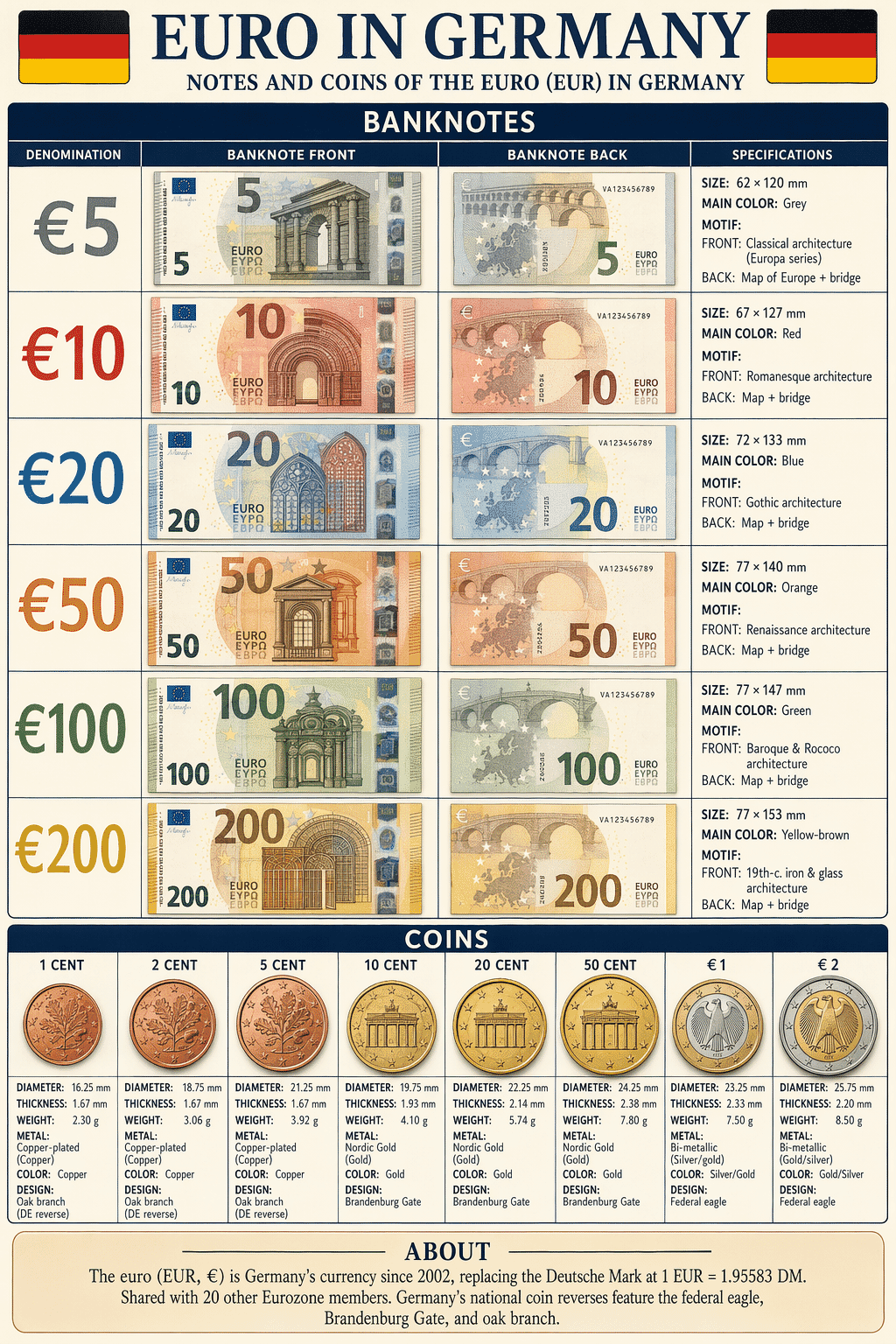
All 20 Eurozone countries share the same euro banknotes — there are no national variants. The current “Europa” series, rolled out in denominations between 2013 and 2019, features architectural motifs from seven eras of European history and improved security features over the earlier 2002 series. The €500 note was withdrawn from issue in 2019 but remains legal tender.
| Denomination | Motif | Introduced | Colour |
|---|---|---|---|
| €5 Europa | Classical architecture | Introduced 2013 | Grey |
| €10 Europa | Romanesque architecture | Introduced 2014 | Red |
| €20 Europa | Gothic architecture | Introduced 2015 | Blue |
| €50 Europa | Renaissance architecture | Introduced 2017 | Orange |
| €100 Europa | Baroque & Rococo architecture | Introduced 2019 | Green |
| €200 Europa | 19th-century iron & glass architecture | Introduced 2019 | Yellow-brown |
Euro coins have a common European obverse (the denomination + a map of Europe) but a national reverse specific to each Eurosystem member. German coins show three motifs: an oak branch on the 1c, 2c, and 5c coins; the Brandenburg Gate on the 10c, 20c, and 50c; and the Bundesadler (federal eagle) on the €1 and €2 coins. All German national reverses are surrounded by the 12 European stars.
| Denomination | German National Reverse | Minted |
|---|---|---|
| 1c, 2c, 5c | Copper-plated steel — common Eurosystem obverse, national reverse: oak branch, Brandenburg Gate, federal eagle (variants) | Since 2002 |
| 10c, 20c, 50c | Nordic gold — national reverse: Brandenburg Gate | Since 2002 |
| €1, €2 | Bi-metallic — national reverse: the Bundesadler (federal eagle), ringed by the European stars | Since 2002 |
A Short History of German Currency
Germany’s currency history mirrors the country’s political history: imperial unification in 1871 produced the gold Mark; two world wars destroyed that currency and its successors; the 1948 Deutsche Mark reform relaunched West Germany’s economy; and 2002 saw Germany abandon the DM for the euro. The Bundesbank, founded 1957, became the anchor of post-war European monetary stability and a model for the ECB.
| Year | Event |
|---|---|
| 1871–1914 | German mark (Goldmark), introduced after unification, on the gold standard. |
| 1914–1923 | Papiermark collapses; hyperinflation peaks at 1 USD = 4.2 trillion marks in Nov 1923. |
| 1924 | Rentenmark, then Reichsmark, restore stability. |
| 1948 | Deutsche Mark (DM) introduced in the three western occupation zones on 20 June — the ‘Währungsreform’ that launches the Wirtschaftswunder. |
| 1949 | East Germany issues its own Mark der DDR. |
| 1957 | Deutsche Bundesbank established; independence enshrined in the Bundesbank Act. |
| 1990 | Currency union: 1 DDR-Mark = 1 DM for wages and small savings following reunification. |
| 1999 | Euro introduced as accounting currency; EUR/DM fixed at 1.95583. |
| 2002 | Euro notes and coins enter circulation on 1 January; DM remains exchangeable at the Bundesbank indefinitely. |
| 2013–2019 | ECB rolls out the ‘Europa’ banknote series with enhanced security features. |
| 2022 | Joachim Nagel becomes Bundesbank President (January), replacing Jens Weidmann. |
| 2023–2024 | ECB hikes deposit rate to 4.00% to fight post-pandemic inflation. |
| 2025–2026 | ECB cuts to 2.00%; held at that level through Q1 2026 after energy-shock re-acceleration. |
The German Economy and the Euro
Germany is the largest economy in the European Union and the third-largest globally by nominal GDP. The euro’s behaviour is inseparable from German economic performance: Germany accounts for roughly 25% of Eurozone GDP, and German manufacturing export strength is historically a key anchor of euro credibility. The 2025 export mix centred on motor vehicles, machinery, chemicals, and pharmaceuticals.
On the monetary side, the ECB runs a single-target inflation regime at 2% over the medium term. After hiking the deposit facility rate to 4.00% in 2023–2024 to fight post-pandemic inflation, the ECB has cut through 2025 and held at 2.00% since February 2026. The April 2026 meeting held rates steady amid renewed uncertainty from Middle East energy shocks; headline inflation is forecast at 2.6% in 2026 before falling toward target in 2027. Germany’s own inflation typically runs slightly below the Eurozone average.
Using Euros in Germany
Cash usage in Germany remains higher than in most Western European peers: roughly 50% of point-of-sale transactions are still in cash (vs under 15% in the Netherlands or Nordics), although the share has fallen sharply since 2020. Cards — girocard (the domestic debit scheme), Visa, and Mastercard — are accepted in supermarkets, department stores, hotels, petrol stations, and most restaurants, but small Imbiss stands, bakeries outside city centres, some taxis, and flea markets are still cash-only.
Typical prices in Germany (2026): espresso at a bakery €2.00–€2.80; Mittagsmenü (lunch special) €10–€14; döner kebab €7–€9; a single Berlin S-Bahn ticket €3.80; a mid-range hotel room in Berlin or Munich €120–€220. ATMs (Geldautomaten) are widespread — Deutsche Bank, Commerzbank, Postbank, and Sparkasse operate the largest networks; out-of-network ATMs charge €3.50–€5.50 per withdrawal.
The Euro Among Major European Currencies
Germany’s closest peers in the European FX landscape are its fellow Eurosystem members, plus the three largest non-euro European economies — the UK, Switzerland, and Poland. Each non-euro regime manages inflation independently via its own central bank.
| Country | Code | Regime | Inflation | Policy rate |
|---|---|---|---|---|
| 🇩🇪 Germany | EUR | Eurosystem (free float) | 2.6% (ECB 2026f) | 2.00% |
| 🇫🇷 France | EUR | Eurosystem (free float) | 2.4% | 2.00% |
| 🇮🇹 Italy | EUR | Eurosystem (free float) | 2.5% | 2.00% |
| 🇳🇱 Netherlands | EUR | Eurosystem (free float) | 2.8% | 2.00% |
| 🇬🇧 United Kingdom | GBP | Free float (BoE inflation target) | 2.6% | 4.50% |
| 🇨🇭 Switzerland | CHF | Free float (managed) | 1.1% | 0.25% |
| 🇵🇱 Poland | PLN | Free float (NBP inflation target) | 4.2% | 5.75% |
Frequently Asked Questions
What is the currency of Germany?
Germany uses the euro (€, ISO 4217 code EUR). It has been Germany’s currency since 1 January 1999 for accounting purposes and since 1 January 2002 in physical banknote and coin form. The euro replaced the Deutsche Mark (DM), which had been West Germany’s — then reunified Germany’s — currency from 1948.
Is the Deutsche Mark still legal tender?
No. The Deutsche Mark lost legal-tender status on 1 January 2002 when euro banknotes and coins were introduced. However, the Deutsche Bundesbank still exchanges DM at any of its branches, indefinitely, at the fixed rate of 1.95583 DM = 1 EUR. By the end of 2024, roughly 12.3 billion DM was still unredeemed.
Who manages monetary policy for Germany?
The European Central Bank (ECB) in Frankfurt sets monetary policy for the 20 Eurozone countries, including Germany. The Deutsche Bundesbank, Germany’s national central bank, implements ECB policy domestically and is represented on the ECB Governing Council by its president, currently Joachim Nagel (since January 2022). ECB policy is set under President Christine Lagarde (since November 2019).
What is the current ECB interest rate?
The ECB deposit facility rate is 2.00% as of April 2026, held steady since February 2026 after a series of cuts through 2024 and 2025. The main refinancing operations rate is 2.15% and the marginal lending facility rate is 2.40%. The ECB’s inflation target is 2% over the medium term.
Does Germany still have its own currency in reserve?
No. Germany has no national currency in circulation alongside the euro. The Bundesbank holds foreign-exchange reserves (principally US dollars and gold) on behalf of the German state, but domestically only the euro is used.
How many euros is one Deutsche Mark worth today?
The fixed conversion rate established in 1999 remains legally valid at the Bundesbank’s exchange counters: 1.95583 DM = 1 EUR, or equivalently 1 DM ≈ €0.51. Commercial banks no longer handle this conversion.
Who are on the current euro banknotes?
The current ‘Europa’ banknote series (2013–2019) features architectural motifs from seven eras of European architectural history rather than any person: classical, Romanesque, Gothic, Renaissance, Baroque & Rococo, 19th-century iron & glass, and modern 20th-century architecture (the last on the withdrawn €500 note). A portrait of Europa — the mythological figure — appears in the watermark.
All data reflects the latest releases from the ECB, the Deutsche Bundesbank, and Eurosystem publications. Current to April 2026 ECB meeting.
