Key Takeaways
- Singapore — 192 destinations. Leads alone for a third year running, the strongest passport in the world.
- Japan, South Korea and the UAE — 188, tied for 2nd. A three-way tie at the top of the runners-up — two East Asian powerhouses joined by the Gulf's fastest-climbing passport.
- UAE — biggest climber of the past 20 years. Up 153 destinations since 2006, now tied with Japan and South Korea at 2nd, the biggest improvement any passport has made in the index's 20-year history.
- United States — joint 10th at 179. Back in the top 10 after briefly dropping out in late 2025, now tied with Iceland.
- Afghanistan — last at 22. The 170-destination gap between the strongest and weakest passports is the widest on record.
Not all passports are created equal. A Singaporean can hop on a plane to 192 countries with nothing more than a stamp at the border — an Afghan citizen can do the same for just 22. That 170-destination gap is the widest ever recorded by the Henley Passport Index, the authoritative ranking of global mobility compiled quarterly from IATA’s Timatic database.
The July 2026 edition, which marks the index’s 20th anniversary, crowns Singapore alone at the top, with Japan, South Korea, and the UAE tied a step behind at 188 destinations, and a large European bloc cementing the upper tier. But the real story of the past two decades isn’t at the top, it is the dramatic climb of the United Arab Emirates, which rose from the middle of the rankings all the way to a tie for 2nd place, the biggest improvement any passport has ever recorded. Meanwhile, the United States, ranked first when the index launched in 2006, has slipped to tenth and is now one of the few top passports whose citizens still need a visa for China, a reminder that passport power is a matter of reciprocity, not just wealth.
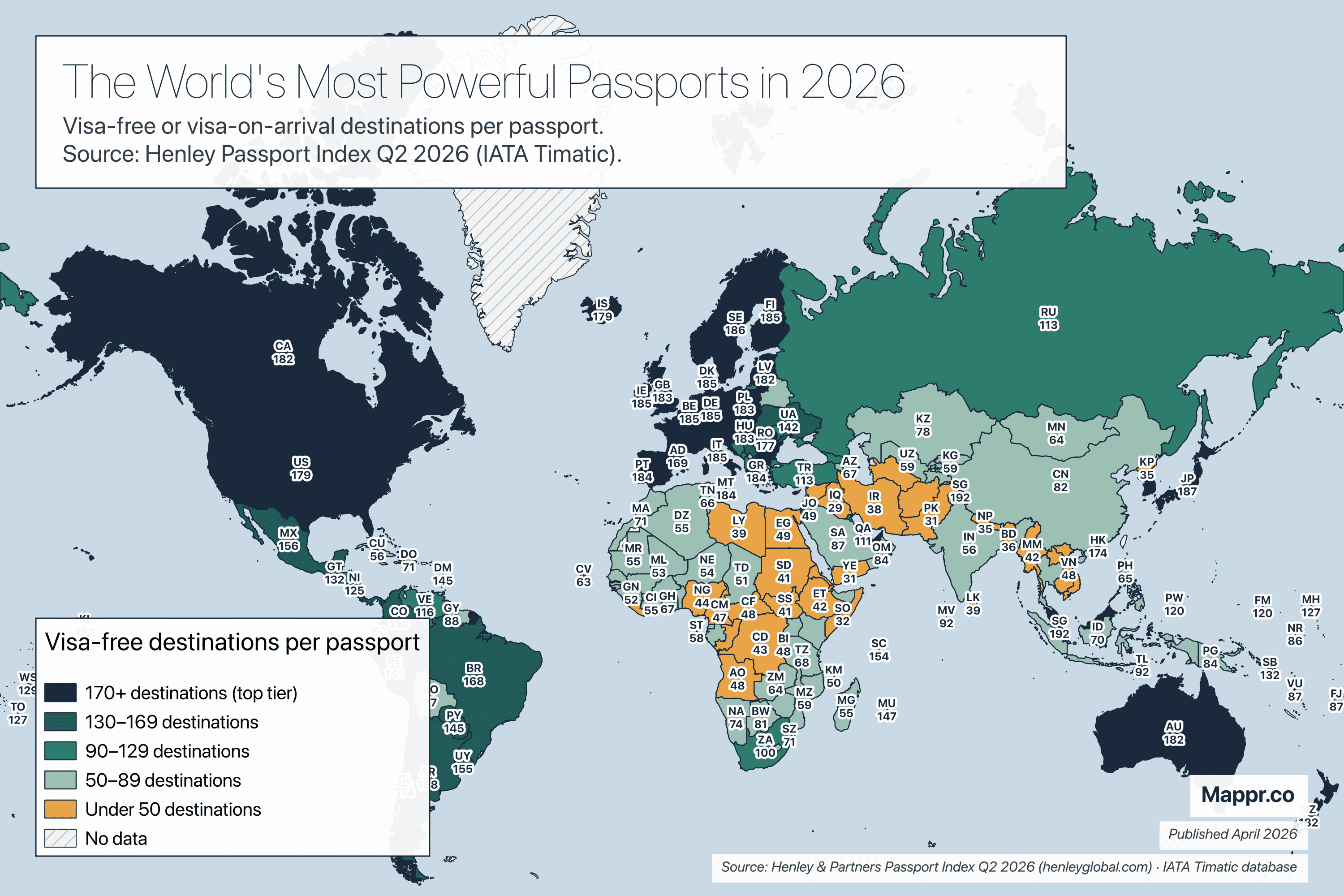
How the Henley Passport Index Works
The Henley Passport Index ranks all 199 passports in the world by how many of 227 destinations their holders can enter without a prior visa — either fully visa-free, via visa-on-arrival, or through an electronic travel authorisation that is effectively automatic. The ranking is compiled quarterly in partnership with the International Air Transport Association (IATA), which maintains the Timatic database used by airline check-in systems worldwide.
What the index does not measure is equally important. It excludes visas that require online applications with approval uncertainty, visas that require payment at the border, and any visa that requires a prior application — even a rubber-stamp one. The net effect is that the index captures what global mobility actually feels like on the ground: can you just show up?
The 10 Most Powerful Passports in 2026
The top of the Henley Index is crowded. Ties are the rule, not the exception — 12 countries share 4th place at 185 destinations, and another seven share 6th. Here is every distinct rank from 1 through 10, covering 35 passports in total:
| Rank | Country | Visa-Free Destinations |
|---|---|---|
| 1 | 🇸🇬 Singapore | 192 |
| 2 | 🇯🇵 Japan | 188 |
| 2 | 🇰🇷 South Korea | 188 |
| 2 | 🇦🇪 United Arab Emirates | 188 |
| 3 | 🇸🇪 Sweden | 186 |
| 4 | 🇧🇪 Belgium | 185 |
| 4 | 🇩🇰 Denmark | 185 |
| 4 | 🇫🇮 Finland | 185 |
| 4 | 🇫🇷 France | 185 |
| 4 | 🇩🇪 Germany | 185 |
| 4 | 🇮🇪 Ireland | 185 |
| 4 | 🇮🇹 Italy | 185 |
| 4 | 🇱🇺 Luxembourg | 185 |
| 4 | 🇳🇱 Netherlands | 185 |
| 4 | 🇳🇴 Norway | 185 |
| 4 | 🇪🇸 Spain | 185 |
| 4 | 🇨🇭 Switzerland | 185 |
| 5 | 🇦🇹 Austria | 184 |
| 5 | 🇬🇷 Greece | 184 |
| 5 | 🇲🇹 Malta | 184 |
| 5 | 🇵🇹 Portugal | 184 |
| 6 | 🇭🇺 Hungary | 183 |
| 6 | 🇲🇾 Malaysia | 183 |
| 6 | 🇵🇱 Poland | 183 |
| 6 | 🇬🇧 United Kingdom | 183 |
| 7 | 🇦🇺 Australia | 182 |
| 7 | 🇨🇦 Canada | 182 |
| 7 | 🇨🇿 Czechia | 182 |
| 7 | 🇱🇻 Latvia | 182 |
| 7 | 🇳🇿 New Zealand | 182 |
| 7 | 🇸🇰 Slovakia | 182 |
| 7 | 🇸🇮 Slovenia | 182 |
| 8 | 🇭🇷 Croatia | 181 |
| 8 | 🇪🇪 Estonia | 181 |
| 9 | 🇱🇮 Liechtenstein | 180 |
| 9 | 🇱🇹 Lithuania | 180 |
| 10 | 🇮🇸 Iceland | 179 |
| 10 | 🇺🇸 United States | 179 |
The big picture: three non-European passports now share the top two rows (Singapore plus the three-way 2nd-place tie of Japan, South Korea, and the UAE), a massive European cluster dominates ranks 4 through 9, and the UAE’s climb is the headline — a passport that in 2006 was ranked around 62nd globally and is now tied for the silver medal.
Interactive World Passport Power Map
Hover over any country to see its 2026 rank and the number of destinations its passport holders can reach visa-free. The map covers all 199 ranked passports — from Singapore’s 192 at the top to Afghanistan’s 24 at the bottom.
The Biggest Movers of the Past 20 Years
Passport rankings are slow-moving — diplomatic relationships take years to formalise, and reciprocal visa agreements follow a long choreography of bilateral negotiation. Which makes the United Arab Emirates’ rise one of the most remarkable trajectories ever recorded.
This July 2026 edition marks the index’s 20th anniversary, and the long view is striking. The average passport now reaches 108 destinations visa-free, nearly double the 58 it managed in 2006. Back then the strongest passports, held by Americans, Danes and Finns, opened 130 destinations; today Singapore alone reaches 192. Access has widened almost everywhere, with only Bolivia recording a net loss over the two decades. Yet the gap between the most and least mobile has grown rather than shrunk: Afghanistan still sits last at 22 destinations, a record 170 behind Singapore. The mobility elite has reshuffled too, with Singapore climbing from 8th in 2006 to 1st, the United States falling from 1st to 10th, and the United Kingdom from 3rd to 6th.
- 🇦🇪 United Arab Emirates: +153 destinations since 2006, up roughly 60 places (from ~62nd to tied 2nd). Driven by a deliberate decade-long diplomatic strategy pairing state visits with reciprocal visa waivers, particularly across the EU, Latin America, and East Asia.
- 🇨🇴 Colombia: Long-term climber, now at 34th with 130 destinations, thanks to Schengen visa waivers negotiated in the mid-2010s and reciprocal agreements with much of Southeast Asia.
- 🇺🇦 Ukraine: 28th at 142 destinations, buoyed by EU visa liberalisation in 2017 and continued solidarity agreements through the 2020s.
- 🇺🇸 United States (falling): Once top-5, now 10th with 179. Brief drop-out of the top 10 in late 2025 triggered global headlines. Reciprocity tensions — particularly several countries imposing entry requirements on US passport holders — have dragged the score down.
- 🇬🇧 United Kingdom (falling): Held top-2 for much of the 2010s, now 6th at 183. Brexit-era recalibration of reciprocal agreements has done more damage than the Brexit vote itself.
Regional Breakdown: Where the Power Clusters
Passport power is heavily regionalised. The same bureaucratic infrastructure that produces bilateral visa waivers also produces regional agreements — Schengen, CARICOM, ASEAN, the Gulf Cooperation Council — that structurally lift entire neighbourhoods at once.
- Europe dominates the top of the index by volume — 30+ European passports score above 170, powered almost entirely by Schengen and EU bilateral agreements.
- East Asia holds the individual top spots: Singapore #1, Japan and South Korea tied #2. Taiwan (135) and Hong Kong (173) also punch above the regional average.
- The Middle East is split dramatically. The UAE (188) and Israel (166) sit high, while Iran (38), Iraq (29), Syria (26), and Yemen (31) cluster at the bottom.
- Sub-Saharan Africa occupies most of the lower-middle tier, though the big regional economies — South Africa (100), Kenya (69), Ghana (68), Nigeria (44) — show meaningful divergence tied to each country’s own diplomatic posture.
- The Americas are stratified: North America top-tier (US 10th, Canada 7th), the Southern Cone strong (Chile 12th, Argentina 15th, Brazil 15th), Central America and the Caribbean in the middle, with the notable bottom-tier presence of Haiti (49) and Cuba (57).
The 10 Weakest Passports in 2026
At the bottom of the index, the pattern is starker: nearly all of the lowest-ranked passports belong to countries under active sanctions, dealing with internal conflict, or operating under heavily restricted international recognition. Here are the 10 passports with the fewest visa-free destinations in 2026:
| Rank | Country | Visa-Free Destinations |
|---|---|---|
| 92 | 🇸🇸 South Sudan | 41 |
| 92 | 🇸🇩 Sudan | 41 |
| 93 | 🇱🇾 Libya | 39 |
| 93 | 🇱🇰 Sri Lanka | 39 |
| 94 | 🇪🇷 Eritrea | 38 |
| 94 | 🇮🇷 Iran | 38 |
| 94 | 🇵🇸 Palestinian Territory | 38 |
| 95 | 🇧🇩 Bangladesh | 36 |
| 96 | 🇳🇵 Nepal | 35 |
| 96 | 🇰🇵 North Korea | 35 |
| 97 | 🇸🇴 Somalia | 32 |
| 98 | 🇵🇰 Pakistan | 31 |
| 98 | 🇾🇪 Yemen | 31 |
| 99 | 🇮🇶 Iraq | 29 |
| 100 | 🇸🇾 Syria | 26 |
| 101 | 🇦🇫 Afghanistan | 22 |
The destination gap between Singapore (192) and Afghanistan (22) is 170, meaning a Singaporean citizen can visit more than eight times as many countries visa-free as an Afghan citizen. That disparity is a proxy for something much bigger: the degree to which a country’s diplomatic standing, political stability, and migration-risk profile are trusted by the rest of the world.
Why Passport Power Matters
Passport power is more than a travel-convenience metric. Visa-free access is a leading indicator of a country’s diplomatic standing, economic integration, and ability to negotiate bilateral agreements. It correlates strongly with GDP per capita, but the correlation is imperfect — the UAE’s climb shows that deliberate foreign policy can outpace raw economic ranking, while the US’s slippage shows that wealth alone doesn’t lock in mobility.
For individuals, a stronger passport is a direct economic asset: it lowers the friction and cost of international business, education, and family visits. For governments, the index is read as a report card on soft power — which is why countries like the UAE and Saudi Arabia have made climbing the index an explicit long-term policy goal.
The State of Global Mobility in 2026
The 2026 Henley Passport Index sketches a world where the mobility gap between the most and least privileged passports has never been wider. Asian passports dominate the top — a structural shift from the mid-2000s, when European and North American passports held the crown almost unchallenged. The United Arab Emirates has rewritten what was thought possible over a 20-year horizon. And the United States, while back in the top 10, is a reminder that passport power is earned bilaterally, year by year.
The anniversary data also carries a paradox. Over the same twenty years that travel freedom expanded, the Institute for Economics and Peace recorded its bleakest Global Peace Index yet, with global peacefulness declining for a twelfth straight year. Henley’s chairman, Christian Kaelin, frames passport power as a measure of geopolitical capital: the strongest passports, he argues, belong to the countries that others most want as partners for trade, investment and security.
For most readers of this map, the ranking is an abstraction — until the moment you’re at a check-in counter in a foreign country and the agent asks if you have a visa. That is the moment the Henley Index becomes very concrete, very fast.
The Complete 2026 Passport Ranking
The full Henley Passport Index for 2026 — all 199 passports sorted by visa-free destinations. Ties on the same rank are listed alphabetically. Data compiled quarterly with the IATA Timatic database.
Every passport in the Henley index, ranked by visa-free access. Use the search box to find any country, or click a column header to sort.
| Rank | Country | Visa-Free Destinations |
|---|---|---|
| 1 | Singapore | 192 |
| 2 | Japan | 188 |
| 2 | South Korea | 188 |
| 2 | United Arab Emirates | 188 |
| 3 | Sweden | 186 |
| 4 | Belgium | 185 |
| 4 | Denmark | 185 |
| 4 | Finland | 185 |
| 4 | France | 185 |
| 4 | Germany | 185 |
| 4 | Ireland | 185 |
| 4 | Italy | 185 |
| 4 | Luxembourg | 185 |
| 4 | Netherlands | 185 |
| 4 | Norway | 185 |
| 4 | Spain | 185 |
| 4 | Switzerland | 185 |
| 5 | Austria | 184 |
| 5 | Greece | 184 |
| 5 | Malta | 184 |
| 5 | Portugal | 184 |
| 6 | Hungary | 183 |
| 6 | Malaysia | 183 |
| 6 | Poland | 183 |
| 6 | United Kingdom | 183 |
| 7 | Australia | 182 |
| 7 | Canada | 182 |
| 7 | Czechia | 182 |
| 7 | Latvia | 182 |
| 7 | New Zealand | 182 |
| 7 | Slovakia | 182 |
| 7 | Slovenia | 182 |
| 8 | Croatia | 181 |
| 8 | Estonia | 181 |
| 9 | Liechtenstein | 180 |
| 9 | Lithuania | 180 |
| 10 | Iceland | 179 |
| 10 | United States | 179 |
| 11 | Bulgaria | 177 |
| 11 | Romania | 177 |
| 12 | Monaco | 176 |
| 13 | Chile | 174 |
| 13 | Cyprus | 174 |
| 13 | Hong Kong (SAR China) | 174 |
| 14 | Andorra | 169 |
| 15 | Argentina | 168 |
| 15 | Brazil | 168 |
| 16 | Israel | 166 |
| 16 | San Marino | 166 |
| 17 | Barbados | 163 |
| 17 | Brunei | 163 |
| 18 | The Bahamas | 158 |
| 19 | St. Kitts and Nevis | 157 |
| 19 | St. Vincent and the Grenadines | 157 |
| 20 | Mexico | 156 |
| 21 | Uruguay | 155 |
| 22 | Antigua and Barbuda | 154 |
| 22 | Seychelles | 154 |
| 23 | Vatican City | 151 |
| 24 | Costa Rica | 148 |
| 25 | Grenada | 147 |
| 25 | Mauritius | 147 |
| 25 | Panama | 147 |
| 26 | Dominica | 145 |
| 26 | Paraguay | 145 |
| 26 | Trinidad and Tobago | 145 |
| 27 | St. Lucia | 144 |
| 28 | Ukraine | 142 |
| 29 | Macao (SAR China) | 141 |
| 29 | Peru | 141 |
| 30 | Serbia | 135 |
| 31 | Taiwan (Chinese Taipei) | 134 |
| 32 | Guatemala | 132 |
| 32 | Solomon Islands | 132 |
| 33 | El Salvador | 131 |
| 34 | Colombia | 130 |
| 35 | Honduras | 129 |
| 35 | Samoa | 129 |
| 36 | Marshall Islands | 127 |
| 36 | Tonga | 127 |
| 37 | Montenegro | 126 |
| 37 | North Macedonia | 126 |
| 38 | Nicaragua | 125 |
| 38 | Tuvalu | 125 |
| 39 | Kiribati | 122 |
| 40 | Albania | 121 |
| 40 | Bosnia and Herzegovina | 121 |
| 41 | Georgia | 120 |
| 41 | Micronesia | 120 |
| 41 | Palau Islands | 120 |
| 42 | Moldova | 119 |
| 43 | Venezuela | 116 |
| 44 | Russian Federation | 113 |
| 44 | Türkiye | 113 |
| 45 | Qatar | 111 |
| 46 | Belize | 100 |
| 46 | South Africa | 100 |
| 47 | Kuwait | 96 |
| 48 | Ecuador | 93 |
| 49 | Maldives | 92 |
| 49 | Timor-Leste | 92 |
| 50 | Guyana | 88 |
| 51 | Bahrain | 87 |
| 51 | Fiji | 87 |
| 51 | Saudi Arabia | 87 |
| 51 | Vanuatu | 87 |
| 52 | Nauru | 86 |
| 53 | Jamaica | 85 |
| 54 | Oman | 84 |
| 54 | Papua New Guinea | 84 |
| 55 | China | 82 |
| 56 | Botswana | 81 |
| 56 | Kosovo | 81 |
| 57 | Kazakhstan | 78 |
| 58 | Belarus | 77 |
| 58 | Bolivia | 77 |
| 59 | Thailand | 76 |
| 60 | Suriname | 75 |
| 61 | Namibia | 74 |
| 62 | Lesotho | 73 |
| 63 | Dominican Republic | 71 |
| 63 | eSwatini | 71 |
| 63 | Morocco | 71 |
| 64 | Indonesia | 70 |
| 64 | Malawi | 70 |
| 65 | Kenya | 69 |
| 66 | Tanzania | 68 |
| 66 | The Gambia | 68 |
| 67 | Azerbaijan | 67 |
| 67 | Ghana | 67 |
| 68 | Rwanda | 66 |
| 68 | Tunisia | 66 |
| 69 | Benin | 65 |
| 69 | Philippines | 65 |
| 69 | Uganda | 65 |
| 70 | Armenia | 64 |
| 70 | Mongolia | 64 |
| 70 | Zambia | 64 |
| 71 | Cape Verde Islands | 63 |
| 72 | Sierra Leone | 62 |
| 73 | Zimbabwe | 61 |
| 74 | Kyrgyzstan | 59 |
| 74 | Mozambique | 59 |
| 74 | Uzbekistan | 59 |
| 75 | São Tomé and Príncipe | 58 |
| 76 | Togo | 57 |
| 77 | Burkina Faso | 56 |
| 77 | Cuba | 56 |
| 77 | India | 56 |
| 77 | Senegal | 56 |
| 78 | Algeria | 55 |
| 78 | Côte d’Ivoire | 55 |
| 78 | Gabon | 55 |
| 78 | Madagascar | 55 |
| 78 | Mauritania | 55 |
| 79 | Niger | 54 |
| 80 | Mali | 53 |
| 80 | Tajikistan | 53 |
| 81 | Equatorial Guinea | 52 |
| 81 | Guinea | 52 |
| 82 | Chad | 51 |
| 83 | Comoro Islands | 50 |
| 83 | Guinea-Bissau | 50 |
| 84 | Egypt | 49 |
| 84 | Haiti | 49 |
| 84 | Jordan | 49 |
| 84 | Liberia | 49 |
| 85 | Angola | 48 |
| 85 | Burundi | 48 |
| 85 | Central African Republic | 48 |
| 85 | Vietnam | 48 |
| 86 | Bhutan | 47 |
| 86 | Cambodia | 47 |
| 86 | Cameroon | 47 |
| 87 | Congo (Rep.) | 46 |
| 88 | Djibouti | 45 |
| 88 | Laos | 45 |
| 88 | Turkmenistan | 45 |
| 89 | Nigeria | 44 |
| 90 | Congo (Dem. Rep.) | 43 |
| 90 | Lebanon | 43 |
| 91 | Ethiopia | 42 |
| 91 | Myanmar | 42 |
| 92 | South Sudan | 41 |
| 92 | Sudan | 41 |
| 93 | Libya | 39 |
| 93 | Sri Lanka | 39 |
| 94 | Eritrea | 38 |
| 94 | Iran | 38 |
| 94 | Palestinian Territory | 38 |
| 95 | Bangladesh | 36 |
| 96 | Nepal | 35 |
| 96 | North Korea | 35 |
| 97 | Somalia | 32 |
| 98 | Pakistan | 31 |
| 98 | Yemen | 31 |
| 99 | Iraq | 29 |
| 100 | Syria | 26 |
| 101 | Afghanistan | 22 |
Passport ranking data is sourced from Henley & Partners' quarterly Passport Index, which draws on the IATA Timatic database. Historical comparisons and regional analysis cross-referenced with national foreign-ministry announcements.