Key Takeaways
- The world's fastest computer is Chinese, but China barely appears on the map. LineShine in Shenzhen tops the new TOP500 at 2.2 exaflop/s, yet China lists just 18 systems, seventh place, while the United States lists 163. China has largely stopped submitting to the list.
- The US still dominates the list: 163 systems and 3 of the 5 exascale machines. El Capitan, Frontier and Aurora rank 2nd to 4th. Together, US systems hold 7,400 of the list's roughly 17,000 petaflops.
- Europe has its first exascale system. JUPITER Booster in Jülich, Germany, holds 5th place at exactly 1.000 exaflop/s. Germany is now 2nd in the world by system count with 47, ahead of Japan's 46.
- The list is freezing over: lowest turnover in TOP500 history. Only 27 systems are new this edition, 5.4%, and the top 10 is unchanged from June. The AI boom's biggest machines sit in private clouds that never submit a benchmark.
Twice a year, the TOP500 ranks the fastest supercomputers on Earth, and twice a year the map of computing power gets redrawn. The 68th list, released at the SC26 conference in Chicago on 16 November, tells a story of two very different maps: one of how many machines countries run, and one of how fast they are. They disagree spectacularly.
The Map: Who Runs the TOP500?
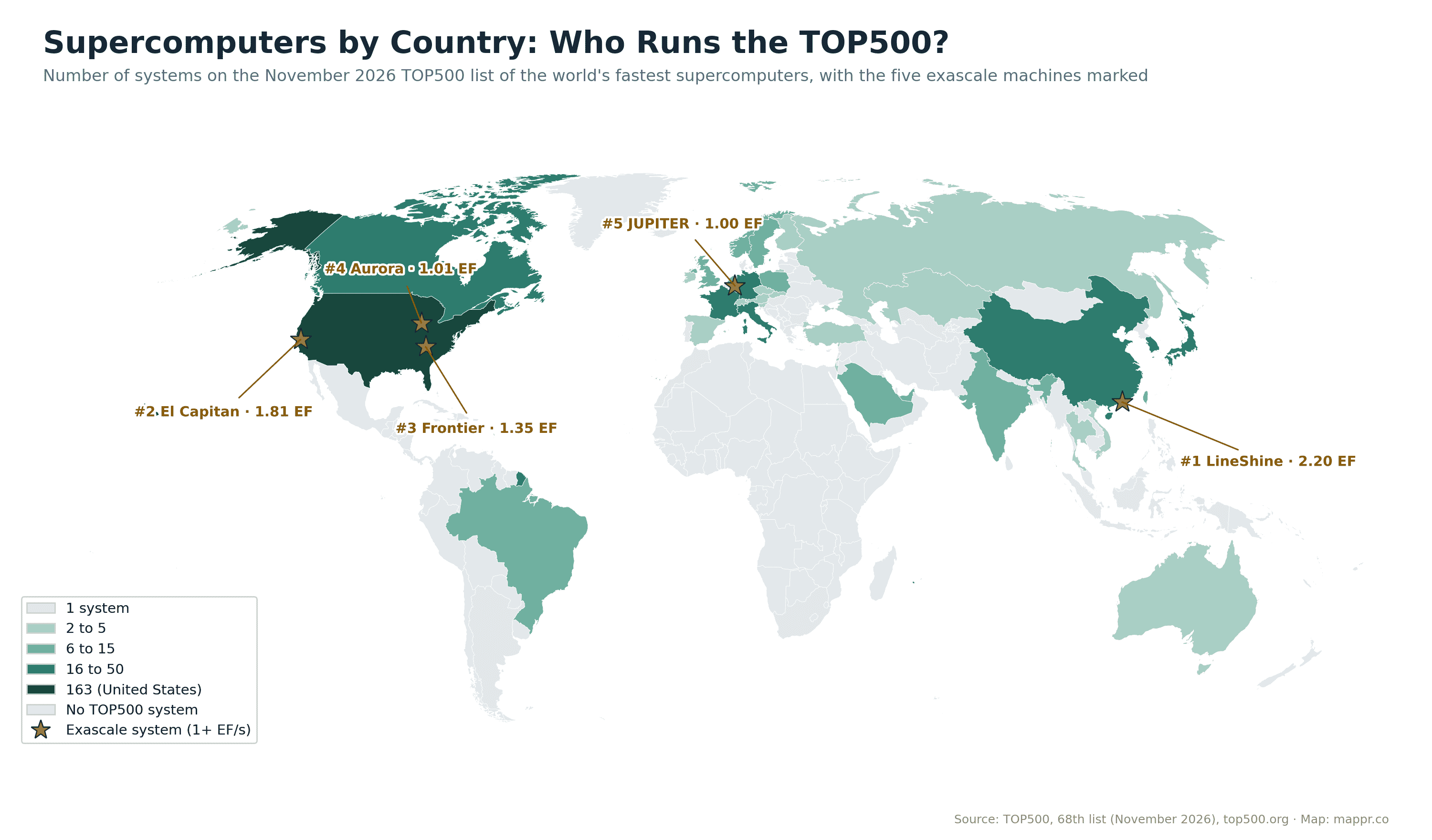
The United States dominates the count with 163 of the 500 systems, nearly a third of the list. Germany is a distant second with 47, just ahead of Japan with 46. In total, 47 countries appear on the list, from South Korea (22) and Italy and France (20 each) down to single systems in Morocco, Indonesia and Iceland.
And then there is China: 7th place, with just 18 systems, behind France and barely ahead of Canada. Which would be unremarkable, except for one thing: the fastest machine on the planet is Chinese.
The Inversion: the #1 Machine Is Where the Map Looks Empty
LineShine, at the National Supercomputing Centre in Shenzhen, tops the list for the second edition running at 2.198 exaflop/s, over a fifth faster than anything the US fields. Yet on the count map, China is a mid-tier green. The explanation is political: since US export controls on advanced chips tightened, China has largely stopped submitting systems to the TOP500. Analysts widely believe it operates far more large systems than it reports. LineShine, built on domestic LingKun processors, reads as a deliberate statement: a single machine submitted to make a point.
The result is a ranking that measures willingness to be counted as much as computing power, and the two maps in this post are best read together.
The Top 10: An Exascale Club of Three Countries
The top 10
The World's 10 Fastest Supercomputers
TOP500 list, November 2026. Performance in petaflop/s (1,000 PF = 1 exaflop/s)
| System | Country | Rank | Linpack (PF) |
|---|---|---|---|
| LineShine | China | #1 | 2,198 |
| El Capitan | United States | #2 | 1,809 |
| Frontier | United States | #3 | 1,353 |
| Aurora | United States | #4 | 1,012 |
| JUPITER Booster | Germany | #5 | 1,000 |
| HPC7 | Italy | #6 | 572 |
| Eagle | United States | #7 | 561 |
| HPC6 | Italy | #8 | 478 |
| Fugaku | Japan | #9 | 442 |
| Alps | Switzerland | #10 | 435 |
Five machines now exceed one exaflop/s on the Linpack benchmark, a quintillion calculations per second: LineShine, the three US Department of Energy giants El Capitan, Frontier and Aurora, and Europe’s first exascale system, JUPITER Booster in Jülich, Germany, which sits at 5th with a poetic exactly-1.000 exaflop/s. The top 10 is completely unchanged from June, the first time that has happened in the list’s 33-year history.
The Other Map: Computing Power, Not Count
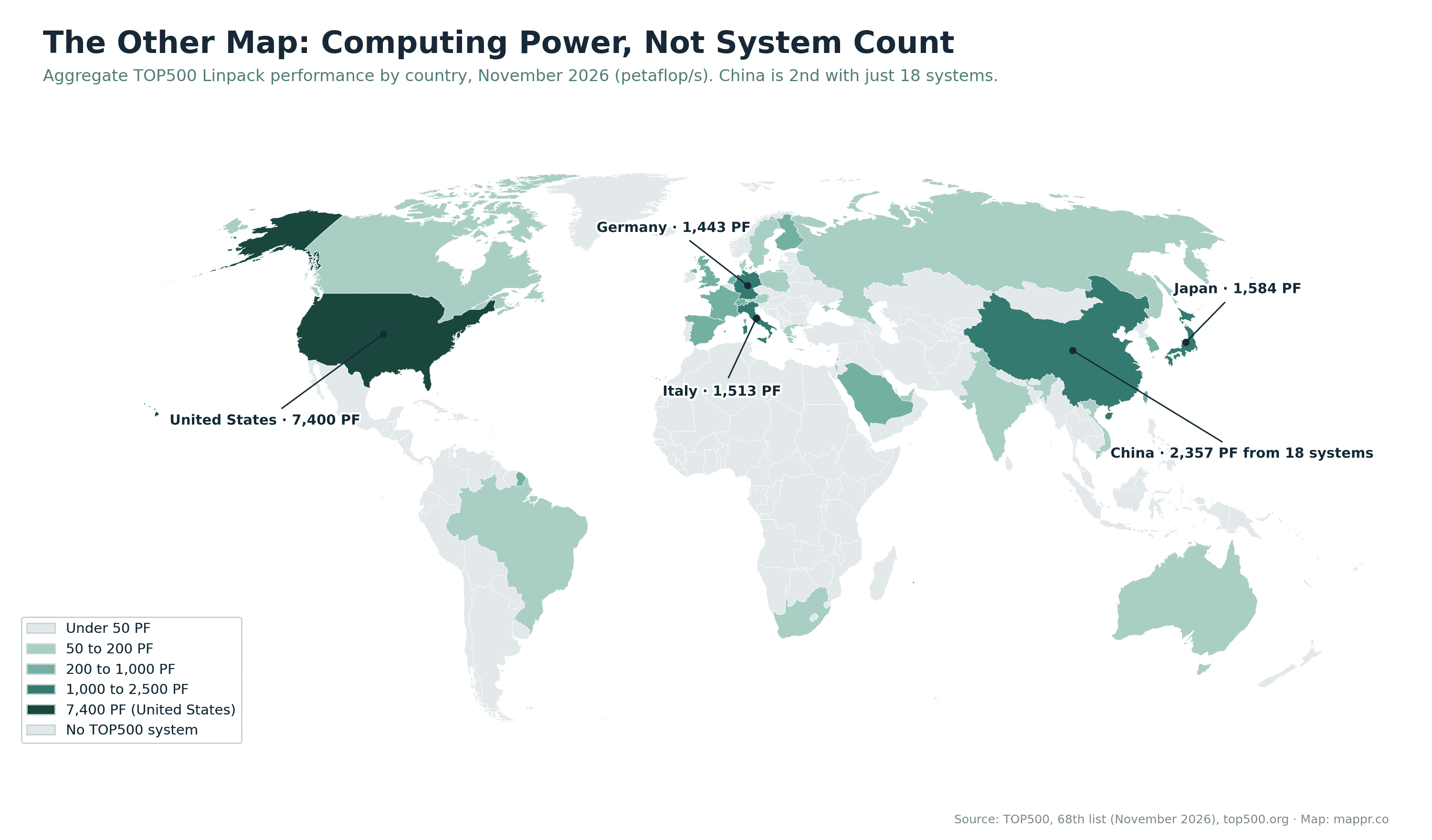
Summing each country’s Linpack scores flips the picture. The US leads with about 7,400 petaflops, but China jumps from 7th to 2nd with 2,357, nearly all of it from LineShine and a handful of older systems. Japan (1,584), Italy (1,513) and Germany (1,443) follow, Italy’s total built on the energy group Eni’s HPC6 and HPC7 machines, the two fastest industrial supercomputers in the world.
The country ranking
Countries With the Most TOP500 Supercomputers
System count and combined Linpack performance, November 2026
| Country | Systems | Combined PF |
|---|---|---|
| United States | 163 | 7,400 |
| Germany | 47 | 1,443 |
| Japan | 46 | 1,584 |
| South Korea | 22 | 976 |
| Italy | 20 | 1,513 |
| France | 20 | 314 |
| China | 18 | 2,357 |
| Canada | 16 | 162 |
| United Kingdom | 13 | 474 |
| Taiwan | 11 | 214 |
| Brazil | 10 | 143 |
| Sweden | 9 | 134 |
The Freeze: Lowest Turnover in TOP500 History
Only 27 systems entered the list this edition, a turnover of 5.4%, the lowest ever recorded. A decade ago, half the list could change in a year. The stagnation has two causes. First, the machines that would dominate the list, the giant AI training clusters of the big cloud and AI companies, never run the public benchmark; their owners see no benefit in disclosure. Second, the systems that are listed stay longer, because scientific centres now sweat their hardware through longer lifecycles.
The notable newcomers tell their own geography: Lux, a new AMD-powered US Department of Energy system, debuted at #14, and India’s Shakti Cloud entered at #35, its highest TOP500 placement yet. On the efficiency-focused Green500, the French system KAIROS in Toulouse defended its crown as the world’s most energy-efficient supercomputer.
Why It Matters
Supercomputers are where climate models, drug discovery, nuclear-stockpile simulation and frontier AI research happen, and access to them is increasingly treated as strategic infrastructure, like ports or power grids. The TOP500 map is the closest thing there is to a public census of that infrastructure. Just remember what it leaves out: the machines nobody wants counted.
Sources: