Key Takeaways
- A record-breaking cycle. FIFA's 2023–26 four-year cycle is on course for around $13 billion in revenue, up roughly 72% on the $7.57 billion Qatar cycle.
- The World Cup is the engine. FIFA estimates about $8.9 billion of that comes directly from the expanded 48-team 2026 tournament in the USA, Canada and Mexico.
- Broadcasting leads the way. Television rights are the single biggest income source, and US media rights alone are up around 94% versus Qatar 2022.
- America is the money centre. The United States is both the main host and home to 14 of FIFA's 26 commercial backers — more than half.
- Ticket prices hit records. FIFA's first-ever dynamic pricing pushed final-match resale listings toward $2 million and triggered a US state investigation.
The 2026 FIFA World Cup will be the biggest in the tournament’s history — 48 teams, 104 matches and three host nations. It will also be by far the most lucrative. Behind the football sits a financial machine that FIFA expects to generate a record sum across its four-year business cycle, the vast majority of it flowing through this single summer.
So how much does FIFA actually make from a World Cup, where does the money come from, and where does it go? We pulled the figures from FIFA’s own reporting and mapped the flows.
A record $13 billion cycle
FIFA budgets in four-year cycles rather than per tournament. Its official 2023–26 budget targeted $11.0 billion in revenue. It has since revised that projection upward to a record ~$13.0 billion — about 72% more than the $7.57 billion it earned across the 2019–22 Qatar cycle. Most of the extra $2 billion comes from the new 2025 Club World Cup, which wasn’t in the original budget.
Of that cycle total, FIFA estimates roughly $8.9 billion comes directly from the expanded 48-team 2026 World Cup itself — the single biggest payday in the organisation’s history.
Follow the money: inflows to outflows
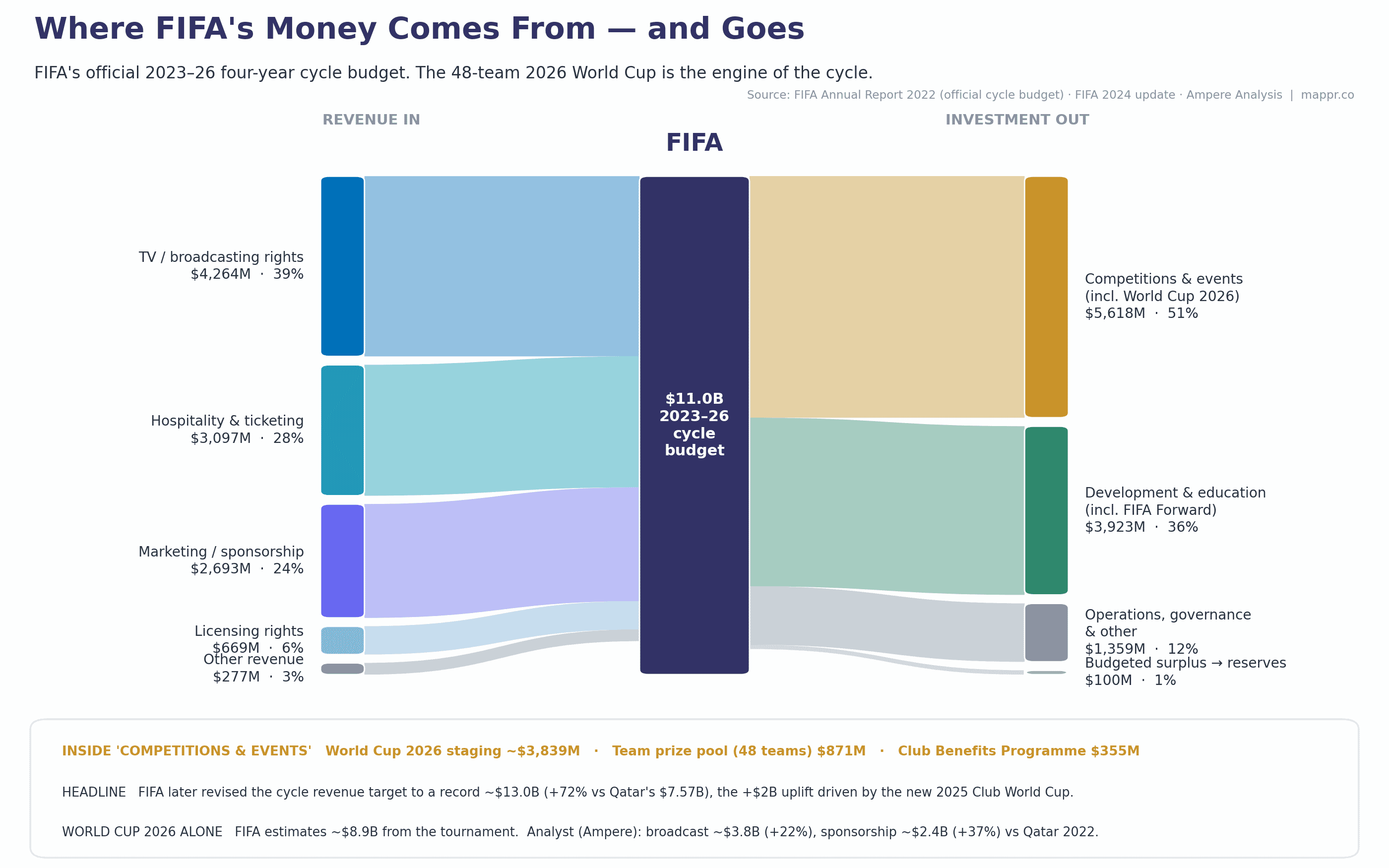
The diagram below traces FIFA’s official cycle budget from where the money comes in (left) through FIFA and out to where it is spent (right). It is built on the clean $11 billion budget, the only figure FIFA publishes with audited line items on both sides.
Where the money comes from
FIFA has four main revenue streams. On the official $11 billion budget they break down as:
- Television & broadcasting rights — $4,264M (39%). The biggest single source by far.
- Hospitality & ticketing — $3,097M (28%).
- Marketing & sponsorship — $2,693M (24%). The FIFA Partners and World Cup sponsors.
- Licensing rights — $669M (6%).
- Other revenue — $277M (3%).
Analysts expect the 2026 edition to break records in every category. Ampere Analysis projects roughly $3.8 billion in broadcast revenue for the tournament (up about 22% on Qatar 2022) and around $2.4 billion in sponsorship (up about 37%). The standout market is the United States, where domestic media rights are estimated to have risen by around 94%.
Which nations bankroll the World Cup
FIFA does not publish revenue country by country, but its commercial backers are public. The map below shows FIFA’s 26 World Cup 2026 partners and sponsors by the country of their corporate headquarters — bubble size is the number of deals, colour is the top tier each country holds.
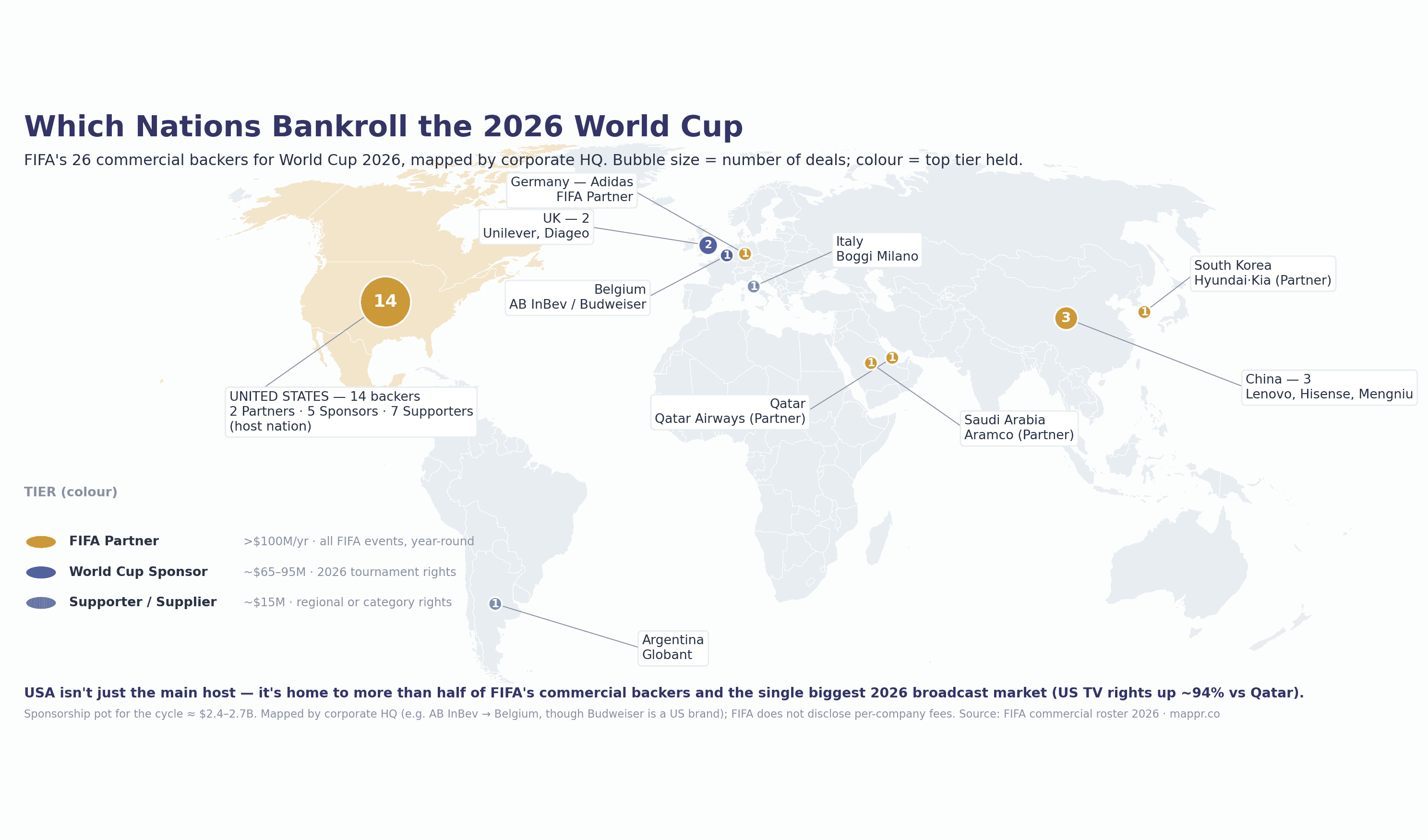
The picture is lopsided. The United States is home to 14 of the 26 backers — two top-tier FIFA Partners (Coca-Cola and Visa) plus sponsors including Bank of America, McDonald’s, Verizon and DoorDash, and a string of supporters. China is second with three (Lenovo, Hisense and Mengniu). The rest are scattered single big-ticket Partners: Adidas (Germany), Hyundai-Kia (South Korea), Aramco (Saudi Arabia) and Qatar Airways (Qatar), with Unilever and Diageo (UK), AB InBev (Belgium), Boggi Milano (Italy) and Globant (Argentina) filling out the lower tiers.
Tier matters because the price tag does. FIFA Partners reportedly pay upwards of $100 million a year for year-round rights across all FIFA events; World Cup sponsors pay an estimated $65–95 million for tournament rights; regional supporters around $15 million. FIFA does not disclose individual fees.
Where the money goes
FIFA’s framing is that more than 90% of its budget is reinvested into football. On the original $11 billion budget the major spending buckets are:
- Competitions & events — $5,618M. Staging the tournaments, with World Cup 2026 the primary driver at around $3,839M.
- Development & education — $3,923M. Includes FIFA Forward grants to member associations and confederations.
- Operations, governance & other — about $1,359M.
- Budgeted surplus — about $100M, added to reserves that already sit at roughly $4 billion.
Two outflows go straight to the game’s participants. The 2026 prize pool is a record $871 million, with a guaranteed minimum of $12.5 million per qualified nation and around $53.5 million on offer to the eventual winner. Separately, a $355 million Club Benefits Programme pays clubs for releasing their players — up about 70% on Qatar, and for the first time it includes $100 million for clubs whose players feature in qualifying, not just the final tournament.
The ticket-price shock
If the commercial side is a story of records, the ticketing side is a story of backlash. For the first time at a World Cup, FIFA adopted dynamic pricing — prices that move with demand, enabled by the relatively loose US regulatory environment. The result was steep, and steeply unpopular.
Group-stage tickets ranged from roughly $380 to $4,105, and analysis found FIFA’s primary categories rose by an average of 34% between October and April. Premium final-match tickets climbed toward $13,000–$16,000 at face value. On FIFA’s own resale platform — which charges fees and carried no meaningful price cap — listings for the July 19 final at MetLife Stadium reached as high as $2 million, with six- and seven-figure asks widely reported. For comparison, the most expensive general-admission final ticket at Qatar 2022 was $1,607, and at Russia 2018 just $1,100.
The reaction was fierce. Football Supporters Europe called the prices “extortionate” and “a monumental betrayal of the tradition of the World Cup.” After the outcry FIFA introduced a cut-price supporter tier — $60 seats for teams’ most loyal fans — and the New York City mayor’s office secured 1,000 tickets at $50 each. The attorneys general of New York and New Jersey opened investigations into the pricing, alleged misleading seat information and staggered sales. Tellingly, by late spring some resale prices were already falling as demand failed to meet FIFA’s peak asks.
Is this still good for the sport?
It’s worth being fair to FIFA on the headline numbers. A $13 billion cycle is not money disappearing into a vault: a record $871 million prize pool, a $355 million club fund and nearly $4 billion in development spending represent real redistribution down the football pyramid, and the World Cup remains the engine that funds the global game between tournaments.
But the ticketing episode is harder to defend. Dynamic pricing optimised for maximum yield, a FIFA-run resale market that profits from $2 million flips, and final tickets that cost more than a car all point the same way: toward squeezing the people who actually fill the stadiums. When the regulator is circling and your own supporters’ groups are using the word “betrayal,” the marginal revenue is not worth the reputational damage — especially for an organisation already sitting on billions in reserves. Commercial growth and a people’s tournament can coexist; pricing out the fans who give the event its atmosphere is a self-inflicted wound. The smarter play would have been to grow the sponsorship and broadcast machine, where the real money is, and keep the turnstiles affordable.
The bottom line
The 2026 World Cup is set to be the richest sporting event ever staged — a roughly $13 billion machine powered by American broadcasters, a globe-spanning roster of corporate backers and, more controversially, the fans in the seats. How FIFA balances that last revenue stream against goodwill may define how this tournament is remembered long after the trophy is lifted on July 19.
Revenue and budget figures from FIFA's official reporting, with tournament-specific estimates and ticketing coverage from named outlets.
Image Sources
- Mappr – Revenue-flow diagram, backers map and featured illustration created by Mappr