Two of the biggest gates in the immigration-investment world slammed shut in the last eighteen months. On 29 April 2025 the European Court of Justice ruled that Malta had to end its citizenship-by-investment scheme, closing the door on what was effectively the last EU passport for sale. On 3 April 2025 Spain switched off its golden visa, followed a year earlier by the Netherlands, and two years earlier by Ireland and the UK. And in June 2026, Latvia’s parliament voted to close most of its residency-by-investment routes from 1 January 2027.
What is left on the map is a smaller, more expensive, and more scrutinised set of programmes. This post maps the world’s golden visas (residency by investment, RBI) and golden passports (citizenship by investment, CBI) as they stand in July 2026, with the minimum ticket price and the current status of every one.
Key Takeaways
- The EU golden passport era is over. On 29 April 2025 the European Court of Justice ruled that Malta had to shut down its citizenship-by-investment scheme. It was the last CBI programme inside the EU.
- Only eight European golden visas remain open in 2026. Portugal, Greece, Italy, Hungary, Bulgaria, Latvia, Malta and Cyprus still offer residency by investment. Spain, the Netherlands, Ireland and the UK have all closed since 2022.
- Latvia is on the way out. Parliament voted in June 2026 to abolish the property, government-securities and bank-deposit routes from 1 January 2027. The president has sent the bill back for a second reading, but investors treat it as a countdown.
- Outside Europe, the market is thriving. The United States EB-5, UAE Golden Visa, Portugal fund route and the five Caribbean CBI programmes are all seeing rising applications as European doors close.
The golden visa map, 2026
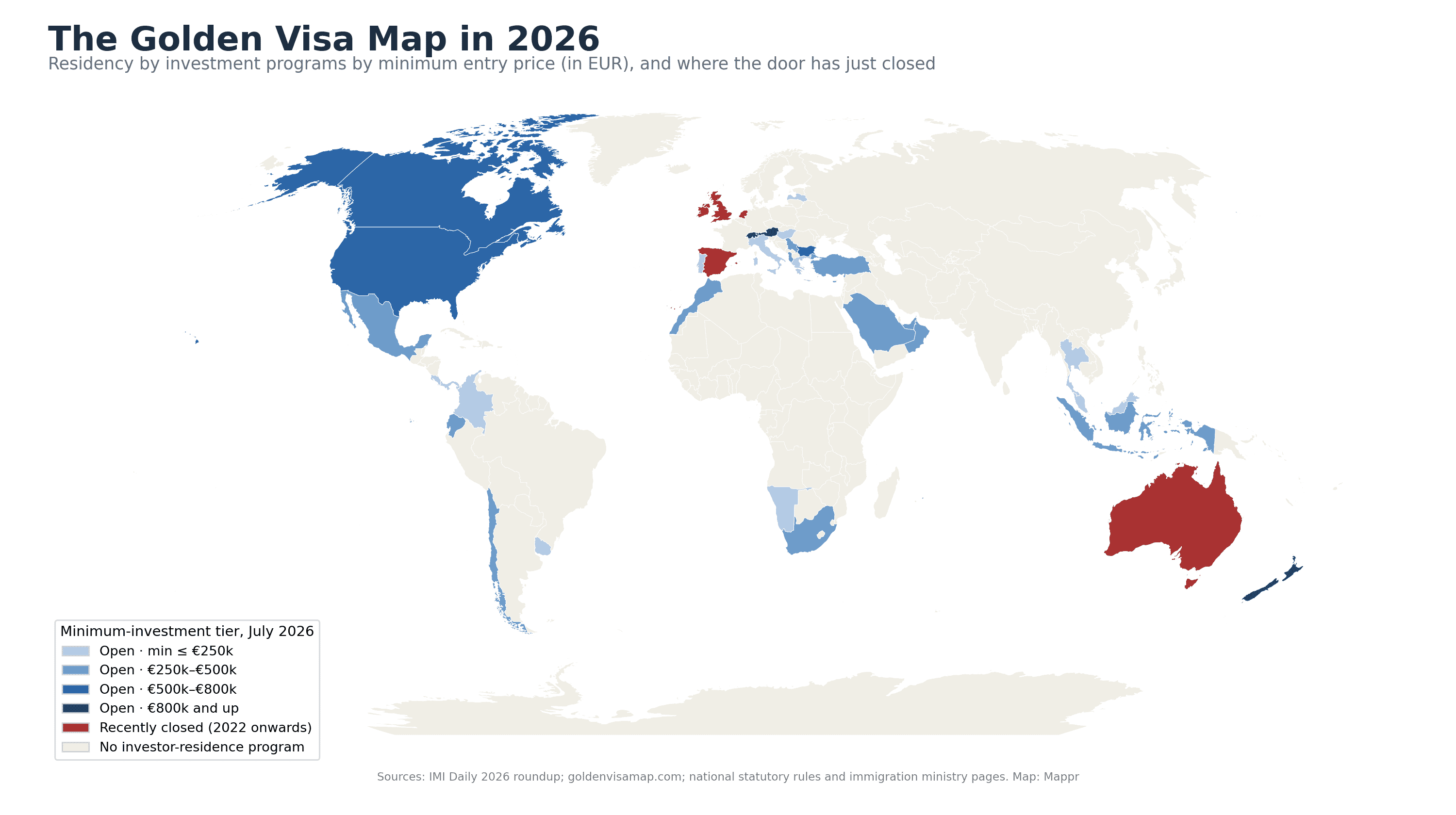
Europe is the most crowded corner of the map, even after the closures. Eight countries still run an RBI programme: Portugal, Greece, Italy, Hungary, Bulgaria, Latvia, Malta and Cyprus. The old cheap-and-cheerful property route is largely gone. Portugal removed real estate in 2023, Hungary’s low-cost direct real-estate window shut in January 2025, and Greece has zoned its programme so that anything in Athens or the islands now costs at least €800,000. The active programmes still on offer either force the money into funds, bonds, or job-creating businesses, or they set the ticket price well above the old €500,000 EU baseline.
Outside Europe the picture is the opposite: business is booming. The United States EB-5 at USD 800,000, the UAE Golden Visa at AED 2 million and the Portugal fund route (still open) are absorbing much of the demand that used to head for Madrid or Amsterdam. Panama, Costa Rica, Mexico and Uruguay run low-cost Latin American residencies. Singapore’s Global Investor Programme sits at the top of the tree at S$10 million.
The eight European countries still open for business
Minimum investment amount and current 2026 status
Who still sells a passport in 2026
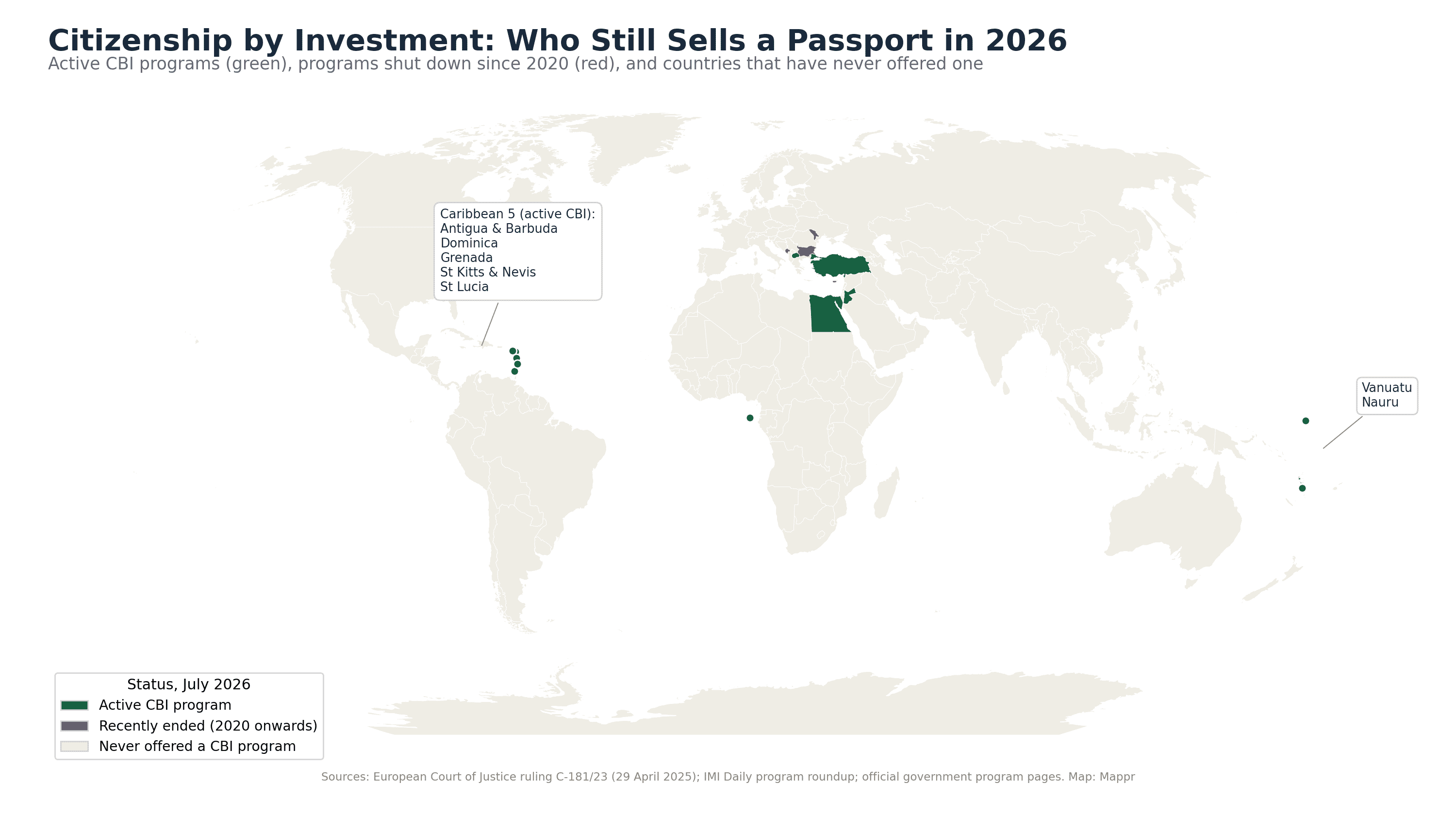
Citizenship by investment is a much smaller industry than residency by investment, and it has shrunk further since 2020. The Cypriot programme was shut down in November 2020 after a leaked Al Jazeera investigation exposed political corruption inside the vetting process. Bulgaria ended its CBI in March 2022 and Montenegro followed in December of the same year. Malta, the last CBI programme inside the EU, was killed by the Court of Justice ruling in April 2025.
The twelve programmes still on the market are all outside the EU. Five are in the Caribbean (Antigua & Barbuda, Dominica, Grenada, St Kitts & Nevis, St Lucia), three are in the Middle East and North Africa (Turkey, Egypt, Jordan), two are in the Pacific (Vanuatu and Nauru, the latter relaunched in 2024 as a climate-resilience fund), and the remaining two are outliers: São Tomé & Príncipe off West Africa (relaunched 2024) and North Macedonia in the Balkans. All ask for a donation or investment somewhere between USD 90,000 and USD 750,000.
The twelve active citizenship-by-investment programmes
Minimum investment and rough time to passport in hand
What triggered the closures
The wave of closures has three parallel drivers. The first is housing affordability. Spain, Portugal, Greece and Ireland all faced political backlash over property-led golden visas pushing prices up in cities investors could not otherwise have afforded to buy in. Spain named it explicitly when it repealed the programme in April 2025; Portugal removed real estate from its route as early as October 2023.
The second is security. The war in Ukraine sharpened European attention on sanctions evasion, and the UK, Ireland and Netherlands closures were all framed in national-security terms. The UK Home Office specifically cited economic-crime concerns when it killed the Tier 1 investor route in February 2022, just days after the invasion.
The third, and most decisive for the CBI half of the map, is EU law. The Court of Justice’s ruling in Commission v Malta found that a member state cannot commodify union citizenship. The decision does not directly touch residency-by-investment (Malta’s MPRP survived), but it draws a hard line that no future EU government can cross without leaving the union.