
Key Takeaways
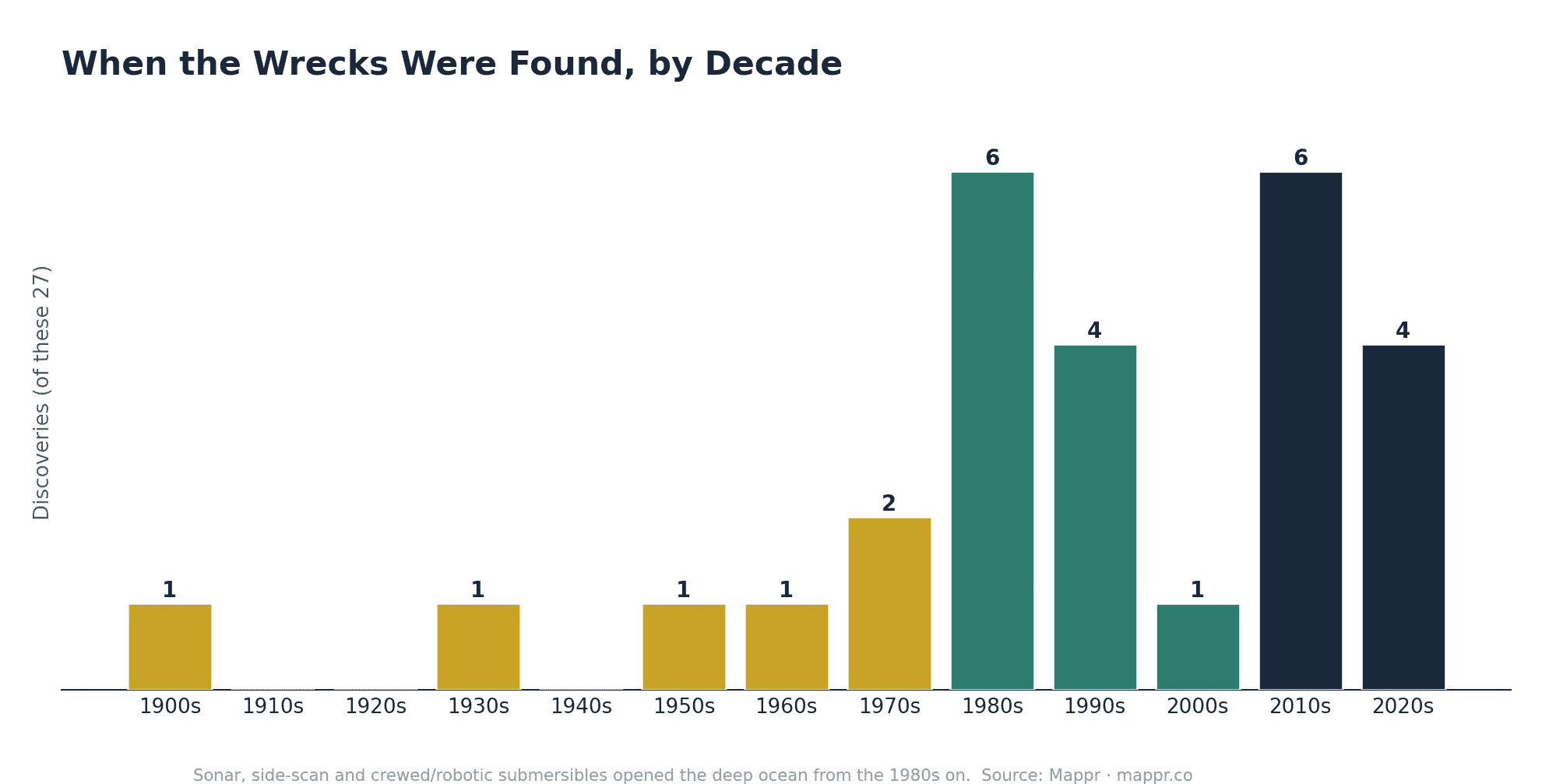
- The golden age of wreck-hunting is now. Most of history's famous wrecks were located only in the last ~45 years, once side-scan sonar and deep-diving submersibles opened the ocean floor.
- Titanic was the turning point. Robert Ballard's 1985 discovery of the Titanic 3,800 m down proved the deep sea was searchable — and kicked off the modern era of exploration.
- The deepest wreck is 6,865 m down. The destroyer escort USS Samuel B. Roberts, found off the Philippines in 2022, is the deepest shipwreck ever located.
- Some stayed lost for centuries. Shackleton's Endurance was found after 107 years, almost perfectly preserved; Spanish galleons like the San José waited more than 300 years.
- A $17 billion prize. The galleon San José, found off Colombia in 2015, carried gold, silver and emeralds now valued near $17 billion — the richest wreck ever found.
For most of history, a ship that sank was simply gone. The ocean is vast, deep and dark, and until recently we had no practical way to find a wreck lying kilometres beneath the surface. That changed in the late 20th century: side-scan sonar, magnetometers, remotely operated vehicles and crewed submersibles turned the seabed into searchable territory. The result has been a remarkable wave of discoveries — from the Titanic to Shackleton’s Endurance — many of them in just the last few decades.
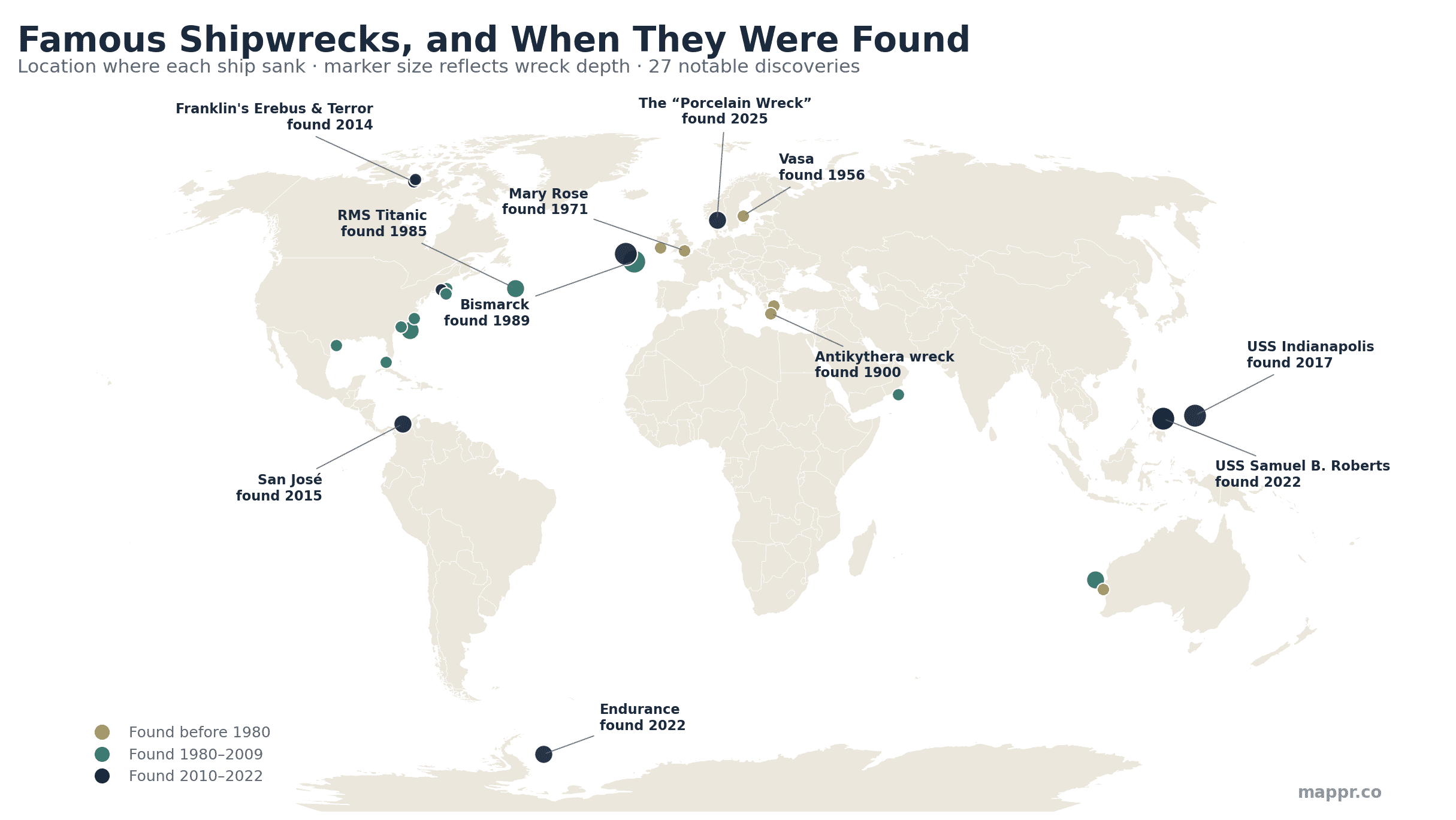
Below we map 27 of the most significant shipwreck discoveries, where each vessel sank and when it was finally found.
Where the famous wrecks lie
A modern wave of discoveries
The timing is striking. A handful of wrecks were located early — the Antikythera wreck by Greek sponge divers in 1900, the Vasa in Stockholm harbour in 1956 — but discoveries cluster heavily from the 1980s onward, exactly as deep-ocean technology matured. The 1980s and the 2010s each produced a burst of finds.
The discoveries that defined the era
RMS Titanic (found 1985). The most famous wreck of all sat undiscovered for 73 years until Robert Ballard located it 3,800 m down in the North Atlantic. The find proved that even the deep abyssal plain could be searched and surveyed.
Endurance (found 2022). Ernest Shackleton’s ship, crushed by Antarctic pack ice in 1915, was found 3,008 m down in the Weddell Sea after 107 years — upright and astonishingly intact, preserved by frigid water free of wood-eating organisms.
The deep frontier. Two destroyers from the WWII Battle off Samar now hold the depth records: the USS Johnston (found 2019, ~6,456 m) and the USS Samuel B. Roberts (found 2022, 6,865 m) — the deepest shipwreck ever located.
Treasure and tragedy. The galleon San José, sunk off Cartagena in 1708, was located in 2015 with a cargo of gold, silver and emeralds valued near $17 billion. In the Arctic, HMS Erebus (2014) and HMS Terror (2016) finally answered the 19th-century mystery of the lost Franklin expedition.
Still happening today. In 2025, researchers exploring the Skagerrak strait between Norway and Denmark found an 18th-century trader — the so-called “Porcelain Wreck” — nearly 600 m down, its cargo of Chinese porcelain, chandeliers and luxury goods almost untouched. It is a reminder that the seabed is still giving up its secrets.
Every wreck on the map
| Ship | Sank | Found | Years lost | Depth | Where it sank |
|---|---|---|---|---|---|
| The “Porcelain Wreck” | c. 1750 | 2025 | 275 | 600 m | Skagerrak strait, off Norway |
| Endurance | 1915 | 2022 | 107 | 3,008 m | Weddell Sea, Antarctica |
| HMB Endeavour | 1778 | 2022 | 244 | 14 m | Newport Harbor, Rhode Island |
| USS Samuel B. Roberts | 1944 | 2022 | 78 | 6,865 m | Philippine Sea, off Samar |
| USS Johnston | 1944 | 2019 | 75 | 6,456 m | Philippine Sea, off Samar |
| USS Indianapolis | 1945 | 2017 | 72 | 5,500 m | Philippine Sea |
| HMS Terror | 1848 | 2016 | 168 | 24 m | Terror Bay, Canadian Arctic |
| Galleon San José | 1708 | 2015 | 307 | 600 m | Off Cartagena, Colombia |
| HMS Erebus | 1848 | 2014 | 166 | 11 m | Queen Maud Gulf, Canadian Arctic |
| SS Gairsoppa | 1941 | 2011 | 70 | 4,700 m | North Atlantic |
| HMAS Sydney II | 1941 | 2008 | 67 | 2,470 m | Indian Ocean, off Western Australia |
| Esmeralda | 1503 | 1998 | 495 | 5 m | Off Al Hallaniyah, Oman |
| Queen Anne’s Revenge | 1718 | 1996 | 278 | 8 m | Beaufort Inlet, North Carolina |
| CSS Hunley | 1864 | 1995 | 131 | 9 m | Off Charleston, USA |
| La Belle | 1686 | 1995 | 309 | 4 m | Matagorda Bay, Texas |
| German battleship Bismarck | 1941 | 1989 | 48 | 4,790 m | NE Atlantic, west of France |
| SS Central America | 1857 | 1988 | 131 | 2,200 m | Off South Carolina |
| RMS Titanic | 1912 | 1985 | 73 | 3,800 m | North Atlantic, off Newfoundland |
| Nuestra Senora de Atocha | 1622 | 1985 | 363 | 17 m | Florida Keys, USA |
| Whydah Gally | 1717 | 1984 | 267 | 9 m | Off Cape Cod, USA |
| RMS Republic | 1909 | 1981 | 72 | 80 m | Off Nantucket, USA |
| HMHS Britannic | 1916 | 1975 | 59 | 122 m | Aegean Sea, off Kea, Greece |
| Mary Rose | 1545 | 1971 | 426 | 14 m | The Solent, England |
| Batavia | 1629 | 1963 | 334 | 5 m | Houtman Abrolhos, Australia |
| Vasa | 1628 | 1956 | 328 | 32 m | Stockholm harbour, Sweden |
| RMS Lusitania | 1915 | 1935 | 20 | 93 m | Off Kinsale, Ireland |
| Antikythera wreck | c. 60 BC | 1900 | 1,960 | 50 m | Off Antikythera, Greece |
About the data
This is a curated selection of notable shipwreck discoveries, not an exhaustive database — thousands of wrecks are found every decade, most of them unremarked. We focused on wrecks that are historically significant, record-setting or culturally famous, all of them located or identified within the last ~125 years (and the great majority within the last 45). “Years lost” is the gap between when a ship sank and when its wreck was found or conclusively identified; depths and coordinates are approximate, and a few discovery dates mark identification rather than first sighting.