Key Takeaways
- Researchers discovered ~6,000 km³ of magma beneath Tuscany at 8–15 km depth — comparable in volume to Yellowstone
- The study used ambient noise tomography, analyzing natural ground vibrations to map subsurface structures
- Existing geothermal sites at Larderello and Monte Amiata sit directly above the newly mapped reservoirs
- No immediate volcanic threat — the magma is deep, stable, and shows no signs of surface activity
- The discovery could help locate geothermal energy, lithium, and rare earth deposits for the green energy transition
A team of geophysicists has discovered vast magma reservoirs totaling approximately 6,000 cubic kilometers of volcanic fluids beneath Tuscany, Italy — a volume comparable to the supervolcanic system under Yellowstone National Park. The study, led by Matteo Lupi of the University of Geneva and published in Communications Earth & Environment, used a technique called ambient noise tomography to map the reservoirs at depths of 8 to 15 kilometers below the iconic Tuscan countryside.
The finding reframes Tuscany — known for its rolling hills, vineyards, and Renaissance cities — as one of Europe’s most significant volcanic zones. While researchers stress there is no immediate eruption risk, the discovery raises new questions about long-term volcanic potential in a densely populated region and opens the door to tapping geothermal energy and critical minerals buried deep beneath the surface.
Interactive Map: Tuscany’s Volcanic Underworld
Explore the magma reservoir zone below. Click on markers to see details about geothermal sites, major cities, and how the Tuscany system compares to Italy’s active volcanoes further south.
What Was Found
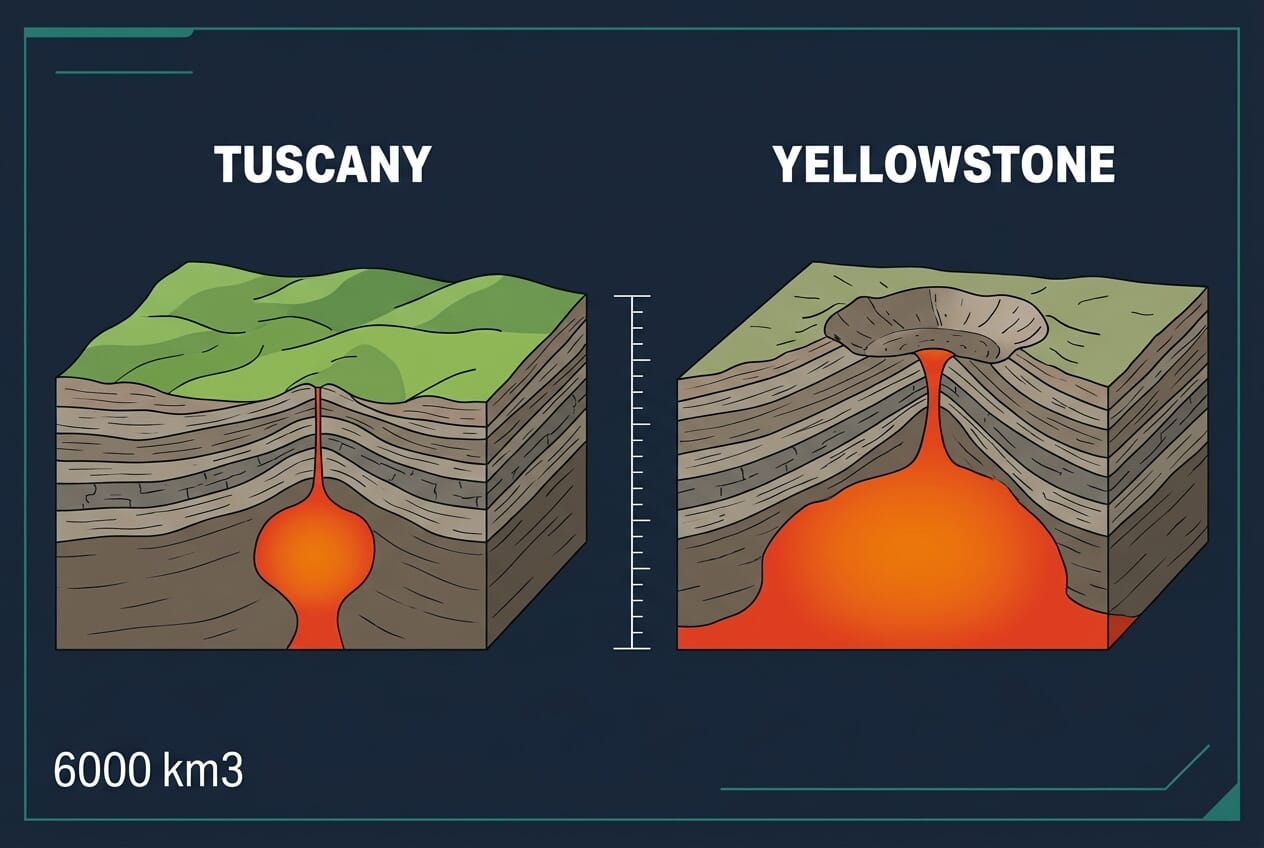
The study detected roughly 6,000 km³ of volcanic fluids — molten and partially molten rock — spread across a broad zone running north to south beneath Tuscany. The reservoirs sit at depths of 8 to 15 km within the continental crust, far below the surface but shallow enough to influence geothermal activity above.
To put the volume in perspective: Yellowstone’s magma chamber holds an estimated 10,000–15,000 km³ of partially molten rock. Tuscany’s 6,000 km³ makes it one of the largest known magma accumulations in a continental setting — and the first of this scale identified in Italy outside of well-known volcanic zones like Vesuvius and Campi Flegrei.
How They Found It
The team used ambient noise tomography — a technique that analyzes natural ground vibrations (seismic noise from ocean waves, wind, and human activity) rather than relying on earthquakes or explosive sources. By recording these vibrations across a dense network of seismic sensors, researchers reconstructed detailed 3D images of subsurface structures.
Magma slows down seismic waves significantly compared to solid rock. The tomographic images revealed large zones of anomalously slow wave speeds at 8–15 km depth, consistent with reservoirs of partially molten rock. Matteo Lupi described the method as “quick and economical” compared to traditional deep-earth imaging, noting it could be applied to other regions suspected of harboring hidden magma.
Tuscany’s Geothermal History
The discovery didn’t come entirely out of nowhere. Tuscany has long been one of Europe’s most active geothermal regions:
- Larderello — Home to the world’s first geothermal power plant (1904), Larderello sits directly above the newly mapped magma zone. Its high-enthalpy steam fields have been producing electricity for over a century.
- Monte Amiata — An extinct volcano (last eruption roughly 200,000 years ago) with medium-enthalpy geothermal resources, hot springs, and historical mercury mining.
- Hot springs — Tuscany is dotted with natural thermal springs, from Saturnia to Bagno Vignoni, all fed by heat from below.
What the new study adds is the source: these surface expressions of heat are connected to a much larger, deeper magma system than previously understood. The geothermal fields at Larderello and Monte Amiata are essentially windows into a vast underground reservoir.
Is There a Volcanic Risk?
The short answer: not right now. Lupi was explicit in the paper: “Although this magma body could, in theory, contribute to the formation of a supervolcano over geological timescales, it currently poses no threat.”
Several factors support this assessment:
- The magma is deep (8–15 km) — far below the 3–5 km depth where most eruptive magma chambers form
- There are no surface indicators of imminent volcanic activity (no uplift, no significant seismicity, no gas emissions)
- Tuscany has no recorded volcanic eruptions in human history
- The reservoirs appear stable — they’ve likely been in place for millions of years
For comparison, Campi Flegrei near Naples — which has a shallower magma chamber at roughly 5 km depth — experiences regular seismic unrest and ground uplift, clear signs of an active volcanic system. Tuscany shows none of these warning signs.
Italy’s Volcanic Context
Italy sits on the boundary between the African and Eurasian tectonic plates, making it one of Europe’s most volcanically active countries. The newly discovered Tuscany reservoir joins a roster of known volcanic systems:
- Vesuvius (Naples) — Most famous for destroying Pompeii in 79 AD. Still actively monitored, with 3 million people living in its shadow.
- Campi Flegrei (Naples) — A supervolcanic caldera experiencing ongoing unrest. Its last major eruption was in 1538.
- Etna (Sicily) — Europe’s most active volcano, erupting frequently with lava flows and ash plumes.
- Stromboli (Aeolian Islands) — One of the world’s most continuously active volcanoes, erupting every few minutes.
Tuscany’s reservoir is fundamentally different from these systems. It lacks the shallow conduits and surface venting that characterize active volcanoes. Think of it as a deep, sleeping heat source rather than a volcano waiting to erupt.
What It Means for Energy and Resources
Beyond the headline-grabbing “supervolcano” comparisons, the practical significance of the discovery may lie in energy and mining. Lupi emphasized that the findings could help pinpoint:
- Geothermal energy: Tuscany already produces geothermal power at Larderello. Understanding the full extent of the heat source could expand production significantly.
- Lithium deposits: Magmatic fluids often carry dissolved lithium — a critical mineral for EV batteries. Geothermal brines in volcanic regions are increasingly targeted as lithium sources.
- Rare earth elements: Similar magmatic processes concentrate rare earths needed for wind turbines, electronics, and defense applications.
As Europe pushes to reduce dependence on Chinese rare earth supplies and expand domestic clean energy, a better understanding of Tuscany’s underground could have strategic value well beyond academic geology.
What Comes Next
The University of Geneva team plans to continue refining their tomographic models with additional sensor data. Future work will focus on determining the exact composition and temperature of the magma — key variables for assessing both volcanic potential and resource extraction feasibility.
For the millions of people living in Tuscany, the immediate takeaway is reassuring: there is no eruption risk on any human timescale. But the discovery is a reminder that even Europe’s most serene landscapes can sit atop vast, hidden forces — and that the same forces could help power the continent’s energy transition.
Image Sources:
- Featured image generated with Google Gemini AI – Illustration of Tuscany landscape with magma cross-section