
Key Takeaways
- A Saharan heat dome is to blame. A dome of high pressure dragged scorching air north from North Africa and parked it over Western Europe, with the heat peaking between 20 and 23 June 2026.
- Iberia is the hottest. Spain and Portugal pushed toward 44°C (111°F), with 42.7°C (109°F) recorded at Pinhão (Portugal) and Andújar (Spain) on 21 June, the heatwave’s highest readings.
- France went on red alert. Highs of 40–44°C (104 to 111°F) put 49 of 96 mainland departments under the top heat warning; hundreds of schools closed or cut hours.
- The UK broke its June record. Around 38°C (100°F) beat the 35.6°C (96°F) set in Southampton in 1976, the hottest June day ever recorded in the United Kingdom.
- Deadly and disruptive. Heat-related deaths, wildfire alerts across France and Iberia, and heat-stressed power grids (blackouts in Turin) followed the spike.
- Not a one-off: a third wave is here. June's heat was one of at least three heatwaves this summer. A third wave began building over Western Europe in mid-July 2026, with Iberia and France again forecast to reach the low-to-mid 40s Celsius.
An exceptionally early and intense heatwave swept across Europe in the days around the 2026 summer solstice, sending temperatures 14–18°C (25 to 32°F) above normal for late June and breaking long-standing records. A stagnant heat dome, a sprawling area of high pressure feeding on hot Saharan air, settled over the continent, with the most brutal heat concentrated over the Iberian Peninsula and France between 20 and 23 June.
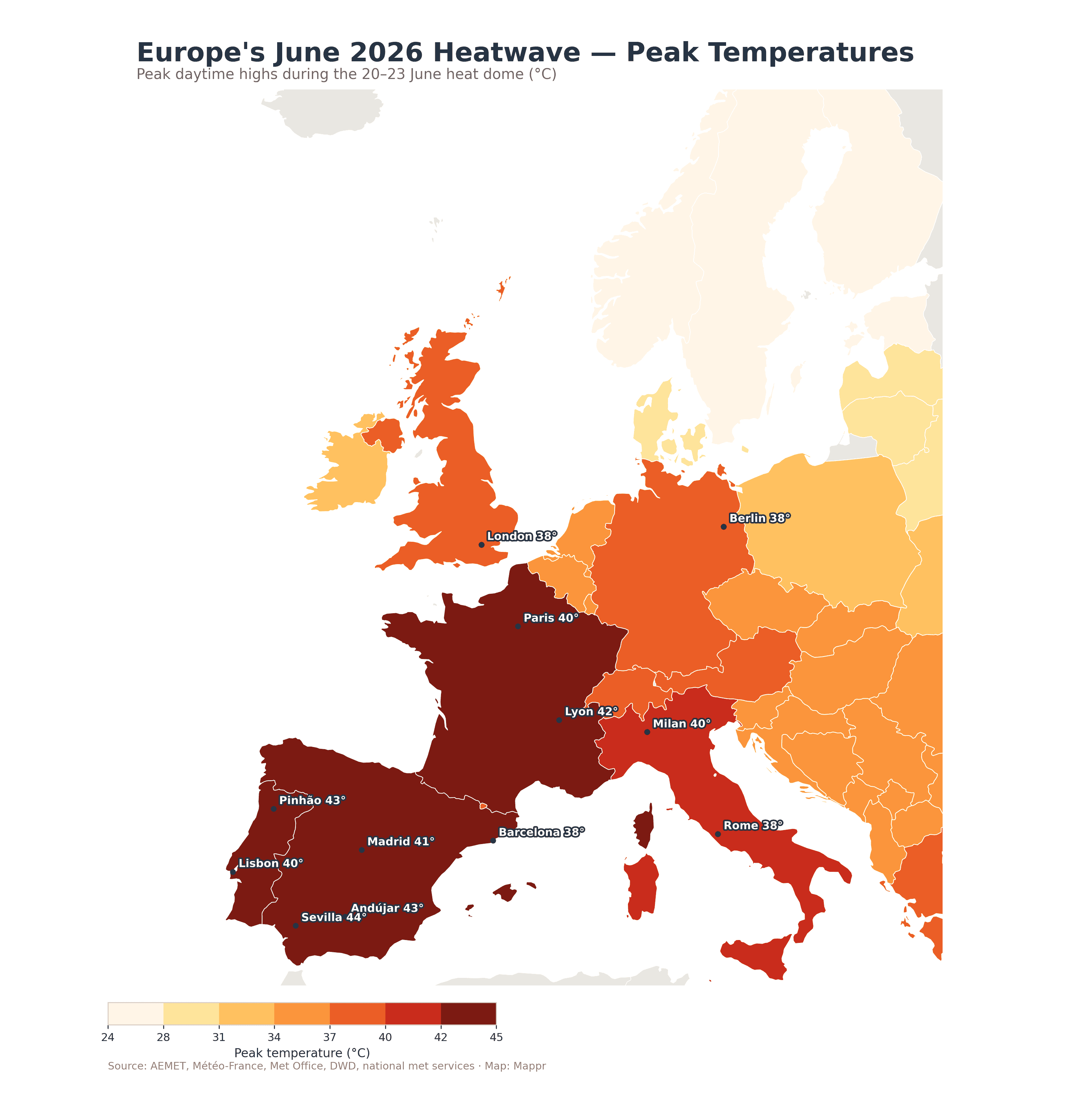
The map below shows the peak daytime highs reached during the heatwave. The gradient tells the story of the heat dome itself: a blast-furnace core over Spain, Portugal and France, then spreading east into Germany, Poland and central Europe later in the month, while barely touching the cooler Nordic and Baltic fringe.
Explore the heatwave, city by city
The static map above shows the peak. The interactive version below lets you explore it city by city. Tap any marker for that city’s peak temperature and whether it set a record, with the colour scaling from amber to deep red as the heat climbs.
The human toll: heatwave deaths across Europe
Update, 11 July 2026: Europe is now enduring its third heatwave in six weeks. Copernicus describes the relentless succession of waves, after spells in late May and the record-breaking heat of late June, as a hallmark of a warming climate. A powerful heat dome has locked back into place over Western and Southwestern Europe and is forecast to hold for at least another week. The heat is already building across Iberia and southwestern France and is set to intensify after 12 July, with forecasters expecting highs into the low-to-mid 40s Celsius across Spain and Portugal and up to 45°C (113°F) in central, western and southwestern France, enough to challenge some regional July records. Barcelona has already logged its hottest temperature in 112 years (9 July), and the United Kingdom, under an amber extreme-heat alert across almost all of England, broke its record for the most days above 34°C in a single year. The renewed heat is fanning the deadly wildfires burning across southern Europe, where a blaze near Los Gallardos in Almería, Spain has killed at least 12 people.
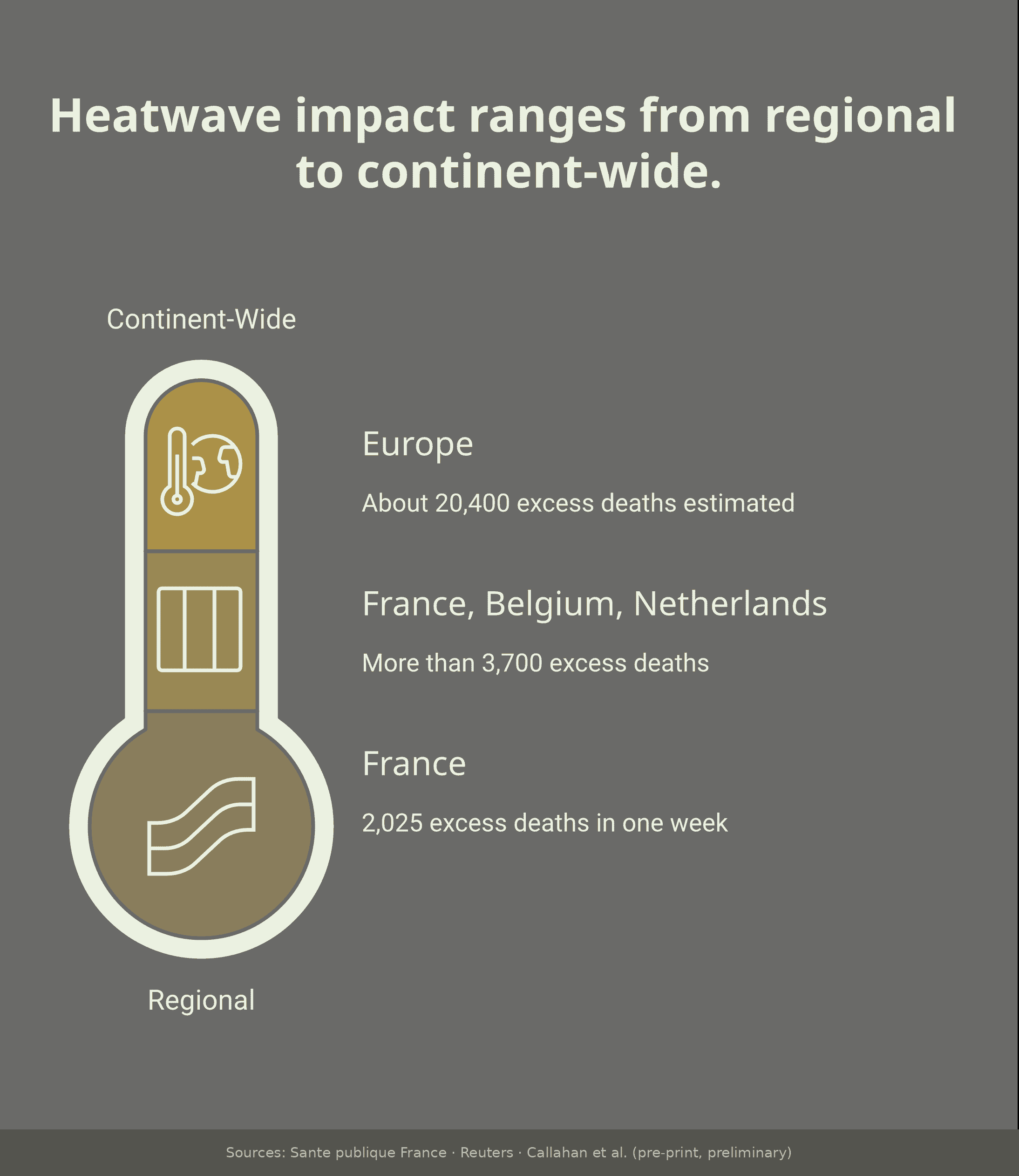
Update, 5 July 2026: the heatwave is over. Atlantic air swept the last of the heat out of Central Europe around 1 July, closing the books on a roughly ten-day event. The official counts have grown grimmer as mortality data firmed up: France recorded 2,025 excess deaths between 22 and 28 June, a 30% jump in overall mortality (62% in the Paris region), double its first estimate. Together with Belgium (~1,200) and the Netherlands (~480), the three countries alone logged more than 3,700 excess deaths. A first rapid modelling study (a pre-print by climate scientist Christopher Callahan) puts the plausible continent-wide toll near 20,400 excess deaths, led by France, Germany, Spain and Italy; that figure is preliminary, but it would make this one of Europe’s deadliest heat events since 2003. And the respite is thin: by 4-5 July a fresh pulse of 45°C (113°F) heat and wildfires was already building over Iberia.
Update, 30 June 2026: WHO Director-General Tedros Adhanom Ghebreyesus has now put the toll at more than 1,300 excess deaths across Europe since 21 June, calling heat stress a “silent killer” and warning that European homes, workplaces and schools “were not built for these temperatures.” As the heat dome pushed east in the final days of June, it set a wave of fresh national records: Germany hit 41.7°C (107°F) at Coschen, near the Polish border, on 28 June, its hottest day on record for a third day running, while Poland reached an all-time high of 40.5°C (105°F) at Słubice and the Czech Republic logged 41.1°C (106°F) at Doksany.
Update, 29 June 2026: the heatwave is now breaking down. Cooler Atlantic air and thunderstorms are pushing in from the west, ending the heat across Spain, France and the Benelux, with the last hot spots over Germany, Poland and the Balkans expected to clear by around 1 July. The human cost is coming into focus: the World Health Organization estimates more than 1,300 excess deaths across Europe since 21 June, including around 1,000 in France and 327 heat-attributed deaths in Spain. Officials caution that heat deaths are undercounted at first, so the totals will keep rising as excess-mortality data firms up.
Update, 28 June 2026: the heatwave has peaked and is easing in the west, but it has left a heavy toll. France’s public-health agency reports around 1,000 excess deaths during the peak, mostly among people over 65 in red-alert areas. Records fell as the heat reached its climax: Germany set a provisional national record of 41.3°C (106°F) near Saarbrücken on 27 June, France hit its hottest June day on record at 43.3°C (110°F), and the United Kingdom reached a new June record of 37.1°C (99°F) at Cavendish in Suffolk. Wildfires have flared in eastern Germany and across the Mediterranean as the dried-out landscape ignites.
Update, 27 June 2026: the heatwave has pushed deep into central and eastern Europe. Germany has breached 40°C (104°F), with peaks near 41°C and some autobahns buckling in the heat, and Poland and the Balkans are next in line as the World Meteorological Organization warns the heat dome will keep shifting east. The United Kingdom logged a fresh June record of 36.9°C (98°F), and Italy has confirmed at least five heat-related deaths, including two farm workers and a homeless man. Across western Europe, dozens of deaths have now been linked to the heat.
Update, 25 June 2026: the heat dome, a stubborn “Omega block,” is now shifting east and intensifying. Germany is forecast to reach about 41°C (106°F) on Friday and Saturday after hitting 38°C (100°F), Italy has placed its highest-level heat alert on 16 cities including Rome, Milan, Florence, Turin and Verona, and Austria is bracing for more. The United Kingdom has confirmed its hottest June day on record. In France the heat is now linked to around 50 deaths, most of them drownings as people sought relief in rivers and lakes.
Update, 24 June 2026: the heatwave has turned deadly. The night of 22–23 June was France’s hottest since 1947, red alerts remain in force across France, Spain, Italy and the UK, and the World Health Organization has called the event a “health emergency,” estimating that heat has killed roughly 200,000 people in Europe over the past four years. Official death tolls always lag, full excess-mortality counts emerge weeks later, but here is what national authorities and media have confirmed so far.
| Country | Deaths reported so far | Details (as of 30 June 2026) |
|---|---|---|
| 🇪🇺 Europe-wide (WHO) | 1,300+ | WHO estimate of excess deaths across Europe since 21 June 2026; modeled excess mortality, not all formally classified as heat-caused |
| 🇫🇷 France | ~1,000 | About 1,000 excess deaths during the peak, mostly people over 65 in red-alert areas, per France’s public-health agency, plus around 48 drownings |
| 🇪🇸 Spain | 327 | 327 heat-attributed deaths since 21 June (Spain’s MoMo daily-mortality monitoring), on top of a record 101 in May. Peaked at 45.1°C (113°F) in Andújar |
| 🇬🇧 United Kingdom | ~25 | Around 25 water- and heat-related deaths; a new June record of 37.1°C (99°F) was recorded at Cavendish, Suffolk |
| 🇮🇹 Italy | At least 5 | Confirmed heat-related deaths including two farm workers and a homeless man; highest-level alert on 16+ cities as the dome shifts east |
| 🇩🇪 Germany | Dozens | Dozens of deaths linked to the heat; the national record was raised again to 41.7°C (107°F) at Coschen on 28 June, a third straight record day |
| 🇵🇹 Portugal | Not yet tallied | Under heat warnings; authorities are monitoring excess mortality |
A few caveats matter. These are preliminary figures that will almost certainly be revised upward as official excess-mortality data comes in. And the causes differ: most of France’s deaths are drownings, people getting into difficulty while trying to cool off, rather than classic heatstroke, while Spain’s 101 is a heat-attributed total for May, before this latest spike. For scale, France alone averages around 5,400 heat deaths a year, and the deadly summer of 2003 killed an estimated 70,000 people across Europe.
A heat dome over Western Europe
The driver was a powerful upper-level ridge building northward out of northwest Africa, creating a classic heat dome: sinking air under high pressure compresses and warms, skies stay cloudless, and the ground bakes day after day. Because the system was so stagnant, heat accumulated rather than dispersing, each day started warmer than the last, and nights offered little relief. Forecasters flagged Monday 22 June as the likely peak of the “brutal” heat before the ridge slowly shifted.
Where it was hottest
🇪🇸 Spain and 🇵🇹 Portugal sat under the core of the dome. Both countries were forecast to approach 44–45°C (111 to 113°F), and on 21 June the mercury hit 42.7°C (109°F) at Pinhão in Portugal’s Douro valley and at Andújar in southern Spain, the highest confirmed readings of the event. Seville and Córdoba were among the worst-hit Spanish cities.
🇫🇷 France baked in 40–44°C (104 to 111°F) heat, with the Rhône valley and the southwest hottest. 🇮🇹 Italy’s northern plains climbed into the low 40s°C (around 105°F), while 🇩🇪 Germany reached the high 30s°C (around 100°F) in the south. Further from the core, 🇬🇧 the UK and 🇮🇪 Ireland stayed cooler but still unusually hot, and the 🇸🇪 Nordic and Baltic countries largely escaped, topping out in the high 20s°C (low-to-mid 80s°F).
Records tumbling
The most striking record came from the United Kingdom, where the Met Office confirmed a new record for the hottest June day ever, with around 38°C (100°F) beating the previous mark of 35.6°C (96°F) set in Southampton in 1976. Across the continent, the event stood out less for any single all-time high than for its timing and breadth: heat of this intensity is more typical of late July or August, not the third week of June. In Austria, GeoSphere stations logged up to 36.6°C (98°F) at Bad Deutsch-Altenburg on 21 June. As the dome slid east at the end of the month, the records kept falling: Germany reached 41.7°C (107°F) at Coschen on 28 June, while Poland (40.5°C / 105°F at Słubice) and the Czech Republic (41.1°C / 106°F at Doksany) set all-time national highs.
Red alerts, wildfires and health
France placed 49 of its 96 mainland departments under a red alert, the highest level, and closed or shortened the day at hundreds of schools. Italy issued red warnings for cities including Rome, Florence, Bologna and Turin, where heat-stressed underground cables triggered repeated blackouts. Emergency services and military units across France and Iberia were placed on wildfire alert as the heat dried out vegetation, and authorities reported a rising toll of heat-related deaths. The prolonged heat also deepened drought conditions heading into summer.
The Aftermath: What Governments Are Changing
The political response began before the heat had fully cleared. France unveiled an emergency farm package (accelerated insurance payouts for heat-damaged crops, closer livestock-loss monitoring and earlier triggers for water restrictions) and faces pressure to adapt schools after hundreds were closed at the peak. Spain is expanding its network of public climate shelters, air-conditioned refuges in libraries and civic buildings pioneered by Barcelona. Several Italian regions re-imposed bans on outdoor work during the hottest hours, a measure first tested in 2025 that is hardening into standard summer policy.
At the European level, the event turned access to cooling into a political issue: air conditioning, long rare in Northern European homes, schools and care homes, is now debated as essential infrastructure, and the European Commission faces calls to fold heat resilience (efficient cooling, renovated buildings, urban greening) into its climate agenda. The WHO, which called heat a “silent killer” as the toll passed 1,300, is pressing every European country to adopt a formal heat-health action plan: early-warning systems, designated cool spaces, and protocols for care homes and outdoor workers. More than half of European countries still lack such a plan, and the WHO’s stated goal is blunt: since nearly all heat deaths are preventable, the target should be zero. Europe is the fastest-warming continent, heating at roughly twice the global average; June 2026 made the cost of treating that as an abstraction brutally concrete.
Why these heatwaves keep coming earlier
Europe is the fastest-warming continent, heating at roughly twice the global average. As the baseline climate warms, the same weather patterns that have always brought summer heat now deliver more extreme spikes, and they arrive earlier in the season. Meteorologists pointed to climate change as a clear contributing factor in the unusually early onset of this heatwave. Events that were once rare are becoming a near-annual feature of European summers, with serious implications for health, agriculture, energy demand and the wildfire season.
For the latest forecasts and warnings, always check your national weather service, and during a heatwave, stay hydrated, avoid the midday sun, and check on elderly neighbours and anyone living alone.
Data and references: