Key Takeaways
- 48,619 people, still unaccounted for. Since 1980, the UN's Working Group on Enforced Disappearances has transmitted 61,626 cases to governments in 115 countries. Nearly 49,000 of them, in 100 countries, have never been clarified: the person was never found, alive or dead.
- Iraq carries a third of the world's docket. Iraq alone has 16,428 outstanding UN cases, more than the next four countries combined, followed by Sri Lanka (6,282) and a tier of Latin American 'dirty war' legacies led by Argentina, Guatemala, Peru and El Salvador.
- It is not just history. Russia's docket jumped by more than 400 cases in a single year as the Working Group took up disappearances from the war in Ukraine, and its 2026 sessions cite ongoing cases involving China, Egypt, Russia, Venezuela and the United States.
- The UN numbers are the tip of the iceberg. The map counts only formally documented UN cases. Syria's true toll is estimated in the tens of thousands, and Mexico's national registry lists over 100,000 missing, against just 355 and 697 UN cases respectively.
- A 20-year-old convention, still missing signatures. 30 August is the International Day of the Victims of Enforced Disappearances, and 2026 marks 20 years since the UN adopted the convention against the practice. Only 77 states have ratified it.
There is a category of loss with no grave, no certificate and no end: the enforced disappearance, when a state (or forces acting with its blessing) takes a person and then denies knowing where they are. Ahead of the International Day of the Victims of Enforced Disappearances on 30 August, we mapped the UN’s entire docket: every case formally transmitted to a government since 1980 that has never been resolved. There are 48,619 of them, in 100 countries.
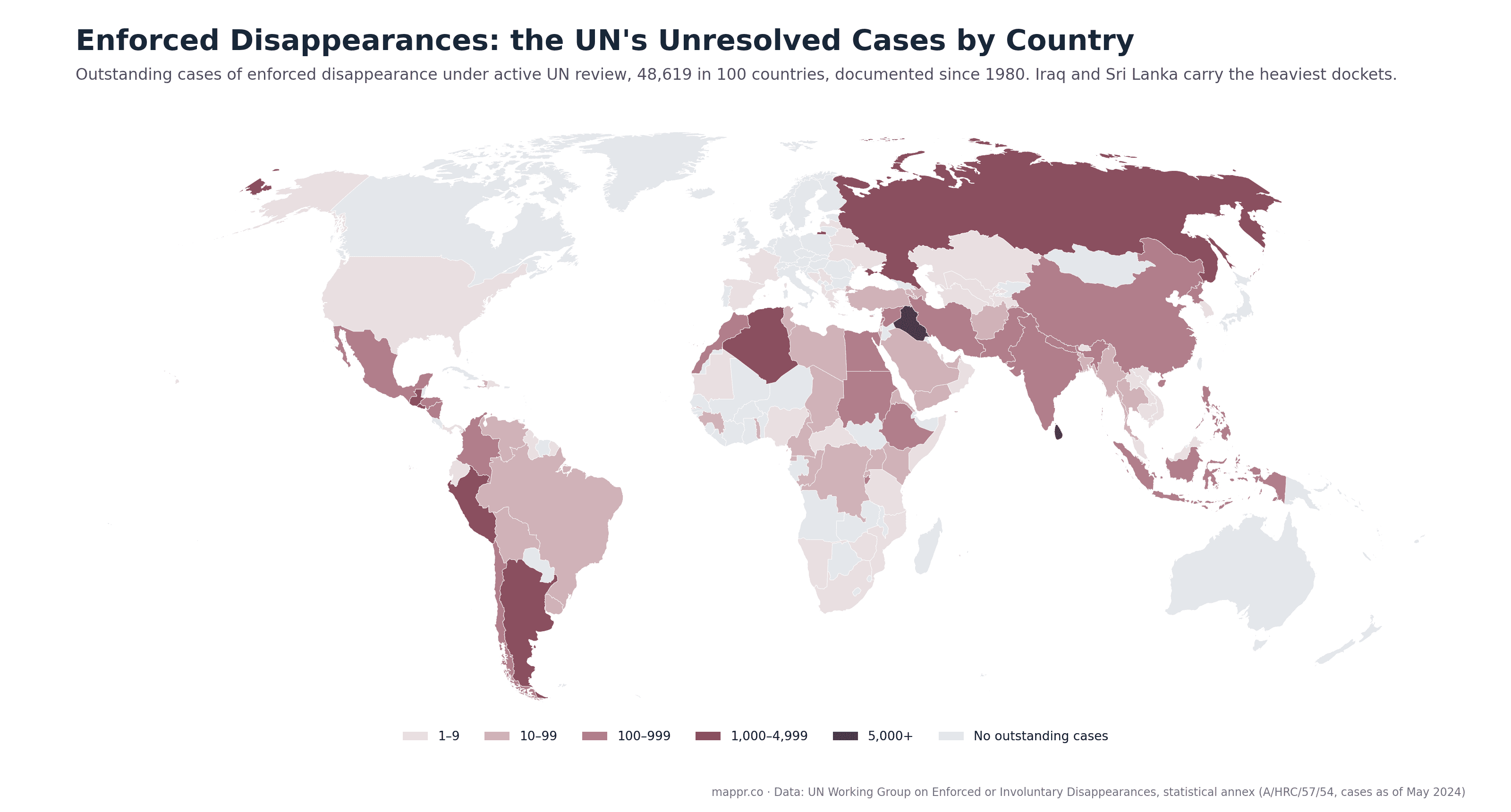
The map is a geography of the 20th century’s worst decades, still open. The UN’s Working Group on Enforced or Involuntary Disappearances (WGEID), created in 1980 as the first of the UN’s thematic human-rights mechanisms, transmits individual cases to governments and keeps them on its books until the fate of the person is clarified. Most never are: of 61,626 cases transmitted in 45 years, almost four in five remain outstanding.
The 15 heaviest dockets
| Country | Outstanding cases | Main historical context |
|---|---|---|
| 🇮🇶 Iraq | 16,428 | Ba’athist era and post-2003 conflict; ISIL-era abductions |
| 🇱🇰 Sri Lanka | 6,282 | Civil war (1983–2009), especially its final phase |
| 🇩🇿 Algeria | 3,313 | ‘Dark decade’ civil conflict of the 1990s |
| 🇦🇷 Argentina | 3,061 | Military junta’s ‘Dirty War’, 1976–1983 |
| 🇬🇹 Guatemala | 2,897 | Civil war, 1960–1996 |
| 🇵🇪 Peru | 2,361 | Internal conflict, 1980–2000 |
| 🇸🇻 El Salvador | 2,283 | Civil war, 1980–1992 |
| 🇷🇺 Russia | 2,149 | Chechnya wars; new cases from the war in Ukraine |
| 🇨🇴 Colombia | 944 | Armed conflict with FARC, ELN and paramilitaries |
| 🇵🇰 Pakistan | 934 | Balochistan and post-2001 ‘war on terror’ detentions |
| 🇨🇱 Chile | 787 | Pinochet dictatorship, 1973–1990 |
| 🇸🇾 Syria | 697 | Assad era; the true scale is in the tens of thousands |
| 🇵🇭 Philippines | 592 | Marcos era and later counter-insurgency campaigns |
| 🇮🇷 Iran | 572 | 1980s mass executions and ongoing repression |
| 🇳🇵 Nepal | 480 | Civil war, 1996–2006 |
Iraq is in a class of its own with 16,428 unresolved cases, the sediment of half a century: Saddam-era purges, the Iran-Iraq war, the Anfal campaign against the Kurds, post-2003 sectarian violence and ISIL’s abductions. Sri Lanka follows with 6,282, most from the civil war’s brutal final years. Then comes the Latin American tier: Argentina, Guatemala, Peru, El Salvador and Chile, where military regimes of the 1970s and 1980s made ‘the disappeared’ (los desaparecidos) a word the world had to learn.
Not just history
The instinct is to read this map as an archive. It is not. Russia’s docket grew from 1,721 to 2,149 in a single year as the Working Group took up cases of Ukrainian civilians who vanished into Russian custody, one of the sharpest single-year increases any country has recorded. And the Working Group’s May 2026 session transmitted new urgent actions involving China, Egypt, Russia, Venezuela and the United States, a reminder that the practice spans every region and every kind of government.
The iceberg problem
The UN’s numbers are precise, verified and vastly incomplete. They count only cases that families or NGOs managed to file with Geneva, which takes access, safety and knowledge that the mechanism exists. Syria shows the gap most starkly: the UN docket lists 697 cases, but since the fall of the Assad government, the International Commission on Missing Persons and Syrian organisations have been cataloguing the regime’s prisons and mass graves, with estimates of the truly disappeared running into the tens of thousands. Mexico is the other extreme: its own national registry counts more than 100,000 missing, largely from cartel violence with state complicity, while the UN docket holds just 355, because most families file at home, not in Geneva. The map, in other words, is a floor.
Twenty years of an unfinished convention
The date of 30 August was chosen by the UN in 2010, but 2026 gives it extra weight: it is the 20th anniversary of the International Convention for the Protection of All Persons from Enforced Disappearance, adopted in December 2006 to make the practice a distinct crime under international law, with no war, emergency or order from above accepted as justification. Two decades on, only 77 states have ratified it, well under half the world. Among the missing signatures are most of the countries at the top of the map above. The UN’s slogan for 2026 is “Victims first. Actions now.”; the map shows how much action remains. For more on how states behave under pressure, see our maps of sanctions by country and travel advisories worldwide.
Sources: