
Key Facts: The Pound Sterling
- ISO 4217 code: GBP · Symbol: £. Divided into 100 pence (p). Sterling is the world's oldest continuously used currency, tracing to Anglo-Saxon silver pennies around AD 971.
- Central bank: Bank of England (est. 1694). The 'Old Lady of Threadneedle Street' — operationally independent since May 1997. Governor Andrew Bailey since March 2020. 2% CPI inflation target.
- Bank Rate: 3.75% · Inflation forecast ~4% for 2026. Down from a 5.25% peak in Aug 2023. Held at 3.75% at the April 2026 MPC meeting as the MPC assesses energy-shock inflation risk.
- 1 GBP ≈ 1.3517 USD. Known in markets as 'Cable'. Range over the past year ~1.27 to 1.37 USD per pound.
- UK never joined the euro. An EU member 1973–2020 with a formal euro opt-out, the UK kept sterling throughout. Brexit took effect 31 January 2020.
What Is the Currency of the United Kingdom?
The currency of the United Kingdom is the pound sterling (symbol £, ISO 4217 code GBP). It is subdivided into 100 pence (p), a change from the pre-1971 system in which the pound was divided into 20 shillings of 12 pence each (240 pence per pound). Sterling is the world’s oldest currency still in continuous use — its roots run back to Anglo-Saxon silver pennies around AD 971.
The pound is issued by the Bank of England, founded on 27 July 1694 as the government’s banker and the second-oldest central bank in the world (after Sweden’s Sveriges Riksbank). Seven commercial banks in Scotland and Northern Ireland also issue sterling notes that are fully backed by Bank of England reserves.
Pound Sterling to US Dollar — 1-Year Chart
The chart below tracks the daily close of GBP/USD (‘Cable’) over the past twelve months — the oldest major FX pair, named after the 19th-century transatlantic telegraph cable. Drivers: the Bank of England–Fed policy-rate differential, UK growth surprises, gilt-market dynamics, and political events.
Line chart. Daily close, USD per GBP · Source: Yahoo Finance · Updated nightly. Data table with 2 rows and 132 columns follows.
| Oct 20 | Oct 22 | Oct 27 | Oct 29 | Oct 31 | Nov 04 | Nov 06 | Nov 10 | Nov 12 | Nov 14 | Nov 18 | Nov 20 | Nov 24 | Nov 26 | Nov 28 | Dec 02 | Dec 04 | Dec 08 | Dec 10 | Dec 12 | Dec 16 | Dec 18 | Dec 22 | Dec 24 | Dec 29 | Dec 31 | Jan 05 | Jan 07 | Jan 09 | Jan 13 | Jan 15 | Jan 19 | Jan 21 | Jan 23 | Jan 27 | Jan 29 | Feb 02 | Feb 04 | Feb 06 | Feb 10 | Feb 12 | Feb 16 | Feb 18 | Feb 20 | Feb 24 | Feb 26 | Mar 02 | Mar 04 | Mar 06 | Mar 10 | Mar 12 | Mar 16 | Mar 18 | Mar 20 | Mar 24 | Mar 26 | Mar 29 | Mar 31 | Apr 02 | Apr 06 | Apr 08 | Apr 12 | Apr 14 | Apr 16 | Apr 20 | Apr 22 | Apr 26 | Apr 28 | Apr 30 | May 04 | May 06 | May 10 | May 12 | May 14 | May 18 | May 20 | May 24 | May 26 | May 28 | Jun 01 | Jun 03 | Jun 07 | Jun 09 | Jun 11 | Jun 15 | Jun 17 | Jun 21 | Jun 23 | Jun 25 | Jun 29 | Jul 01 | Jul 05 | Jul 07 | Jul 09 | Jul 13 | Jul 15 | Jul 19 | Jul 21 | Jul 23 | Jul 27 | Jul 29 | Aug 02 | Aug 04 | Aug 06 | Aug 10 | Aug 12 | Aug 16 | Aug 18 | Aug 20 | Aug 24 | Aug 26 | Aug 30 | Sep 01 | Sep 03 | Sep 07 | Sep 09 | Sep 13 | Sep 15 | Sep 17 | Sep 21 | Sep 23 | Sep 27 | Sep 29 | Oct 01 | Oct 05 | Oct 07 | Oct 11 | Oct 13 | Oct 15 | Oct 19 | Oct 21 | |
|---|---|---|---|---|---|---|---|---|---|---|---|---|---|---|---|---|---|---|---|---|---|---|---|---|---|---|---|---|---|---|---|---|---|---|---|---|---|---|---|---|---|---|---|---|---|---|---|---|---|---|---|---|---|---|---|---|---|---|---|---|---|---|---|---|---|---|---|---|---|---|---|---|---|---|---|---|---|---|---|---|---|---|---|---|---|---|---|---|---|---|---|---|---|---|---|---|---|---|---|---|---|---|---|---|---|---|---|---|---|---|---|---|---|---|---|---|---|---|---|---|---|---|---|---|---|---|---|---|---|---|---|
| USD per GBP | 1.34 | 1.34 | 1.33 | 1.33 | 1.32 | 1.31 | 1.31 | 1.31 | 1.32 | 1.32 | 1.32 | 1.31 | 1.31 | 1.32 | 1.32 | 1.32 | 1.33 | 1.33 | 1.33 | 1.34 | 1.34 | 1.34 | 1.34 | 1.35 | 1.35 | 1.35 | 1.34 | 1.35 | 1.34 | 1.35 | 1.34 | 1.34 | 1.34 | 1.35 | 1.37 | 1.38 | 1.37 | 1.37 | 1.35 | 1.37 | 1.36 | 1.36 | 1.36 | 1.35 | 1.35 | 1.36 | 1.34 | 1.34 | 1.34 | 1.34 | 1.34 | 1.32 | 1.34 | 1.34 | 1.34 | 1.34 | 1.32 | 1.32 | 1.32 | 1.32 | 1.34 | 1.34 | 1.36 | 1.35 | 1.35 | 1.35 | 1.35 | 1.35 | 1.36 | 1.35 | 1.36 | 1.36 | 1.35 | 1.34 | 1.34 | 1.34 | 1.35 | 1.35 | 1.34 | 1.35 | 1.34 | 1.33 | 1.34 | 1.34 | 1.34 | 1.33 | 1.32 | 1.32 | 1.32 | 1.33 | 1.33 | 1.34 | 1.33 | 1.34 | 1.33 | 1.35 | 1.34 | 1.34 | 1.33 | 1.33 | 1.34 | 1.35 | 1.35 | 1.35 | 1.35 | 1.35 | 1.35 | 1.35 | 1.36 | 1.36 | 1.36 | 1.35 | 1.35 | 1.35 | 1.35 | 1.36 | 1.35 | 1.35 | 1.34 | 1.34 | 1.32 | 1.32 | 1.32 | 1.32 | 1.32 | 1.32 | 1.32 | 1.33 | 1.33 | 1.33 | 1.34 |
Over the past 12 months sterling has traded in a relatively narrow 1.27–1.37 range against the dollar, ending around 1.3517. The MPC’s 3.75% Bank Rate is notably higher than the ECB’s 2.00% — supporting sterling against the euro — but lower than the Fed’s 4.25%.
Pound Sterling Banknotes and Coins
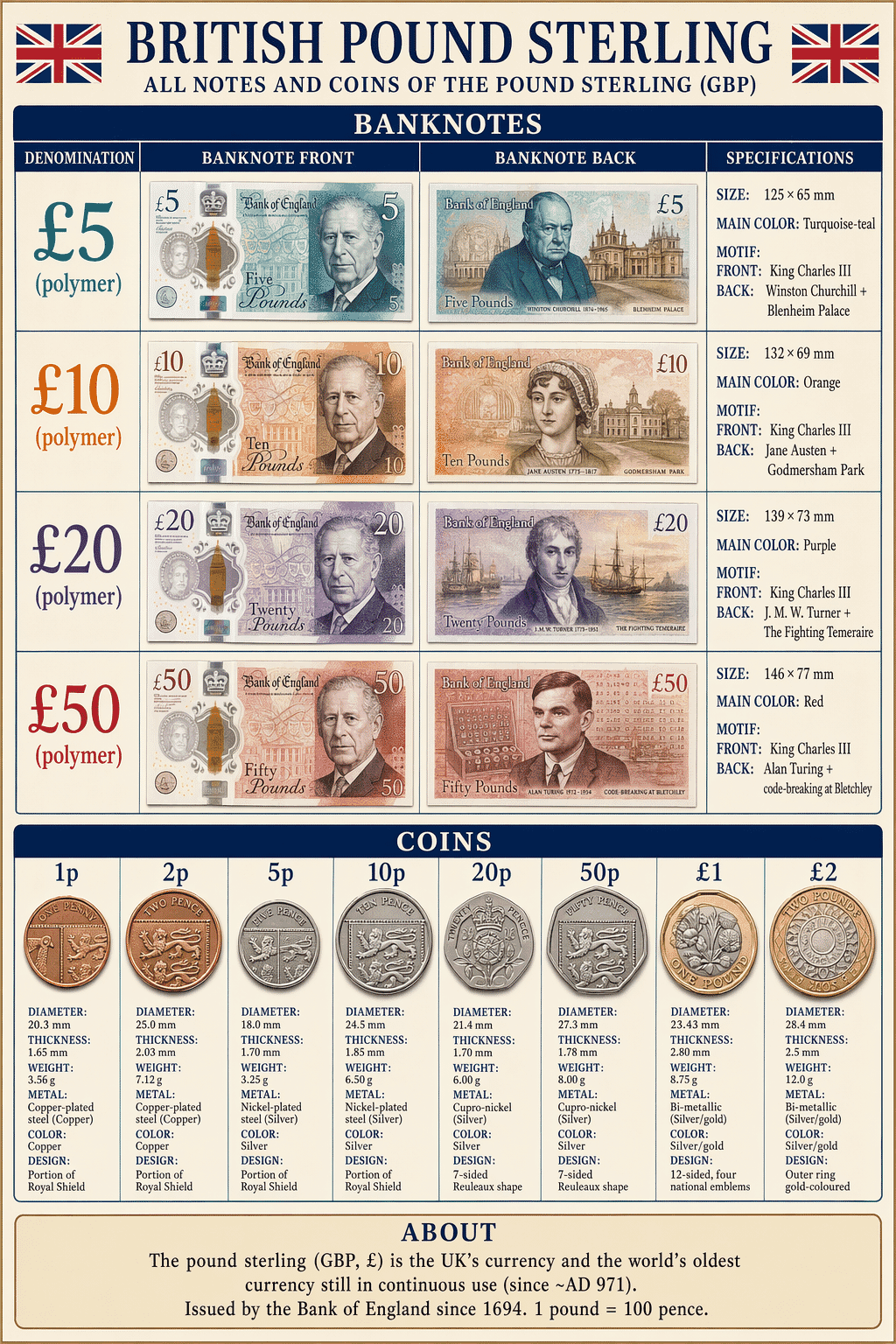
Bank of England banknotes switched from cotton paper to polymer between 2016 and 2021, dramatically improving durability and counterfeit resistance. All four denominations now feature a cultural figure on the reverse paired with the monarch on the obverse — King Charles III since June 2024, replacing Queen Elizabeth II.
| Denomination | Figure | Context | Colour |
|---|---|---|---|
| £5 | Winston Churchill (polymer, 2016) | Former Prime Minister; WWII leader | Turquoise-teal |
| £10 | Jane Austen (polymer, 2017) | Novelist (1775–1817), Pride and Prejudice | Orange |
| £20 | J. M. W. Turner (polymer, 2020) | Romantic painter (1775–1851) | Purple |
| £50 | Alan Turing (polymer, 2021) | Mathematician, father of modern computing | Red |
Coins carry the reigning monarch’s portrait on the obverse. A 2008 redesign by Matthew Dent turned the reverses of the 1p to 50p coins into jigsaw pieces of the Royal Shield, with the £1 coin showing the whole shield. The £1 coin itself was redesigned in 2017 as a 12-sided bi-metallic piece inspired by the old threepenny bit.
| Denomination | Description | Series |
|---|---|---|
| 1p, 2p | Copper-plated steel; portions of the Royal Shield | In circulation since 1971 (decimal Day) |
| 5p, 10p | Nickel-plated steel; portions of the Royal Shield | Since 1968 (reformed 2012) |
| 20p, 50p | Cupro-nickel; seven-sided Reuleaux heptagon shape | 20p since 1982, 50p since 1969 |
| £1 | Bi-metallic, 12-sided; floral emblems of the four UK nations | Current design since March 2017 |
| £2 | Bi-metallic with gold-coloured outer ring | Since 1998 |
A Short History of Sterling
Sterling’s continuous use for more than a millennium makes it the longest-running currency in the world. The central drama has been repeated: peg to gold, suspension in crisis, restoration, abandonment. The 1971 decimalisation was the most visible reform; the 1997 grant of independence to the Bank of England was arguably the more economically consequential.
| Year | Event |
|---|---|
| 971 | The pound sterling emerges from Anglo-Saxon silver pennies; one pound = 240 silver pennies. |
| 1694 | Bank of England founded on 27 July as the government’s banker; notes begin to replace goldsmith receipts. |
| 1816 | Gold standard formally adopted; gold sovereign issued. |
| 1914–1931 | Gold standard suspended in WWI; partial return 1925; final exit 21 September 1931. |
| 1971 | Decimalisation on 15 February (‘Decimal Day’) — 1 pound = 100 new pence replaces the old 240-penny system. |
| 1979–1992 | Sterling joins ERM 8 Oct 1990; ejected on ‘Black Wednesday’ 16 Sep 1992 after failed peg defence. |
| 1997 | Bank of England granted operational independence by Chancellor Gordon Brown on 6 May. |
| 2016 | Brexit referendum (23 June) triggers sterling’s largest one-day fall on record. |
| 2022 | ‘Mini-budget’ (23 Sep) sparks gilt-market crisis; sterling hits record $1.035 low on 26 Sep. |
| 2024 | Following Queen Elizabeth II’s death (2022), polymer notes bearing King Charles III enter circulation on 5 June. |
| 2025–2026 | BoE Bank Rate cut from 5.25% to 3.75% amid disinflation; held at 3.75% as of the April 2026 MPC meeting. |
The UK Economy and Sterling
The United Kingdom is the world’s sixth-largest economy by nominal GDP and the largest in Europe outside the Eurozone. London is the world’s second-largest foreign-exchange trading centre after the United States, handling around 38% of global FX turnover — so sterling’s behaviour is closely watched even by people who never hold a pound.
The Bank of England runs a symmetric 2% CPI inflation target. After CPI peaked at 11.1% in October 2022 amid the energy shock, it has since returned close to target. Bank Rate peaked at 5.25% in August 2023 and has been cut steadily since — held at 3.75% in April 2026 while the MPC assesses the new round of energy-price pressure from the Middle East conflict. Inflation is now forecast to rise back to ~4% before falling in 2027.
Using Pounds in the UK
The UK is one of the most cashless societies in Europe. Card payments overtook cash in 2017 and now account for over 80% of POS volume; contactless is the default. Visa, Mastercard, and increasingly Apple Pay and Google Pay are accepted in supermarkets, all chain restaurants, black cabs and Uber, on London buses and the Tube (no paper tickets — just tap in), and at nearly every independent café. Cash holds up in street markets, some pubs outside cities, and cash-only barbers.
Typical prices (2026): a coffee in a London independent café £3.20–£4.50; a meal deal at Tesco/Sainsbury’s/Boots £4.00–£5.00; a pint of beer in a London pub £6.00–£8.00, elsewhere £4.50–£6.50; a single London Tube fare (contactless, off-peak) £2.80; a mid-range London hotel room £150–£280. ATMs (cashpoints) are free at bank branches, supermarkets, and high-street post offices — avoid the blue ‘Link’ standalones and hotel lobby machines, which often charge £1.50–£2.75 per withdrawal.
Sterling Among Major European Currencies
Outside the euro, the UK is part of a small group of Western-European nations that kept their own currencies. Sweden (SEK), Norway (NOK), Switzerland (CHF), and Denmark (DKK, pegged to the euro) are its closest peers on regime; Poland (PLN) is the largest non-euro EU currency.
| Country | Code | Regime | Inflation | Policy rate |
|---|---|---|---|---|
| 🇬🇧 United Kingdom | GBP | Free float (BoE inflation target) | ~4% (2026f, energy shock) | 3.75% |
| 🇪🇺 Eurozone | EUR | ECB (free float) | 2.6% | 2.00% |
| 🇨🇭 Switzerland | CHF | Free float (SNB managed) | 0.5% | 0.00% |
| 🇳🇴 Norway | NOK | Free float (Norges Bank inflation target) | 3.0% | 4.00% |
| 🇸🇪 Sweden | SEK | Free float (Riksbank inflation target) | 0.9% | 1.75% |
| 🇩🇰 Denmark | DKK | ERM II peg 7.46038 DKK=1 EUR | 1.8% | 1.60% |
| 🇵🇱 Poland | PLN | Free float (NBP inflation target) | ~2.5% | 4.00% |
Frequently Asked Questions
What is the currency of the United Kingdom?
The currency of the United Kingdom is the pound sterling (symbol £, ISO 4217 code GBP). It is subdivided into 100 pence (‘p’). Sterling is the world’s oldest continuously used currency, dating back more than a thousand years to the Anglo-Saxon penny.
Is the United Kingdom in the Eurozone?
No. The UK was an EU member from 1973 until 31 January 2020, but never adopted the euro. The UK held a formal Treaty opt-out, and repeated political judgements (the “five economic tests” under Gordon Brown’s chancellorship) concluded the conditions for euro membership weren’t met. Brexit ended any prospect of joining the euro.
Who manages UK monetary policy?
The Bank of England, founded 1694 and granted operational independence in 1997. Its current governor is Andrew Bailey (since March 2020). The Monetary Policy Committee (MPC) sets Bank Rate to meet a symmetric 2% CPI inflation target. The MPC meets eight times a year.
What is the current Bank of England interest rate?
Bank Rate is 3.75% as of April 2026, down from a peak of 5.25% reached in August 2023. The Bank cut steadily through 2024–2025 as inflation fell, then held at 3.75% in early 2026 while assessing the inflation impact of Middle East energy shocks.
How many dollars is one pound worth?
At the latest daily close, 1 GBP = approximately 1.3517 USD. Sterling has been relatively stable against the dollar over the past 12 months, trading in a 1.27–1.37 range. GBP/USD is historically called ‘Cable’, a reference to the 19th-century transatlantic telegraph cable that transmitted the rate between London and New York.
Who are on current UK banknotes?
The current polymer series features four historical figures: Winston Churchill on the £5 (2016), Jane Austen on the £10 (2017), J. M. W. Turner on the £20 (2020), and Alan Turing on the £50 (2021). All notes were updated in 2024 to include the portrait of King Charles III in place of the late Queen Elizabeth II, though both versions remain legal tender.
Are Scottish and Northern Irish banknotes accepted in England?
Technically they are not legal tender in England, but they are legal currency and widely accepted — though some English shops and taxi drivers may decline them. Seven commercial banks issue their own notes: three in Scotland (Bank of Scotland, RBS, Clydesdale Bank) and four in Northern Ireland (Bank of Ireland, First Trust, Danske Bank, Ulster Bank). All are fully backed by Bank of England reserves.
All data current to April 2026 — Bank of England and ONS releases.

