Key Takeaways
- At least 274,000 deaths a year, far more than believed. A new PLOS Medicine study estimates snakebites kill at least 274,000 people annually, with the true toll possibly reaching 513,000. Even the low figure roughly doubles the previous benchmark estimates.
- The surprise: Africa outweighs South Asia. Sub-Saharan Africa accounts for 45% of global snakebite deaths, with incidence rates nearly three times South Asia's, a pattern never identified before. The old story that India dominates the global toll no longer holds.
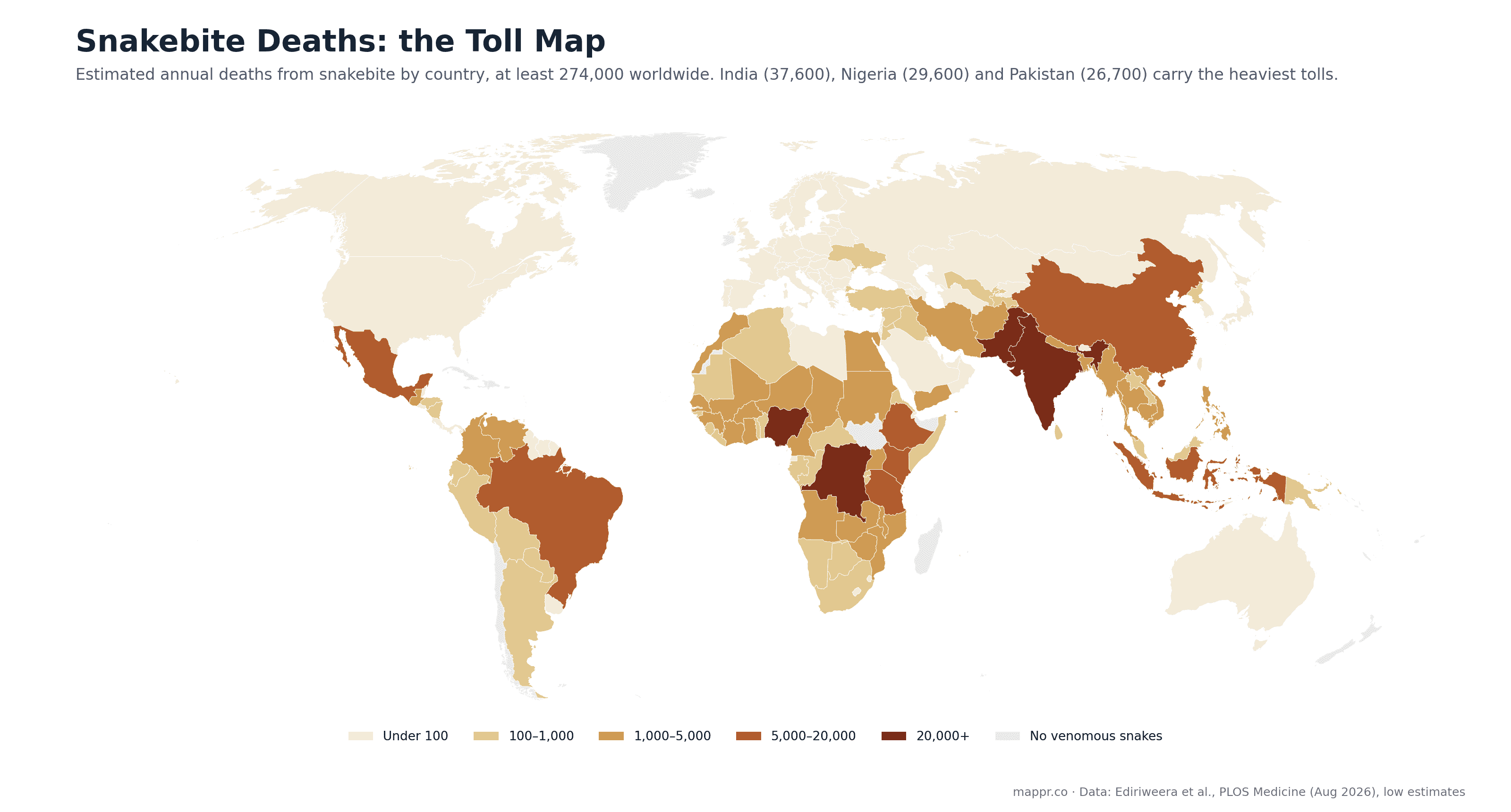
- India still leads by country, but not by much. India's estimated 37,600 deaths a year remain the world's highest, but Nigeria (29,600), Pakistan (26,700) and DR Congo (20,700) follow closer than anyone assumed. The top 20 countries carry 78% of all deaths.
- More than half the world's snake countries have no data. Of 170 countries with venomous snakes, 100 lack robust mortality data. Nearly a third of the estimated global burden falls in countries where nobody is systematically counting.
- A neglected disease with a working cure. Antivenom exists and works; the deaths concentrate where it is scarce, unaffordable or hours away. The WHO's target of halving snakebite deaths by 2030 now looks much further away than it did a month ago.
The deadliest animal encounter on Earth is not the one you would guess from the headlines. A major new study in PLOS Medicine, published on 25 August by researchers at the Liverpool School of Tropical Medicine and the University of Kelaniya in Sri Lanka, estimates that snakebites kill at least 274,000 people every year, and possibly as many as 513,000. Even the conservative figure is roughly double the long-standing benchmark estimates. We mapped the study’s country-level numbers, and they redraw the geography of one of the world’s most neglected causes of death.
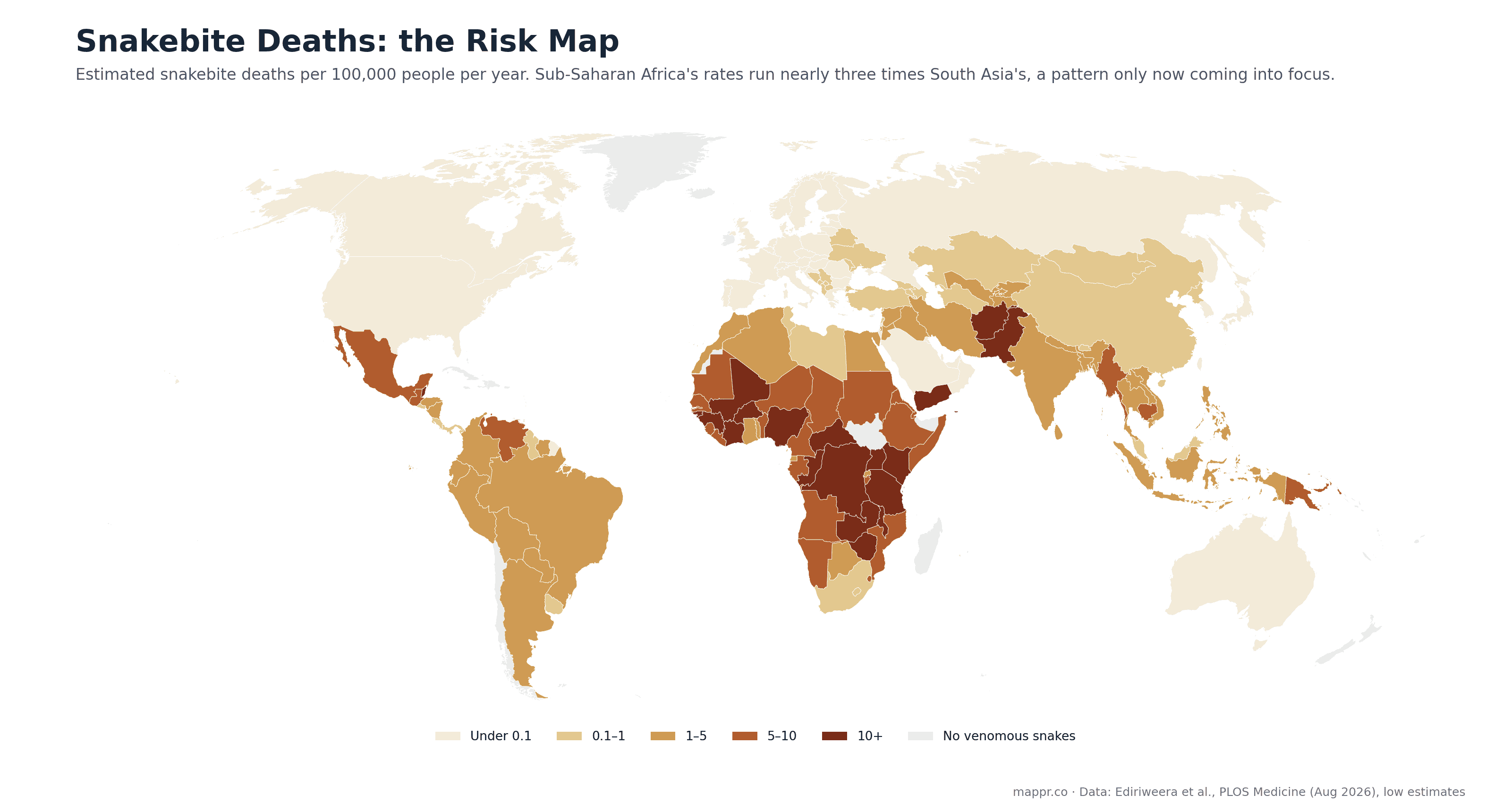
Mapped as a rate, the risk belt runs straight across the tropics: the Sahel and Central Africa burn darkest, with Mali (18.7 deaths per 100,000 a year), DR Congo (18.2) and Yemen (16.5) at the extreme, alongside Afghanistan and Pakistan. For comparison, the United States, with its rattlesnakes and copperheads and its ample stock of antivenom, loses a handful of people a year, a rate indistinguishable from zero.
The finding that rewrites the story: Africa first
For two decades the standard account held that India was half the global problem. The new modelling overturns that: Sub-Saharan Africa accounts for 45% of the world’s snakebite deaths, against 27% for South Asia, and its incidence rates run nearly three times higher, a pattern the authors note was never identified before. The reason it stayed hidden is brutally simple: Africa is where the counting is thinnest. Rural victims die at home or at traditional healers, never entering a hospital register.
The 15 heaviest tolls
| # | Country | Deaths/yr (low) | Deaths/yr (high) | Deaths per 100k |
|---|---|---|---|---|
| 1 | 🇮🇳 India | 37,600 | 70,100 | 2.7 |
| 2 | 🇳🇬 Nigeria | 29,600 | 55,300 | 13.8 |
| 3 | 🇵🇰 Pakistan | 26,700 | 50,500 | 11.6 |
| 4 | 🇨🇩 DR Congo | 20,700 | 38,700 | 18.2 |
| 5 | 🇲🇽 Mexico | 12,000 | 22,500 | 8.6 |
| 6 | 🇮🇩 Indonesia | 11,900 | 22,100 | 4.4 |
| 7 | 🇨🇳 China | 10,200 | 19,000 | 0.7 |
| 8 | 🇪🇹 Ethiopia | 9,400 | 17,600 | 9.1 |
| 9 | 🇧🇷 Brazil | 8,000 | 15,000 | 3.8 |
| 10 | 🇰🇪 Kenya | 7,200 | 13,500 | 13.1 |
| 11 | 🇹🇿 Tanzania | 5,850 | 11,000 | 10.5 |
| 12 | 🇾🇪 Yemen | 4,900 | 9,100 | 16.5 |
| 13 | 🇺🇬 Uganda | 4,850 | 9,100 | 11.4 |
| 14 | 🇲🇲 Myanmar | 4,600 | 8,650 | 9.7 |
| 15 | 🇲🇱 Mali | 4,350 | 8,100 | 18.7 |
India still tops the table at an estimated 37,600 deaths a year, concentrated in its rural rice-growing belt, where the ‘big four’ (Russell’s viper, common krait, Indian cobra and saw-scaled viper) do most of the killing. But the gap has closed dramatically: Nigeria, Pakistan and DR Congo together exceed India’s toll, and Mexico’s 12,000 makes Latin America a bigger part of the story than commonly assumed.
Do:
- Move away from the snake and stay as calm and still as possible; panic and movement speed the venom’s spread.
- Remove rings, watches and tight clothing near the bite before swelling starts.
- Immobilise the bitten limb like a fracture (a splint or sling helps) and keep it at or below heart level.
- Get to a hospital or clinic as fast as possible. Antivenom is the only effective treatment, and the earlier it is given, the better it works.
- Try to remember the snake’s appearance or photograph it from a safe distance; do not try to catch or kill it.
- If the person is vomiting or drowsy, lay them on their left side in the recovery position.
Do not:
- Do not cut the wound or try to suck out the venom, and do not apply a tourniquet; these cause serious harm and save no one.
- Do not apply ice, heat, chemicals or traditional remedies such as ‘black stones’ or herbs.
- Do not drink alcohol or take aspirin or ibuprofen, which can worsen bleeding from viper bites.
- Do not wait for symptoms to appear before seeking help; some deadly bites are painless at first.
Based on WHO snakebite first-aid guidance. This is general information, not a substitute for emergency medical care.
Counting the uncounted
The study’s method is as important as its result. The team reviewed nearly two decades of literature across 79 countries, then used geostatistical modelling to correct a known bias: hospital registers systematically miss snakebite deaths. Where community surveys exist (researchers going village to village), they consistently find several times more deaths than official records. The ‘low’ estimates on our maps apply a partial correction; the ‘high’ ones assume the survey-level undercount applies broadly. The honest answer lies somewhere between 274,000 and 513,000, and of 170 countries with venomous snakes, 100 have no robust mortality data at all.
That makes snakebite arguably the world’s deadliest neglected tropical disease, killing more people than dengue, cholera and Ebola combined in a typical year, with a century-old, working treatment. Antivenom is scarce, cold-chain-dependent and often unaffordable exactly where the risk map above burns darkest. The WHO has targeted a halving of snakebite deaths by 2030; this study suggests the starting line was twice as far back as anyone thought.
Sources: