Key Takeaways
- Yes, the 2026-27 season has already started, and early. Japan's season began roughly six weeks ahead of schedule with school closures by September; the Netherlands and Switzerland show Europe's earliest signals, and the US West Coast is ticking up.
- The strain to watch is H3N2 subclade K. A new H3N2 variant (J.2.4.1, 'subclade K') emerged in August 2025 and now makes up the majority of recently analyzed H3N2 viruses worldwide, driving the early starts.
- Australia's just-finished season is the preview. About 171,000 lab-confirmed cases in a subclade-K dominated season: a heavy year, though far below 2025's all-time record of ~503,000.
- This year's shot is trivalent and already matched to subclade K. WHO dropped the extinct B/Yamagata line; the 2026-27 vaccine covers H1N1, a subclade-K H3N2 and B/Victoria. Health agencies recommend vaccinating now, not at the winter peak.
Every autumn the same question: has flu season actually started? For 2026-27 the answer is yes, and earlier than usual. We pulled the WHO’s FluNet surveillance data (lab confirmations from 144 reporting countries over the last five weeks) to map where influenza is already circulating, and gathered what the season’s new variant, this year’s vaccine composition, and the official guidance mean for you.
The Map: Where Flu Is Circulating Right Now
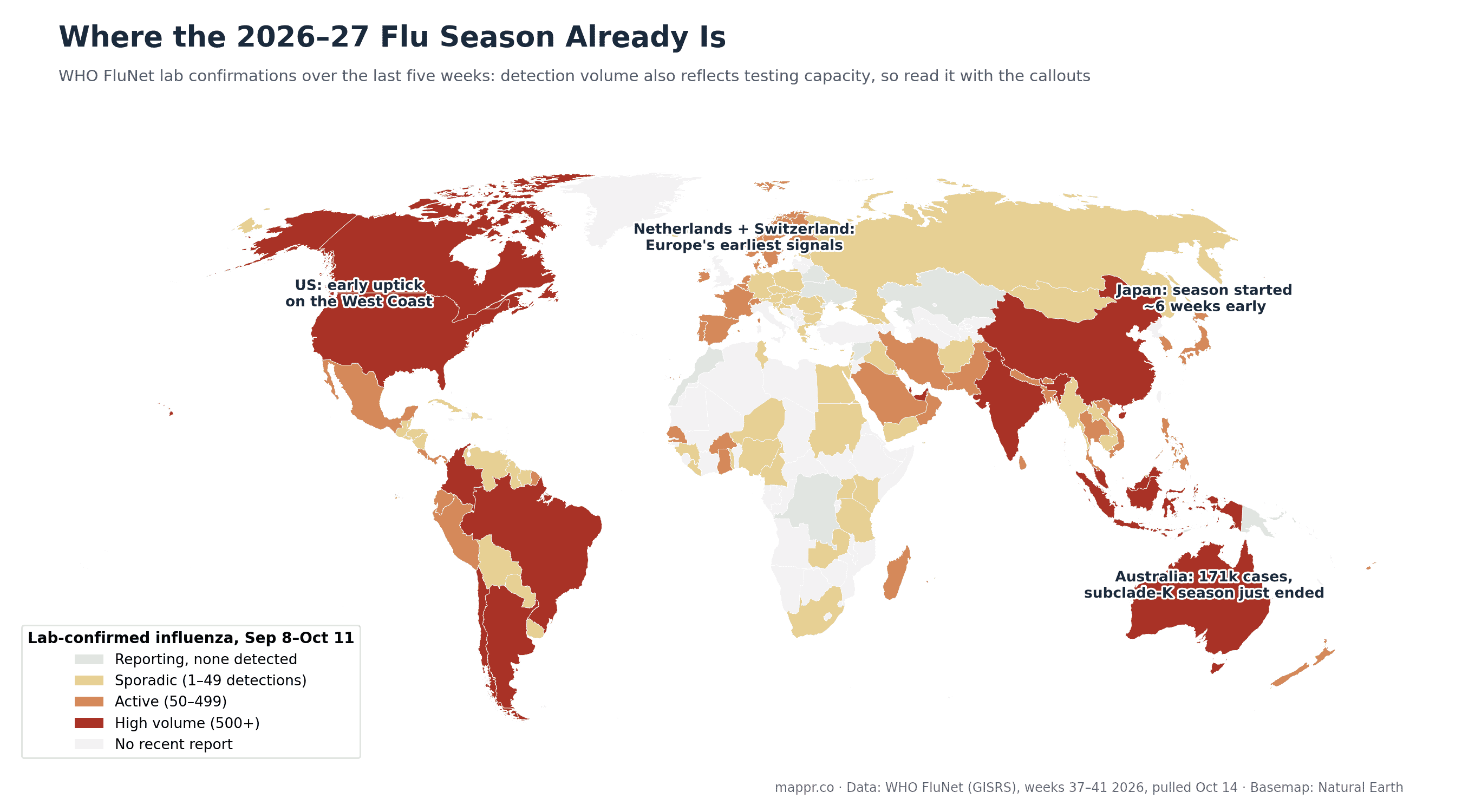
A caveat worth stating plainly: FluNet counts lab confirmations, so big testers (the US, China, India, Brazil) show high volumes year-round. The signal is in the timing and positivity: Japan’s season started about six weeks early, with outbreaks and school closures from late August; in Europe, sentinel samples in the Netherlands and Switzerland are already coming back majority-positive, the continent’s earliest clear signals; and US surveillance shows an early uptick on the West Coast. The Southern Hemisphere, meanwhile, is winding down from its own heavy season.
What to Expect: the Subclade K Season
The reason for the early starts has a name: H3N2 subclade K (technically J.2.4.1), a variant that emerged in August 2025 and spread worldwide within a year. The WHO reports it now accounts for the majority of recently characterized H3N2 viruses, and seasons driven by novel H3N2 variants tend to start early and hit older adults hardest.
The fuller FluNet picture is mixed rather than monolithic: over the last five weeks, subtyped influenza A worldwide splits roughly 57% H1N1 to 43% H3N2, with influenza B still circulating too. Subclade K is the rising force within H3N2 rather than the only flu out there, which is exactly the scenario the new vaccine was built for.
Australia’s season is the best preview we have: about 171,000 lab-confirmed cases in a subclade-K-dominated winter. Heavy, but roughly a third of 2025’s record ~503,000, suggesting a serious rather than catastrophic baseline, with the usual caveat that Northern Hemisphere severity depends on vaccine uptake and match.
This Year’s Shots: What’s in the 2026-27 Vaccine
The WHO-recommended Northern Hemisphere formulation is trivalent: the B/Yamagata lineage hasn’t been seen since 2020 and was formally dropped. The three components:
🧪 A/H1N1: A/Missouri/11/2025-like
🧪 A/H3N2: A/Darwin/1454/2025-like (egg-based) or A/Darwin/1415/2025-like (cell/recombinant), both subclade K
🧪 B/Victoria: B/Tokyo/EIS13-175/2025-like (egg) or B/Pennsylvania/14/2025-like (cell/recombinant)
The product menu is the familiar one: standard-dose shots for most people, high-dose or adjuvanted vaccines preferred for 65+, cell-based and recombinant options that skip egg-adaptation drift, and the nasal spray (live attenuated) for most non-pregnant people aged 2-49.
Who Should Get Vaccinated, and When
🇺🇸 CDC: everyone aged 6 months and older, annually, unless contraindicated.
🌍 WHO & ECDC priority groups: adults 65+, pregnant women, children (especially under 5), people with chronic conditions (heart, lung, diabetes, immunocompromise), care-home residents, and health and care workers.
⏰ Timing: protection takes about two weeks to build. With the season running early, the agencies’ advice this year is unusually simple: October is the moment, not December.
This article is informational, not medical advice: timing, eligibility and product choice are decisions for you and your clinician or national health service.
Data and reporting for this article come from the following sources: