On World Hepatitis Day, 28 July 2026, one finding from the World Health Organization’s Global Hepatitis Report 2026 stands out: viral hepatitis now kills more people than HIV. In 2024 it caused about 1.3 million deaths worldwide, and the trend is going the wrong way.
Almost all of those deaths, around 82%, come from hepatitis B (about 1.1 million deaths), and hepatitis B deaths have risen 17% since 2015 even as hepatitis C deaths fell 12% to roughly 240,000. The world, WHO says plainly, is not on track to eliminate viral hepatitis by 2030.
This map is about where people are dying of hepatitis, and who is actually turning the tide. It is the companion to our map of chronic hepatitis B prevalence by country: prevalence shows who is infected, this shows who is dying and who is on course to stop it.
Key Takeaways
- Hepatitis now kills more than HIV. Viral hepatitis caused about 1.3 million deaths in 2024, overtaking HIV. WHO calls it one of the world's deadliest, and most neglected, infections.
- Hepatitis B is the killer, and it is rising. Hepatitis B causes about 82% of the deaths (1.1 million a year) and those deaths have climbed 17% since 2015. Hepatitis C deaths, by contrast, fell 12% to around 240,000.
- Ten countries, most of the deaths. Around 69% of all hepatitis B deaths are concentrated in just ten countries across Asia-Pacific and Sub-Saharan Africa, led by China, India and Nigeria.
- The 2030 target will be missed. WHO says the world is not on track to eliminate viral hepatitis by 2030. Testing and treatment coverage remain far too low almost everywhere.
- But a few countries prove it can be done. WHO singles out Egypt, Georgia, Rwanda and the United Kingdom as success stories, with Bangladesh, Brazil and China making strong progress.
Where Hepatitis Kills the Most
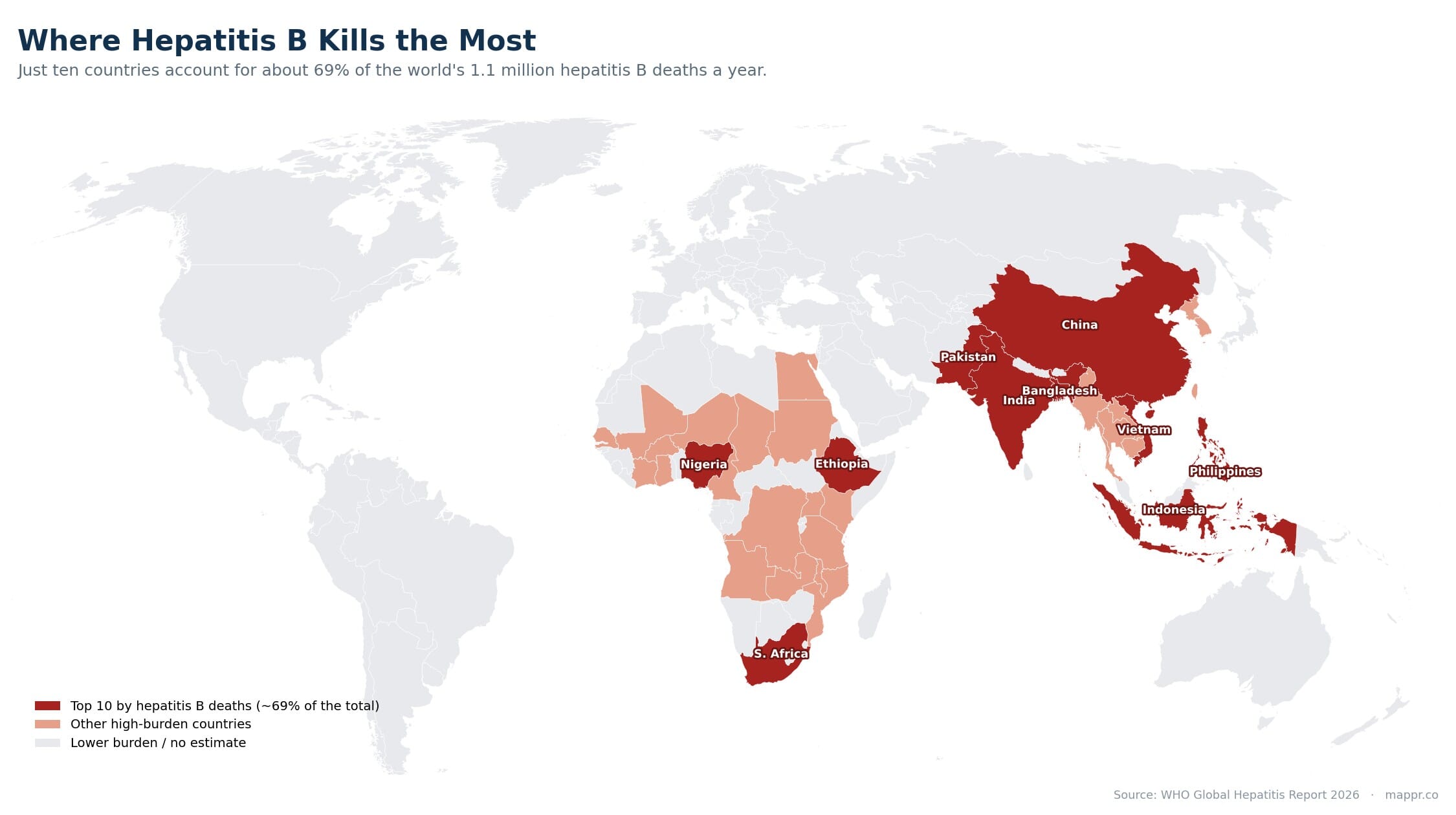
Hepatitis deaths are extraordinarily concentrated. About 69% of the world’s hepatitis B deaths occur in just ten countries, spread across the WHO Western Pacific, South-East Asia and African regions.
China and India carry the largest absolute burdens, simply because of their size and high historic infection rates, followed by Nigeria, Indonesia and the others below. Hepatitis C deaths are more dispersed, but cluster in the Eastern Mediterranean and Eastern Europe and Central Asia.
| # | Country | WHO region |
|---|---|---|
| 1 | China | Western Pacific |
| 2 | India | South-East Asia |
| 3 | Nigeria | Africa |
| 4 | Indonesia | South-East Asia |
| 5 | Pakistan | Eastern Mediterranean |
| 6 | Bangladesh | South-East Asia |
| 7 | Ethiopia | Africa |
| 8 | Philippines | Western Pacific |
| 9 | South Africa | Africa |
| 10 | Viet Nam | Western Pacific |
The ten countries that together account for about 69% of global hepatitis B deaths. Source: WHO Global Hepatitis Report 2026.
Why Hepatitis B Deaths Are Rising While Hepatitis C Falls
The two diseases are moving in opposite directions. Hepatitis C is now curable with a short course of tablets, and countries that rolled out testing and treatment, above all Egypt, have driven deaths down fast. That is why hepatitis C deaths fell 12% since 2015.
Hepatitis B is harder. There is a cheap, effective vaccine, but no cure, only lifelong suppression. Millions were infected before vaccination spread, and as that generation ages, more are developing liver cancer and cirrhosis. Too few are ever tested or treated, so deaths keep climbing.
The World Is Not On Track. A Few Countries Are.
WHO’s 2030 goal is to cut new infections by 90% and deaths by 65%. Globally, that target will be missed. But the report deliberately highlights countries showing it is achievable.
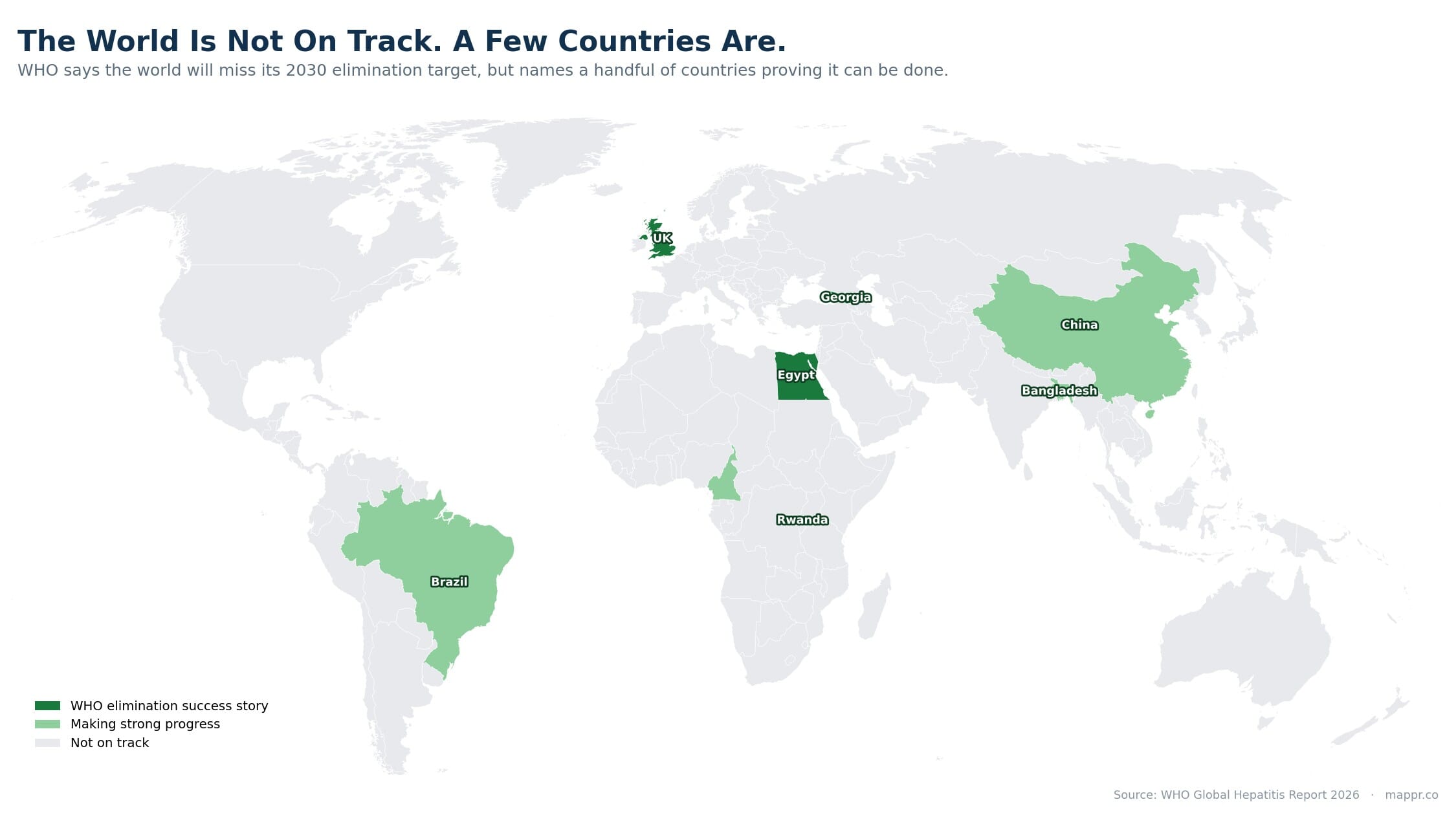
Egypt is the standout, having gone from one of the world’s worst hepatitis C epidemics to the brink of elimination. Georgia, Rwanda and the United Kingdom are also named as success stories, while Bangladesh, Brazil and China are making strong progress. Their common thread is political commitment plus cheap generic medicines and routine testing.
Frequently Asked Questions
How many people die from viral hepatitis each year?
About 1.3 million people died from viral hepatitis in 2024, according to WHO’s Global Hepatitis Report 2026. That is more than die from HIV.
Which is deadlier, hepatitis B or C?
Hepatitis B. It causes roughly 82% of hepatitis deaths, about 1.1 million a year, while hepatitis C causes about 240,000.
Why are hepatitis B deaths rising?
Hepatitis B has a vaccine but no cure. Many people infected before vaccination was widespread are now developing liver cancer and cirrhosis, and too few are tested or treated. Deaths have risen 17% since 2015.
Which countries have the most hepatitis deaths?
Just ten countries account for about 69% of hepatitis B deaths, led by China, India, Nigeria and Indonesia, across the Asia-Pacific and African regions.
Is the world on track to eliminate hepatitis by 2030?
No. WHO says the world will miss the 2030 elimination target, but names Egypt, Georgia, Rwanda and the UK as proof it can be done.
How is hepatitis transmitted?
It depends on the type. Hepatitis A spreads through contaminated food and water (the faecal-oral route), often where sanitation is poor. Hepatitis B and hepatitis C spread through blood and body fluids: sharing needles, unscreened blood or medical equipment, and from mother to baby at birth. Hepatitis B can also pass through unprotected sex. None of them spread through casual contact like hugging, sharing food, or coughing.
What is the difference between hepatitis A, B, and C?
All three inflame the liver, but they differ in how they spread and how dangerous they are. Hepatitis A is usually a short, self-limiting illness caught from contaminated food or water, has a vaccine, and never becomes chronic. Hepatitis B spreads through blood and body fluids, has a vaccine but no cure, and can become a lifelong chronic infection that leads to liver cancer and cirrhosis. Hepatitis C spreads mainly through blood, has no vaccine but is now curable with a short course of tablets, and also causes chronic liver damage if left untreated. Hepatitis B and C cause almost all hepatitis deaths.
Figures on hepatitis deaths, trends and elimination progress are drawn from the following sources: