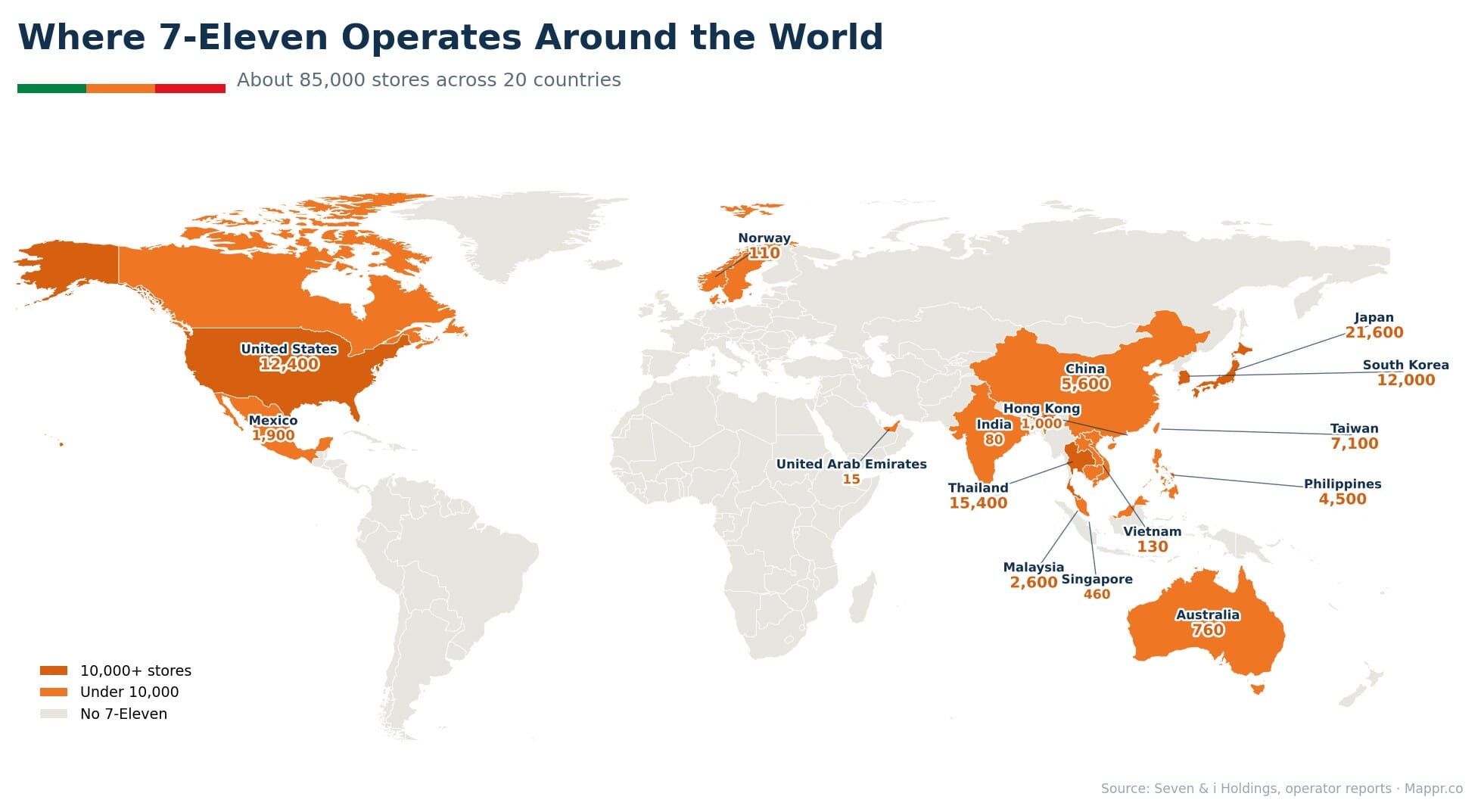
7-Eleven is the largest convenience-store chain on Earth, with roughly 85,000 stores worldwide. Yet for all that scale, you can only walk into one in 20 countries. There is no 7-Eleven in the United Kingdom, Germany, France, Brazil or anywhere in Africa. The chain’s map is one of the most lopsided in global retail, and it tells a story that is overwhelmingly about Asia.
We mapped where 7-Eleven actually operates, and how many stores each country has, using the latest figures from Seven & i Holdings and its local operators. Because store counts and country lists shift constantly, we refresh this data every quarter.
Key Takeaways
- About 85,000 stores worldwide. 7-Eleven is the world's largest convenience-store chain, but it operates in just 20 countries, plus the Chinese territories of Hong Kong and Macao.
- It is overwhelmingly Asian. Thirteen of the 20 countries are in Asia-Pacific, and the region accounts for the vast majority of stores.
- Japan is the heartland. Japan has about 21,600 stores, the most of any country, followed by Thailand (~15,400), the United States (~12,400) and South Korea (~12,000).
- Huge gaps on the map. There is no 7-Eleven in the UK, Germany, France, Italy, Spain, Brazil, Russia or anywhere in Africa. It also left Indonesia in 2017 and Israel in 2024.
- American born, Japanese owned. Founded in Texas in 1927, 7-Eleven is now owned by Japan's Seven & i Holdings, which fended off a takeover bid from Circle K's owner in 2024.
The 20 countries where 7-Eleven operates
As of mid-2026, 7-Eleven operates in 20 sovereign countries: Japan, Thailand, South Korea, Taiwan, China, the Philippines, Malaysia, Singapore, Vietnam, Cambodia, Laos, India and Australia in the Asia-Pacific region; the United States, Canada and Mexico in North America; Denmark, Norway and Sweden in Europe; and the United Arab Emirates in the Middle East. It also runs stores in the Chinese territories of Hong Kong and Macao, which are usually counted as separate markets rather than countries.
It is really an Asian story
Strip away the branding and 7-Eleven is essentially an Asian retailer. Thirteen of its 20 countries are in Asia-Pacific, and the region holds the overwhelming majority of its stores. Japan alone has around 21,600, more than the entire United States. Thailand, with roughly 15,400 stores run by the conglomerate CP All, has one of the densest convenience-store networks anywhere in the world relative to its population. Taiwan packs in about 7,100, and South Korea around 12,000. For hundreds of millions of people across East and Southeast Asia, 7-Eleven is not a novelty but a daily fixture that sells everything from hot meals to bill payments.
The surprising gaps on the map
What is missing is just as striking. There is no 7-Eleven in the United Kingdom, Germany, France, Italy or Spain. None in Brazil or anywhere else in South America. None anywhere in Africa. In Europe the brand exists only in Denmark, Norway and Sweden, where it is run by the Norwegian group Reitan. The chain has also retreated from markets it once held: it pulled out of Indonesia in 2017 and closed its Israeli stores in 2024, and it left the United Kingdom, Brazil and Turkey decades ago.
An American icon, now Japanese owned
The chain’s origins are American. It began in Dallas, Texas, in 1927 as an ice company that started selling milk, bread and eggs, and took the name 7-Eleven in 1946 to advertise its then-radical hours of 7am to 11pm. Its Japanese licensee grew so successful that it eventually bought the parent company, and today 7-Eleven is owned by Japan’s Seven & i Holdings. In 2024 the Canadian owner of Circle K, Alimentation Couche-Tard, launched a takeover bid worth around 47 billion dollars; Seven & i resisted, and the offer was withdrawn in 2025.
Who actually runs your local 7-Eleven
Very few of these stores are run directly from Japan. 7-Eleven expands through master-licence deals, handing a whole country to a local operator. Thailand’s stores belong to CP All, Taiwan’s and the Philippines’ to President Chain Store, South Korea’s to Lotte’s Korea Seven, the Nordic stores to Reitan, and India’s young network to Reliance Retail, which opened the first Indian store in 2021. In Hong Kong, Macao and Singapore they are run by DFI Retail Group. This is why a 7-Eleven in Bangkok, Tokyo and Dallas can feel like three completely different shops.
7-Eleven stores by country
Approximate store counts for every 7-Eleven market, sorted by size. Markets marked with an asterisk (Hong Kong and Macao) are Chinese territories counted separately from mainland China. Figures are the latest available and are refreshed quarterly.
| Country / Market | Approx. stores | Local operator | As of |
|---|---|---|---|
| Japan | 21,600 | Seven-Eleven Japan | 2025 |
| Thailand | 15,400 | CP All | 2025 |
| United States | 12,400 | 7-Eleven, Inc. | 2025 |
| South Korea | 12,000 | Korea Seven (Lotte) | 2024 |
| Taiwan | 7,100 | President Chain Store | 2025 |
| China | 5,600 | Regional licensees | 2025 |
| Philippines | 4,500 | Philippine Seven Corp | 2025 |
| Malaysia | 2,600 | 7-Eleven Malaysia | 2025 |
| Mexico | 1,900 | 7-Eleven Mexico | 2023 |
| Hong Kong * | 1,000 | DFI Retail Group | 2024 |
| Australia | 760 | 7-Eleven Australia | 2026 |
| Canada | 600 | 7-Eleven Canada | 2023 |
| Singapore | 460 | DFI Retail Group | 2024 |
| Denmark | 185 | Reitan Convenience | 2024 |
| Vietnam | 130 | Seven System Vietnam | 2025 |
| Norway | 110 | Reitan Convenience | 2024 |
| India | 80 | Reliance Retail | 2024 |
| Sweden | 80 | Reitan Convenience | 2024 |
| Macao * | 50 | DFI Retail Group | 2024 |
| Cambodia | 30 | CP All Cambodia | 2025 |
| Laos | 30 | CP All Laos | 2025 |
| United Arab Emirates | 15 | Seven Emirates Investment | 2021 |