Key Takeaways
- Malaysia shut the doors. On 21 July 2026 the Iskandar Puteri City Council in Johor revoked the business licence of the Network School at Forest City, ordering it to cease operations from 22 July over breaches of licensing and premises rules, amid a political storm about its members and its mission.
- Kazakhstan opened them. Within hours, Kazakhstan's Ministry of Digital Development signed a memorandum of understanding with founder Balaji Srinivasan to host the first Network School campus in the country. The exact city has not been announced.
- What a network state is. Coined by Srinivasan in his 2022 book, a network state is a tightly aligned online community that crowdfunds physical territory around the world and eventually seeks diplomatic recognition. It builds the people first and adds the land later, the reverse of a normal country.
- The Network School is the prototype. A membership co-living and co-working community for digital nomads and founders (around US$1,500 a month), it is Srinivasan's real-world test of the idea: a physical hub for an online tribe.
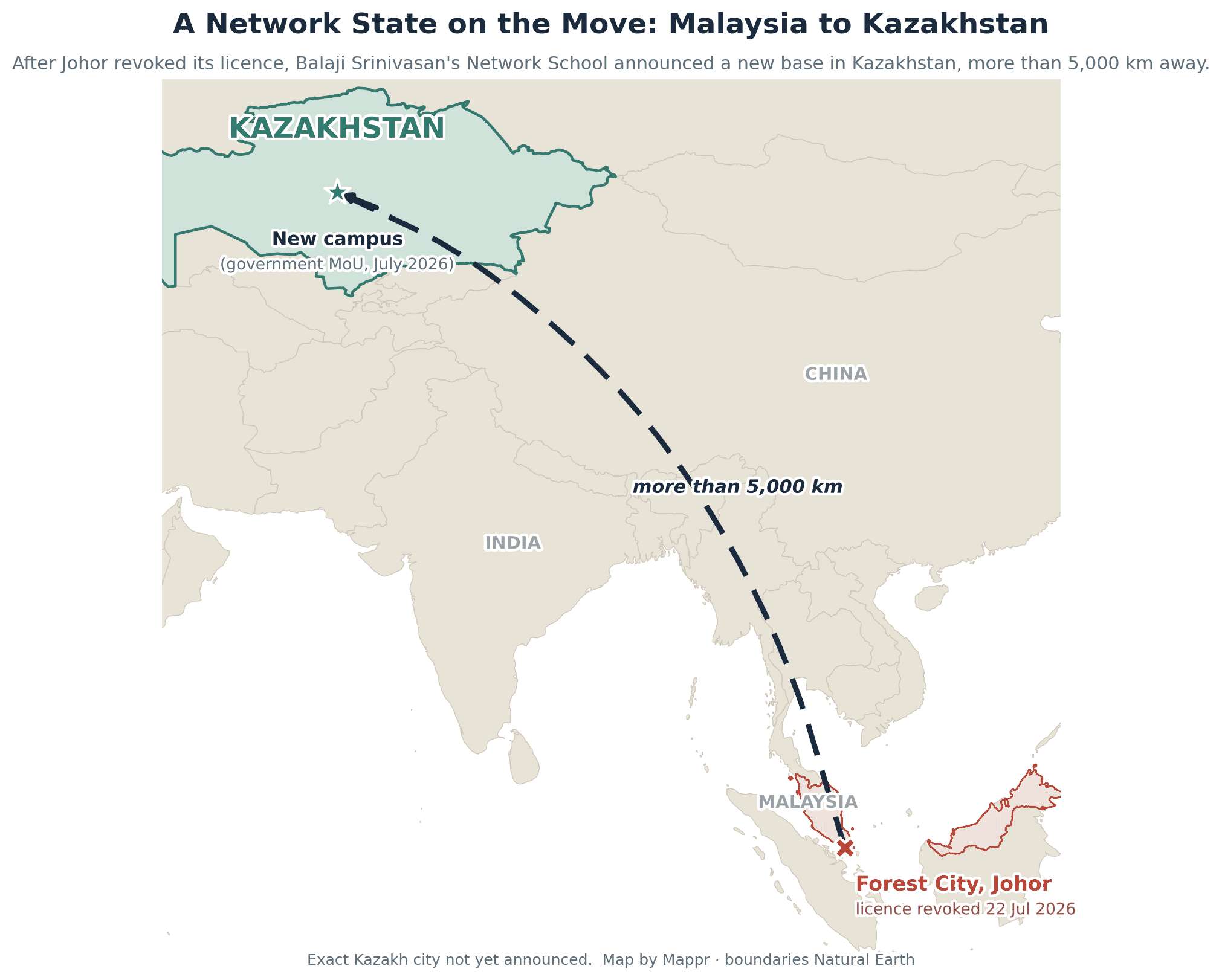
- A 5,000 km jump. The move sends the community from the southern tip of Malaysia, next to Singapore, to landlocked Central Asia, more than 5,000 km away.
A self-styled “network state” just learned how much it still depends on ordinary nation-states. In July 2026, Malaysian authorities revoked the operating licence of the Network School, a tech community founded by American investor Balaji Srinivasan at the Forest City development in Johor. Within hours, Srinivasan announced that the school had found a new home: Kazakhstan. Here is what happened, where the community is heading, and what the whole “network state” idea actually means.
What happened in Malaysia
The Network School had set up at Forest City, a vast, half-empty property development built on reclaimed islands in Johor, the Malaysian state that sits directly across the water from Singapore. On 21 July 2026, the Iskandar Puteri City Council announced it had revoked the school’s business licence and ordered it to cease all activity from the following day. The Johor state government publicly backed the decision.
Officials framed the formal grounds narrowly: the operator had breached its licensing conditions and the approved use of its premises, and part of the operation was running from a building without a valid council licence. The political heat around it was anything but narrow. The investigation was triggered by claims on social media that the school had helped bring foreign nationals into the country, and by louder concerns that Srinivasan’s mission to build communities that sit apart from existing states was a challenge to Malaysian sovereignty. Immigration officers who inspected the site reported that members held valid travel documents.
The pivot to Kazakhstan
Almost immediately, Kazakhstan stepped in. The country’s Ministry of Digital Development, Innovation and Aerospace Industry said it had signed a memorandum of understanding with Srinivasan to establish the first Network School campus in Kazakhstan. As of publication, no specific city or special zone has been named, so it is not yet clear whether the community will land in the capital, Astana, in the business hub of Almaty, or somewhere purpose-built in Kazakhstan.
The logic is not hard to read. Kazakhstan has spent years courting crypto, data centres and tech talent, and a minister-level welcome for a high-profile digital community fits that push. For the Network School, it is a jurisdiction openly advertising that it wants exactly this kind of experiment. The wider region is on the rise too: Central Asia is one of the fastest-climbing areas in our map of the world’s best startup ecosystems.
So what is a network state?
The phrase comes from Srinivasan’s 2022 book of the same name. His definition, boiled down, is this: a network state is a highly aligned online community with a shared purpose, the ability to act collectively, an in-group recognisable to one another, and the means to crowdfund territory scattered around the world, that eventually wins a measure of diplomatic recognition from existing countries.
The key move is an inversion. A traditional nation-state starts with a contiguous piece of land and the people who happen to live on it. A network state starts with the people, an online community bound by values rather than geography, and only later acquires the land, buying up apartments, buildings and eventually whole districts and stitching them into a single networked archipelago governed by shared software and norms. Think of it as a country that boots up as a group chat and tries to grow a body.
It is a deliberately provocative idea, and a contested one. Supporters see a peaceful way to start new communities and experiment with governance. Critics see wealthy foreigners trying to carve out enclaves that answer to no one, which is close to the fear that surfaced in Johor.
The Network School, the real-world prototype
The Network School is Srinivasan’s attempt to move the idea off the page. It is a co-living and co-working community, part school and part startup commune, aimed at digital nomads, remote workers and founders, with membership running at around US$1,500 a month. Residents live together, work on projects, and follow programmes loosely themed around technology, health and wealth. Reports describe hundreds of international members passing through the Forest City site.
That is what makes the Malaysian episode revealing. A community whose whole pitch is that it can exist above and beyond borders was closed by a city council enforcing local by-laws, and rescued by a national ministry offering a new address. For all the talk of transcending the nation-state, the Network School still needs a state to say yes. Its future now depends on whether Kazakhstan proves a more durable host than Malaysia did, and on whether the model can survive being this portable.
Reporting and figures are drawn from the following sources:
Image Sources