Key Takeaways
- The US is not just first, it is untouchable. The United States tops StartupBlink's 2026 index with a score of 314, having grown 23.6% in a year. Its lead over second-placed United Kingdom widened to 3.92 times, the largest gap the index has ever recorded.
- Singapore is closing on the podium. Behind the US sit a tight cluster: the UK (2nd), Israel (3rd) and Singapore (4th), which grew 24.4% and is now within 5% of Israel's score. France, long a top-10 fixture, dropped out to 11th.
- Central Asia is the fastest-growing region on Earth. Central Asia's startup ecosystems grew 81% in a year, more than any other sub-region, led by Tashkent (+156%) and Almaty (+70%). Uzbekistan alone surged 227%.
- Saudi Arabia posts the fastest growth of any major economy. Saudi Arabia jumped 10 places to 28th, its highest ever, on 97% growth. Riyadh was among the fastest-rising cities in the world.
- Some giants are shrinking. Not everyone is rising. The United Arab Emirates fell 27.5%, Russia 15.3% and China 7.9%, with Beijing and Shanghai both down more than 20% as capital and talent shift elsewhere.
Where in the world are the best places to build a startup, and where is that map being redrawn fastest? The StartupBlink Global Startup Ecosystem Index 2026 ranks 100 countries and 1,556 cities on a single score built from three things: the quantity of startup activity, its quality and impact, and the business environment that supports it. We mapped the results, and the story is one of an entrenched leader, a surging periphery and a few former stars in retreat.
The world’s top startup ecosystems
First, the league table. Because the scores are so top-heavy (the United States alone scores 314 against a global median near 5), a straight colour ramp would wash almost everyone into the same shade. So the map below shades countries by their global rank tier instead, which reads far more clearly.
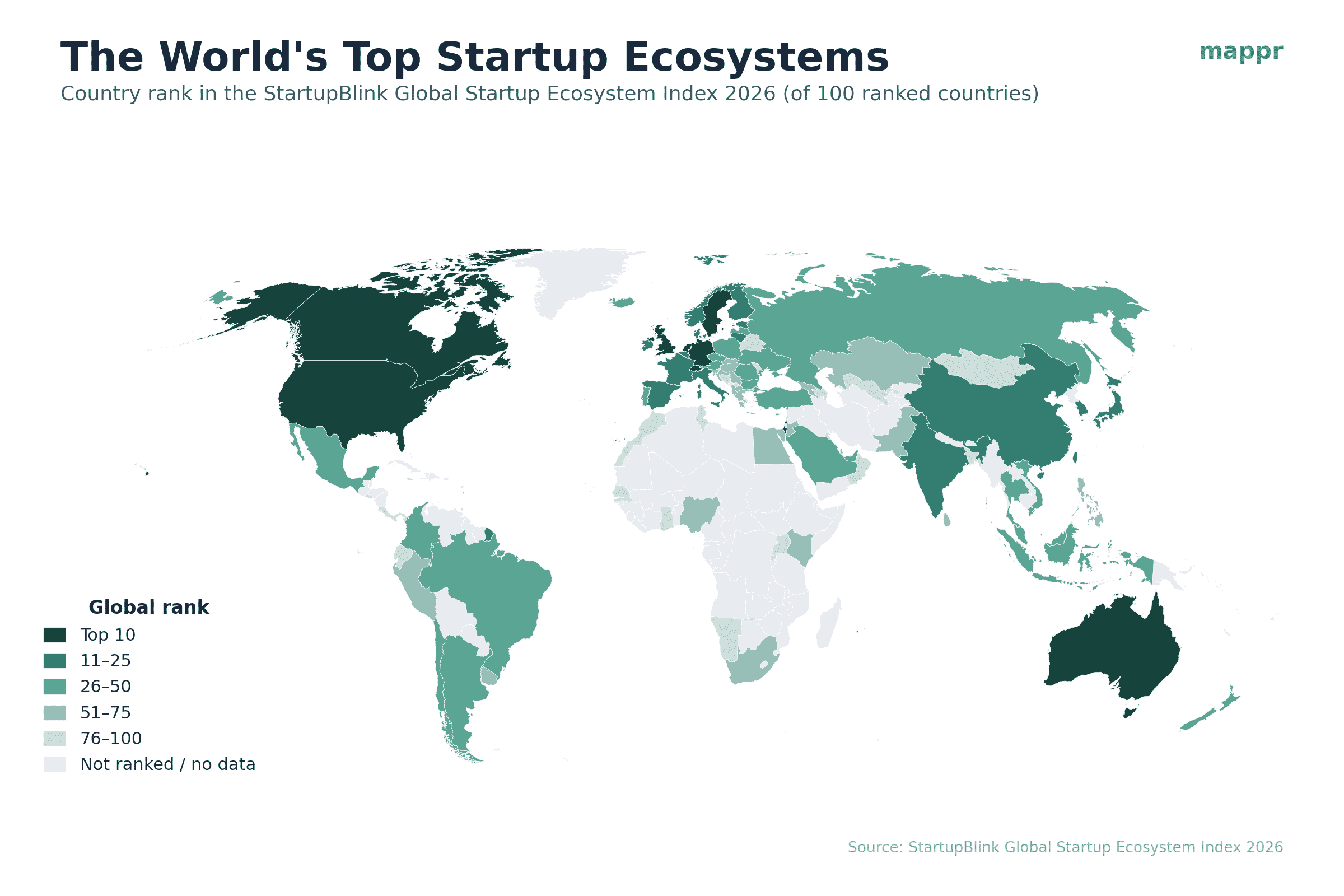
North America, Western and Northern Europe, Israel, Singapore and Australia form the dark core of established ecosystems. The United States is in a league of its own, scoring nearly four times the second-placed United Kingdom. Behind them, Israel and Singapore anchor a tight chasing pack, with Singapore growing 24.4% and now within 5% of Israel. The most notable faller among the elite is France, which slipped out of the top 10 to 11th after several years inside it.
| Rank | Country | Ecosystem score | Annual growth |
|---|---|---|---|
| 1 | United States | 314.1 | +23.6% |
| 2 | United Kingdom | 80.1 | +13.2% |
| 3 | Israel | 71.5 | +15.0% |
| 4 | Singapore | 68.0 | +24.4% |
| 5 | Canada | 49.5 | +9.0% |
| 6 | Sweden | 40.8 | +15.5% |
| 7 | Germany | 37.6 | +13.5% |
| 8 | Switzerland | 36.1 | +13.7% |
| 9 | Australia | 35.4 | +22.9% |
| 10 | The Netherlands | 34.5 | +11.8% |
| 11 | France | 33.9 | +4.7% |
| 12 | Estonia | 33.4 | +8.8% |
| 13 | Spain | 27.6 | +19.3% |
| 14 | Finland | 25.9 | +13.2% |
| 15 | China | 24.8 | -7.9% |
| 16 | Ireland | 24.3 | +14.5% |
| 17 | Denmark | 22.7 | +9.4% |
| 18 | Japan | 20.0 | +10.7% |
| 19 | South Korea | 20.0 | +20.6% |
| 20 | Taiwan | 19.9 | +41.1% |
Where ecosystems are growing fastest
Rank tells you who is winning today. Growth tells you where the map is heading, and it tells the opposite story. The next map shades countries by their annual ecosystem growth, and the pattern is striking: the fastest growth is happening well outside the established core, while several giants are in outright decline.
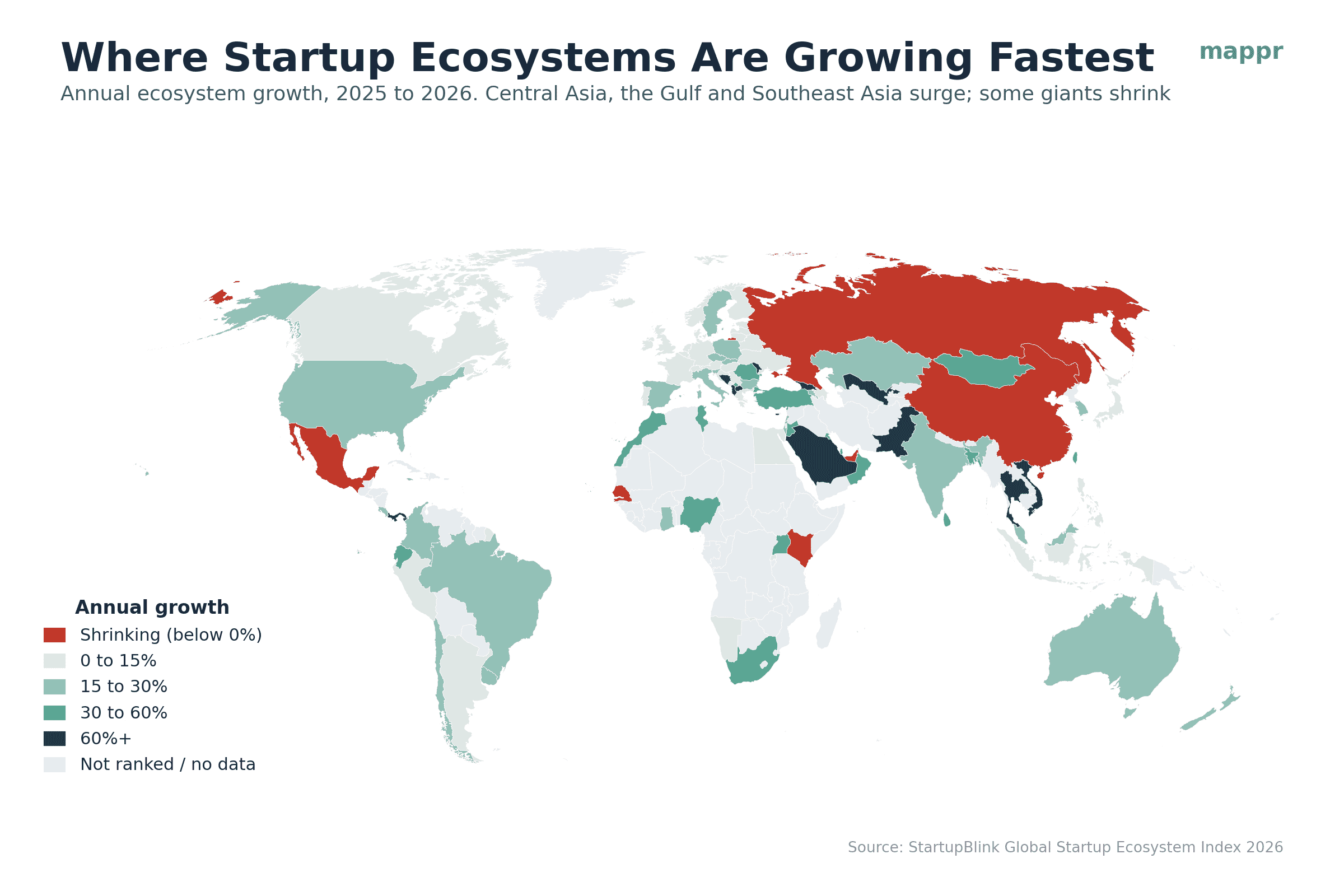
The single loudest signal is Central Asia, the fastest-growing sub-region on the planet at 81%, powered by Tashkent (up 156%) and Almaty (up 70%). Uzbekistan grew a remarkable 227%. Close behind, Saudi Arabia posted 97% growth and climbed 10 places to 28th, its best-ever position, while Vietnam (+68%), Thailand (+63%) and Cyprus (+63%) all roughly doubled their momentum. Among larger economies, India (+26%, 21st) and Taiwan (+41%, 20th) keep climbing.
The red on the map is just as telling. The United Arab Emirates fell 27.5% and dropped nine places to 30th; Russia slid 15.3% and China 7.9%, with the Chinese heavyweights Beijing and Shanghai both down more than 20%. Capital, talent and attention are visibly rotating away from some of the names that dominated the 2010s.
The cities where it actually happens
Startups cluster in cities, not countries, and here the concentration is even sharper. San Francisco Bay remains the undisputed capital of the startup world with a score of 935, more than two and a half times second-placed New York. London, Los Angeles and Boston complete the top five, and American cities take a striking share of the top 20 overall.
| Rank | City | Country | Score | Annual growth |
|---|---|---|---|---|
| 1 | San Francisco Bay | United States | 935.3 | +9.7% |
| 2 | New York | United States | 352.2 | +11.6% |
| 3 | London | United Kingdom | 197.6 | +5.4% |
| 4 | Los Angeles Area | United States | 152.4 | +9.5% |
| 5 | Boston Area | United States | 127.1 | -1.1% |
| 6 | Beijing | China | 107.7 | -21.4% |
| 7 | Tel Aviv Area | Israel | 86.7 | +9.8% |
| 8 | Shanghai | China | 81.4 | -20.0% |
| 9 | Paris | France | 79.2 | -3.2% |
| 10 | Singapore City | Singapore | 78.9 | +26.7% |
| 11 | New Delhi | India | 78.5 | +22.0% |
| 12 | Bangalore | India | 77.0 | -0.7% |
| 13 | Tokyo | Japan | 66.4 | +8.1% |
| 14 | Austin | United States | 64.3 | +25.6% |
| 15 | Berlin | Germany | 58.7 | -2.6% |
The rising cities mirror the country map. Austin (+26%) keeps climbing inside the US top tier, India’s New Delhi and Bangalore sit in the global top 12, and Singapore City grew nearly 27%. Meanwhile the two Chinese giants, Beijing and Shanghai, are the notable declines near the top, each shedding around a fifth of their score.
What the map is telling us
Put the two maps side by side and the shape of the next decade appears. The established ecosystems of North America, Europe and the Asian city-states still own the scoreboard, and the United States is pulling further ahead, not falling back. But the momentum has moved to the edges: to Central Asia, the Gulf, Southeast Asia and pockets of Africa and Latin America, where small ecosystems are growing at rates the giants can no longer match. Startup ecosystems are still overwhelmingly concentrated, but for the first time in years, the fastest-moving parts of the map are the ones that used to be blank.
All rankings, scores and growth rates are from StartupBlink's Global Startup Ecosystem Index 2026 (100 countries, 1,556 cities):
Image Sources