A microscopic parasite is having an outsized summer. Since 1 May 2026, US federal and state health officials have been investigating a fast-growing outbreak of cyclosporiasis, an intestinal illness caused by the parasite Cyclospora cayetanensis, with more than 32,500 confirmed or suspected cases across at least 48 states and 922 hospitalizations. But the outbreak is not evenly spread. One state, Michigan, is bearing almost the entire brunt.
It has now killed. On 3 August 2026 Michigan reported the outbreak’s first two deaths, in people with significant underlying health conditions.
Key Takeaways
- A major parasite outbreak is spreading across the US. Since May 2026, health officials have logged more than 32,500 confirmed or suspected cases of cyclosporiasis, a parasitic intestinal illness, across at least 48 states and the District of Columbia, with 922 hospitalizations. Michigan reported the outbreak's first two deaths on 3 August 2026.
- Michigan is the epicenter by a wide margin. Michigan alone has reported thousands of cases. In the last state-level breakdown the CDC published, on 17 July, it accounted for 1,141 of the cluster's lab-confirmed cases; the state's own count, which includes suspected cases, reached 14,277 on 20 August, with 335 hospitalizations as of 20 August and two deaths reported on 3 August. MDHHS lifted its advisory against bagged salad greens on 6 August as new case reports slowed.
- Salad greens are the leading suspect. The confirmed source of the nine-state cluster is shredded iceberg lettuce from Taylor Farms served at Taco Bell, though the FDA says it is still investigating other sources and on 22 July opened a separate traceback into a second Cyclospora outbreak that had grown to 93 illnesses by 29 July with no food identified. A recall followed on 16-17 July: Taylor Farms pulled central-Mexico iceberg from the US market, and Marketside bagged lettuce was recalled from Walmart in 27 states. On 24 July the FDA widened the lettuce-linked outbreak from five states to nine, on 5 August to 15 states and 6,358 illnesses, and on 13 August to 17 states and 9,481 illnesses with at least 398 hospitalizations, adding Maine and Massachusetts, and on 20 August to 10,930 illnesses with at least 454 hospitalizations without adding a state.
- It comes from contaminated fresh produce or water. Cyclospora is a microscopic parasite spread through food or water contaminated with feces, not from person to person. It causes prolonged, watery diarrhea and is treatable with antibiotics.
Michigan is the epicenter
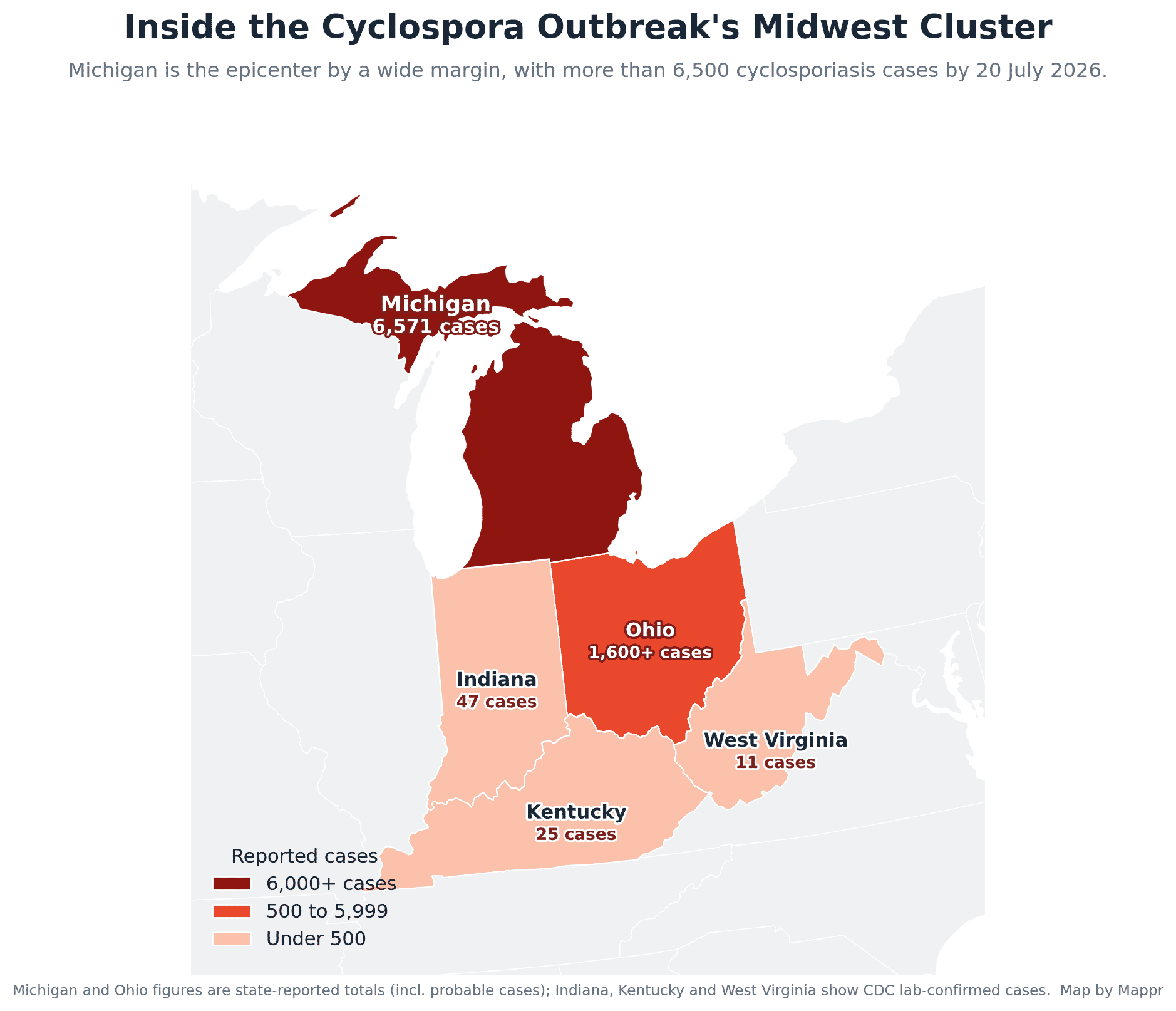
The lettuce-linked outbreak started as a tight Midwestern cluster and has widened twice. In the state-level breakdown the CDC published on 17 July it ran Michigan (1,141 cases), Ohio (420), Indiana (47), Kentucky (25) and West Virginia (11), about 1,644 laboratory-confirmed cases in all.
On 24 July the FDA added Illinois, Kansas, Oklahoma and Pennsylvania, taking it to nine states and 1,947 cases. On 5 August it added six more: Arkansas, Iowa, Missouri, Nebraska, New Hampshire and North Carolina.
The cluster now stands at 10,930 illnesses across 17 states, with at least 454 hospitalizations and the two Michigan deaths, on the FDA and CDC update of 20 August. Illness onsets now run from 14 June to 11 August.
Maine and Massachusetts were the two states added on 13 August, and Michigan still carries the bulk of it.
The 20 August update did something new. It added 1,449 people to the outbreak without adding a single state, the first time in this investigation the count has grown while the map stood still.
Its health department reported 14,277 cases on 20 August, up 368 on the 13,909 it published a week earlier, with 335 hospitalizations as of 20 August.
That was the first new number in a week. MDHHS moved its outbreak page to a weekly Thursday refresh, so the 12,485 total stood untouched from 6 August until the 13 August update landed.
The county picture moved with it. Wayne rose to 2,095 from 2,029 and Oakland to 1,538 from 1,499, on the table MDHHS published on 20 August.
The next one lands on Thursday. The page says totals, hospitalization status and county data update weekly on Thursdays by 11 a.m. Eastern, which puts Michigan’s next new number on 27 August.
Michigan passed 10,000 on 29 July, in a state that normally records about 50 cyclosporiasis cases a year. Cases have now been reported in 72 of its 83 counties, plus the city of Detroit, which reports separately.
The worst-hit counties are Wayne (2,095 cases), Oakland (1,538), Washtenaw (1,105) and Ingham (921), on the county table MDHHS refreshed on 20 August. Genesee (653) and Muskegon (583) come next, with Detroit counted separately at 432.
The outbreak records its first deaths
On 3 August MDHHS reported two deaths among Michigan cases, the first deaths tied to this outbreak anywhere since it began on 1 May.
The department said both people had significant underlying health conditions “that may have been impacted by cyclosporiasis and dehydration,” and that both became ill before the FDA announced the iceberg-lettuce recall on 17 July. No further information will be released about them.
MDHHS added that cyclosporiasis is generally not life-threatening and that death from it is uncommon in the United States. The CDC says it is aware of both deaths and will add laboratory-confirmed cases, hospitalizations and deaths to its own page.
Signs the Michigan curve has turned
The state now thinks the peak is behind it. On 28 July, chief medical executive Dr. Natasha Bagdasarian said roughly 475 of the cases added since 24 July came from a reporting backlog at a single health system, not from new illnesses.
She said the share of emergency-department visits with diarrhea as the main complaint is also slowing. Her caveat: some health systems are now limiting testing to patients who are severely ill or immunocompromised, because of laboratory backlogs and testing-supply limits, so milder cases may go uncounted.
She is not crediting the recall alone. “I don’t know if a single product recall is related to the slowdown that we’ve seen,” she said, pointing also to public guidance on peeling, cooking and stripping the outer layers off fresh produce.
On 29 July, with the state total at 10,077, she said emergency-department visits for diarrhea were still slowing.
Her produce advice also hardened: buy whole heads of lettuce rather than pre-washed bags or salad kits, strip off the outer two or three layers of leaves, wash the rest, and cook greens where you can.
The next day’s count pointed the same way. MDHHS logged 10,386 cases on 30 July, a rise of 309, against 397 the day before and 427 the day before that.
The line is not straight, though. On 31 July MDHHS logged 10,773 cases, a rise of 387, bigger than the previous day’s 309. Reporting arrives in lumps, so single days move either way.
The weekend read is softer. MDHHS logged 11,234 cases on 3 August, up 461 on 31 July. Spread over the three days since, that is roughly 154 a day, well below the 387 added on 31 July alone.
Tuesday was heavier again. MDHHS logged 11,508 cases on 4 August, a rise of 274 in a day, against the roughly 154 a day the weekend averaged.
Wednesday broke the pattern. MDHHS logged 12,218 cases on 5 August, a rise of 710 in a day, one of the largest single-day increases since the outbreak began on 1 May.
The state has since said why. A data note on the MDHHS outbreak page says the 4 August reported date includes about 473 cases that had not previously reached the department because of delayed laboratory reporting.
Those cases do not reflect a sudden increase in illnesses, the department says. It is the same explanation it attached to the 475-case jump on 24 July.
Thursday settled it back down. MDHHS logged 12,485 cases on 6 August, a rise of 267 in a day, roughly a third of Wednesday’s jump.
Hospitalizations are the counterweight. The state’s weekly table went to 335 on 20 August, 21 more than the 314 it reported a week earlier, against the 35 it added the week before that.
Outside the state, epidemiologists read the curve the same way. “We may well be on a downslope,” Craig Hedberg, a professor of environmental health sciences at the University of Minnesota, told Food Safety News on 31 July.
Michigan’s own read hardened on 6 August. “The worst is behind us, at least based on the data we have available to us today,” Bagdasarian told CIDRAP News, adding that the judgement applies to Michigan alone.
She also explained the lag. Health systems ran short of tests and built laboratory backlogs, so many cases reported now are old ones: the vast majority, she said, had symptom onset before 16 July.
The first weekly number tests that read. Michigan added 1,424 cases in the seven days to 13 August, a rise of about 11 percent, and the state again said new case reports and diarrhea-related emergency-department visits are declining.
The second weekly number is the smallest of the outbreak. Michigan added 368 cases and 21 hospitalizations in the seven days to 20 August, a rise of under 3 percent, against 1,424 the week before.
The age pattern has not shifted. People aged 30 to 39 remain the largest group at 2,937 infections, on the figures MDHHS published on 20 August.
Michigan lifts its lettuce warning
The state has now acted on its own read of the curve. On 6 August MDHHS lifted the advisory against bagged salad mixes, telling residents they may resume their usual food handling practices and make choices based on their individual risk tolerance.
The reasoning is arithmetic. On a seven-day average incubation period the department places most exposures in late June and early July, so it judges the majority of the contaminated produce no longer available to eat.
It cited the two signals it has been pointing at for a week: new case reports slowing, and a downward trend in diarrhea-related emergency-department visits.
This is not a blanket all-clear. Recalled products should still be thrown out, and MDHHS is keeping its ordinary advice on rinsing produce and washing hands and surfaces.
An outside food scientist backed the call. “The guidance is sufficient,” Donald Schaffner of Rutgers University told Reuters, saying there is very little risk in eating iceberg lettuce in Michigan and the surrounding area because the implicated lettuce has either been consumed or discarded.
Why the case counts do not match
You may see several different numbers for this outbreak, and they are all correct, because they measure different things.
The CDC’s confirmed figure counts only laboratory-confirmed cases reported into the federal surveillance system, which lags reality by about six weeks. It reached 17,180 US-acquired cases across 48 states plus the District of Columbia for 1 May to 24 August, with 922 hospitalizations, up from 15,716 a week earlier.
That count now carries the deaths. The CDC’s surveillance page lists two deaths and 922 hospitalizations, and still puts the median illness onset date at 7 July, with a median patient age of 46 and a range of 1 to 99.
One word on that page changed with it. The CDC now calls this a large multistate outbreak linked to processed iceberg lettuce from central Mexico, which points at a facility rather than a field.
Travel cases sit outside all of that. The CDC counts a further 1,805 laboratory-confirmed cases across 46 states and Puerto Rico in people who were abroad in the two weeks before they fell ill, with 63 hospitalizations and no deaths, on data through 24 August.
Michigan’s own tally (14,277 by 20 August) includes suspected and probable cases its state labs are working through, part of the at least 11,844 not-yet-confirmed cases the CDC is tracking on top of its confirmed count.
And the combined national picture of more than 32,500 confirmed and suspected cases folds in every state’s reports. As the CDC itself notes, the true number is almost certainly higher still, because many people with mild cases never get tested.
Adding the states up by hand gives a higher floor again. Food Safety News totalled every state’s published count on 31 July and reached more than 21,000 cases across all fifty states, against 20,927 the same morning in its publisher’s own tally.
That floor keeps rising. On 5 August the same tally reached 23,295 across all fifty states, using figures the health departments published by 4 August.
It rose again two days later. The same fifty-state count reached 25,836 on 7 August, against 10,468 laboratory-confirmed cases and more than 12,255 awaiting confirmation on the CDC’s page.
It has climbed again since. The same fifty-state tally reached 27,937 on 10 August, up 1,182 in three days, with ten states rising and Maine appearing on the chart for the first time.
It moved again the next day. The count reached 28,056 on 11 August, with Missouri at 1,577, North Carolina at 906, Oklahoma at 506, Arkansas at 252, Wisconsin at 216 and Maine at 27 among the states that shifted.
It climbed again the next day. The same fifty-state tally reached 28,374 on 12 August, up 318, with Kansas, New York, West Virginia and Virginia the four states that moved.
Kansas is the day’s number. It went to 748 cases after adding 133 in a single weekly update, with hospitalizations up from 20 to 32 and 225 interviews still pending.
It also shows how to misread a total. Of those 748 cases, 625 were reported in July and 56 so far in August: the cumulative line jumped while the weekly line fell.
Michigan’s refresh then moved the whole line. The same fifty-state tally reached 29,912 on 13 August, against 28,374 on 12 August, with the 1,424 cases Michigan added behind most of it.
It kept going without Michigan. The count reached 30,523 on 14 August, up 611 on the day, in a tally its author describes as the sum of what forty health departments have published on schedules running from daily to never.
The gap with the federal number is not closing. The states now run 6,173 cases ahead of the CDC’s 24,350, against 5,562 the day before.
That widening is the calendar, not the outbreak. The CDC publishes once a week on Tuesdays, so the gap opens from Wednesday to Monday and shuts again every Tuesday when the federal count catches up.
The weekend makes the same point. The fifty-state tally still read 30,523 when its author rechecked it on the evening of Saturday 15 August, because most state dashboards do not publish at weekends.
It held there through Sunday. No federal page and no state count moved on 16 August either, leaving the tally at 30,523 for a third day.
Tuesday broke the standstill. The same fifty-state tally reached 31,342 on 18 August, up 819 on the 30,523 it had held for three days.
The gap has started closing again. The states now run 3,785 cases ahead of the combined federal count of 27,557, against 6,173 a week earlier, which is Atlanta catching up rather than the states slowing down.
It moved again the next day. The same fifty-state tally reached 31,521 on 19 August, up 179, with eight states posting new numbers since Saturday.
Illinois and Indiana are the two that matter. Illinois stands at 1,260 on data published to 11 August and Indiana at 2,069 on 19 August, with New York at 939, Texas at 315, Arkansas at 277 and Virginia at 214.
The federal number did not move with it. The CDC publishes weekly on Tuesdays, so the gap over its 27,557 opened back out to 3,964 and should shut again on 25 August.
Thursday moved it again. The same fifty-state tally reached 31,889 on 20 August, against 31,521 the day before, with nine rows on its chart moving.
One of those rows was a correction rather than an increase. Texas hands a count to reporters instead of running a dashboard, and its most recent published figure is 315 cases with 52 hospitalizations, where the chart had been carrying 198.
Friday moved it again. The same fifty-state tally reached 31,972 on 21 August, with West Virginia and Florida posting new numbers, Michigan’s Thursday total folded in, and one row of the chart corrected upward by 31 people.
The two movers are small states reporting late. West Virginia reached 313 cases with 20 hospitalizations on its own outbreak page on 21 August, and Florida reached 450 after adding 43 illnesses.
The weekend moved it again. The same fifty-state tally reached 32,169 on Sunday 23 August, up 197 on the 31,972 it carried on 21 August.
Missouri did most of that. Its Sunday report crossed two thousand, and Washington’s own page went to 71 on data through 21 August, in a weekend when no federal number moved at all.
Tuesday night moved it again. The same fifty-state tally reached 32,500 on 25 August, up 331 on the 32,169 it carried on 23 August.
The federal count moved on the same day. Adding the CDC’s 17,180 confirmed cases to the 11,844 awaiting confirmation gives 29,024, which leaves the state floor about 3,500 ahead rather than the 3,964 it ran a week ago.
Wednesday barely moved it. The same fifty-state tally reached 32,506 on 26 August, up six on the 32,500 it carried the night before, in a day when no federal page and no large state dashboard published.
The six are all one state. Hawaii appeared on the chart for the first time at 6 cases, which is the smallest daily addition the tally has recorded in this outbreak.
The attribution ratio has slipped back. Of the CDC’s 17,180 confirmed US-acquired cases, 10,930 are assigned to the recalled lettuce, about six in ten, because the federal total grew by 1,464 in the week to 24 August while the lettuce cluster did not move at all.
A second national count landed on 17 August. Nexstar’s own analysis of state health data put more than 30,000 confirmed or probable cases across the US this year, counting domestic and travel-associated illnesses together.
All three numbers point the same way: a large outbreak whose confirmed count will keep climbing for weeks even if new infections are already slowing.
None of them is the number of people who got sick. Routine stool tests do not find this parasite unless somebody asks for it by name, and diarrhea that comes and goes for a month often never reaches a doctor.
There is a published multiplier for that gap. Scallan and colleagues put underdiagnosis for Cyclospora at 83.1, which applied to 17,180 confirmed cases gives roughly 1.4 million people, an estimate with wide margins rather than a headcount.
Hospitalizations have now all but converged. The thirteen states that publish a hospital figure totalled 735 between them on 13 August, after Michigan moved from 279 to 314, while the CDC recorded 740 for the whole country that day.
The two series met on 13 August, then parted again. A floor built by adding up thirteen state health departments sat within five of the federal count that day.
The federal refreshes have pulled it wide open. Federal hospitalizations went to 922 on 25 August, 94 more in a week and roughly 185 clear of a state-published floor that has barely moved, with North Carolina still at 32.
The other 37 states still publish no hospital figure at all, so neither total is a full count. Michigan alone accounts for 314 of the state-published number.
The federal figure has an unexplained half of its own. Of the 922 hospitalizations the CDC has counted since 1 May, 454 are assigned to the recalled lettuce, which leaves 468, about half, with no food named for them.
No recall covers those people. It is the same gap the case counts show, carried into the column that measures how badly this parasite hurts people, and it is why the agencies still list other clusters as unsolved.
Health-records data gives a fourth angle. Truveta, which analyses de-identified US medical records, found July cyclosporiasis diagnoses running more than 11 times the average July of the past eight years.
In that same data, more than 20 percent of diagnosed patients visited an emergency department within two weeks of diagnosis. It is a measure of severity among people who got tested, not of the whole outbreak.
The gap shows up state by state. The CDC credits Indiana with 47 laboratory-confirmed cases in the lettuce cluster; the Indiana Department of Health, counting every reported case in the state, read 2,069 on 19 August, with Allen County the worst hit at 501 on 17 August.
Ohio runs the same way: the Toledo-Lucas County Health Department reported 1,299 positive cases in Lucas County alone and 3,400 across northwest Ohio on 26 August, against the 420 the CDC has laboratory-confirmed for the whole state.
The state’s own count has caught up fast. The Ohio Department of Health logged 4,013 cases on 31 July, about 1,500 more than a week earlier, which makes Ohio the second-worst-hit state after Michigan.
It has kept climbing since. The ODH dashboard showed nearly 4,900 confirmed cases for the year as of 4 August, with 3,399 of them confirmed between 4 July and 4 August, against 76 in all of 2025.
The figure has since firmed up. ODH counted 4,949 cases across 82 counties on 6 August, against 4,013 across 80 counties on 30 July, a rise of more than 900 in a week.
Ohio was still climbing in mid-August. ODH reported 5,452 cases across 84 counties on 13 August, another 503 in a week, with all but nine of them dated since 20 June.
Ohio has now turned too. ODH counted 5,874 cases across the same 84 counties on 20 August, up 422 in a week, on the dashboard the Columbus Dispatch read on 21 August.
The slope is the point. Ohio added 1,437 cases in the week to 30 July, 936 in the week to 6 August, 503 in the week to 13 August and 422 in the week to 20 August.
The hospital load came with it. More than 100 people were hospitalized with cyclosporiasis in Ohio in the month to 4 August, on the same dashboard.
Its county ranking does not match Toledo’s, because the two count different things. ODH put Cuyahoga County at 695 and Lucas at 690 on 13 August, with Franklin at 158 and Licking at 41, a ranking that has flipped since early August.
Its health director is not calling a turn. Dr. Bruce Vanderhoff said at a press conference on 4 August that Ohio had seen a second straight week of significant increases, and described a fairly steady and alarming rise over the past couple of months.
He also argued against avoiding fresh produce altogether, urging a thorough rinse under running water and a brush on tougher skins instead.
Northwest Ohio says its testing peaked in early July
Lucas County has now put a date on its own peak. Brandon Palinski of the Toledo-Lucas County Health Department said positive laboratory tests peaked in the week of 5 to 11 July at 443, and fell to 37 in the last week of the month.
He was careful about what that means. The decline could show the parasite has left the food supply, he said, but he would put it no higher than a prediction and expects clearer guidance within two weeks.
For scale, he said the county recorded 12 cyclosporiasis cases in total across the five preceding years. He also cautioned that Taylor Farms lettuce may not have been the only contaminated source.
The county is now standing its response down. Toledo-Lucas said its cyclosporiasis information hotline closes after 7 August, citing the drop in the rate of new positive cases.
Northeast Indiana carries half the state
Indiana’s cases are not spread evenly. Roughly half of the state’s reported cases sit in its northeast counties, led by Allen County at 503, then DeKalb and Noble at 144 each and Steuben at 135, on the health department’s 19 August update.
The state total has moved since. Indiana read 2,069 cases on 19 August, 21 more than the 2,048 it published two days earlier.
The contrast with the rest of the state is stark. Marion County, more populous than all of northeast Indiana combined, has 147 cases, and Lake County, with 100,000 more residents than Allen, has 22.
Local officials think they know why. DeKalb County health officer Dr. Mark Souder said Taco Bell came up again and again in patient interviews, and that the true local count could be eight to 10 times what has been reported.
Missouri doubles in a week
Another state has crossed a thousand. The Missouri Department of Health and Senior Services counted 1,095 cases as of 3 August, more than double the figure it reported a week earlier, in a state that normally logs about a dozen a year.
Missouri joined the Taco Bell cluster on 5 August, one of the six states the FDA added. Officials say not all its cases trace to a single source, and put part of the rise down to wider awareness and more testing.
St. Louis County says people there who fell ill did report eating at Taco Bell. The state total was still 1,095 when St. Louis Public Radio checked on 6 August.
The federal count ranks it third. The CDC credits Missouri with 568 confirmed cases in the lettuce cluster, the third-highest total in the country, against the 1,095 the state counted at the time.
The state number has since jumped again. Missouri’s health department released figures on Sunday 9 August putting it at 1,577 cases, a 44 percent rise in a week and more than 500 additional patients.
Its epidemiologists say the new reports are old illnesses. Nathan Koffarnus of the state health department said many cases now being investigated are people who have been sick for weeks, which fits an illness that can run a month or more.
His read has since softened further. Cases are still being added daily but the rate has noticeably slowed, Koffarnus told ABC17 News on 11 August, and he is hopeful Missouri is nearing an endpoint, with a little way still to go.
The number jumped again anyway. Missouri’s health department released figures on Sunday 16 August putting the state at 1,950 cases, against 1,577 a week earlier.
It has now crossed two thousand. The state’s weekly communicable disease report put Missouri at 2,152 cases on Sunday 23 August, up 202 on the 1,950 it published a week earlier.
The rate is what changed. That is a rise of about 10 percent in a week, against roughly 24 percent the week before and 44 percent the week before that, which is the shape Koffarnus described.
Kansas has not moved with it. It still reads 748 cases with 32 hospitalizations, and officials in both states are warning parents about school lunchboxes, because symptoms can take one to two weeks to appear.
Even the newly added states show the lag. Pennsylvania had recorded 45 cases by 22 July, five more than in all of 2025, with 31 of them in Allegheny County, where health officials say they have found no common source and are not yet calling it an outbreak.
Illinois passes a thousand
Illinois has been in the lettuce cluster since 24 July and passed four figures in early August. State officials counted 995 confirmed or probable cases on data published to 4 August, with 58 people hospitalized.
It has kept going since. Illinois read 1,260 cases on data published to 11 August, up 265 in a week, with no deaths reported.
One suburban county is driving part of it. McHenry County reported at least 61 cases since 25 June, five times its total for the same period in 2025, and says its investigation is still active.
Washington shows the travel side of the count
Some states are barely in this at all. The Washington State Department of Health counted 71 cyclosporiasis cases from 1 May to 21 August, with two hospitalizations and no deaths, and says it sees no rise among residents who did not travel.
Its interviews show why the national count is hard to read. Of 65 patients asked about travel, 42 had been to a country where the parasite is endemic, 38 of them to Mexico, and 22 had not left the United States at all.
Two of its cases still belong to the lettuce outbreak. Both were infected at a Taco Bell while travelling in Michigan, and the state’s page still says no recalled iceberg lettuce was distributed to Washington.
The federal paperwork no longer agrees. The FDA added Washington on 13 August to a list of places the recalled lettuce may have been further distributed, and the state page has not been updated to match.
Almost nobody else counts this. A review published on 20 August found only four states, Washington, Utah, Oregon and California, publish a count of residents who caught the parasite while travelling inside the US, about 27 people between them.
Nebraska’s largest county keeps adding cases
One county is still counting upward. The Douglas County Health Department, which covers Omaha, reported 86 cyclosporiasis cases on 17 August, 15 more than the 71 it had two weeks earlier.
It reads them as part of the same event. Evidence suggests the illnesses are likely connected to the recalled shredded iceberg lettuce from Taylor Farms de Mexico, the department said, repeating the advice to throw out any recalled lettuce still at home.
Hawaii investigates a case with no travel
A new question has opened in the Pacific. The Hawaii Department of Health said on 26 August it is investigating the state’s sixth cyclosporiasis case of the summer, an Oahu resident who became ill at the end of July.
The travel history is what makes it different. The resident did not leave Hawaii during the period when they were likely exposed, while the five cases the state reported earlier this summer were all travel-associated.
The recall cannot explain it either. No recalled Taylor Farms de Mexico iceberg lettuce was distributed to or sold in the islands, so investigators are working through other food and environmental exposures.
It is one case, and the department calls it potential rather than confirmed as locally acquired. It lands, though, in the same column as the roughly four in ten confirmed US cases the lettuce cluster does not account for.
The source: shredded lettuce at Taco Bell
The source has now been identified. On 17 July 2026, the CDC and FDA linked the laboratory-confirmed outbreak to shredded iceberg lettuce served at Taco Bell in the five states then known to be affected, a list that grew to nine on 24 July. The lettuce was supplied by Taylor Farms, which traced it to a single grower in Mexico. Taco Bell voluntarily removed the product from its supply chain. Fresh produce is a classic vehicle for Cyclospora, which is difficult to wash off leaves, and investigators had circled salad greens for weeks before the confirmation: Michigan officials repeatedly said lettuce was the item that “regularly comes up” when they interviewed the people who got sick.
By mid-July the response hardened from voluntary withdrawal into a formal recall. On 16-17 July 2026, Taylor Farms de Mexico moved to pull all iceberg lettuce grown in central Mexico from the US market, and Marketside-brand bagged lettuce sold at Walmart was recalled: 12-ounce and 24-ounce Iceberg Salad and 8-ounce and 16-ounce Shredded Lettuce, carrying best-if-used-by dates from 18 July to 3 August. The recalled lettuce had been shipped to 27 states between late June and mid-July, and officials urged shoppers to check the bags in their fridge and throw out anything that matched. One late-breaking twist briefly muddied the picture: a Taylor Farms lettuce sample reported positive on 18 July was ruled a false positive after a laboratory re-review, and the FDA said that as of 19 July no product sample had tested positive for Cyclospora. The agency stressed this does not change its case, because the traceback and the pattern of illnesses still converge on the same central-Mexico iceberg lettuce, and the recall remains in force.
Then the picture got more complicated. On 22 July the FDA added a second, separate Cyclospora outbreak to its active investigations table, reference number 1392, covering 72 illnesses with no food identified and a traceback under way.
That one is still growing. The FDA’s outbreak table read 115 illnesses when checked on 8 August, up from 93, with no food named and the traceback still open.
The unsolved list is getting longer, not shorter. One of the 8 July clusters has grown from 10 to 25 illnesses, the other, at 18, is now marked ended, and the FDA opened a fourth Cyclospora investigation on 5 August with 10 illnesses and no product named.
Counted in full, the table carries more than that. On 9 August it listed seven active Cyclospora files: the lettuce investigation, plus six with no food named holding 178 illnesses between them.
Those six ran 115, 25, 18, 10, 8 and 2 illnesses on 9 August. The two smallest, opened on 3 June and 17 June, are already marked ended, as is the 18-case file from 8 July.
The biggest of them has since jumped. Checked on 13 August, reference 1392 carried 172 illnesses against 115, and the file opened on 5 August moved from 10 to 11.
The FDA says why in one line. The 1392 incident now includes additional illnesses based on similarities in reported exposures, which is a merge rather than a wave of new infections.
The unnamed pile is growing faster than the named one. Those six files now hold 236 illnesses between them, up from 178 in four days, and still no product has been identified for any of them.
It has grown again since. The same six files carried 270 illnesses on the FDA table as it read on 21 August, and no product has been named for any of them.
Reference 1392 is most of that, at 201 illnesses against 172 on 13 August. The file opened on 5 August moved from 11 to 14, and one of the 8 July clusters from 25 to 27.
The table moved again on Wednesday. The same six files carried 281 illnesses on the FDA’s outbreak table, content current as of 26 August, against 270 on 21 August, and still no product has been named for any of them.
Reference 1392 is still most of it, at 203. The file opened on 5 August ran from 14 to 22, and one of the 8 July clusters from 27 to 28.
The CDC has now said so in public. Its 18 August surveillance refresh added a section headed Clusters of illness under investigation, stating that it and the FDA are looking at at least six other clusters whose sources have not been confirmed.
The clusters are not new; the page they sit on is. They had been visible only in a regulatory table, and the agency says it will issue outbreak notices if sources are identified and there is something for consumers to do.
The 25 August refresh went one step further. For the first time the CDC said plainly that its national total counts the lettuce outbreak and at least six smaller multistate outbreaks together, which had been left for readers to infer.
Acting FDA commissioner Kyle Diamantas told reporters the agency’s investigation continues into other potential sources and commodities. The lettuce link to the Taco Bell cluster is not in doubt; what is in doubt is how much of the national surge it explains.
Michigan’s own investigators sound less certain than the federal framing. The state’s chief medical executive, Dr. Natasha Bagdasarian, told Reuters in a story published 25 July that Michigan’s interviews did not single out any one fast-food chain, and that about 12 percent of the state’s patients have no clear link to lettuce or to eating at a fast-food chain at all. The state is also thin on staff for an outbreak this size: Michigan has 23 fewer infectious-disease workers and 123 fewer county health staff after roughly $12 billion in COVID-era grants to states were cancelled in 2025, and counties are borrowing nurses from hepatitis C and HIV programs to run interviews that can take 45 minutes each. Oakland County, with 710 reported cases as of 24 July, is working through them with four communicable-disease nurses and three epidemiologists. The CDC sent a team of epidemic intelligence officers to Ohio on 22 July for three weeks.
Six more states join the lettuce cluster
It is official now. The Washington Post reported on the afternoon of 4 August, citing unnamed sources, that Arkansas, Iowa, Nebraska, New Hampshire, North Carolina and Missouri had been added to the CDC’s list for the Taco Bell and Taylor Farms outbreak, taking it to 15 states.
The FDA confirmed it the next day. Its outbreak page, updated on 5 August, lists the same six states and puts the cluster at 6,358 illnesses with at least 278 hospitalizations and two deaths.
The reason is a wider net, not a wider outbreak. The FDA says CDC expanded its confirmed cases to take in people who reported eating at Taco Bell or eating recalled Taylor Farms iceberg lettuce, which pulled in illnesses states had already counted.
Most of the added illnesses are old. Onset dates in the cluster begin on 22 June and run to 31 July, and many started before the 17 July recall.
The agency has also stepped up internally. CNN reported on 5 August, citing a source briefed on the response, that the CDC has moved to a level 3 emergency response, the lowest of its tiers, which lets it reassign staff to the investigation.
Two of the six sit awkwardly with what their own officials have said. North Carolina’s health department has repeatedly found no Taco Bell association in its cases, and Taylor Farms says it did not ship the recalled lettuce to Nebraska, where patients nonetheless reported eating at Taco Bell.
North Carolina restated its position on 5 August. Exposures to Taco Bell or lettuce make up a small proportion of the state’s increase, its health department said, and falling case numbers suggest the main sources have already passed through the food chain.
The gap between the two counts is the point. Food Safety News totalled the 15 states at 21,393 reported cases on 4 August, against the federal outbreak figure of 1,947.
Maine joins after the federal list closed
A sixteenth state has since put its hand up. The Maine CDC issued a public health advisory on 7 August saying the state now meets the national case definition for inclusion in the multistate outbreak.
Its numbers are small by Midwestern standards. Maine has identified 27 confirmed and probable cyclosporiasis cases in 2026, 10 of them tied to the lettuce outbreak, and the federal list has now caught up with it.
Maine and Massachusetts take it to 17 states
The federal list moved on 13 August. The FDA added Maine and Massachusetts, taking the lettuce cluster to 17 states and 9,481 illnesses with 398 hospitalizations.
That is 3,123 more illnesses and 120 more hospitalizations than the 5 August figure. The last recorded illness onset moved to 3 August, and most of the cluster still began before the 17 July recall.
The other end of the range moved too. The CDC has quietly dated the outbreak’s first illness to 14 June, eight days earlier than the 22 June it had been using, on the investigation page as it read on 14 August.
Eight days is a long way here. Distribution of the recalled lettuce began on 29 June, so the first patient in the federal count fell ill about two weeks before the earliest recalled lettuce shipped, a gap Bill Marler flagged on 14 August.
The wording moved with the numbers. The FDA now describes the outbreak as people exposed to processed Taylor Farms de Mexico iceberg lettuce served or purchased at various locations, including those who previously reported eating at Taco Bell.
That is no longer a Taco Bell cluster by definition, which is the third time the case definition has widened since 17 July.
The distribution map grew too. Confirmed distribution of the recalled lettuce now runs to 31 states, up from 27, with nine more listed as possible: California, Delaware, North Dakota, Rhode Island, South Dakota, Vermont, Washington, the District of Columbia and Puerto Rico.
FDA inspectors reach the Mexican plant
The inspection everyone has been asking about has started. In the same 13 August update the FDA said it has initiated an onsite inspection and sampling at Taylor Farms de Mexico, in coordination with Mexican officials.
It is the first recorded inspector presence at the Doctor Mora plant since the outbreak began, 27 days after the recall and seven years after the previous visit in 2019.
The agency’s own line has not softened. The FDA says it remains confident that all recalled iceberg lettuce related to this outbreak is off the market, and as of 13 August no product sample has tested positive for Cyclospora.
Mexico says its own samples came back clean
Mexico got there first, and found nothing. COFEPRIS, the federal sanitary-risk regulator, said laboratory analysis of samples taken at Taylor Farms de Mexico found no Cyclospora cayetanensis and no fecal coliforms, in an announcement dated 29 July.
The sampling was narrow. Inspectors collected ten iceberg lettuce samples, five whole heads and five finished chopped and washed products, plus four water samples, over three days from 18 to 20 July.
The dates are the argument. Both sets of samples were taken after the 17 July recall, and the FDA’s own inspectors did not arrive until 13 August, twenty-six days after Mexico’s swabs, by which time the implicated lettuce had long stopped running.
Iowa opens a dashboard of its own
One of the six added states is now publishing weekly. The Iowa Department of Health and Human Services opened a cyclospora dashboard after the state joined the lettuce cluster, and counted 272 infections for 2026.
That is 46 more than its 30 July update, in 55 of Iowa’s 99 counties, against 69 cases in all of 2025. Most laboratory-confirmed infections landed in the week of 5 July, and 47 of this year’s cases were acquired abroad.
The cases cluster around Des Moines. Dallas County is highest at 51 to 70 cases, Polk County at 31 to 50, with Warren and Pottawattamie at 11 to 30 and every other county at 10 or fewer.
The dashboard has moved since. Iowa reached 300 infections for 2026 in its weekly update on 13 August, 28 more than the week before, and more confirmed cases than the previous four years combined.
Dallas County is still the centre of it, now in a band of 51 to 80 cases, with Polk and Pottawattamie at 31 to 50 each. More than 100 of the state’s laboratory-confirmed infections began in the week of 5 July.
The case against the lettuce, made in public
The attribution has now drawn a serious public challenge. On 19 August food-safety lawyer Bill Marler, whose firm represents outbreak victims, set out the strongest case he could that the lettuce may not be the source.
He credits the argument to others. It comes from the International Fresh Produce Association and Trevor Suslow, an emeritus food-safety scientist at the University of California.
It rests on what is missing. No product sample has tested positive, the one that did was retracted as a laboratory error, and the link runs through patient interviews rather than a genetic match.
The parasite is part of it. The argument says molecular typing for Cyclospora cannot independently confirm that scattered cases belong to one cluster, though the CDC’s surveillance page says it does use molecular fingerprinting to help identify cases that may be part of outbreaks.
The alternative on offer is water. Cyclospora turns up in US wastewater, and the hypothesis points at sewage overflows around Detroit and Toledo, Lake Erie and recreational water after mid-June rainfall.
The arithmetic is the sharpest part. The lettuce advisory accounts for 9,481 of the 15,716 confirmed US-acquired cases, about six in ten, and leaves the rest unexplained.
The agencies have not moved. The FDA and CDC still say epidemiologic and traceback data show iceberg lettuce from Taylor Farms de Mexico was contaminated and made people sick.
Genotyping ties the patients to each other
The laboratory answer arrived the next day. A paragraph that was not on the CDC page a week earlier appeared in the 20 August update: investigators are genotyping samples from sick people, and the parasites that caused these illnesses are genetically related.
The agency calls that additional evidence that the people in this outbreak got sick from the same source. It is careful to say genotyping is not whole genome sequencing: it targets particular markers to group related parasites rather than reading the whole organism.
Read it precisely, because it cuts both ways. It closes off the argument that this summer is unrelated cyclosporiasis piling up at once, but it cannot tie the patients to a head of lettuce, because there is no positive product isolate to compare them against.
The FDA moved in the same direction on the same day. Its 13 August text named an onsite inspection at the Taylor Farms de Mexico processor; the 20 August text says inspections and sampling at iceberg lettuce growers in Mexico, plural, with federal, state and international partners.
That is the investigation moving upstream, from the plant to the fields, which is where a waterborne parasite would have reached the crop in the first place.
Marler answers his own argument
He gave the water hypothesis one day. On 20 August Marler published the rebuttal, with the same disclosure attached: his firm represents people sickened in this outbreak and has sued Taylor Farms entities.
The parasite is the first problem. Cyclospora cayetanensis infects only humans, so every oocyst in an American waterway came out of an American, and the country logged 1,180 cases in all of 2025 against 15,716 confirmed this season.
Geography is the second. Water is local, and this outbreak sits in 47 states plus the District of Columbia and Puerto Rico, which would need dozens of unconnected water systems to fail in the same direction inside eight weeks.
The calendar is the third. The earliest onset is 14 June, the parasite needs seven to 15 days in the environment before it can infect anyone, and symptoms take about a week, which puts contamination in late May, ahead of the mid-June sewer overflows.
Michigan has answered the swimming question in writing. Its public FAQ says lakes and pools are not a known route, citing dilution, the delay before shed oocysts become infectious, and the absence of any documented US outbreak from swimming.
A newspaper makes the case against lettuce itself
The argument widened on 24 August. Writing in the Washington Post, Tamar Haspel argued Americans should stop eating lettuce altogether: it makes people sick, it takes land and water, roughly as much is thrown away as eaten, and it delivers little nutritionally.
Her illness figures come from a 2024 paper. Yang and Scharff, in the Journal of Food Protection, attribute up to 2,307,558 foodborne illnesses a year to leafy greens at a cost of up to $5.278 billion, with lettuce accounting for up to 75.7 percent of the illnesses.
Those are the top of a range. The paper’s own 90 percent interval runs from 1,077,815 to 4,075,642 illnesses, which puts the lettuce share nearer 820,000 at the bottom, and the analysis predates this summer.
Marler answered the same day. He grants that the column asks a fair question, and parts company with the answer: the illnesses are not in the plant, he argues, they are in the water that reaches it.
Where the recalled lettuce actually went
The recall paperwork answers the other objection. Marler added up the 21 entries in FDA enforcement Event 99453 and found the recall covered 236,192 cases of product from the Doctor Mora plant in Guanajuato.
Taco Bell is a small part of it. Walmart’s Marketside label took 109,476 cases, about 46 percent of the total, Taylor Farms’ own foodservice label took 68,897, and Yum, Taco Bell’s owner, took 5,900.
The rest went into the middle of the supply chain: Cross Valley Farms, the US Foods private label, at 19,016 cases, Sysco at 11,519, Subway at 8,075, the purchasing cooperative Markon at 7,459 and Jack in the Box at 5,130.
That is why so many sick people say they never went near a Taco Bell. Most of the recalled lettuce was sold in a bag at Walmart or served under somebody else’s name.
Nine more places on the distribution list
The list has since grown without an announcement. On 13 August the FDA named nine more states and territories as places the recalled lettuce may have been further distributed: California, Delaware, North Dakota, Rhode Island, South Dakota, Vermont, Washington, the District of Columbia and Puerto Rico.
That takes the paperwork to 31 confirmed states plus those nine jurisdictions. The addition sat on the page for ten days before anyone reported it, on 23 August.
None of the nine appears to have told its own residents. Washington’s health department page still tells readers no recalled iceberg lettuce reached the state.
The response draws criticism
The federal timeline is now being picked over. On 30 July, epidemiologist Michael Osterholm said officials repeated mistakes from a 1997 Cyclospora outbreak, noting the CDC did not issue a Health Alert Network notice until 14 July, about six weeks after the investigation began.
His centre, CIDRAP at the University of Minnesota, has run an op-ed arguing the outbreak was primarily a communications failure rather than an investigative one. Neither the CDC nor the FDA has publicly answered the charge.
Something came off the consumer page on 20 August. The paragraph naming where the recalled lettuce was distributed, at least 31 states including Taco Bell locations and Marketside products at Walmart, was removed from the CDC’s outbreak page, along with the link to the recall notice.
The FDA still publishes both distribution lists, so the information has not left the government. It has left the page a worried shopper is likeliest to land on, on the day the federal count rose by 1,449.
The produce industry wants the questions widened. The International Fresh Produce Association filed comments with the CDC on 4 August asking it to add drinking water, recreational water, wastewater and septic systems to the questionnaire investigators use on patients.
Cyclospora spreads through fecal contamination of water or soil, the association argues, so environmental routes deserve the same weight as food. It also asked the CDC to reopen old, unsolved Cyclospora investigations.
The critics have started writing prescriptions. On 7 August, food-safety lawyer Bill Marler published fifteen things the FDA and CDC could do about Cyclospora, four of which, he argues, need no rulemaking, no appropriation and no act of Congress.
His first complaint is the arithmetic itself. Four different national numbers were in circulation in the same week, he notes, and no two of them count the same thing.
His sharpest point is the case definition. The CDC widened it on 5 August from people who reported eating at one chain to people who reported that chain or the recalled lettuce, the count went from 1,947 to 6,358 that evening, and nobody announced the change.
He also wants the laboratory work published. The CDC has had targeted amplicon deep sequencing for this parasite since 2018, the only tool that could say whether the lettuce cluster, the six unsolved files and North Carolina’s herb signal are one event or four, and no genotypes have been released.
One more item is a reversal. Required Cyclospora reporting in FoodNet came off effective 1 July 2025, ten months before the first illness in this outbreak, and reinstating it is in nearly every letter Congress has sent this summer.
A federal document published in the middle of all this makes the washing advice look thin. The FDA’s final guide to minimizing biological hazards in ready-to-eat fresh-cut produce says it is not aware of any antimicrobial that would significantly minimize or prevent Cyclospora cross-contamination.
Wash water is not a kill step, the guide adds, and antimicrobials cannot reach a parasite that has attached to the leaf or been internalized in the tissue.
Marler picked up the gap on 11 August: across 80 pages the guide never tells anyone to test agricultural water for Cyclospora, though the FDA has carried a validated detection method for the parasite in water since 2020 and in produce since 2017.
Congress is writing without reply. Thirteen letters have now gone to the FDA and CDC about this outbreak, five from the House and eight from the Senate, on a count published on 14 August.
None has been answered in public. Seven carried deadlines that have already passed, and the most recent, from Senator Elizabeth Warren on 13 August, sets a deadline of 27 August.
Ten days on, that has not changed. A review published on 23 August found no published answer to any of the thirteen letters, leaving Warren’s Thursday deadline the only one still live.
The funding argument got another airing on 14 August. NPR reported that cuts to the federal grants states rely on are slowing and muddling the response, in a year whose confirmed count of nearly 14,000 cases is about seven times the previous record.
The traceability delay now has a formal challenge. On 14 August the Safe Food Coalition, a group of consumer and food-safety advocates, asked Congress to rescind the appropriations rider that stops the FDA enforcing its food-traceability rule until July 2028.
The rule was finalized in 2022 and was due to take effect on 20 January 2026. The coalition cites this outbreak in its letter, and argues that without traceability records the response falls back on recalls broad enough to sweep in produce that was never involved.
Three delays, on the record
The paperwork is public now. Christina Jewett and Julie Creswell of the New York Times obtained Michigan’s correspondence under the state’s open-records law and published on 15 August, alongside two earlier Bloomberg reconstructions.
The first delay is twelve days. Michigan’s rapid response team asked Yum Brands for Taco Bell’s supply-chain records on 1 July, asked again on 3 July and a third time on 6 July, and the FDA had everything it needed on 13 July. It named a Taylor Farms plant in Guanajuato on 15 July.
The rule written for exactly that request is not in force. FSMA 204, the food-traceability rule, would have required those records within 24 hours. It was pushed to 2028, and Congress then barred the FDA from spending its appropriation to enforce it.
The second delay is fourteen days. Michigan raised notifying the public with the company on 2 July and told businesses handling raw produce to take extra precautions on 4 July. The public heard on 16 July.
The third is sixty hours. Bloomberg reported that after the recall deadline passed, White House officials convened a call with the FDA and CDC, asked them to walk through the evidence tying the outbreak to the lettuce, and reviewed drafts of the press releases before approving them the same evening.
The statements went up after 10 p.m. Eastern. They named Taco Bell, did not name Taylor Farms and did not say whether there would be a recall: a US health official told Bloomberg the back-and-forth kept the public in the dark an additional 60 hours.
Who asked for the traceability delay
The lobbying record behind that delay is now public. The Guardian read the disclosures and reported on 16 August that from 2024 into 2025 the Food Industry Association, Publix Super Markets, the National Retail Federation and the International Foodservice Distributors Association all lobbied on the traceability rule.
The retail federation’s filings are the most specific. They say it requested appropriations language directing the FDA to work collaboratively with industry on the rule, and that it was seeking support for a bill relaxing the requirements. It and Publix did not answer the paper’s requests for comment.
Industry made the cost case earlier. At a 2024 Reagan-Udall Foundation roundtable whose attendees included Chipotle, Kellogg, Kwik Trip, McDonald’s, the National Restaurant Association and the National Grocers Association, representatives argued traceability would require significant increases in labor, equipment and space.
Growers are on the other side of the argument. De Ann Davis of the Western Growers Association told the Guardian her members have collected shipment data voluntarily for more than a decade, and that the association supports the rule.
The filings themselves went further on 17 August. The International Foodservice Distributors Association described its own work, in its own words, as support for the 30-month compliance date extension, and the National Restaurant Association named the appropriations vehicle by bill number in the quarter it passed.
One correction rides with it. The delay did not come from the One Big Beautiful Bill Act but from Section 780 of the shutdown deal, Public Law 119-37, which bars the FDA from spending anything to enforce the rule before 20 July 2028.
The earlier bill has a name attached too. H.R. 7563, which would have stripped the lot-code requirement, was introduced in March 2024 by Scott Franklin of Florida, who sat on the House Appropriations subcommittee that funds the FDA. It never got a vote.
The FDA’s acting chief urges confidence in lettuce
The agency put a face to its position on 11 August. Acting commissioner Kyle Diamantas said Americans should feel confident eating fresh produce, leafy greens included, as the FDA finalized that fresh-cut produce guidance.
He went further on CNBC the same day, saying Americans should have full confidence in the food supply and that the FDA remains confident all iceberg lettuce tied to this outbreak has been removed from the market. The source, he said, was found in record time.
It landed on the day the CDC published 13,895 laboratory-confirmed cases. Marler’s response was that a guidance document conceding the wash does not work is leadership, and standing beside it telling people to feel confident is cheerleading.
The job is about to change hands. On 19 August President Trump nominated Dr. Heidi Overton, deputy director of the White House Domestic Policy Council, as FDA commissioner, subject to Senate confirmation.
She would inherit this outbreak on her first day: 17,180 laboratory-confirmed infections, 922 hospitalizations and two deaths, with more than 11,800 cases still awaiting investigation.
Marler published a to-do list for her on 20 August: name a dedicated human-foods deputy, grant the company-naming petition pending since February, publish what is known about the unexplained clusters, revive the traceability rule, and write Cyclospora into the agricultural water standards.
The guidance itself is stronger than the framing around it. It names Cyclospora a known or reasonably foreseeable hazard in salad mixes containing lettuce and carrots, in berries, in fresh basil and in fresh cilantro.
It also tells processors that rewashing product which ran through out-of-spec water is not an acceptable corrective action. But it is non-binding, carries no effective date and took eight years to move from draft to final.
The political read is sharper still. Writing in The Nation on 10 August, epidemiologist Gregg Gonsalves called the outbreak a stark reminder of what happens when a public-health system is gutted.
He lists the cuts behind it: the CDC’s food-surveillance programme dropped from eight monitored pathogens to two, with Cyclospora among those cut, and the FDA’s food-traceability rule pushed back to 2028.
The border numbers are the other half of the argument. The FDA averaged 917 foreign food-facility inspections a year from 2018 to 2023, against the annual target of 19,200 written into the Food Safety Modernization Act, on Government Accountability Office figures Food Safety News revisited on 9 August.
A second essay puts a name to the pattern. Writing on 10 August, a food-safety manufacturer argued this is normalization of deviance, the term Diane Vaughan coined for the Challenger inquiry: a known risk tolerated because nothing bad had happened yet.
The specific charge is a missing verification. The FDA’s own assessment after the 2013 outbreak told the company to test its water and re-evaluate its produce wash step, and there is no public record that either was ever confirmed.
What the government says this parasite costs
The official price tag is small. The USDA’s Economic Research Service costs Cyclospora at 11,407 US cases and $5.3 million a year, at $464.63 per case, a figure that excludes pain and suffering and every industry loss.
This summer has already passed it. Bill Marler, the food-safety lawyer who publishes Food Safety News and is suing over the outbreak, set out the arithmetic on 3 August: 21,452 counted cases on Friday afternoon, close to $10 million at the USDA’s own per-case cost.
Britain traces its own cases to Mexico
The Mexican thread surfaced abroad on 30 July. The UK Health Security Agency, with Public Health Scotland and Public Health Wales, reported 67 Cyclospora cases between 30 April and 15 July: 30 in England, 27 in Scotland and 10 in Wales.
Of the 52 patients whose travel history was known, 48 had been to Mexico, most of them staying at all-inclusive resorts in the Riviera Maya and Cancun. England recorded 87 cases in all of 2025.
This is a separate cluster from the US outbreak, and no supplier links the two. UKHSA expects travel-linked cases to keep rising this summer, and says it may also start seeing cases tied to travel to the United States.
Mexico has now responded. Its health ministry said it is investigating the tourist state of Quintana Roo, which contains Cancun and the Riviera Maya, after the British reports.
A note on the map This map zooms in on the original five-state outbreak cluster and shows each state’s latest reported case count. The FDA widened the outbreak to nine states on 24 July, to 15 on 5 August and to 17 on 13 August, and none of the twelve added states are drawn here. Michigan and Ohio publish state totals that include probable cases, which is why they run far higher than the CDC’s laboratory-confirmed figures, and Indiana now does the same: its health department reported 2,069 cases statewide on 19 August against the 47 the CDC has laboratory-confirmed for the lettuce cluster. Kentucky and West Virginia are drawn here at the smaller lab-confirmed counts. Michigan’s total reached 14,277 on 20 August, so the value drawn on the map now runs well behind the state’s own count. The broader national surge reaches many more states, but counts are reported unevenly and lag the real spread. The CDC now records laboratory-confirmed cases in 48 states and the District of Columbia. The cluster is no longer Midwestern. The FDA confirmed on 5 August that Arkansas, Iowa, Missouri, Nebraska, New Hampshire and North Carolina are part of it, and added Maine and Massachusetts on 13 August, none of which are drawn here. Cyclospora infections rise every US summer; what makes 2026 notable is the scale of the Michigan cluster. |
North Carolina points at parsley and cilantro
North Carolina is running its own surge, and its investigators are looking at different foods. At a press conference on 21 July, state health officials said parsley and cilantro, alongside lettuce, keep showing up repeatedly in interviews with people who got sick.
The state has counted 940 cyclosporiasis cases and 32 hospitalizations since 1 May, the totals on the NCDHHS dashboard refreshed on 25 August. That is 11 more cases than the 929 it read a week earlier, and the fourth week running that the weekly rise has shrunk.
The hospital line has stopped moving. NCDHHS revised its running total down from 33 to 31 in the week to 11 August, added one on 18 August to reach 32, and added none at all in the week to 25 August.
Its position on the source has not changed. NCDHHS still says it has found no Taco Bell association in its cases, and no supplier has been named.
On 28 July the department launched a Cyclosporiasis Cases and Outbreaks Dashboard, updated weekly on Tuesdays. It now tells residents to avoid parsley and cilantro or cook them fully: heating food to 165 degrees Fahrenheit kills the parasite, while washing produce reduces but does not remove it.
The 25 August refresh puts Wake County at 520 cases, well over half the state total. On the 11 August breakdown Durham was a distant second at 63, then Mecklenburg at 46 and Henderson at 43.
Its weekly curve has turned too. Cases peaked at 230 in the week ending 10 July and fell to 36 in the week ending 31 July, though NCDHHS cautions that the most recent three weeks are incomplete.
The herbs are the first foods other than iceberg lettuce that officials have publicly tied to any part of this summer’s national surge. The FDA’s table listed seven active Cyclospora investigations on 9 August, and only the lettuce one has a named source.
North Carolina is inside the lettuce cluster anyway. The FDA added it on 5 August, and the state responded that Taco Bell and lettuce exposures explain only a small share of its increase.
New Hampshire is the only state to name a place
One state answered the attribution question properly. New Hampshire tied a cluster to recalled Taylor Farms lettuce served on the salad bar at the Cheshire Medical Center cafeteria in Keene, starting from nine confirmed cases with sixteen people identified as exposed, ten of them hospital employees.
By early August the state was reporting 69 cases with 32 of them tied to the recalled product, in a state that normally sees between two and nine in a year. It is the highest attribution rate anywhere.
The reason is the setting, not the lettuce. A hospital can see illness in its own workforce and report it the same week; a grocery store cannot, and the same product reached food-service businesses in 31 states.
The lawsuits have started
Litigation began within days of the FDA naming the lettuce. The first complaints were filed on 17 July, and by 23 July court records showed at least three suits against Taco Bell, at least four against Taylor Farms and one against a franchisee: a mix of personal-injury claims and California class actions seeking economic damages for money spent on the food. One, filed in the US District Court for the Eastern District of Michigan by Preston and Marie Parrish of Durand, argues Taylor Farms should have known the risk given a 2013 Cyclospora outbreak and a 2024 E. coli outbreak tied to its produce. The firm representing them says it has more than 100 clients in Michigan who fell ill. Representatives for Taco Bell and Taylor Farms did not immediately respond to requests for comment. Michigan now counts cases in 72 counties, and state officials call it the largest cyclosporiasis outbreak Michigan has recorded.
A new Michigan complaint
The filings keep coming. Kimberly Harris of Warren, Michigan, sued Taco Bell and Taylor Farms in the same federal court on 31 July, saying she ate Taco Bell food in Warren on 12 June and fell ill on 6 July.
Her complaint says she received a liver transplant in 2008 and had to stop her transplant medication while being treated with antibiotics. The claims have not been tested in court, and neither company is recorded as admitting fault.
A class claim followed days later. Dawn Koss sued in the same federal court on 3 August, naming Taco Bell Corp., Taco Bell of America, Taylor Fresh Foods and Taylor Farms California, and says she ate at a Taco Bell in Yale, Michigan on 28 June and later tested positive.
Hers is a proposed class action rather than a single-plaintiff suit. It asks to represent consumers nationwide who fell ill after eating lettuce served at Taco Bell during the outbreak, plus a Michigan subclass, and the defendants had not answered as of 5 August.
It is Michigan’s fifth outbreak lawsuit, and it adds a consumer-protection count: the complaint says the companies represented the food as safe and fit to eat when it was not. Koss said she was still symptomatic when she filed on 3 August, more than a month after her alleged exposure.
Lawyers expect many more. Claims are mounting from Michigan’s largest cyclosporiasis outbreak, the Detroit News reported on 11 August, with at least one legal expert predicting hundreds of additional claims.
The litigation spreads beyond Michigan
The claims are no longer only Michigan’s. Patrick Bogard of Louisville sued a Taco Bell franchisee, ABTB Louisville LLC, along with Taylor Fresh Foods and Taylor Farms California, in the US District Court for the Western District of Kentucky. The complaint was filed on 6 August and published on 15 August.
He says he ate at a Taco Bell on Outer Loop four times in June and July before he fell ill. The complaint pleads strict product liability, negligence and breach of warranty. The claims have not been tested in court, and neither company is recorded as admitting fault.
The number behind it is the one to watch. Marler Clark, the firm that filed it, says it now represents more than 400 people in 20 states over this outbreak, and this is the fifth Cyclospora case it has brought.
Illinois gets its first complaint
A third state now has a case on file. Alonso Zaragoza and Jadhira Sanchez of Chicago sued Taylor Fresh Foods and Taylor Farms California in the US District Court for the Northern District of Illinois, case number 1:26-cv-10148, published on 21 August.
The timeline is the point of it. Zaragoza bought a Chalupa Supreme box meal at a Taco Bell on West Belmont Avenue on 11 July, worked until he could not stand, and reached an emergency room on 15 July, the day after the CDC issued its health advisory.
The diagnosis took another three weeks. Two further clinic visits followed, and the result naming the parasite came back on 4 August, 23 days after his first symptom. Sanchez brings her own claim for loss of consortium.
The complaint pleads ten counts, among them strict product liability, breach of express and implied warranty and negligence, and demands a jury. The claims have not been tested in court, and neither company is recorded as admitting fault.
Taylor Farms answers
The company is no longer silent. Its founder and chief executive, Bruce Taylor, answered questions for the first time on 24 July, telling Forbes that the coverage is scaring people off fresh produce: “Americans are afraid and avoiding healthy fresh food to their own detriment.”
He had already sent a lobbyist to the White House for an emergency meeting, to register frustration at being excluded from the investigation. Taylor Farms says it has stopped sourcing iceberg from central Mexico for the rest of the season and sent its own specialists there to look for the contamination.
The company went further on 7 August. Taylor Farms says its own testing has found no contamination with the parasite, Food Safety News reported, while government testing remains inconclusive.
It also points at its record. The company says it has spent $200 million on food safety across a business turning over about $7 billion a year, and that it has cooperated fully with regulators wherever concerns were raised.
Then a second federal list arrived. On 8 August the USDA’s Food Safety and Inspection Service issued a public health alert covering 18 meat and poultry products made with jalapeños recalled in a Salmonella Javiana outbreak, and 14 of the 18 came out of four Taylor Farms plants.
This is a different outbreak from the one in this story: a different pathogen, a different ingredient and a different importer. The peppers came from a grower in Sinaloa through Coast Citrus Distributors, and Taylor Farms bought the contaminated ingredient like every other processor on the list.
The Salmonella outbreak behind it has sickened 345 people in 27 states, with 36 hospitalizations and no deaths, on onsets running from 19 June to 20 July. Of 191 people interviewed, 177 had eaten at a Mexican-style restaurant, and the FDA has named Chipotle and QDOBA.
A watchdog puts numbers on Taylor Farms
The supplier’s size is now on the record. A report published on 19 August by Farm Action, a farmer-led watchdog group, describes Taylor Farms as a $7 billion business with more than 25,000 staff and 30 processing plants across North America and Europe.
Its share of the aisle is the point. The report puts the company at 40 percent of the salad kits sold in the country, producing more than 265 million servings a week, and growing about a quarter of its own vegetables.
The recommendations follow from that. Farm Action asks for stronger antitrust enforcement against dominant produce companies, investment in regional processing, caps on farm subsidy payments and prompt implementation of the Food Traceability Rule.
It also wants a post-mortem. The group calls for a required FDA review of major multistate outbreaks once they close, and for White House visitor logs to be published again.
The same facility was implicated in 2013
There is a precedent, and it is the same building. US health authorities tied a 2013 Cyclospora outbreak to Taylor Farms, tracing it to the same central-Mexico facility named this summer.
The FDA’s investigation then found the plant washing salad-mix components in “recycled wash water” that could “create the potential for cross contamination and spread of” Cyclospora, and noted that some employee hand-washing facilities did not appear to be of sanitary design.
Former FDA deputy commissioner Frank Yiannas called the scale of this outbreak an alarm bell for the industry and its regulators. “We need to rethink our approaches,” he told CNN. “The definition of insanity is doing the same thing and expecting different results.”
The precedent is wider than one building. A CNN investigation published on 6 August found health officials have tied Taylor Farms to at least five outbreaks of Cyclospora or E. coli over the past decade, and that the company played each one down while saying its own testing found nothing.
The inspection record has now been counted. CBS News reported on 11 August that the FDA carried out just under a thousand foreign food-safety inspections in 2025, and the plant its own traceback later named was not one of them.
Three visits in fifteen years is the whole history. An investigator went into Taylor Farms de Mexico at Doctor Mora, Guanajuato in 2011, again in August 2013 during an outbreak that infected 631 people in 25 states, and again in 2019.
Only one of the three left a public document. The 2019 inspection found no violations, so no Form 483 was issued and nothing was published: the entire public record is a row in a spreadsheet with a column reading no.
The narrative accounts may yet surface. Marler Clark said on 12 August it is filing Freedom of Information Act requests for the establishment inspection reports covering all three visits, plus the assignments and sample-collection records.
The inspection numbers are the part with teeth. The FDA had not sent an inspector to the company’s Mexico plant since 2019, and in the first six months of 2026 only five of its more than 168,000 produce shipments from Mexico were physically inspected at the border.
Taylor Farms told CNN it invests hundreds of millions of dollars a year in food safety, goes beyond industry standards and legal requirements, and has cooperated fully with regulators wherever concerns were raised. Some experts told CNN its sheer scale makes it likelier than smaller rivals to appear in outbreak records.
The outbreak reaches the blood supply
On 27 July the American Red Cross declared a national blood supply crisis, only the second in its history after January 2022. Donations have fallen to a four-year summer low, and the Red Cross named extreme heat, poor air quality and widespread foodborne illness among the reasons donor turnout is down.
The Red Cross now holds less than a one-day national supply of type O positive blood, the most commonly transfused type, and has begun limiting distributions to individual hospitals. It says three extra donors at each blood drive this summer would end the shortage.
Shopping habits have shifted too. In a CBS News/YouGov poll of 2,193 US adults taken 22-24 July and published on 26 July, four in 10 said they are buying or eating less fresh produce because of the outbreak.
A second poll points the same way. Quinnipiac University, surveying 963 US adults from 23 to 27 July, found 43 percent confident in government oversight of food safety and 55 percent not confident, with 30 percent saying they had no confidence at all.
Growers are plowing lettuce back into the soil
The fear is now showing up in the fields. US fresh-lettuce sales fell nearly 9 percent in the month to mid-July against the same period last year, about 7.6 million pounds, on NielsenIQ figures reported by the Wall Street Journal on 1 August.
A grower at Coastline Family Farms, in California’s Salinas Valley, said he chopped up 300,000 pounds of romaine hearts and plowed them back into the ground, with no evidence his crop carried the parasite. Demand for his greens is down by as much as 30 percent.
“It is incredibly demoralizing,” he told the Journal. “I would’ve been better off taking a vacation in the South of France than planting the crop.” The Salinas Valley supplies close to half the lettuce eaten in the United States.
The pullback runs wider than lettuce. Sales of cauliflower, carrots, spinach, Brussels sprouts and even salad dressing have fallen, and Taco Bell’s sales dropped 25 percent in the week after its lettuce was named.
The price data has caught up with the volumes. Lettuce prices fell more than 16 percent in July on the government’s own inflation figures, the Guardian reported on 16 August, as shoppers walked past the shelf.
Six and a half million households stopped buying salad
The pullback has now been counted. Numerator, which tracks purchases across 200,000 US households, found more than 6.5 million of them stopped buying salad mixes and kits in the month ending 26 July, and more than 26 million stopped buying salads and fresh greens altogether.
Awareness is close to universal. 87 percent of produce shoppers knew about the outbreak, more than a quarter of households said they had stopped buying salads and greens entirely, and one in ten cut back.
The firm puts about $280 million a month of consumer produce spending at risk for as long as the outbreak runs. In states with more than 200 reported cases, spending per household on lettuce, salad and greens fell 10.7 percent.
Restaurants took it too. Trips for salads at quick-service chains fell more than 16 percent in the month, and Placer.ai measured Taco Bell traffic about 8 percent below its early-2026 average in the week of 3 August, after nearly 20 percent in the week of 20 July.
A rebound may be waiting. 82 percent of the shoppers who stopped buying salad mixes and kits told Numerator they intend to start again once the outbreak is contained.
Taco Bell’s owner puts a number on it
The company has now quantified the damage itself. On 30 July, Yum Brands told investors that US same-store sales at Taco Bell were down 2 percent for the third quarter to date, through 27 July.
Chief executive Chris Turner called it a “meaningful near-term sales impact” and said he expects it to be temporary. Finance chief Ranjith Roy said the worst came over the weekend of 18 July, and that the previous four days had recovered about half the drop.
Chains with no link to the outbreak are paying too. Chipotle, which serves romaine and a Supergreens mix but no iceberg, told investors on 29 July that mistrust of fresh lettuce weighed on its sales through the second half of July.
Yum’s shares rose more than 3 percent on the day of the results, after falling about 5 percent since the FDA named the chain in mid-July.
Footfall data shows the hit fading. Placer.ai counted Taco Bell visits down 11.1 percent on 1 August against its Saturday average for 1 January to 6 July, against a 19.1 percent fall the week before.
A salad chain closes for good
The outbreak has now helped close a chain. Salad and Go, a drive-thru salad company founded in Gilbert, Arizona in 2013, filed for Chapter 11 on 3 August and served its last meals on 5 August.
It shut roughly 70 locations across Arizona and Nevada. Chief executive Mike Tattersfield called it a painful day for everyone who built, worked for and loved the company.
No illness has been tied to the chain. Salad and Go blamed weakening consumer demand, earlier growth missteps and rising costs, and said the outbreak weakened confidence across the industry on top of that.
What is cyclosporiasis?
Cyclospora cayetanensis is a one-celled parasite too small to see. People catch it by eating food or drinking water contaminated with feces containing the parasite, most often via fresh produce grown or washed in contaminated water. It does not spread directly from person to person. The illness it causes, cyclosporiasis, brings watery diarrhea that can last weeks and relapse, along with cramps, nausea, fatigue and weight loss. It is rarely fatal and is treatable with antibiotics (typically co-trimoxazole), but the prolonged, draining symptoms are why hospitalizations mount. Cases spike in the US every summer, usually tied to fresh produce.
The bottom line
Cyclosporiasis is not new, and it is not the deadliest thing in the produce aisle. What makes the 2026 outbreak stand out is its concentration: a national surge that has, so far, landed overwhelmingly on one state.
The Michigan curve has now turned enough for the state to act on it. Daily reports peaked on 13 July at 726 cases, emergency-department visits for diarrhea are slowing, and on 6 August MDHHS lifted its advisory against bagged salad greens.
The daily additions are not falling in a straight line: 427, then 397, then 309, then 387 on 31 July, then 461 across the three days to 3 August, then 274 on 4 August, then 710 on 5 August, then 267 on 6 August.
The series is weekly now. The seven days to 13 August added 1,424, an average of about 203 a day, below every daily figure Michigan logged in the first week of August.
The next seven days went further. The week to 20 August added 368, about 53 a day, the smallest week Michigan has recorded in this outbreak.
Confirmed counts will keep climbing regardless, because it can take up to six weeks to tie a case to the outbreak. The CDC’s laboratory-confirmed national total rose from 10,468 to 13,895 in the week to 10 August, while the illnesses behind it were already slowing.
The CDC expects reported illnesses to keep rising into the end of August, when the US Cyclospora season normally winds down.
A taper is not guaranteed either. Roughly 12 percent of Michigan’s patients have no clear link to lettuce or a fast-food meal, some health systems are now testing only the sickest patients, and the FDA still has a second Cyclospora outbreak with no source identified.
Michigan reached 14,277 reported cases on 20 August, across 72 of its 83 counties, the largest cyclosporiasis outbreak the state has recorded, with 335 hospitalizations and two deaths.
Ohio’s dashboard counted 5,874 cases across 84 counties on 20 August, and Indiana’s read 2,069 on 19 August.
Northwest Ohio is at 3,400 on 26 August and North Carolina at 940 from 25 August, with Missouri at 2,152 on 23 August, Illinois at 1,260 on 11 August, Kansas at 748 on 12 August and Washington at 71 to 21 August.
The reporting rhythm has changed. MDHHS has moved its outbreak page to a weekly Thursday refresh due by 11 a.m. Eastern, so Michigan’s next new total is due on 27 August, while Indiana and Toledo-Lucas County still publish on weekdays.
The federal page has caught up. The CDC refreshed its surveillance count on 11 August with data through 10 August, its first move in a week, adding 3,427 laboratory-confirmed cases and 223 hospitalizations at a stroke.
It moved again a week later. The 18 August refresh, with data through 17 August, added 1,821 laboratory-confirmed cases and 88 hospitalizations, taking the national figures to 15,716 and 828.
Most of that was backlog, not new illness. The pool of cases awaiting investigation fell from more than 12,255 to at least 10,455 in the same update, and the median onset date moved only three days, to 7 July.
The week to 18 August, the backlog went the other way. It rose to at least 11,841, so cases were still arriving faster than the system could confirm them even as the weekly additions shrank.
The next refresh landed on 25 August, with data through 24 August. It added 1,464 laboratory-confirmed cases and 94 hospitalizations, taking the national figures to 17,180 and 922 across 48 states and the District of Columbia.
The backlog stopped growing with it. The pool awaiting confirmation read at least 11,844, three more than a week earlier, after a fortnight of moving by thousands.
The practical advice remains the ordinary kind: wash produce thoroughly, cook herbs if you are worried, and watch for prolonged diarrhea.