
American emigration is having a moment. A Wall Street Journal analysis of 15 destinations counted roughly 180,000 U.S. citizens relocating overseas in 2025, the highest number since the Great Depression. Ireland’s Foreign Births Register – the paperwork route to citizenship-by-grandparent – has been swamped since the 2024 election. Nature magazine tracked a 30% jump in U.S. scientists applying for jobs abroad in the first quarter of 2025. And yet the underlying map has been shifting for longer than the political cycle: Spain overtook Germany in 2023 and France in 2024, Portugal cooled after killing its property golden visa, and Denmark and Ireland kept quietly moving up the ranking.
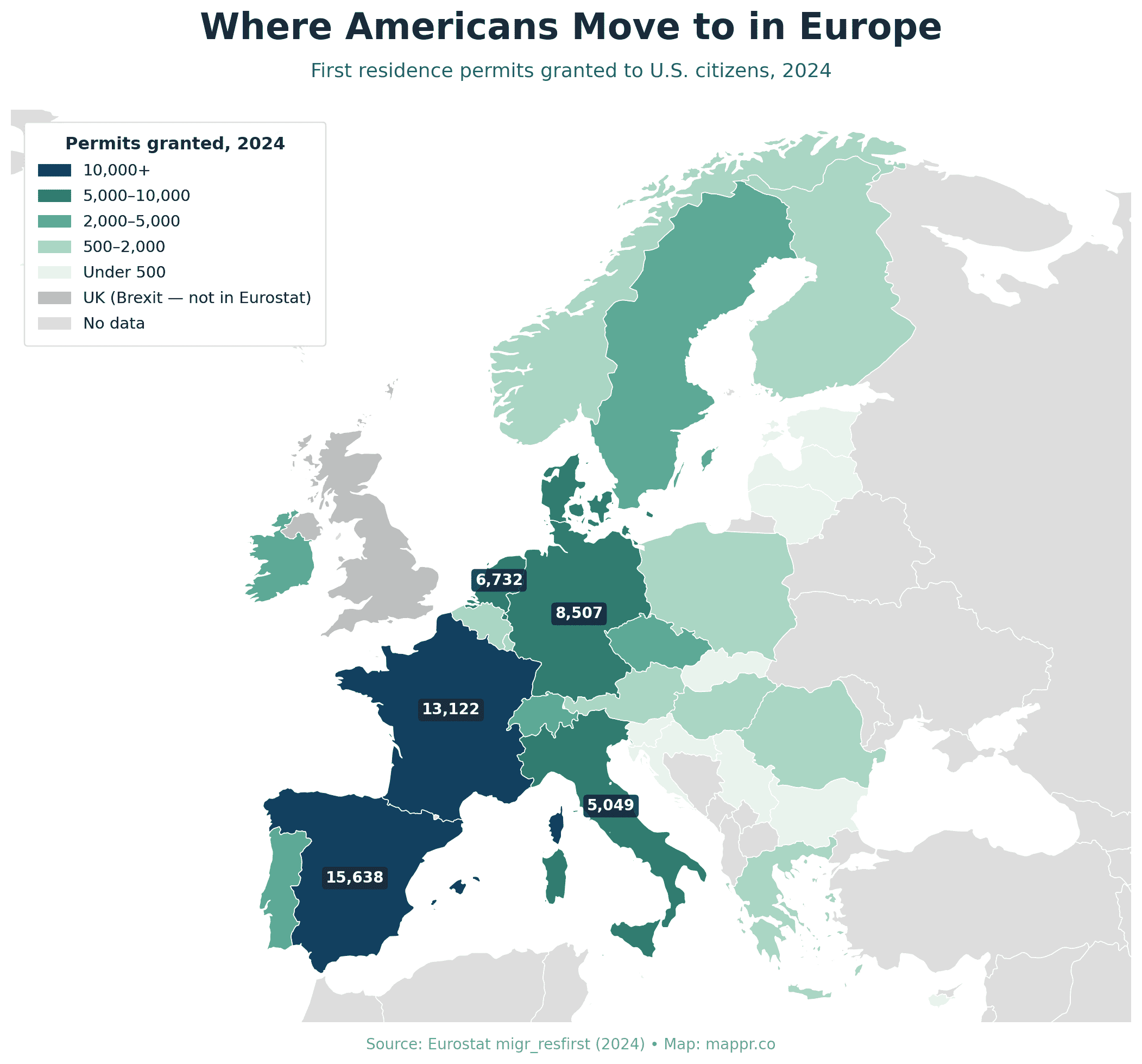
Below, we map the definitive data source: Eurostat’s count of first residence permits granted to U.S. citizens by every EU, EEA and EFTA country in 2024. The EU27 total came in at 80,424, up from 78,911 in 2023 and 75,044 in 2022 – a steady 7% climb across two years. The United Kingdom is the only major destination missing from the Eurostat picture (it stopped reporting after Brexit); we cover it separately using UK Home Office data.
Key Takeaways
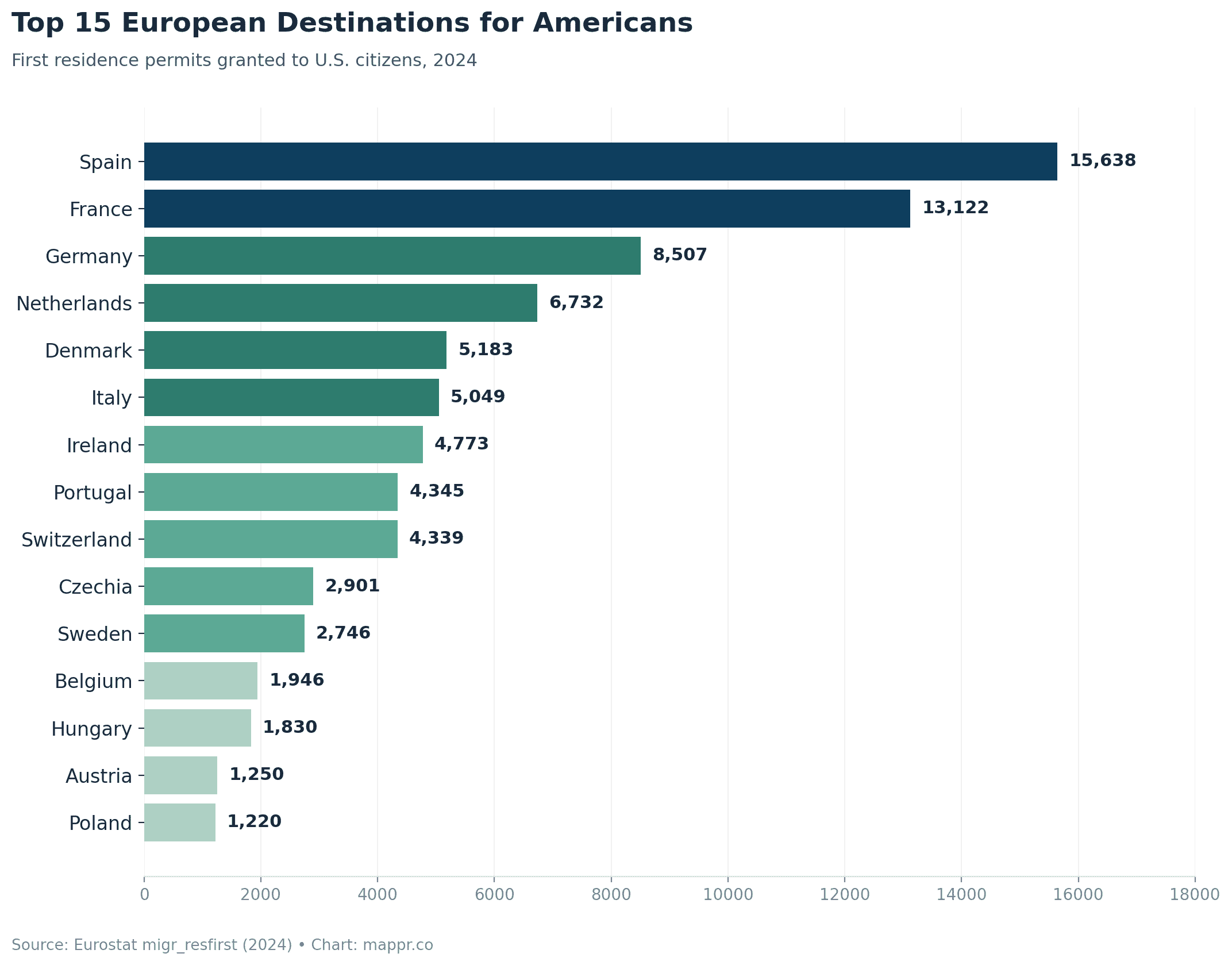
- Spain overtook France as the #1 destination. Spain granted 15,638 first residence permits to U.S. citizens in 2024, up 41% since 2022, pushing France (13,122) into second.
- Germany slid to third, down 23% in two years. Berlin used to top the list. From 11,077 permits in 2022 the count fell to 8,507 in 2024 as U.S. tech and academic hiring softened.
- Portugal cooled off after the golden visa reform. The October 2023 removal of the property-investment route trimmed Portugal's U.S. permits from 4,743 (2023) to 4,345 (2024).
- Ireland is the citizenship-by-descent story. Ireland granted 4,773 permits in 2024. Separately, U.S. applications to the Foreign Births Register (the citizenship-by-grandparent route) surged after the 2024 election.
- 80,424 EU permits, and a record year overall. The EU27 total rose to 80,424 in 2024, up 7% since 2022. A Wall Street Journal analysis of 15 destinations counted roughly 180,000 U.S. citizens relocating in 2025, the highest number since the Great Depression.
The 2024 Map of Americans in Europe
Two things jump out. The Mediterranean is now the clear centre of gravity: Spain, France, Italy, Portugal and Greece together took 39,049 permits in 2024, almost half the EU27 total. And the traditional postwar destinations of Northern Europe – Germany, the Netherlands, Denmark, Sweden, Ireland – still absorb a big share, but the growth is southbound.
Top 15 European Destinations for Americans
Spain alone accounts for nearly one in five of all EU first permits handed to U.S. citizens. France is not far behind, and after that the ranking becomes surprisingly tight – six countries (Germany, the Netherlands, Denmark, Italy, Ireland and Portugal) sit between 4,300 and 8,500 permits.
What Changed: The Five-Year Reshuffle
Comparing 2019 (the last pre-pandemic year) with 2024 shows how much the map has moved. Spain went from 9,603 to 15,638 permits, a 63% increase. Portugal roughly quadrupled, from 1,090 to 4,345. Germany declined from 13,557 to 8,507, losing its long-held top slot. Denmark added a third. Ireland added a quarter. Only Italy, of the top ten, is essentially flat over five years.
🇪🇸 Spain: The New Number One
Spain’s climb was already visible in the Eurostat series before the 2024 U.S. election. The country doubled its U.S. permit count between 2019 and 2024, driven by three visa routes that Americans have taken to enthusiastically: the non-lucrative visa (proof of passive income, no work needed), the digital nomad visa launched in 2023, and the entrepreneur (autónomo) visa. Even the end of Spain’s golden visa on 3 April 2025 has not slowed the trend – the property-investment route was only ever a small share of American admissions, and Barcelona, Madrid, Valencia and Málaga remain the four cities international real-estate brokers report as top American shopping lists.
🇫🇷 France: Steady, Big and Bureaucratic
France has held roughly steady between 12,000 and 13,000 U.S. permits a year since 2019. The long-stay visitor visa (VLS-TS “visiteur”) is the workhorse route for retirees and remote workers who can prove income, and the country’s tech-focused Passeport Talent has become popular with founders and senior engineers. Paris still dominates, but Occitanie, Nouvelle-Aquitaine and Provence account for a growing share of permits – the same départements that already host large British and Dutch expat communities.
🇩🇪 Germany: The Slide From #1
Germany used to top this list. In 2019 it granted 13,557 permits to U.S. citizens, more than any other EU country. By 2024 that count had fallen 37% to 8,507. Part of the story is a hiring pullback: U.S. tech companies with Berlin and Munich offices trimmed headcount after 2022, and Germany’s own economic malaise has weighed on the EU Blue Card and skilled-worker pipelines. Part of it is a shift in taste – younger movers who used to head for Berlin’s cultural scene are increasingly choosing Lisbon, Barcelona or Madrid instead.
🇳🇱 Netherlands: The DAFT Advantage
The Netherlands’ 6,732 permits in 2024 owe an outsized share to a treaty most other Europeans don’t have: the 1956 Dutch American Friendship Treaty (DAFT), which lets any American start a Dutch business with a €4,500 investment and receive a two-year residence permit, renewable indefinitely. It is the closest thing in Europe to a bespoke visa for U.S. self-employed workers, and the Amsterdam and Utrecht startup scenes have been quietly absorbing DAFT movers for years.
🇩🇰 Denmark: The Science and Tech Magnet
Denmark’s 5,183 permits are disproportionately weighted toward researchers, life-sciences workers and family reunifications – the country’s Positive List for skilled workers, Fast Track scheme for large employers and Startup Denmark visa all target high-skill migration. It is a small country: on a per-100k-residents basis Denmark actually ranks higher than any of the giants above it.
🇮🇹 Italy: Slower Than Expected
Italy’s 5,049 permits mark a modest decline from 2023 (6,453). The country’s elective residence visa is famously demanding on documentation and slow at consulates, and the newer digital nomad visa (launched 2024) has taken time to ramp up. The bright spot is the citizenship-by-descent (jure sanguinis) route: Americans with an Italian great-great-grandparent can still claim citizenship without ever setting foot in Italy first – though a 2025 reform narrowed eligibility, which may show up in future numbers.
🇮🇪 Ireland: Small Country, Big Ancestral Pull
Ireland’s 4,773 permits look modest until you notice the country is smaller than the New York metropolitan area. The bigger Ireland-America story is happening on a separate register: the Foreign Births Register, the paperwork route through which anyone with an Irish grandparent can claim Irish (and therefore EU) citizenship. U.S. applications rose sharply after the 2024 election – Ireland reported a 46% increase in Americans applying for citizenship, and Tortoise Media documented a similar surge in Irish passport requests. Citizenship-by-descent doesn’t show up in residence-permit statistics, but it means the true count of Americans establishing a Plan B in Ireland is much higher than Eurostat suggests.
🇵🇹 Portugal: The Golden Visa Comedown
Portugal’s permit count peaked at 4,743 in 2023 before slipping to 4,345 in 2024. In October 2023 the country ended the property-investment route to its golden visa – for years the marquee residency-by-investment program in Europe and a favourite of U.S. buyers. The country now leans on the D7 (passive-income) and D8 (digital nomad) visas, and while Lisbon and Porto remain heavily American in feel, price rises and short-term-rental restrictions have blunted some of the buzz. Portugal is still #8, and D7 processing has caught up after a brutal 2022–2023 backlog.
🇨🇭 Switzerland: The Non-EU Outlier
Switzerland is not in the EU but is included in Eurostat’s dataset for context. Its 4,339 permits in 2024 have been remarkably stable at that level for a decade – Zurich, Geneva and Basel absorb a steady flow of American finance, pharma and international-agency workers, and the Swiss quota system caps sudden growth in a way the EU doesn’t. Getting in is harder; staying pays better.
The UK: Missing From the Map, Not From the Story
The United Kingdom is the biggest hole in the Eurostat picture. Since Brexit the UK doesn’t feed the same first-permit dataset, so it is greyed out on the map above. But UK Home Office statistics make one thing clear: the Americans-to-Britain flow is enormous, if you count all its routes together. In the year ending September 2025, U.S. nationals accounted for 4.6 million Electronic Travel Authorisations (ETAs) – short-term travel authorisations, but a proxy for how much Americans want to be in Britain. Sponsored study visas granted to U.S. nationals rose 7% year-on-year against a general 30% decline. And the Global Talent visa has become the go-to route for the wave of U.S. scientists Nature tracked in early 2025, with several UK universities publicly recruiting American researchers whose federal funding was cut.
Adding the UK to the same ranking would almost certainly put it in the top three, alongside Spain and France, with a workload split heavily toward high-skill migration. British universities, financial services, biotech and creative industries are the primary landing pads.
The Post-Election Surge: Why 2025 Was a Different Year
Eurostat’s 2024 numbers were locked in before Donald Trump’s return to the White House. The relocations that followed the November 2024 election show up in 2025 permit data, which the EU will publish in early 2027. What we already have is a set of leading indicators from destination countries and independent trackers, and they all point in the same direction.
- Wall Street Journal (2026): 180,000+ Americans relocated to 15 sampled countries in 2025, the highest count since the Great Depression. The paper’s analysis called it “the new American dream is to no longer live in America.”
- Nature magazine (2025): U.S. scientists submitted ~30% more applications for jobs abroad in Q1 2025 than in Q1 2024. A survey of 1,600+ scientists found 75% were considering leaving.
- Ireland Foreign Births Register: 46% year-on-year rise in U.S. applications for Irish citizenship after November 2024.
- Latin American student flow: Business schools including ESADE in Spain report students who would have chosen the U.S. now picking European campuses for “stability and freedom.”
- UK Global Talent visa: Several UK universities publicly launched recruitment drives for U.S. researchers whose federal grants were cancelled, with visible take-up.
How the flow lands geographically in 2025 and 2026 depends on which routes remain open. Spain’s golden visa ended in April 2025, but the country’s non-lucrative and digital nomad routes are still generous. Portugal’s D7 has cleared its backlog. Italy’s jure sanguinis tightened. France’s Passeport Talent expanded again in 2025. Ireland is running as fast as it can on Foreign Births Register applications, with a multi-year processing queue.
The Visa Routes Americans Actually Use
Behind the headline map is a menu of very different pathways. Eurostat’s reason breakdown for U.S. citizens splits roughly into education (about 30% of permits), employment (25%), family (25%) and “other” including retirement, remote work and religious postings (20%). The employment share skews heavily toward tech, finance, life sciences and academia. The “other” bucket is where the passive-income and digital-nomad visas sit, and where most of the recent growth has come from.
- Passive-income visas: Portugal’s D7, Spain’s Non-Lucrative Visa, France’s Long-Stay Visitor, Greece’s Financially Independent Person (FIP) visa. All require proof of income (typically €2,000–€3,500/month) and Spanish and Portuguese residence permits, no work rights.
- Digital nomad visas: Portugal D8 (launched 2022), Spain (2023), Italy (2024), Greece, Malta, Estonia. Income thresholds vary; most require remote employment or self-employment with foreign clients.
- Skilled-worker routes: Germany’s Blue Card and skilled-worker visa, Netherlands’ Highly Skilled Migrant, France’s Passeport Talent, UK’s Skilled Worker and Global Talent, Denmark’s Positive List. The workhorse for corporate movers.
- Entrepreneur routes: Netherlands’ DAFT (Dutch American Friendship Treaty) is the most permissive; Spain, Portugal, Italy and Estonia all have variants. Ireland and France have startup-specific visas.
- Citizenship-by-descent: Ireland (grandparent), Italy (great-great-grandparent, tightened 2025), Poland, Germany, Hungary, Portugal (Sephardic Jewish descent), plus Spain and Portugal for descendants of Sephardic Jews. None require prior residence.
- Golden visas: Spain terminated April 2025, Portugal removed the property route in October 2023, Ireland closed in 2023. Still active: Greece, Italy, Malta, Latvia. The 2026 program map has moved toward passive-income and lifestyle visas rather than investment.
What Comes Next
Three things are worth watching as the 2025 numbers land. First, whether Spain’s golden-visa closure meaningfully dents its top-of-ranking position or whether the digital nomad and non-lucrative pipelines absorb the demand (early indications: they do). Second, whether the U.S. scientist exodus continues at the Q1 2025 pace – if so, the UK, Denmark, Netherlands and Germany will all see disproportionate gains in skilled-worker permits. Third, whether the Irish Foreign Births Register and Italian jure sanguinis routes translate ancestry-based citizenship into actual residence, or whether Americans continue to secure the passport as an insurance policy while living in the U.S.
The bigger picture: U.S. emigration to Europe is not a dramatic 2024 political event. It is a slow, structural shift that has been building since the pandemic, that predates the current administration by five years, and that has re-centered on the Mediterranean while the traditional Northern European destinations quietly reshuffle. Eurostat’s 2025 release, due in early 2027, will show how much of the post-election surge really landed, but the data on this map is already the closest picture we have of the reshuffle in progress.
Sources:
Official data
- Eurostat – First residence permits by reason, length of validity and citizenship (migr_resfirst), 2024
- UK Home Office – Immigration system statistics, year ending December 2025
- Migration Observatory (University of Oxford) – Home Office Control of Immigration statistics
- Oireachtas parliamentary question on Foreign Birth Registration processing (July 2025)
Trend reporting
- Wall Street Journal – Americans are leaving the U.S. in record numbers
- The Guardian – Democracy supporters and the emigration surge (June 14, 2026)
- Newsweek – More Americans looking toward Ireland for Plan B (June 26, 2026)
- NPR/KRVS – After Trump's re-election, U.S. scientists find jobs in the UK (June 30, 2026)
- Inside Higher Ed – Latin American students choosing Spain over U.S. (June 22, 2026)
- Tortoise Media – Surge in Americans seeking Irish passports after Trump re-elected
- Forbes – Golden visas are now about healthcare, rights and family futures (June 28, 2026)