Key Takeaways
- Central Asia's glaciers had their worst year on record in 2025. The region lost roughly 30 cubic kilometres of ice in a single year — close to 2% of all the ice it has left — its most extreme mass-loss year ever measured.
- The Pamir-Karakoram anomaly is ending. For decades, glaciers in the Pamir and Karakoram defied the global trend, staying stable or even growing while ice vanished everywhere else. That last holdout is now breaking down.
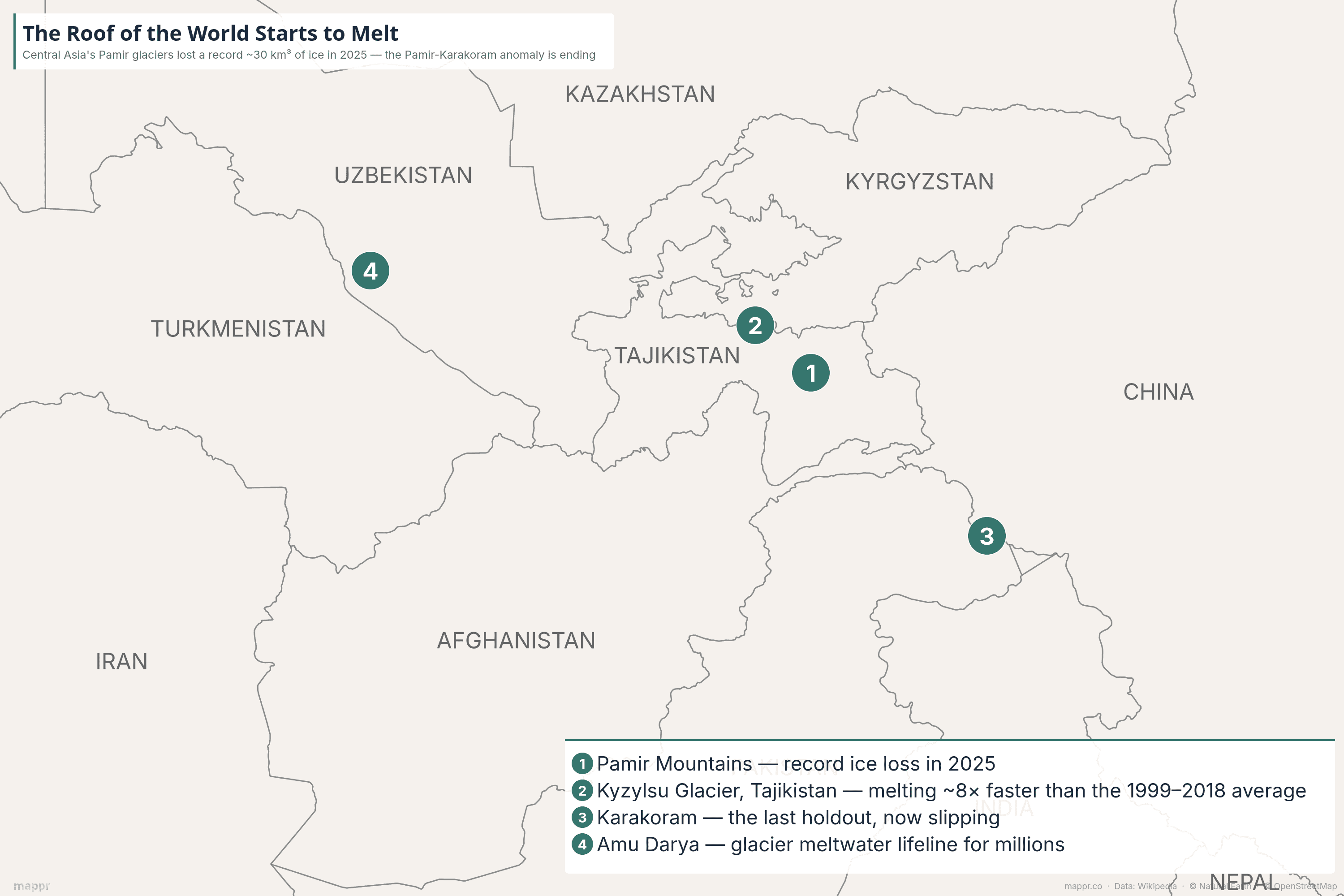
- The tipping point was a collapse in snowfall around 2018. Researchers tracking Tajikistan's Kyzylsu Glacier found annual precipitation fell by about a third, and the glacier began losing mass up to eight times faster than its 1999–2018 average.
- Millions downstream depend on this ice. Pamir meltwater feeds the Amu Darya and Syr Darya — the rivers that water farms, cities and hydropower across Tajikistan, Uzbekistan, Kyrgyzstan, Turkmenistan and Kazakhstan.
For decades, one corner of the planet stubbornly refused to follow the rules of climate change. While glaciers from the Alps to the Andes retreated, the ice of the Pamir and Karakoram mountains — the “roof of the world” — held steady, and in places even grew. Glaciologists called it the Pamir-Karakoram anomaly, and it was one of the few hopeful footnotes in an otherwise grim story. That footnote is now being erased.
In 2025, glaciers across Central Asia suffered their most extreme melt year on record, shedding roughly 30 cubic kilometres of ice — nearly 2% of everything they had left — in a single season. New research suggests the anomaly didn’t just weaken; it tipped, and the shift looks irreversible. Here is where it’s happening, and why it reaches far beyond the mountains.
📉 A record-breaking year for ice
The headline number is stark. A 2026 analysis of Central Asia’s mountain glaciers found the region lost on the order of 30 cubic kilometres of ice during 2025 — equivalent to nearly 2% of its entire remaining glacier volume vanishing in twelve months. It was the most extreme mass-loss year in the satellite record. The cause was a brutal combination: persistently above-average spring and summer temperatures, an unusually early start to the melt season, and a shortage of fresh snow in late spring and summer to shield the ice from the sun.
🧊 What made the Pamir-Karakoram anomaly special
Almost everywhere on Earth, warming has meant shrinking glaciers. The Pamir, Karakoram and western Kunlun ranges were the great exception. Through the 2000s and 2010s their glaciers stayed close to balance — neither gaining nor losing much — and a handful even advanced. Scientists dubbed it the “Karakoram anomaly,” or, taking in the neighbouring range, the Pamir-Karakoram anomaly, and spent years debating what protected it: a quirk of the circulation that delivers winter snow, unusually heavy snowfall, or the insulating layer of rocky debris that blankets many of these glaciers. Whatever the mix, it made this the last large region of stable ice on the planet.
❄️ The tipping point: when the snow stopped
New work led by glaciologist Francesca Pellicciotti at the Institute of Science and Technology Austria pinpoints when the spell broke. By reconstructing conditions on Tajikistan’s Kyzylsu Glacier from 1999 to 2023 and publishing the results in Communications Earth & Environment, her team identified a tipping point around 2018 — driven not primarily by hotter summers, but by a sustained collapse in snowfall. Annual precipitation fell by roughly a third, snow depth dropped, and the avalanches that used to top the glaciers up with extra snow dwindled. Starved of new ice and left exposed, Kyzylsu began losing mass up to eight times faster than its 1999–2018 average. The 2025 melt season then hammered an already weakened system.
💧 A meltwater lifeline for millions
This is not only a story about mountains. The Pamir glaciers are the frozen reservoir at the head of the Amu Darya and Syr Darya, the two great rivers of Central Asia. During the hot, dry months, glacier melt is what keeps them flowing — sustaining irrigation, drinking water, ecosystems and hydropower across Tajikistan, Uzbekistan, Kyrgyzstan, Turkmenistan and Kazakhstan. There is a cruel twist in the timing: as glaciers shrink they first release more water, a temporary surge sometimes called “peak water,” before runoff falls away for good once the ice runs low. Communities that come to depend on that surge can be left dangerously short when it ends.
The last holdout joins the rest
For glaciologists, the end of the Pamir-Karakoram anomaly removes one of the few remaining question marks in the global picture of ice loss. For the tens of millions of people living downstream, it shortens the runway to plan for a future with less reliable summer water. The roof of the world held out longer than anywhere else. Now it, too, is melting — and the meltwater traced on the map above is running on a clock.