
Key Facts: The Euro in Croatia
- Currency: Euro (EUR) — since 1 January 2023. Croatia is the 20th country to adopt the euro, replacing the kuna (HRK) at the fixed rate 1 EUR = 7.53450 HRK.
- Central bank: Hrvatska narodna banka (HNB). Now a Eurosystem national central bank. Governor Boris Vujčić (since 2012) sits on the ECB Governing Council.
- Coins feature Nikola Tesla + a marten (kuna). Each Eurosystem member designs its own coin reverses. Croatia's €1 coin honours the marten — the animal that gave the old kuna its name.
- Kuna still exchangeable indefinitely at HNB. HRK lost legal-tender status on 15 January 2023, but the Croatian National Bank exchanges kuna banknotes and coins to euros free of charge at any of its branches, with no deadline.
- ECB deposit facility rate: 2.00%. Set by the ECB in Frankfurt for all 20 Eurozone members. Inflation in Croatia has converged close to the Eurozone average since adoption.
What Is the Currency of Croatia?
Croatia’s currency is the euro (symbol €, ISO 4217 code EUR). On 1 January 2023, Croatia became the 20th member of the Eurosystem, adopting the euro in place of the Croatian kuna (HRK). It was the first country to join the euro since Lithuania in 2015, and the first of the Western Balkans-adjacent states to complete the full accession path.
The transition was fixed at 1 EUR = 7.53450 HRK — the same central rate Croatia had held in ERM II since 10 July 2020. A two-week period of dual circulation followed adoption, after which the kuna ceased to be legal tender on 15 January 2023. The Croatian National Bank (Hrvatska narodna banka, HNB) continues to exchange kuna banknotes and coins to euros indefinitely and without fees.
Euro to US Dollar — 1-Year Chart
Croatia shares the euro with 19 other Eurozone countries. The chart below tracks EUR/USD — the relevant exchange-rate benchmark for any euro user, since it’s the world’s largest-volume FX pair.
Line chart. Daily close, USD per 1 EUR · Source: Yahoo Finance · Updated nightly. Data table with 2 rows and 131 columns follows.
| Oct 12 | Oct 14 | Oct 16 | Oct 20 | Oct 22 | Oct 27 | Oct 29 | Oct 31 | Nov 04 | Nov 06 | Nov 10 | Nov 12 | Nov 14 | Nov 18 | Nov 20 | Nov 24 | Nov 26 | Nov 28 | Dec 02 | Dec 04 | Dec 08 | Dec 10 | Dec 12 | Dec 16 | Dec 18 | Dec 22 | Dec 24 | Dec 29 | Dec 31 | Jan 05 | Jan 07 | Jan 09 | Jan 13 | Jan 15 | Jan 19 | Jan 21 | Jan 23 | Jan 27 | Jan 29 | Feb 02 | Feb 04 | Feb 06 | Feb 10 | Feb 12 | Feb 16 | Feb 18 | Feb 20 | Feb 24 | Feb 26 | Mar 02 | Mar 04 | Mar 06 | Mar 10 | Mar 12 | Mar 16 | Mar 18 | Mar 20 | Mar 24 | Mar 26 | Mar 29 | Mar 31 | Apr 02 | Apr 06 | Apr 08 | Apr 12 | Apr 14 | Apr 16 | Apr 20 | Apr 22 | Apr 26 | Apr 28 | Apr 30 | May 04 | May 06 | May 10 | May 12 | May 14 | May 18 | May 20 | May 24 | May 26 | May 28 | Jun 01 | Jun 03 | Jun 07 | Jun 09 | Jun 11 | Jun 15 | Jun 17 | Jun 21 | Jun 23 | Jun 25 | Jun 29 | Jul 01 | Jul 05 | Jul 07 | Jul 09 | Jul 13 | Jul 15 | Jul 19 | Jul 21 | Jul 23 | Jul 27 | Jul 29 | Aug 02 | Aug 04 | Aug 06 | Aug 10 | Aug 12 | Aug 16 | Aug 18 | Aug 20 | Aug 24 | Aug 26 | Aug 30 | Sep 01 | Sep 03 | Sep 07 | Sep 09 | Sep 13 | Sep 15 | Sep 17 | Sep 21 | Sep 23 | Sep 27 | Sep 29 | Oct 01 | Oct 05 | Oct 07 | Oct 12 | |
|---|---|---|---|---|---|---|---|---|---|---|---|---|---|---|---|---|---|---|---|---|---|---|---|---|---|---|---|---|---|---|---|---|---|---|---|---|---|---|---|---|---|---|---|---|---|---|---|---|---|---|---|---|---|---|---|---|---|---|---|---|---|---|---|---|---|---|---|---|---|---|---|---|---|---|---|---|---|---|---|---|---|---|---|---|---|---|---|---|---|---|---|---|---|---|---|---|---|---|---|---|---|---|---|---|---|---|---|---|---|---|---|---|---|---|---|---|---|---|---|---|---|---|---|---|---|---|---|---|---|---|
| USD per EUR | 1.16 | 1.16 | 1.17 | 1.16 | 1.16 | 1.16 | 1.17 | 1.16 | 1.15 | 1.15 | 1.15 | 1.16 | 1.16 | 1.16 | 1.15 | 1.15 | 1.16 | 1.16 | 1.16 | 1.17 | 1.16 | 1.16 | 1.17 | 1.18 | 1.17 | 1.17 | 1.18 | 1.18 | 1.17 | 1.17 | 1.17 | 1.17 | 1.17 | 1.16 | 1.16 | 1.17 | 1.18 | 1.19 | 1.2 | 1.18 | 1.18 | 1.18 | 1.19 | 1.19 | 1.19 | 1.19 | 1.18 | 1.18 | 1.18 | 1.18 | 1.16 | 1.16 | 1.16 | 1.15 | 1.14 | 1.15 | 1.16 | 1.16 | 1.16 | 1.15 | 1.16 | 1.15 | 1.15 | 1.17 | 1.17 | 1.18 | 1.18 | 1.18 | 1.17 | 1.17 | 1.17 | 1.17 | 1.17 | 1.17 | 1.18 | 1.17 | 1.17 | 1.17 | 1.16 | 1.16 | 1.16 | 1.17 | 1.16 | 1.16 | 1.15 | 1.15 | 1.16 | 1.16 | 1.15 | 1.15 | 1.14 | 1.14 | 1.14 | 1.14 | 1.14 | 1.14 | 1.14 | 1.14 | 1.15 | 1.14 | 1.14 | 1.14 | 1.14 | 1.15 | 1.15 | 1.15 | 1.15 | 1.15 | 1.15 | 1.16 | 1.16 | 1.17 | 1.17 | 1.17 | 1.16 | 1.16 | 1.16 | 1.16 | 1.16 | 1.16 | 1.15 | 1.15 | 1.15 | 1.14 | 1.14 | 1.13 | 1.12 | 1.12 | 1.12 | 1.12 |
Over the past 12 months the euro has moved in a roughly 1.10–1.18 range against the dollar, closing recently near 1.18. The ECB’s current 2.00% deposit rate, set against the Fed’s 4.25%, is the dominant driver of the pair’s trajectory.
Euro Banknotes and Croatian Coins
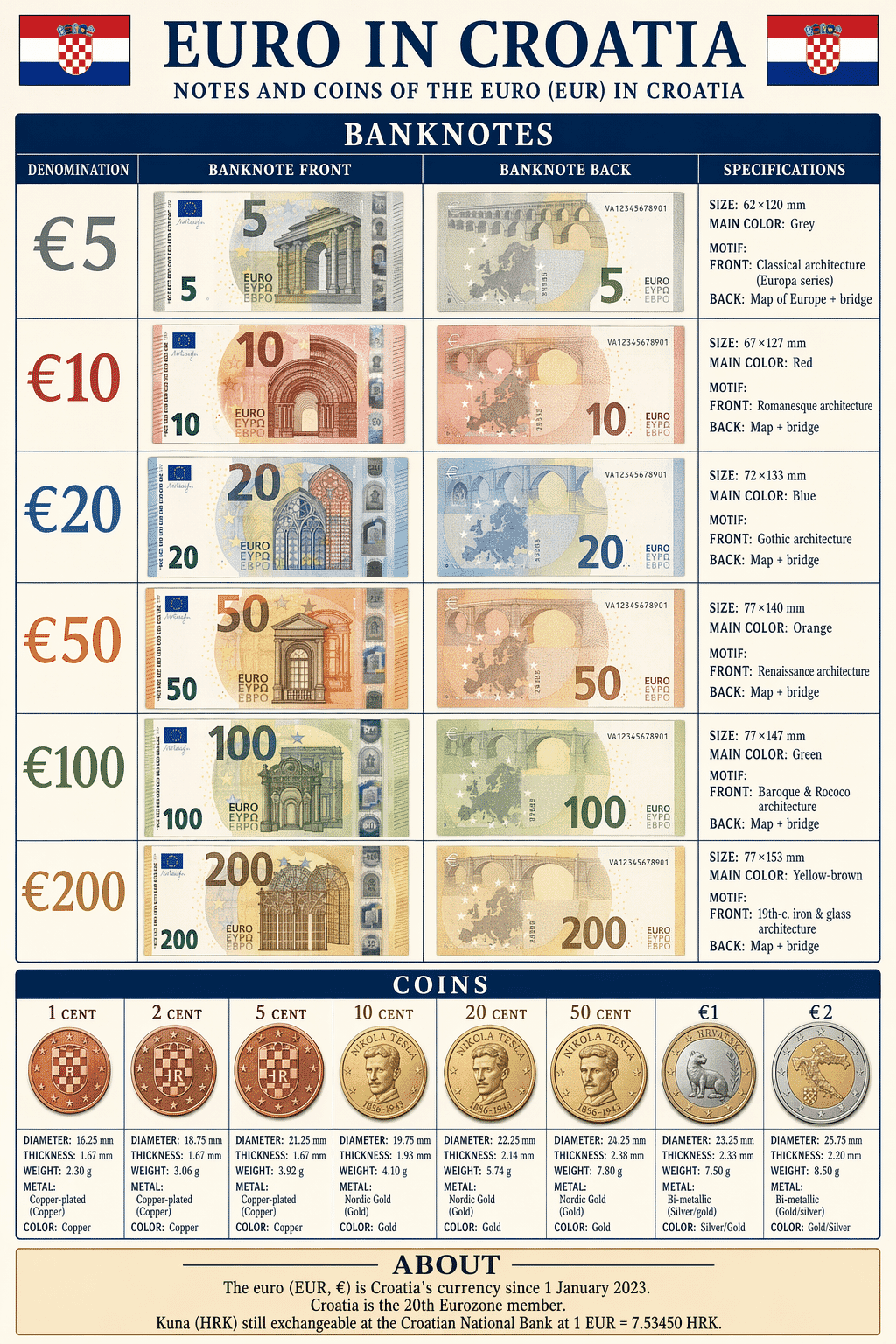
Croatia uses the same euro banknotes as the other 19 Eurosystem members — the “Europa” series introduced in denominations from €5 to €200 between 2013 and 2019. The €500 note is still legal tender but is no longer issued.
| Denomination | Motif | Notes | Colour |
|---|---|---|---|
| €5 Europa | Classical architecture | Same ECB banknotes as Germany + all Eurozone | Grey |
| €10 Europa | Romanesque architecture | — | Red |
| €20 Europa | Gothic architecture | — | Blue |
| €50 Europa | Renaissance architecture | — | Orange |
| €100 Europa | Baroque & Rococo architecture | — | Green |
| €200 Europa | 19th-century iron & glass architecture | — | Yellow-brown |
Euro coins have a national reverse unique to Croatia. The designs were selected via a public competition in 2021. The small coins (1c, 2c, 5c) carry the country abbreviation “HR” on a chequerboard. The mid-sized coins (10c, 20c, 50c) show a portrait of Nikola Tesla, the Croatian-born inventor. The €1 coin depicts a kuna (pine marten) — a graceful nod to the pre-euro currency’s namesake animal. The €2 coin shows a map of Croatia with the country’s red-and-white chequerboard motif.
| Denomination | Croatian National Reverse | Minted |
|---|---|---|
| 1c, 2c, 5c | Copper-plated steel — Croatian national reverse: ‘HR’ lettering on a chequerboard background | Since 2023 |
| 10c, 20c, 50c | Nordic gold — Croatian national reverse: Nikola Tesla portrait | Since 2023 |
| €1 | Bi-metallic — Croatian national reverse: the kuna (marten), the animal on the pre-euro currency | Since 2023 |
| €2 | Bi-metallic — Croatian national reverse: map of Croatia with “HR” and a chequerboard motif | Since 2023 |
From Kuna to Euro: Croatia’s Currency History
The Croatian kuna had a short but successful run. Introduced in 1994 during the country’s independence and post-war stabilisation, it replaced the transitional Croatian dinar and was named after the pine marten — a fur-bearing animal historically used as a unit of account in Croatian lands. By 2022, after nearly three decades of stability, Croatia had effectively out-grown the kuna: its economy was already heavily euroised, and the kuna’s ERM II peg had been held without stress.
| Year | Event |
|---|---|
| 1994 | Croatian kuna (HRK) introduced 30 May, replacing the transitional Croatian dinar of 1991–1994. |
| 1997 | Hrvatska narodna banka (Croatian National Bank) achieves full operational independence. |
| 2004 | Croatia applies for EU membership; convergence toward the euro becomes a stated long-term goal. |
| 2013 | Croatia joins the European Union on 1 July. Euro adoption begins to move from policy goal to timetable. |
| 2020 | Kuna joins ERM II (the euro’s waiting room) on 10 July at a central rate of 7.53450 HRK = 1 EUR. |
| 2022 | ECOFIN Council clears Croatia to adopt the euro on 12 July; ECB converges rate set at 7.53450 HRK = 1 EUR. |
| 2023 | Croatia adopts the euro on 1 January, becoming the 20th Eurosystem member. Dual-circulation with the kuna runs for two weeks; the kuna loses legal-tender status on 15 January. HNB continues to exchange kuna indefinitely. |
| 2024–2026 | Croatia’s first full years on the euro. Inflation has converged toward Eurozone average; Zagreb retains HNB as a Eurosystem national central bank. |
The Croatian Economy and the Euro
Croatia is a small, open, services-heavy economy. Tourism contributes roughly 25% of GDP — one of the highest shares in the EU — and most of those receipts come from Eurozone visitors, a fact that made euro adoption especially logical. Manufacturing, shipbuilding, and pharmaceuticals account for most of the remainder of exports.
On the monetary side, Croatia is now subject to the ECB’s single inflation target of 2% over the medium term. Croatian inflation initially ran noticeably above the Eurozone average in 2023 — driven partly by small-scale price rounding during the euro changeover — but has since converged. The ECB’s deposit facility rate sits at 2.00% as of April 2026; Croatia’s own credit conditions now move with Frankfurt rather than Zagreb.
Using Euros in Croatia
Cards are widely accepted along the Dalmatian coast (Dubrovnik, Split, Zadar, Šibenik), in Istria (Rovinj, Pula), and in Zagreb — Visa and Mastercard work nearly everywhere, including most konobas, restaurants, hotels, ferry tickets, and tolls. Contactless is near-universal. In smaller villages, inland national parks (Plitvice, Krka — entry is cardable), and on some ferries to smaller islands, cash is still useful.
Typical prices in euros (2026): espresso in a café €1.50–€2.50; marenda (set lunch) €10–€16 in a konoba, €18–€28 in a mid-range restaurant; a scoop of gelato €2.00–€2.50; a single Zagreb tram ticket €0.53; a mid-range hotel in Split or Dubrovnik in July €140–€280. ATMs (bankomat) are abundant in tourist zones — Zagrebačka banka, Privredna banka Zagreb, and Erste&Steiermärkische Bank operate the largest networks. Avoid Euronet ATMs at airports and on tourist strips — the conversion margins can be steep.
Croatia Among Its Neighbours
Croatia is now firmly in the euro camp — alongside Slovenia (euro since 2007) and Slovakia (since 2009). Hungary, Romania, and Serbia retain their own currencies with varying degrees of float; Bulgaria is the next likely Eurozone candidate with its currency-board BGN already fixed to the euro.
| Country | Code | Regime | Inflation | Policy rate |
|---|---|---|---|---|
| 🇭🇷 Croatia | EUR (since 2023) | Eurosystem (free float) | 3.5% | 2.00% |
| 🇸🇮 Slovenia | EUR (since 2007) | Eurosystem (free float) | 2.4% | 2.00% |
| 🇸🇰 Slovakia | EUR (since 2009) | Eurosystem (free float) | 2.9% | 2.00% |
| 🇭🇺 Hungary | HUF | Free float (MNB inflation target) | 4.3% | 6.50% |
| 🇷🇴 Romania | RON | Managed float | 5.0% | 6.50% |
| 🇧🇬 Bulgaria | BGN (pegged to EUR) | Currency board → euro 2026 candidate | 2.6% | 2.00% |
| 🇷🇸 Serbia | RSD | Managed float | 5.2% | 5.75% |
Frequently Asked Questions
What is the currency of Croatia?
The currency of Croatia is the euro (€, ISO 4217 code EUR). Croatia adopted the euro on 1 January 2023, becoming the 20th member of the Eurosystem. The euro replaced the Croatian kuna (HRK) at the fixed conversion rate of 1 EUR = 7.53450 HRK.
Is the Croatian kuna still legal tender?
No. The kuna ceased to be legal tender on 15 January 2023, after a two-week dual-circulation period. However, the Hrvatska narodna banka (HNB) will continue to exchange kuna banknotes and coins to euros indefinitely at no charge, at any of its branches in Zagreb, Osijek, Rijeka, and Split.
Why did Croatia adopt the euro?
Croatia’s financial system was already heavily euroised before 2023 — roughly 70% of bank deposits and over 50% of loans were already denominated in euros or indexed to the euro. Adopting the euro formally eliminated exchange-rate risk on those positions, lowered borrowing costs (especially for the government), and removed FX fees on the large tourism-driven transaction flows (tourism accounts for around 25% of Croatia’s GDP).
Who manages monetary policy for Croatia?
The European Central Bank (ECB) in Frankfurt, under President Christine Lagarde. The Croatian National Bank (HNB), still headed by Governor Boris Vujčić, is now a Eurosystem national central bank. Governor Vujčić sits on the ECB Governing Council and votes on euro-area monetary-policy decisions.
What do Croatian euro coins look like?
Like every Eurosystem member, Croatia designed its own national reverses for the eight denominations. The 1c, 2c, and 5c coins show the “HR” country abbreviation on a chequerboard pattern. The 10c, 20c, and 50c coins show a portrait of the Croatian-born inventor Nikola Tesla. The €1 coin shows a marten (kuna), honouring the old currency’s namesake animal, and the €2 coin shows a map of Croatia with the country’s chequerboard coat of arms.
Do Croatian euro coins work in the rest of the Eurozone?
Yes. All euro coins from any Eurosystem member are legal tender across the entire euro area. You can spend Croatian-issue €1 coins in Berlin, Paris, Rome, or Dublin without any conversion.
How many euros was one kuna worth?
The fixed conversion rate set by the ECOFIN Council on 12 July 2022 was 1 EUR = 7.53450 HRK, or equivalently 1 HRK ≈ €0.13. HNB still exchanges kuna at this rate.
All data current to April 2026 — post-adoption sources from HNB and the ECB, plus the 2022 ECOFIN convergence decision.

