Key Takeaways
- A record year for air travel. IATA's 2025 World Air Transport Statistics, released on July 16, 2026, show close to five billion passenger journeys. Total demand rose 5.3% over 2024 and the industry filled a record 83.6% of its seats.
- The US is biggest but barely growing. The United States remains the world's largest air market at 890.1 million passengers, yet it grew just 1.6%, the slowest of the top 10. China is second at 776.1 million, up 4.8%.
- Central Asia is the growth story. Kazakhstan's passenger numbers jumped 40.0% to 18.1 million and Uzbekistan rose 16.9% to 12.5 million. Vietnam grew 14.8% to 80.9 million, the fastest of the larger markets.
- Japan overtakes India for fifth. Japan grew 9.2% to 223.5 million and leapfrogged India, which slipped to sixth at 218.2 million. The widely repeated line that India is the world's fifth-biggest market comes from last year's report.
- No African country in the top 10. The entire top 10 is made up of North American, European and Asian markets. Africa's busiest single route, Cape Town to Johannesburg, carried 3.4 million passengers, a scale that keeps the continent off the global leaderboard.
Every summer, the world’s airlines carry more people than the year before, and in 2025 they carried more than ever. On July 16, 2026, the International Air Transport Association (IATA) published its 2025 World Air Transport Statistics, the industry’s definitive annual scorecard. The freshest hard numbers on the board show an air travel market that has not just recovered from the pandemic but pushed well past it: close to five billion passenger journeys, demand up 5.3% on 2024, and a record 83.6% of all seats filled.
Behind that global figure sits a league table of national markets, and it tells a story of a shifting centre of gravity in world aviation. Here is how the biggest and fastest-growing air markets stack up.
The biggest air passenger markets in 2025
The top of the table is a two-horse race that no one else is close to. The United States remains the world’s largest air market by a wide margin at 890.1 million passengers, followed by China at 776.1 million. Both are powered overwhelmingly by domestic travel; in fact, every one of the ten busiest airport pairs on Earth in 2025 was a domestic route, led by Jeju to Seoul at 13.3 million passengers.
| Rank | Country | Passengers 2025 (millions) | YoY growth |
|---|---|---|---|
| 1 | United States | 890.1 | +1.6% |
| 2 | China | 776.1 | +4.8% |
| 3 | United Kingdom | 269.7 | +3.4% |
| 4 | Spain | 252.7 | +5.0% |
| 5 | Japan | 223.5 | +9.2% |
| 6 | India | 218.2 | +3.3% |
| 7 | Italy | 187.3 | +5.8% |
| 8 | Germany | 163.8 | +3.4% |
| 9 | France | 152.6 | +2.2% |
| 10 | Türkiye | 129.3 | +2.9% |
After the two giants, the ranking is dominated by Europe. The United Kingdom (269.7 million), Spain (252.7 million), Italy, Germany and France all make the top ten, a reflection of the continent’s dense web of short-haul and holiday routes. Türkiye rounds out the list, its position boosted by Istanbul’s rise as a global connecting hub.
Passengers carried by each country’s airlines
A world map of air travel looks a little different from the market league table, and the reason is a useful lesson in how the data works. The map below uses the most complete free by-country dataset available, the World Bank’s count of passengers carried by each country’s registered airlines. On that measure, small countries with giant airlines punch far above their weight.
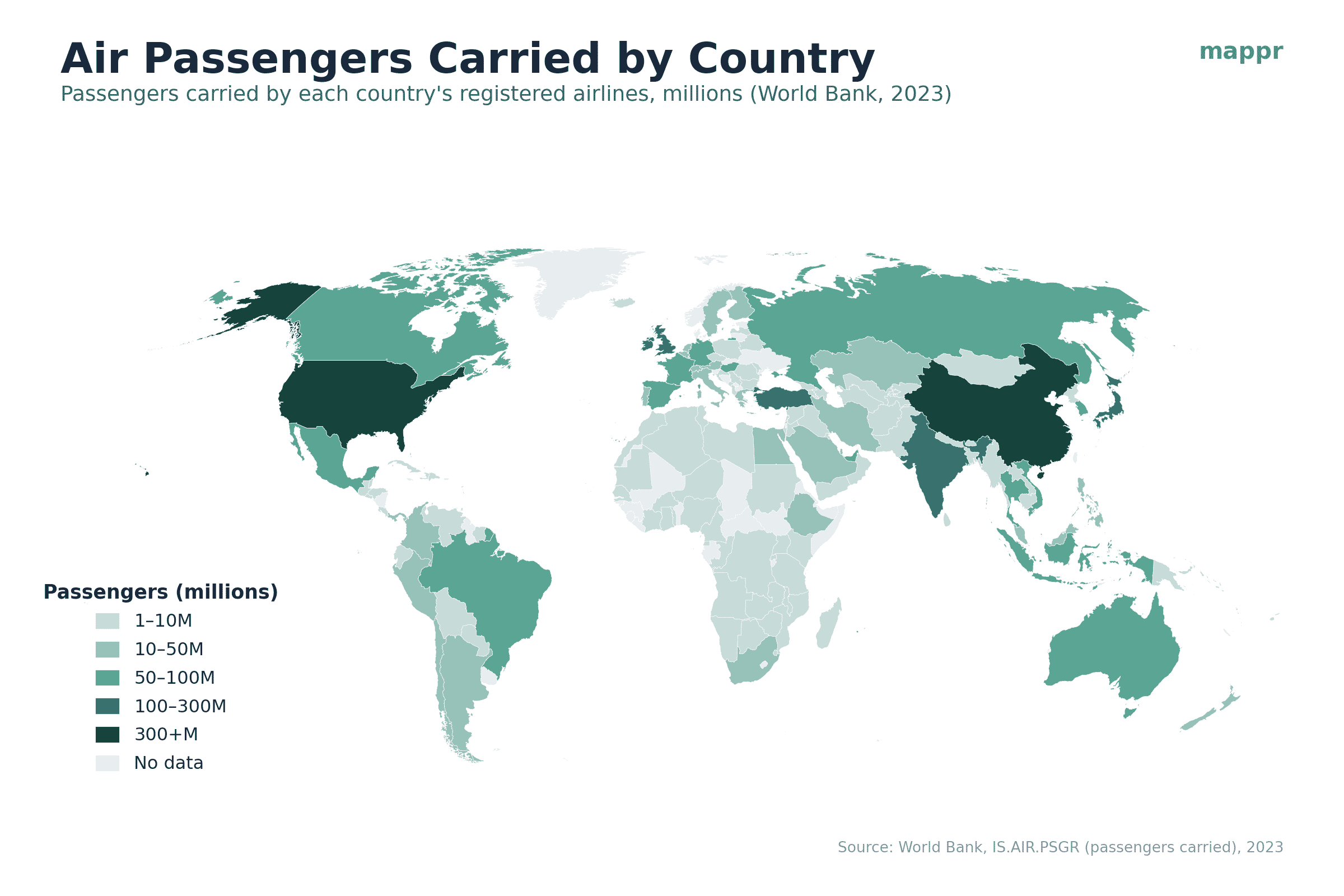
This is why Ireland appears among the heaviest hitters: Ryanair, Europe’s largest airline, is Irish-registered, so its roughly 200 million annual passengers count under Ireland. The same effect lifts the United Arab Emirates (home to Emirates and Etihad) and Hungary (home to Wizz Air). It is a reminder that the country that sells the ticket is not always the country the passenger lives in or flies to.
The fastest-growing markets: Central Asia takes off
If the size ranking is stable, the growth ranking is where the action is. The standout story of 2025 is Central Asia. Kazakhstan saw passenger numbers surge 40.0% to 18.1 million, by far the fastest growth of any sizeable market, and neighbouring Uzbekistan grew 16.9% to 12.5 million. Both are riding a wave of visa liberalisation, new low-cost carriers and a strategic push to become transit points between Europe and Asia.
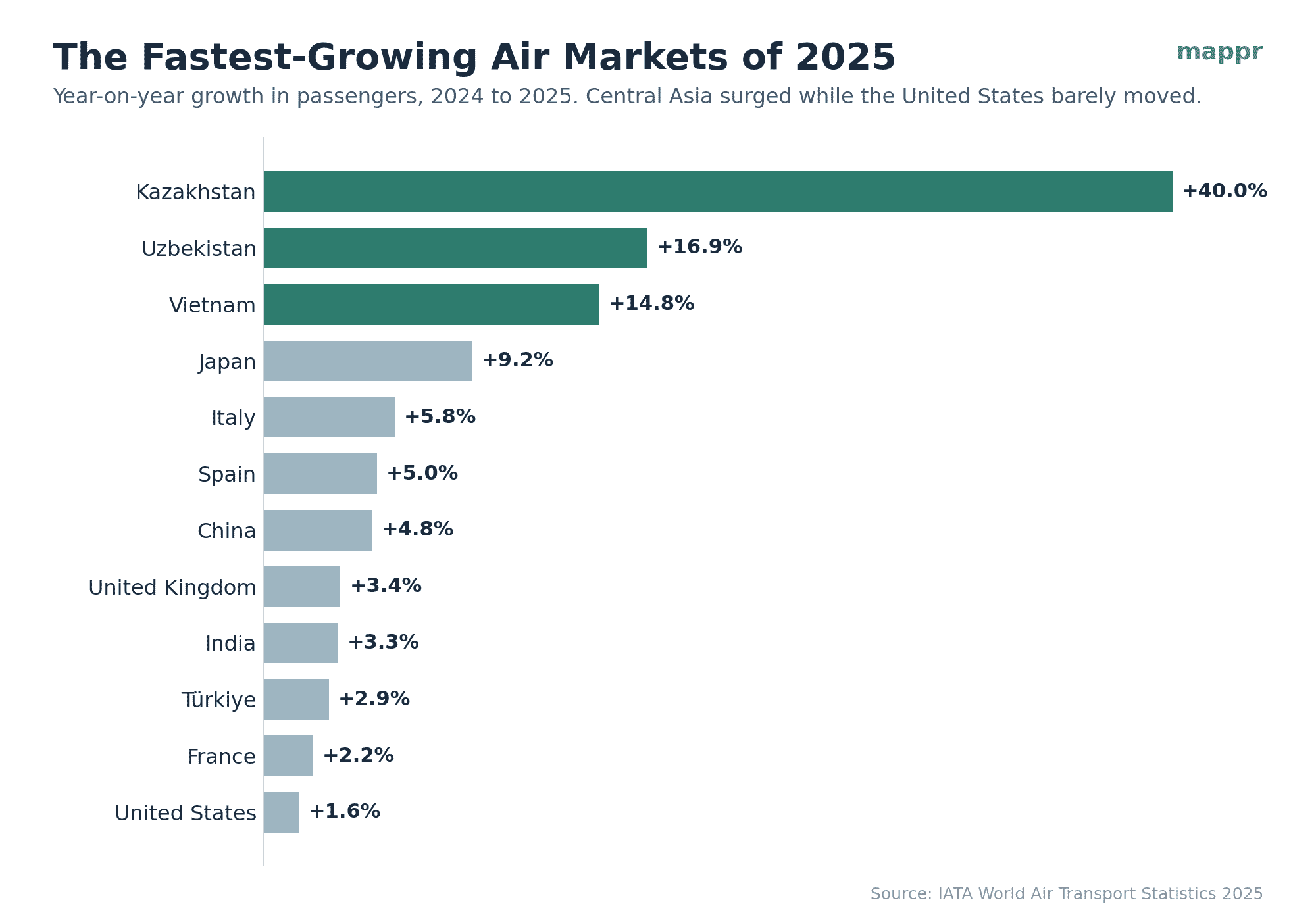
Vietnam was the fastest-growing of the larger markets, up 14.8% to 80.9 million, while Japan led the established heavyweights at 9.2%. The contrast at the other end is stark: the United States, the biggest market of all, grew just 1.6%. Mature markets are close to full, so the growth is coming from the places that are still building their aviation systems.
Japan overtakes India
One quiet but telling change sits in the middle of the table. In 2025, Japan grew fast enough to overtake India for fifth place, pushing India to sixth. If you have seen the claim that India is the world’s fifth-largest aviation market, that figure is from the 2024 edition of these statistics. India is still growing (up 3.3% to 218.2 million) and remains one of the most watched markets in the world, but in the 2025 numbers Japan’s post-pandemic rebound put it narrowly ahead.
Where is Africa?
The most striking absence from the top 10 is an entire continent. No African country makes the list, and the gap is large. Africa’s single busiest route, Cape Town to Johannesburg, carried 3.4 million passengers in 2025, a healthy figure for one city pair but a fraction of the domestic networks that fill the top of the table. By seat capacity, the largest African air markets are Egypt, South Africa and Morocco, but even the biggest of them sits well outside the global top tier. For a continent of more than 1.4 billion people, air travel remains comparatively thin, held back by high costs, fragmented markets and limited intra-African connectivity.
A note on how the numbers are counted
Two data quirks are worth understanding. First, IATA’s market figures count domestic journeys once and international journeys in both the origin and destination country, so the per-country totals are a measure of market activity rather than a simple headcount of residents. Second, the world map above uses a different source, the World Bank’s airline-registration series, and its most recent complete year is 2023 rather than 2025. That is why the map and the table do not line up perfectly: they answer slightly different questions, one about where airlines are based and one about where the market activity happens. We have kept them clearly labelled rather than blending the two.
What both views agree on is the direction of travel. Aviation’s established giants still dominate the totals, but its momentum has moved to Central Asia, Southeast Asia and the other markets still writing their first chapters. On current trends, the map of who flies the most is going to keep redrawing itself.
Passenger figures are from IATA's 2025 World Air Transport Statistics (released July 16, 2026); the world map uses World Bank passengers-carried data for 2023:
Image Sources