Key Takeaways
- A 57-square-kilometre airport city. King Salman International Airport (KSIA) is being built over and around Riyadh's existing King Khalid airport. The masterplan covers about 57 square kilometres, six parallel runways and a target of up to 120 million passengers a year by 2030, rising to 185 million by 2050. Construction began in September 2025.
- Riyadh Air is already in the sky. Saudi Arabia's new premium carrier, Riyadh Air, launched commercial service in 2026 and now flies from Riyadh to London Heathrow, Dubai, Jeddah and Cairo, with more routes rolling out. CEO Tony Douglas is targeting more than 100 destinations by the end of the decade.
- Dubai's real answer is not DXB. Dubai International (DXB) handled a record 95.2 million passengers in 2025 and is near its practical ceiling. Dubai's true rival to Riyadh is the vast Al Maktoum (DWC) rebuild, planned for 150 million within a decade and ultimately 260 million, more than KSIA's own top target.
- Riyadh already runs a tight ship. King Khalid International Airport was named the world's most punctual large airport by aviation analytics firm Cirium for 2024, with an on-time record above 86 percent. Operational reliability is central to Riyadh's pitch to transit passengers.
- The clock is Expo 2030. KSIA's first phase is timed to be operational for World Expo 2030, which Riyadh hosts from October 2030 to March 2031. The airport, the airline and the expo are all pieces of the same Vision 2030 push.
Saudi Arabia is not building an airport. It is building a city with runways. Under the banner of Vision 2030, Riyadh is constructing King Salman International Airport (KSIA), a project so large it is designed to swallow the capital’s existing airport whole and turn the Saudi capital into one of the world’s biggest aviation crossroads. The goal is explicit: to pull the flows of global transit traffic that currently make Dubai and Doha rich toward Riyadh instead.
It is an audacious bet, and Riyadh is not entering an empty market. The Gulf is already the most hub-dense corner of the planet. Here is how the new contender lines up against the incumbents.
The Gulf’s battle for the skies
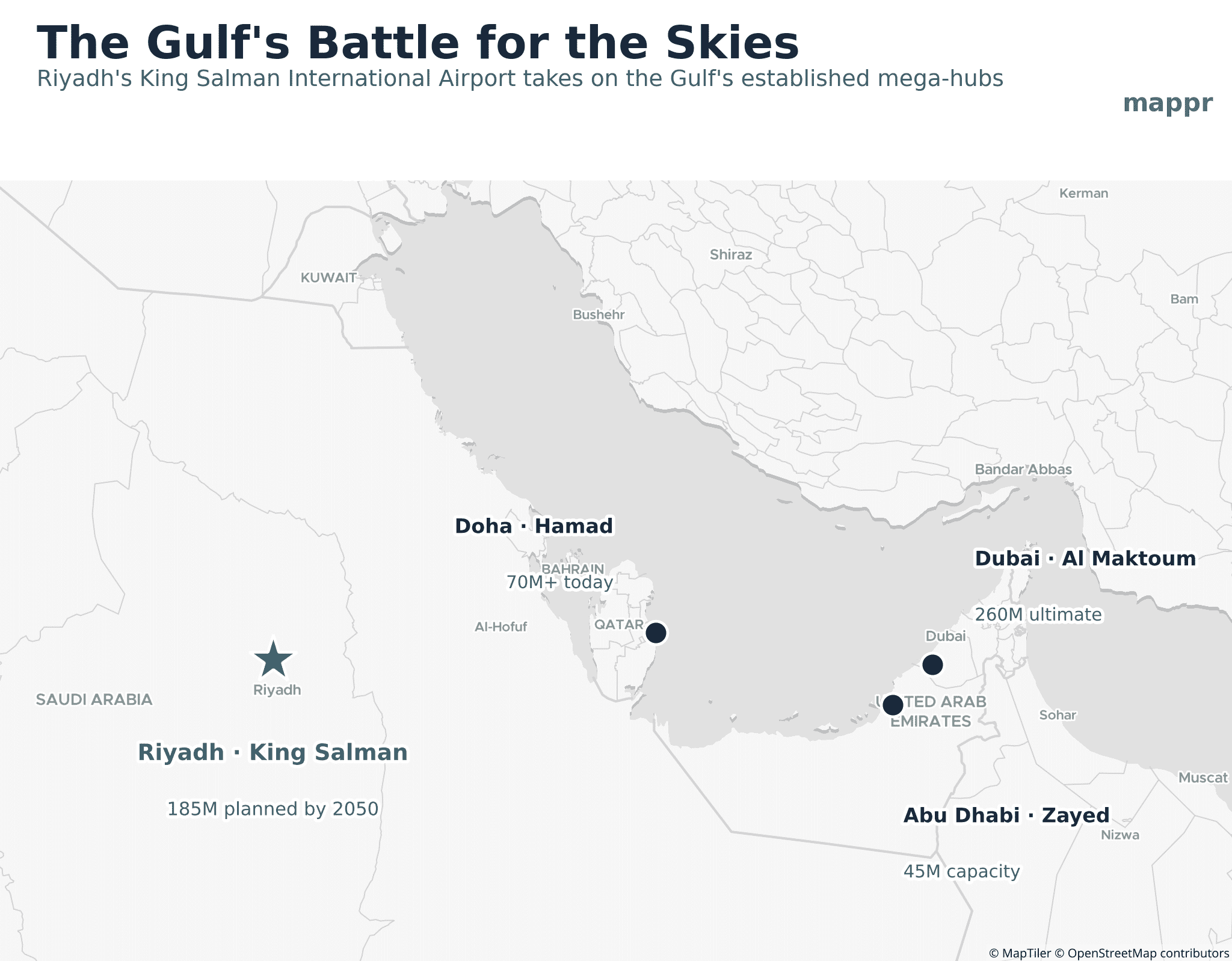
The map makes the ambition and the challenge clear at a glance. Riyadh sits inland, away from the coastal cluster of Doha, Abu Dhabi and Dubai that has spent two decades turning the Gulf into the connecting point between Europe, Asia and Africa. To win, KSIA has to be big enough and slick enough to pull traffic west.
Inside the King Salman vision
The numbers are staggering. The KSIA masterplan spans roughly 57 square kilometres, an area larger than many cities, with about 45 square kilometres of aviation land and the rest given over to logistics, residential and commercial districts. It is built over and around the existing King Khalid International Airport (RUH), whose current terminals stay in use as the site expands around them.
At its heart are six parallel runways, more than any airport operating today, designed to move aircraft without the bottlenecks that constrain two-runway rivals. The plan calls for six commercial terminals plus a landmark iconic terminal, a royal terminal and a dedicated private-aviation terminal. Capacity is staged: up to 120 million passengers a year by 2030 (some official materials cite 100 million), scaling to 185 million by 2050, alongside a cargo target of 3.5 million tonnes. Construction officially began in September 2025, and a third runway broke ground in January 2026.
The anchor carrier: Riyadh Air
A mega-hub needs a mega-airline to fill it, and Saudi Arabia has built one from scratch. Riyadh Air, backed by the Public Investment Fund and led by former Etihad chief Tony Douglas, moved from concept to commercial reality in 2026. It now operates scheduled flights from Riyadh to London Heathrow, Dubai, Jeddah and Cairo, with Madrid, Manchester, Kuala Lumpur, Mumbai and others rolling out, plus regulatory approvals secured for the United States and China. The airline is targeting more than 100 destinations by the end of the decade. For now it flies from King Khalid airport; it will migrate to KSIA when the new hub opens.
Dubai and Doha are not standing still
The weak point in the breathless coverage of KSIA is the assumption that its rivals are frozen in place. They are not. Dubai International (DXB) handled a record 95.2 million passengers in 2025, but it is hemmed in by the city around it and is close to its practical maximum. Dubai’s real reply to Riyadh is the Al Maktoum (DWC) rebuild, a 35-billion-dollar expansion approved in 2024 that is planned to reach 150 million passengers within a decade and ultimately 260 million, which would make it larger than KSIA’s own 2050 ceiling.
Qatar’s Hamad International in Doha carried 54.3 million passengers in 2025 and lifted its capacity past 70 million with a recent expansion, while Abu Dhabi’s Zayed International hit a record 32.5 million. The table below sets the contenders side by side, separating what each airport handles today from what it is planning.
| Airport | ICAO | 2025 passengers | Planned capacity | Runways |
|---|---|---|---|---|
| Riyadh — King Salman (KSIA) | OERK | ~42M (existing RUH site) | 120M by 2030; 185M by 2050 | 6 (planned) |
| Dubai — International (DXB) | OMDB | 95.2M | ~100M (near its ceiling) | 2 |
| Dubai — Al Maktoum (DWC) | OMDW | ~1M (build-out) | 150M this decade; 260M ultimate | 5 (planned) |
| Doha — Hamad (DOH) | OTHH | 54.3M | 70M+ (current) | 2 |
| Abu Dhabi — Zayed (AUH) | OMAA | 32.5M | ~45M | 2 |
Read together, the picture is not one hub replacing another but a regional arms race in concrete and runways. Riyadh is the newcomer with the deepest pockets, but Dubai’s DWC project is aiming even higher.
Smart tech, and a tense neighbourhood
Riyadh’s pitch leans heavily on technology and reliability. The KSIA masterplan embeds biometric screening, artificial intelligence and robotics with the aim of a seamless, low-friction passenger journey, and the existing Riyadh airport already delivers on the reliability promise: Cirium named King Khalid the world’s most punctual large airport for 2024, with an on-time performance above 86 percent.
The harder question is geopolitics. KSIA is being built in a volatile neighbourhood: during the February 2026 hostilities between the United States and Iran, Riyadh’s airport was among the sites Iran targeted, and the entire Gulf currently sits at the US State Department’s Level 3 Reconsider Travel advisory. A hub built to move hundreds of millions of passengers has to convince the world that the region’s skies will stay open and safe. That is a promise about stability as much as about runways.
Racing to Expo 2030
All of this is tied to a hard deadline. Riyadh hosts World Expo 2030 from October 2030 to March 2031, on a site in the north of the city next to the new airport. The first operational phase of KSIA is meant to be ready to greet the millions of visitors the expo expects. The airport, the airline and the expo are three faces of the same wager: that Riyadh, long a place people flew over on the way to somewhere else, can become a place the world flies to.
Whether it can genuinely out-hub Dubai and Doha will not be clear for years. But the scale of the bet is not in doubt. In the Gulf’s battle for the skies, Saudi Arabia has just put its largest chip on the table.
Project figures are from official masterplans and airport authorities; passenger totals are latest full-year (2025) reported figures: