Key Takeaways
- Russia still leads, but the map is spread across Europe. Russia has produced the most Grandmasters of any federation (around 185), ahead of the United States (106) and Germany (97). Europe and the former Soviet republics account for the overwhelming majority of the world's roughly 2,000 GM titles.
- India is the fastest-rising chess nation on Earth. India crossed 85 Grandmasters in 2024 and now sits around 90, ranking third or fourth in the world. It went from just 2 GMs in 1993 to 36 in 2014, doubling again in a single decade.
- Gukesh made India the home of the World Champion. In December 2024, 18-year-old Gukesh Dommaraju became the youngest undisputed World Chess Champion in history, breaking a record Garry Kasparov had held since 1985.
- Per capita, tiny nations rule the board. Iceland has roughly one Grandmaster for every 25,000 people, a legacy of hosting the 1972 Fischer versus Spassky match. Armenia, where chess is a compulsory school subject, tops every country with a population above one million.
- Only about 44 women hold the open GM title. The Grandmaster title is open to everyone, but women make up only around 2 percent of all holders. Hungary's Judit Polgar remains the strongest woman ever to play the game.
Every year on 20 July, the chess world marks World Chess Day, the United Nations observance that commemorates the founding of the International Chess Federation (FIDE) in Paris on that date in 1924. It is a fitting moment to ask a geographic question about a game born in India and perfected in Europe: where do the world’s Grandmasters actually come from?
The Grandmaster (GM) title is the highest honour in over-the-board chess, awarded by FIDE for life once a player achieves the required norms and rating. Since the title was formalised in 1950, roughly 2,000 players have earned it. The map below shows how those titles are distributed across the globe, and it tells a story of long-established chess cultures being challenged by a new superpower in the making.
The global chess map
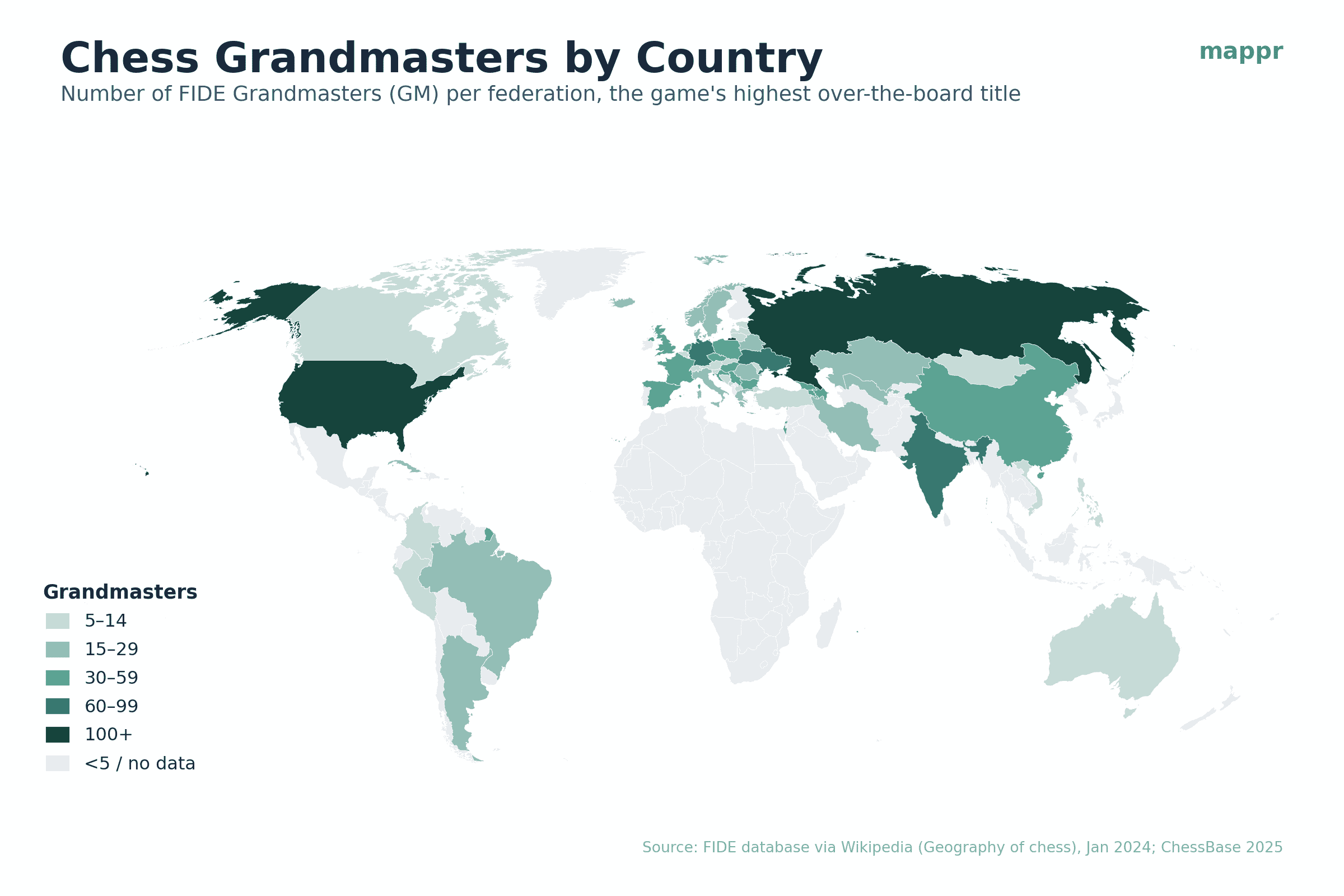
The pattern is unmistakable. A dense band running from Western Europe through the Balkans and into the former Soviet Union holds most of the world’s Grandmasters, the product of a century of state-backed chess schools, deep club traditions and famous training academies. Outside that heartland, only a handful of countries shade dark: the United States, whose numbers are swollen by elite players who switched federations, and India, the lone South Asian giant that now rivals any European nation.
Everywhere else, chess talent is thinner on the ground. Africa has yet to produce a Grandmaster in most of its countries, and much of Southeast Asia, the Pacific and Central America sits in the lightest band. The game is genuinely global, but its elite is still concentrated in a few dozen federations.
The top chess nations by Grandmaster count
The table below ranks the leading federations by their total number of Grandmasters. It is sortable and searchable, so you can find any country. A note on the numbers: FIDE counts England, Scotland and Wales as separate federations (40, 6 and 2 GMs respectively), which we have combined into the United Kingdom here to match the map.
| Rank | Country | Grandmasters |
|---|---|---|
| 1 | Russia | 185 |
| 2 | United States | 106 |
| 3 | Germany | 97 |
| 4 | India | 92 |
| 5 | Ukraine | 88 |
| 6 | Spain | 59 |
| 7 | France | 55 |
| 8 | Serbia | 53 |
| 9 | Hungary | 52 |
| 10 | China | 51 |
| 11 | Poland | 50 |
| 12 | Israel | 49 |
| 13 | United Kingdom | 48 |
| 14 | Netherlands | 43 |
| 15 | Armenia | 40 |
| 16 | Bulgaria | 35 |
| 17 | Czechia | 33 |
| 18 | Georgia | 31 |
| 19 | Azerbaijan | 30 |
| 20 | Croatia | 30 |
| 21 | Cuba | 26 |
| 22 | Romania | 26 |
| 23 | Sweden | 25 |
| 24 | Argentina | 23 |
| 25 | Italy | 18 |
| 26 | Kazakhstan | 18 |
| 27 | Norway | 18 |
| 28 | Greece | 17 |
| 29 | Uzbekistan | 17 |
| 30 | Denmark | 16 |
| 31 | Belarus | 15 |
| 32 | Brazil | 15 |
| 33 | Iceland | 15 |
| 34 | Iran | 15 |
| 35 | Canada | 14 |
| 36 | Slovakia | 14 |
| 37 | Slovenia | 14 |
| 38 | Türkiye | 14 |
| 39 | Philippines | 13 |
| 40 | Vietnam | 13 |
| 41 | Austria | 11 |
| 42 | Colombia | 11 |
| 43 | Lithuania | 11 |
| 44 | Montenegro | 11 |
| 45 | Switzerland | 11 |
| 46 | Australia | 10 |
| 47 | Latvia | 10 |
| 48 | North Macedonia | 10 |
| 49 | Peru | 10 |
| 50 | Belgium | 9 |
| 51 | Mongolia | 8 |
| 52 | Bosnia and Herzegovina | 7 |
| 53 | Moldova | 7 |
| 54 | Estonia | 6 |
Russia remains the undisputed heavyweight, though its total is harder to pin down than it looks. Since 2022, a number of Russian Grandmasters have competed under the neutral FIDE flag, so different sources place the country anywhere from about 185 to over 210. Either way, no other federation is close on raw history.
Behind Russia, the United States ranks second with 106 Grandmasters, a figure inflated by a wave of elite transfers: Fabiano Caruana, Wesley So and Levon Aronian all switched to the US flag in the 2010s. Germany (97), Ukraine (88), Spain, France, Serbia, Hungary and China round out the traditional powers. Hungary’s presence is a reminder of a golden pedigree that produced the Polgar sisters; China’s is the fruit of a deliberate, decades-long national programme that has yielded two World Champions.
India’s Grandmaster surge
If the overall map is a portrait of chess history, India is a portrait of its future. The country that gave the world chaturanga, the sixth-century ancestor of chess, spent decades as a chess backwater. In 1993 India had just two Grandmasters, Viswanathan Anand and Dibyendu Barua. Anand’s rise to World Champion in 2007 lit a fuse.
The growth since has been staggering. India reached 36 Grandmasters in 2014, then more than doubled that to 85 by 2024, and now numbers around 90, placing it third or fourth in the world. It is not a top-heavy pyramid either: India has more than 30,000 FIDE-rated players, second only to Russia, and in 2025 it held the second-highest average rating among the world’s top ten players.
The symbolic peak came in December 2024, when Gukesh Dommaraju, then 18, defeated Ding Liren to become the youngest undisputed World Chess Champion in history. Alongside Gukesh, teenagers Rameshbabu Praggnanandhaa and Arjun Erigaisi have all broken into the world’s elite, and India swept both the Open and Women’s gold medals at the 2024 Chess Olympiad in Budapest. Three of the ten youngest Grandmasters in history are Indian.
Grandmasters per capita: small nations punch above their weight
Counting raw totals rewards big, populous countries. Adjust for population and a completely different leaderboard appears, dominated by tiny nations where chess is woven into the culture.
Iceland is the classic example. With around 13 Grandmasters for a population of just 340,000, it has more GMs per head than almost anywhere on Earth. That density traces directly to 1972, when Reykjavik hosted the Fischer versus Spassky “Match of the Century” and chess fever gripped the island. Armenia is the standout among larger nations: roughly 40 Grandmasters for fewer than three million people, in a country where chess has been a compulsory subject in primary schools since 2011 and is effectively the national sport. Montenegro, Georgia, Serbia and Croatia also rank far higher per capita than their absolute totals suggest.
The 44 women who hold the Grandmaster title
The Grandmaster title has no gender: it is open to anyone who meets the requirements. Yet of the roughly 2,000 people who hold it, only about 44 are women, close to 2 percent. (This is distinct from the separate, lower-threshold Woman Grandmaster title.)
Hungary’s Judit Polgar, who reached a peak rating of 2,735 and beat nearly every World Champion of her era, is the strongest woman ever to play chess. The first woman to earn the open title was Georgia’s Nona Gaprindashvili in 1978. The trend is upward: in 2025, India’s Divya Deshmukh secured the Grandmaster title by winning the FIDE Women’s World Cup, part of the same Indian wave reshaping the top of the game.
How many Grandmasters are there in the world?
It sounds like a simple question, but the answer depends on what you count. FIDE has awarded roughly 2,140 Grandmaster titles since 1950. Because the title is held for life, only around 1,890 of those holders are still living. And of those, perhaps 700 to 1,000 are genuinely active, competing regularly and rated above the Grandmaster threshold.
The trend is one of steady inflation. There were about 524 Grandmasters worldwide in 1993; three decades of stronger training, computer preparation and a booming online game have quadrupled that. The title is harder to earn than ever in playing terms, yet there are more holders than ever, a paradox that says as much about the spread of chess as about any single champion.
This World Chess Day, the geography of the game is shifting under our feet. The old European and post-Soviet powers still hold the numbers, but the momentum has moved east. On current trends, the country that invented chess may soon top the very map it has chased for a thousand years.
Data and references (Grandmaster counts as of the FIDE database, January 2024, with later figures noted):