
Key Takeaways
- Changi is a global super-hub in a tiny city-state. Singapore has essentially one major commercial airport — but Changi (SIN) is one of the world’s great hubs, with around 131 regularly-served nonstop destinations, home base of flag carrier Singapore Airlines and its low-cost arm Scoot, and a perennial contender for the title of world’s best airport.
- Singapore–Newark is the longest flight on Earth. Changi is Singapore’s only US gateway. Singapore Airlines flies nonstop to New York (both JFK and Newark), Los Angeles, San Francisco and Seattle — and the roughly 19-hour Singapore–Newark run is the longest scheduled commercial flight in the world.
- Seletar is the quiet number two. Seletar (XSP), in the north of the island, handles business and private aviation plus a handful of Firefly turboprop hops across the strait to Malaysia, and anchors the Seletar Aerospace Park (Rolls-Royce, ST Engineering). It is tiny next to Changi.
- Johor Bahru and Batam widen the catchment. Because Singapore is so small, budget travellers often cross to Senai (Johor Bahru) in Malaysia or ferry to Batam and Bintan in Indonesia for cheaper regional fares. The new Johor Bahru–Singapore RTS Link rail, due around the end of 2026, will turn the JB hop into a five-minute ride.
- Terminal 5 is on the way. Changi broke ground on a mega Terminal 5 in 2025; when it opens in the mid-2030s it will lift the airport’s capacity well beyond 100 million passengers a year and reinforce its role as Southeast Asia’s premier transfer hub.
Singapore is one of the world’s busiest aviation crossroads — packed into a single island city-state barely 50 km across. With so little land, it doesn’t scatter flights across a dozen regional fields the way a big country does; almost everything funnels through one airport. But what an airport: Singapore Changi is rated among the best on the planet and connects the city to roughly 131 destinations with regular nonstop flights, spanning Asia-Pacific, Europe, the Middle East, Australia and North America.
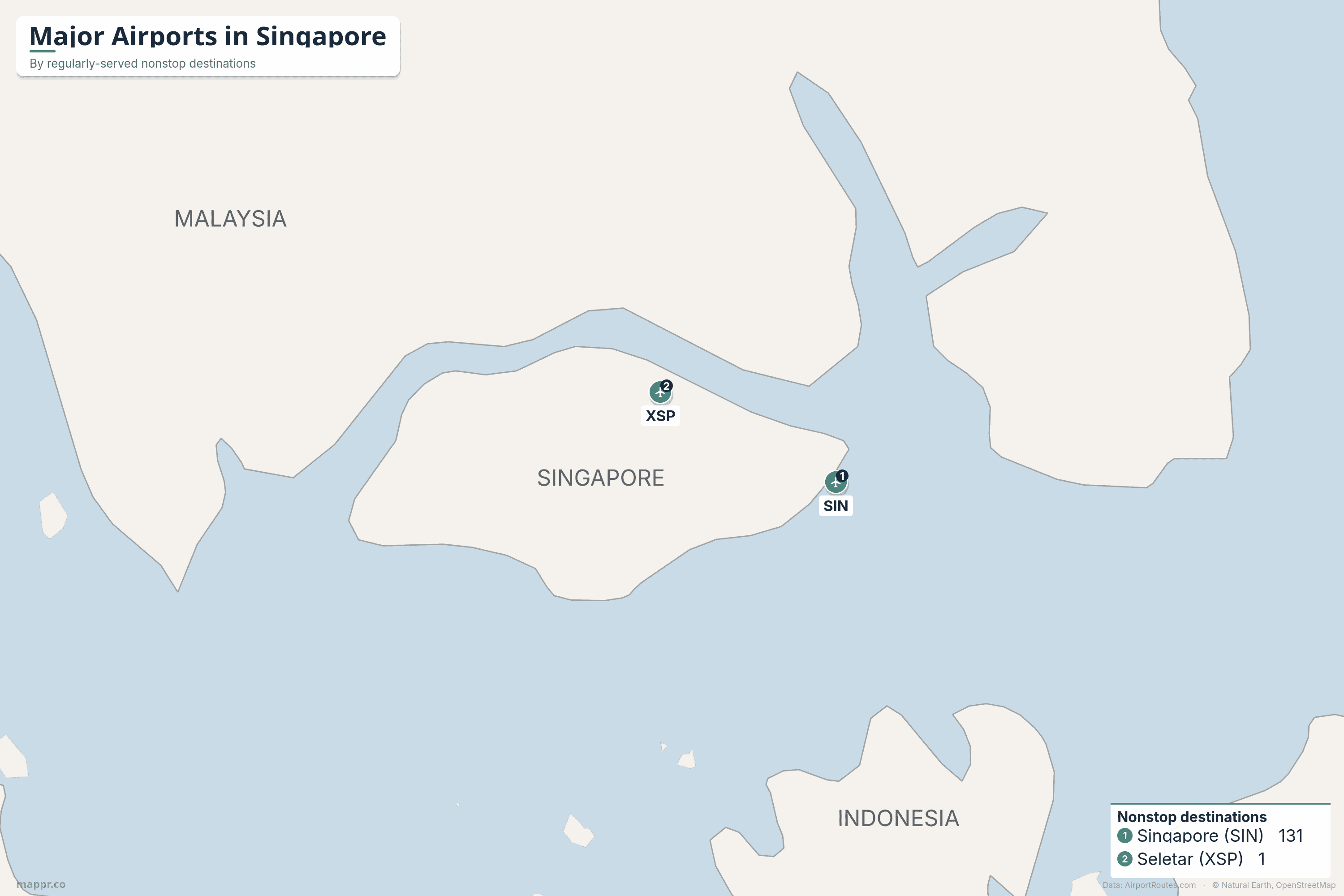
Just two airports carry scheduled commercial service. Changi (SIN) is the giant international hub and the home of flag carrier Singapore Airlines, part of Star Alliance, alongside its low-cost arm Scoot; Seletar (XSP) is a much smaller field in the north of the island, focused on business aviation and short turboprop hops. The map and table below rank the two by the number of destinations they serve with regular flights, drawing on live AirportRoutes route data.
Can you fly nonstop from Singapore to the US?
Yes — from Changi. Singapore Airlines operates nonstop service to New York (both JFK and Newark), Los Angeles, San Francisco and Seattle, and United flies its own nonstop between San Francisco and Singapore.
The headline act is Singapore–Newark: at around 19 hours and roughly 15,000 km, it is the longest scheduled commercial flight in the world, flown by Singapore Airlines’ ultra-long-range Airbus A350-900ULR. Seletar plays no part in this — it has no long-haul flights at all, so every US trip from Singapore leaves from Changi.
RANKED BY DESTINATIONS
Singapore’s airports at a glance
By regularly-served nonstop destinations (live AirportRoutes data). Changi carries essentially all of Singapore’s scheduled traffic; Seletar runs a single regular turboprop route.
| Airport | IATA | Serves | Location |
|---|---|---|---|
| 1. Singapore Changi | SIN | 131 | Changi, east Singapore |
| 2. Seletar | XSP | 1 | Seletar, north Singapore |
A closer look at Singapore’s airports
✈️ Singapore Changi Airport (SIN)
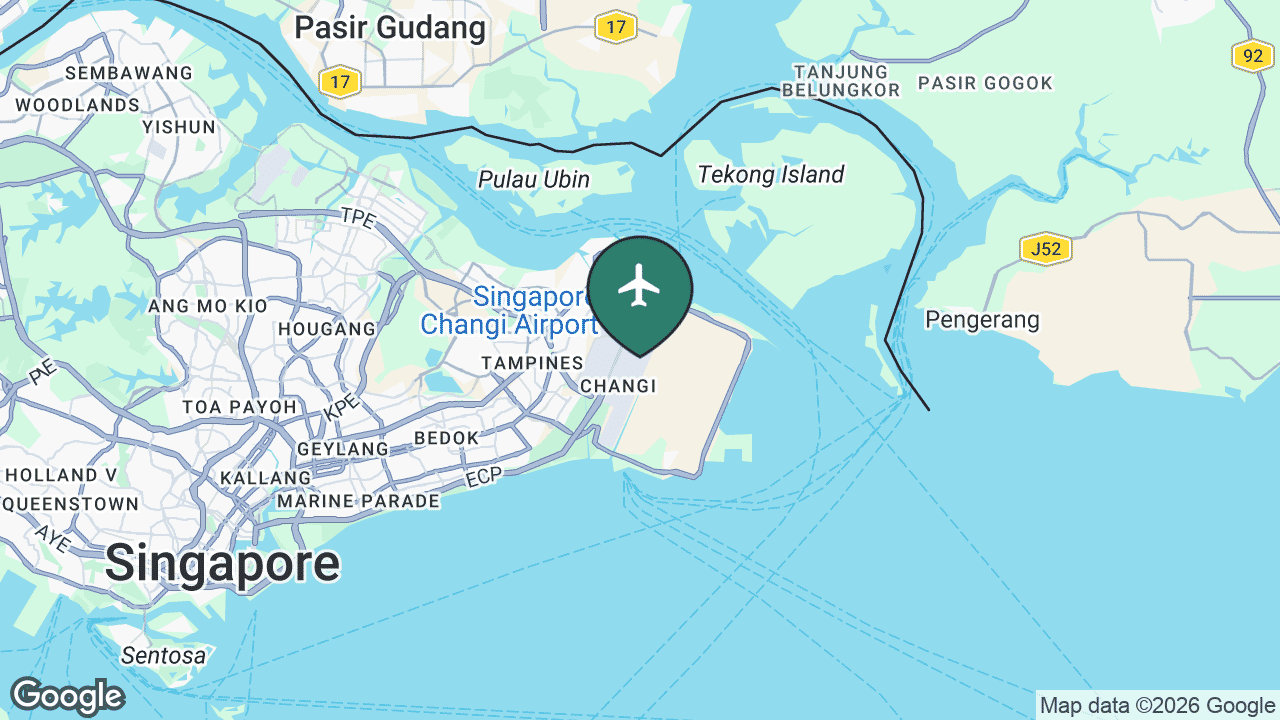
Changi Airport sits on reclaimed land at the eastern tip of the island, about 17 km from the city centre, and it is the engine of Singapore’s aviation. It is consistently ranked among the world’s very best airports, famous for the Jewel complex and its towering indoor waterfall, and it works as one of Southeast Asia’s great transfer points — competing head-on with Bangkok, Kuala Lumpur, Hong Kong, Doha and Dubai for connecting traffic. It is the home base of Singapore Airlines, the Star Alliance flag carrier, and its low-cost arm Scoot.
Changi reaches roughly 131 regularly-served nonstop destinations, including around 41 intercontinental routes — by far the widest network in the region. It is strongest across Asia-Pacific, with dense links to Kuala Lumpur, Jakarta, Bangkok, Hong Kong, Taipei, Manila, Guangzhou and Chennai, layered with long-haul service to Europe, the Gulf, Australia and North America. The airport’s future is the under-construction Terminal 5, which broke ground in 2025 and is due to open in the mid-2030s, eventually pushing total capacity well past 100 million passengers a year.
Main airlines: Singapore Airlines and Scoot, alongside IndiGo, China Eastern, Qantas and dozens of international carriers. See SIN’s full route map on AirportRoutes →
✈️ Seletar Airport (XSP)
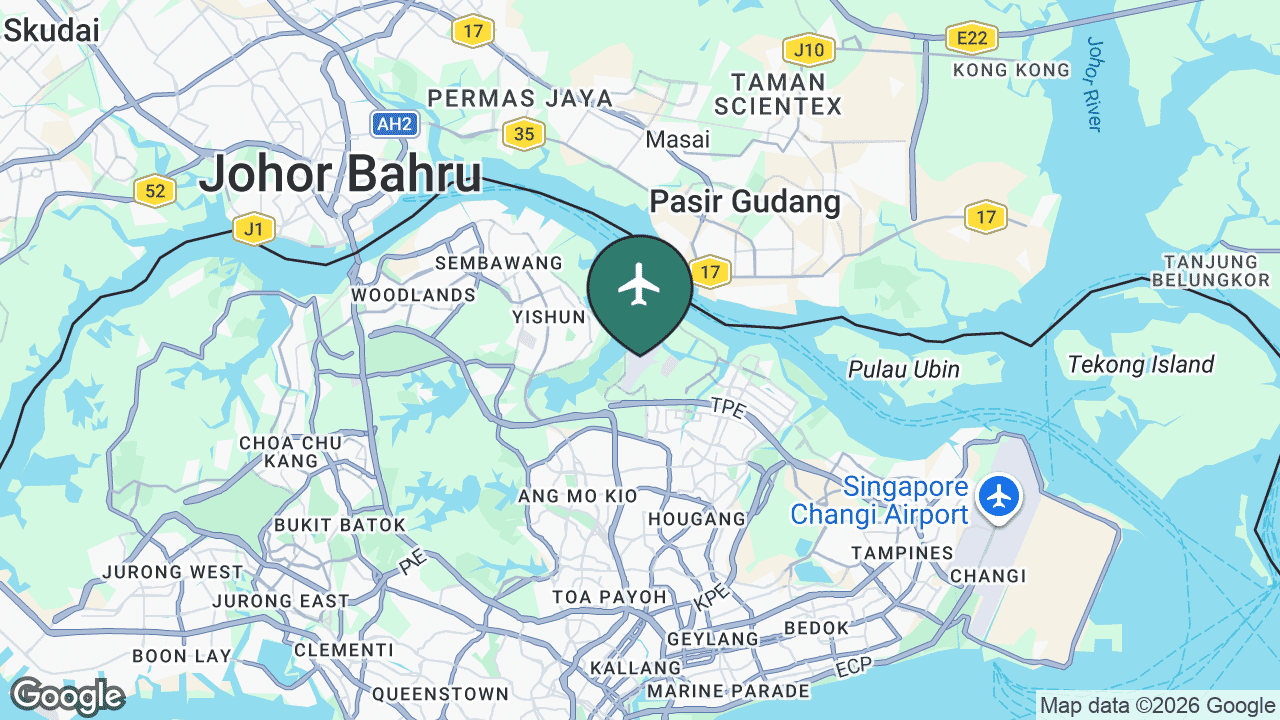
Seletar Airport, in the north of the island near the Johor Strait, is Singapore’s secondary airport — and its oldest, having opened back in 1928. Today it is given over to business and private aviation, flight training and a small amount of scheduled turboprop service, and it anchors the Seletar Aerospace Park, a cluster of aviation manufacturing and maintenance firms that includes Rolls-Royce (which assembles Trent engines there) and ST Engineering.
For scheduled passengers it is minimal: about one regularly-served route — Firefly’s ATR turboprops shuttling across the strait to Subang (the old Kuala Lumpur city airport), with seasonal hops to Malaysian leisure spots such as Redang. Firefly moved its Singapore turboprop flights from Changi to Seletar in 2018, and they remain the airport’s only regular commercial passenger service.
Main airlines: Firefly (turboprop), plus extensive business-aviation traffic. See XSP’s full route map on AirportRoutes →
What about Johor Bahru and Batam?
Because Singapore is so compact, a surprising share of its air travel actually begins in a neighbouring country. For cheap regional fares in particular, Changi’s premium positioning can’t always match what’s on offer just across the borders — and getting there is easy.
Across the causeway in Malaysia, Senai International Airport (JHB) at Johor Bahru is a big AirAsia base with cheap domestic-Malaysia and regional fares, and plenty of Singapore-based travellers cross over to use it. That hop is about to get far easier: the new Johor Bahru–Singapore RTS Link, a cross-border metro due to open around the end of 2026, will connect Woodlands in northern Singapore to Bukit Chagar in JB in roughly five minutes. To the south, a short ferry across the strait reaches the Indonesian islands of Batam (BTH) and Bintan, whose airports feed budget connections deep into Indonesia. Add it all up and Singapore effectively shares a much larger regional airport network than its own two fields suggest. For the Malaysian side of that picture, see our guide to the major airports in Malaysia.
Airport rankings, nonstop-destination counts, served cities, airline lists and US connections are drawn from live AirportRoutes route data (observed AeroAPI flight data — a sample, not a complete published schedule; we use the regularly-served figure, which filters one-off observations). Airport history and notable facts — Changi’s Terminal 5, the Singapore–Newark ultra-long-haul, the RTS Link and Seletar’s aerospace role — are cross-checked against the cited references. The maps are Mappr originals.
Primary Data Source:
- AirportRoutes — Major airports & routes, Singapore – Live route data: per-airport nonstop destinations, served cities, airlines and US connections.
References:
- Changi Airport Group – Operator of Singapore Changi Airport; background on terminals, Jewel and the Terminal 5 project.
- Singapore Airlines – Singapore’s Star Alliance flag carrier and the main operator at Changi, including the ultra-long-haul US routes.
- Seletar Airport – Singapore’s secondary airport for business aviation and turboprop service; background on the Seletar Aerospace Park.
- Wikipedia — Singapore Changi & Seletar airports – Airport background, passenger figures and operational history.
- Google Static Maps – Base maps for the per-airport locator images.
🌍 More maps & data for Singapore
Browse more: All airports by country


