Key Takeaways
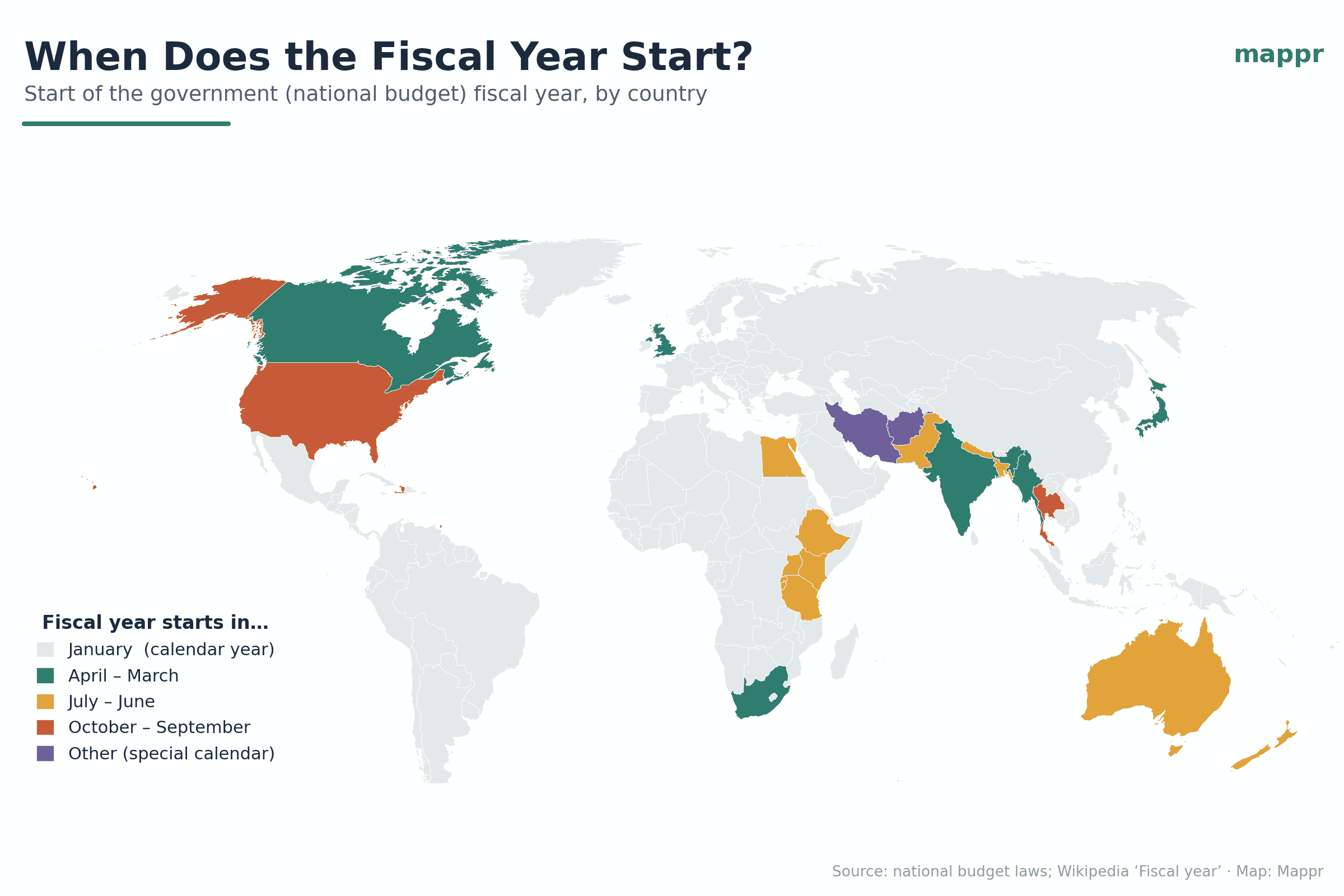
- Most of the world budgets by the calendar. The large majority of countries — from China and Russia to Germany, Brazil and most of Europe — run their government fiscal year from 1 January to 31 December.
- April–March is the Commonwealth pattern. The UK, India, Japan, Canada, South Africa, Singapore and Hong Kong start the fiscal year on 1 April — a habit rooted in an 18th-century British calendar quirk and spread by empire.
- July–June is the southern-hemisphere and East-African choice. Australia, New Zealand, Pakistan, Bangladesh, Egypt and much of East Africa (Kenya, Uganda, Tanzania, Rwanda) run from 1 July to 30 June.
- The US starts in October. The US federal government's fiscal year begins on 1 October — pushed back from July in 1976 to give Congress more time to pass the budget. Thailand, Haiti and Trinidad also use October.
- A few follow a different calendar entirely. Iran and Afghanistan start the year around Nowruz (21 March) on the Solar Hijri calendar, while Ethiopia and Nepal follow their own calendars, beginning in July.
For most of the world, the financial year and the calendar year are the same thing: governments open their books on 1 January and close them on 31 December. But a sizeable minority of countries march to a different drum — starting their budget year in April, July, October, or even on a date set by an entirely different calendar. The map below shows when each country’s government fiscal year begins.
This matters more than it sounds. A country’s fiscal year sets the rhythm of its national budget, its tax deadlines and its economic statistics — and the reasons a nation lands on April, July or October are a mix of agriculture, colonial history and political convenience. Here’s who uses what, and why.
What is a fiscal year?
A fiscal year (or financial year) is the 12-month period a government or company uses for accounting and budgeting. It doesn’t have to line up with the January–December calendar — it just has to be a consistent 12 months. Note that the government fiscal year and the personal tax year aren’t always the same within one country: Japan’s government runs April–March, for example, but its personal income tax is assessed on the calendar year. The map and tables here track the government (national budget) fiscal year.
🇬🇧 April to March: the Commonwealth pattern
The most famous alternative is the 1 April – 31 March year. It’s used by the United Kingdom and a string of countries shaped by British administration, including India, Canada, South Africa, Singapore, Hong Kong and Myanmar — plus Japan, which adopted it independently.
- United Kingdom — 1 April – 31 March
- India — 1 April – 31 March
- Japan — 1 April – 31 March
- Canada — 1 April – 31 March
- South Africa — 1 April – 31 March
- Singapore — 1 April – 31 March
- Hong Kong — 1 April – 31 March
- Myanmar — 1 April – 31 March
Why April? The British tax year is a leftover from a calendar change. Until 1752 the English new year began on 25 March (Lady Day). When Britain switched from the Julian to the Gregorian calendar that year, 11 days were dropped — and to avoid shortchanging the treasury, the tax year-end was nudged forward by 11 days, landing near the start of April. The government’s accounting year settled on 1 April, and the British Empire carried the April–March year to India and beyond. Japan chose April–March in 1886, partly to align the budget with the rice-tax harvest.
🌏 July to June
The 1 July – 30 June year is the other big club. It’s used across the southern hemisphere by Australia and New Zealand, in South Asia by Pakistan and Bangladesh, in Egypt, and right across East Africa — Kenya, Uganda, Tanzania, Rwanda and Burundi, whose budgets are loosely harmonised through the East African Community.
- Australia — 1 July – 30 June
- New Zealand — 1 July – 30 June
- Pakistan — 1 July – 30 June
- Bangladesh — 1 July – 30 June
- Egypt — 1 July – 30 June
- Kenya — 1 July – 30 June
- Uganda — 1 July – 30 June
- Tanzania — 1 July – 30 June
- Rwanda — 1 July – 30 June
- Burundi — 1 July – 30 June
- Ethiopia — ~8 July – 7 July (Ethiopian cal.)
- Nepal — mid-July (Bikram Sambat)
A mid-year start has a practical appeal: it keeps the busy end-of-year accounting away from the Christmas and New Year holidays, and in agricultural economies it can line the budget up with the harvest and planting cycle. Ethiopia and Nepal also begin around July, but on their own calendars (more on that below).
🇺🇸 October to September
The world’s largest economy is an outlier. The United States federal government runs its fiscal year from 1 October to 30 September — which is why American budget fights and “government shutdown” deadlines always cluster around the end of September.
- United States — 1 October – 30 September
- Thailand — 1 October – 30 September
- Haiti — 1 October – 30 September
- Trinidad and Tobago — 1 October – 30 September
It wasn’t always this way: the US federal year used to start on 1 July, but in 1976 Congress moved it back three months to October to give itself more time to actually pass the appropriations bills each year. Thailand, Haiti and Trinidad & Tobago also use an October start.
That October date is the federal government’s year — U.S. companies are a different story. A business can choose almost any 12-month period as its fiscal year, ending on the last day of whichever month fits its seasonal cycle (the tax code even allows a 52-to-53-week year). In practice about 70% of U.S. public companies still use the calendar year, ending on 31 December, but the other roughly 30% do not: many retailers close their books in late January once the holiday shopping season is banked (Walmart’s fiscal year ends around 31 January), Microsoft and Procter & Gamble run to 30 June, and Apple’s year ends in late September. U.S. states add another layer again — most of them run July–June.
🗓️ A different calendar entirely
A handful of countries don’t anchor their fiscal year to the Gregorian calendar at all. Iran and Afghanistan use the Solar Hijri calendar, whose new year falls on the spring equinox — so their fiscal year begins around 21 March (Nowruz). Ethiopia keeps the ancient Ethiopian calendar, with a fiscal year that runs roughly 8 July to 7 July, and Nepal follows the Bikram Sambat calendar, starting in mid-July.
- Iran — ~21 March (Nowruz)
- Afghanistan — ~21 December (Solar Hijri)
- Ethiopia — ~8 July – 7 July (Ethiopian calendar)
- Nepal — mid-July (Bikram Sambat)
Reference
Countries Whose Fiscal Year Isn't the Calendar Year
Government (national budget) fiscal year. Every other country uses 1 January – 31 December.
| Country | Government fiscal year |
|---|---|
| United Kingdom | 1 April – 31 March |
| India | 1 April – 31 March |
| Japan | 1 April – 31 March |
| Canada | 1 April – 31 March |
| South Africa | 1 April – 31 March |
| Singapore | 1 April – 31 March |
| Hong Kong | 1 April – 31 March |
| Myanmar | 1 April – 31 March |
| Australia | 1 July – 30 June |
| New Zealand | 1 July – 30 June |
| Pakistan | 1 July – 30 June |
| Bangladesh | 1 July – 30 June |
| Egypt | 1 July – 30 June |
| Kenya | 1 July – 30 June |
| Uganda | 1 July – 30 June |
| Tanzania | 1 July – 30 June |
| Rwanda | 1 July – 30 June |
| Burundi | 1 July – 30 June |
| Ethiopia | ~8 July – 7 July (Ethiopian cal.) |
| Nepal | mid-July (Bikram Sambat) |
| United States | 1 October – 30 September |
| Thailand | 1 October – 30 September |
| Haiti | 1 October – 30 September |
| Trinidad and Tobago | 1 October – 30 September |
| Iran | ~21 March (Nowruz) |
| Afghanistan | ~21 December (Solar Hijri) |
Why don’t all countries use the calendar year?
Three forces explain almost every exception. History and inertia: once a date is baked into law, tax software and decades of statistics, changing it is painful — Britain’s April year survives a 270-year-old calendar reform precisely because no one wants to renumber everything. Colonial inheritance: the April–March year spread with the British Empire, which is why India and much of the Commonwealth still use it today. Practical timing: a mid-year start keeps the accounting crunch away from the holidays, can align with the agricultural cycle, or — as in the United States — simply buys the legislature more time to pass the budget.
A few countries have switched in recent decades to simplify cross-border business: Indonesia moved from April–March to the calendar year in 2001, and Saudi Arabia adopted the calendar year in 2016. But for now, the world’s budgets still start on at least four different months of the year.
Government fiscal-year start dates are compiled from national budget laws and finance-ministry documentation, cross-referenced with the Wikipedia overview of fiscal years by country. The map is a Mappr original.
Data Sources:
- Wikipedia — Fiscal year (operation by jurisdiction) – Country-by-country summary of government and personal fiscal years.
- National budget laws & finance ministries – Primary confirmation of each government's fiscal-year start, including the US (1 October) and the UK (1 April).
Image Sources:
- Map by Mappr – World map of fiscal-year start dates — a Mappr original built from these sources and Natural Earth boundaries.