Key Takeaways
- The AAA club is down to 11. Only 11 countries still hold S&P's top AAA rating: Australia, Canada, Denmark, Germany, Liechtenstein, Luxembourg, the Netherlands, Norway, Singapore, Sweden and Switzerland. No country has been promoted into it in years; the traffic has all been one way, out.
- America lost its last AAA in 2025. The United States is now AA+ at all three big agencies. S&P cut it in 2011 and Fitch in 2023, but it kept a top grade at Moody's until May 2025, when Moody's finally downgraded it to Aa1.
- France fell out of the double-A club. In autumn 2025, Fitch (September) and S&P (October) both cut France to A+, and Moody's put its Aa3 on negative outlook, over a deepening fiscal-credibility crisis. France now sits alongside Japan and China, not Germany.
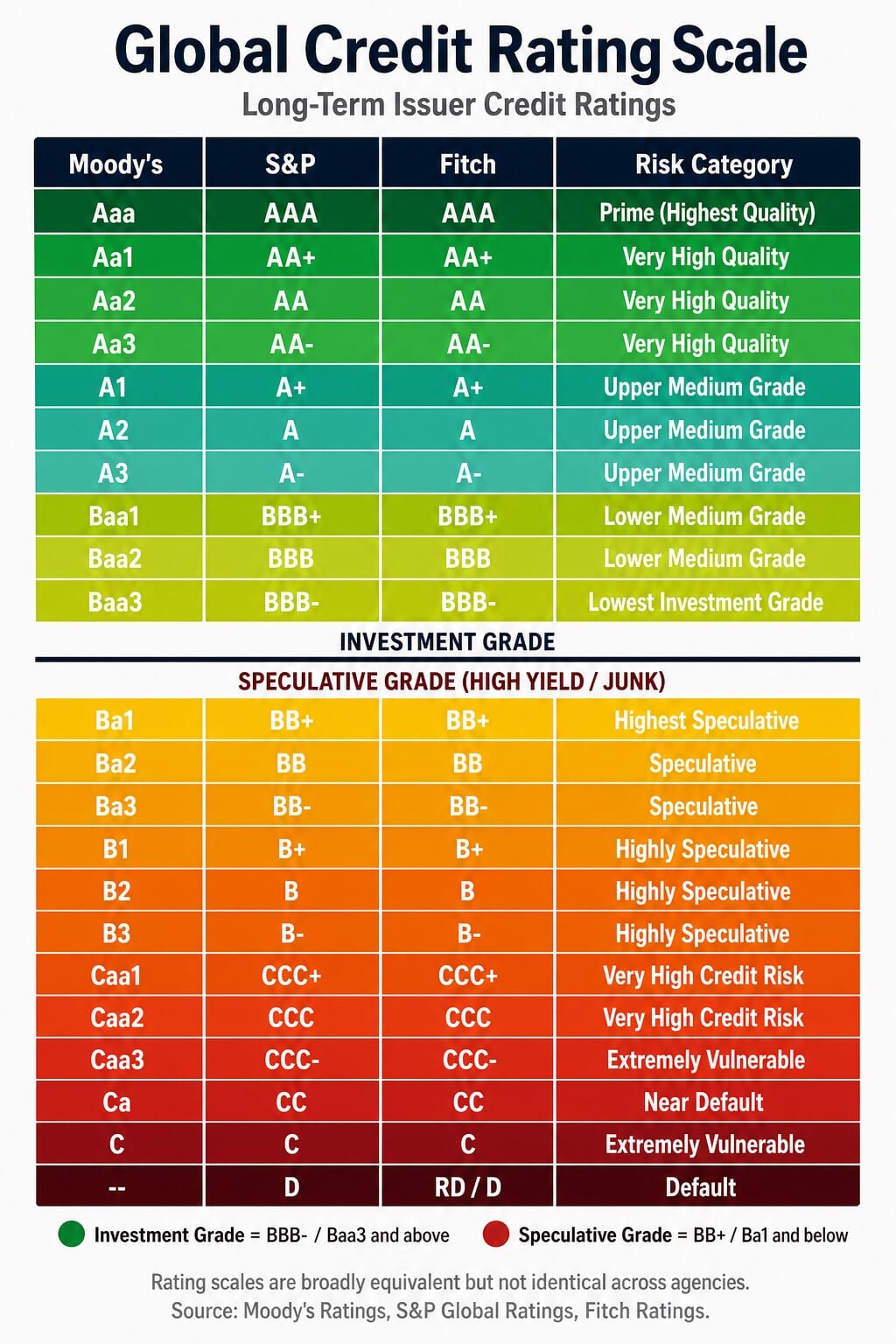
- The line that really matters is BBB-. Everything from BBB- up is investment grade; BB+ and below is speculative, or junk. Of roughly 130 rated governments, a little over half are investment grade. Crossing that line is the expensive downgrade, because index and regulatory rules force funds to sell.
- Not everyone is falling. Greece clawed its way back to investment grade (now BBB) after its debt crisis, India won its first S&P upgrade in 18 years, and Indonesia was affirmed at BBB in July 2026. Credit ratings can rise as well as fall.
A sovereign credit rating is the closest thing the world has to a report card for a country’s finances. The three big agencies, S&P, Moody’s and Fitch, grade each government on how likely it is to pay its debts, from a gold-plated AAA down through investment grade to speculative junk and, at the bottom, default. That grade sets how much it costs a country to borrow. And right at the top, the exclusive club of AAA-rated nations is quietly shrinking.
We mapped every rated country by its S&P grade. The picture is a familiar one of a wealthy, creditworthy core and a riskier periphery, but the story of 2026 is what is happening at the very top.
The world’s credit ratings, mapped
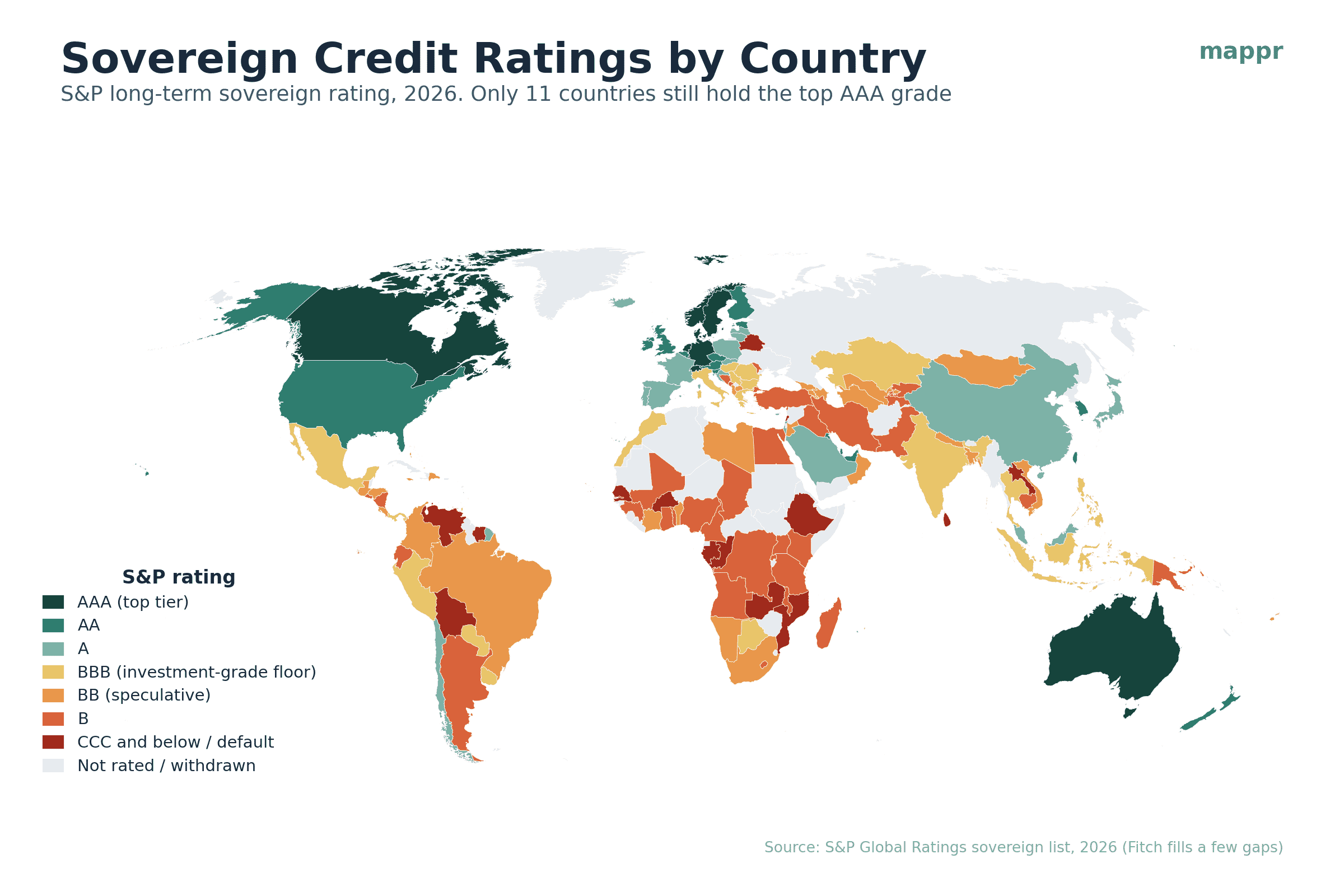
The colour gradient runs from the safest borrowers to the most distressed. A dark-green band of AAA and AA countries covers North America, Western and Northern Europe, and the wealthy Asia-Pacific. The amber BBB tier, the last rung of investment grade, catches big emerging economies like India, Indonesia, Italy and Greece. Below that, most of Latin America, Africa and parts of Asia sit in the orange and red of speculative grade, where borrowing is far more expensive.
The scale itself is worth decoding. The three big agencies use slightly different notations for the same idea, running from a top-tier “Prime” grade down to default, with the all-important investment-grade line splitting the ladder in two.
The AAA club, down to 11
At the summit, the air is thin. By S&P’s rating, just 11 countries still hold a AAA: Australia, Canada, Denmark, Germany, Liechtenstein, Luxembourg, the Netherlands, Norway, Singapore, Sweden and Switzerland. They are small, rich and fiscally cautious, a mix of Nordic states, Alpine financial centres and resource-rich Commonwealth economies. The exact membership shifts slightly by agency: New Zealand holds the top Aaa at Moody’s but sits one notch down at S&P and Fitch, and Canada is AAA at S&P and Moody’s but AA+ at Fitch. What every version of the list has in common is that it keeps getting shorter.
Who fell: the United States and France
The two most consequential losses of recent years both came from the club’s founding members. The United States, the issuer of the world’s reserve currency, lost its last top grade in 2025. S&P had already stripped its AAA back in 2011 and Fitch followed in 2023, but the US clung to a top rating at Moody’s until May 2025, when Moody’s cut it to Aa1, citing years of widening deficits and political gridlock over the debt ceiling. All three now rate America AA+.
France fell further and faster. In the space of a few weeks in autumn 2025, Fitch (September) and S&P (October) both downgraded it from AA- to A+, and Moody’s placed its Aa3 rating on negative outlook, all pointing to the same cause: a fiscal-credibility crisis and the most severe political instability the country has seen in decades. France, long a fixture of the double-A tier alongside Germany, now shares a grade band with Japan and China.
Look up any country
The table below carries the S&P sovereign rating for every rated country, flagged as investment grade or speculative. It is sortable and searchable, so you can check any nation.
| Country | S&P rating | Grade |
|---|---|---|
| Australia | AAA | Investment grade |
| Canada | AAA | Investment grade |
| Denmark | AAA | Investment grade |
| Germany | AAA | Investment grade |
| Liechtenstein | AAA | Investment grade |
| Luxembourg | AAA | Investment grade |
| Netherlands | AAA | Investment grade |
| Norway | AAA | Investment grade |
| Singapore | AAA | Investment grade |
| Sweden | AAA | Investment grade |
| Switzerland | AAA | Investment grade |
| Austria | AA+ | Investment grade |
| Finland | AA+ | Investment grade |
| Hong Kong | AA+ | Investment grade |
| Ireland | AA+ | Investment grade |
| New Zealand | AA+ | Investment grade |
| United States | AA+ | Investment grade |
| Qatar | AA | Investment grade |
| Slovenia | AA | Investment grade |
| South Korea | AA | Investment grade |
| United Arab Emirates | AA | Investment grade |
| Belgium | AA- | Investment grade |
| Czechia | AA- | Investment grade |
| Estonia | AA- | Investment grade |
| Kuwait | AA- | Investment grade |
| Taiwan | AA- | Investment grade |
| United Kingdom | AA- | Investment grade |
| Bermuda | A+ | Investment grade |
| China | A+ | Investment grade |
| France | A+ | Investment grade |
| Iceland | A+ | Investment grade |
| Japan | A+ | Investment grade |
| Lithuania | A+ | Investment grade |
| Portugal | A+ | Investment grade |
| Saudi Arabia | A+ | Investment grade |
| Spain | A+ | Investment grade |
| Chile | A | Investment grade |
| Croatia | A | Investment grade |
| Israel | A | Investment grade |
| Slovakia | A | Investment grade |
| Andorra | A- | Investment grade |
| Cyprus | A- | Investment grade |
| Latvia | A- | Investment grade |
| Malaysia | A- | Investment grade |
| Malta | A- | Investment grade |
| Poland | A- | Investment grade |
| San Marino | A- | Investment grade |
| Bulgaria | BBB+ | Investment grade |
| Italy | BBB+ | Investment grade |
| Philippines | BBB+ | Investment grade |
| Thailand | BBB+ | Investment grade |
| Uruguay | BBB+ | Investment grade |
| Greece | BBB | Investment grade |
| India | BBB | Investment grade |
| Indonesia | BBB | Investment grade |
| Mexico | BBB | Investment grade |
| Botswana | BBB- | Investment grade |
| Hungary | BBB- | Investment grade |
| Kazakhstan | BBB- | Investment grade |
| Mauritius | BBB- | Investment grade |
| Morocco | BBB- | Investment grade |
| Panama | BBB- | Investment grade |
| Paraguay | BBB- | Investment grade |
| Peru | BBB- | Investment grade |
| Romania | BBB- | Investment grade |
| Serbia | BBB- | Investment grade |
| Trinidad and Tobago | BBB- | Investment grade |
| Azerbaijan | BB+ | Speculative (junk) |
| Guatemala | BB+ | Speculative (junk) |
| Oman | BB+ | Speculative (junk) |
| Albania | BB | Speculative (junk) |
| Brazil | BB | Speculative (junk) |
| Colombia | BB | Speculative (junk) |
| Costa Rica | BB | Speculative (junk) |
| Dominican Republic | BB | Speculative (junk) |
| Georgia | BB | Speculative (junk) |
| Ivory Coast | BB | Speculative (junk) |
| Jamaica | BB | Speculative (junk) |
| Libya | BB | Speculative (junk) |
| South Africa | BB | Speculative (junk) |
| Uzbekistan | BB | Speculative (junk) |
| Vietnam | BB | Speculative (junk) |
| Armenia | BB- | Speculative (junk) |
| Bahamas | BB- | Speculative (junk) |
| Bangladesh | BB- | Speculative (junk) |
| Benin | BB- | Speculative (junk) |
| Fiji | BB- | Speculative (junk) |
| Grenada | BB- | Speculative (junk) |
| Honduras | BB- | Speculative (junk) |
| Jordan | BB- | Speculative (junk) |
| Mongolia | BB- | Speculative (junk) |
| Namibia | BB- | Speculative (junk) |
| Nepal | BB- | Speculative (junk) |
| North Macedonia | BB- | Speculative (junk) |
| Turkmenistan | BB- | Speculative (junk) |
| Barbados | B+ | Speculative (junk) |
| Cape Verde | B+ | Speculative (junk) |
| Guinea | B+ | Speculative (junk) |
| Iran | B+ | Speculative (junk) |
| Kyrgyzstan | B+ | Speculative (junk) |
| Moldova | B+ | Speculative (junk) |
| Montenegro | B+ | Speculative (junk) |
| Rwanda | B+ | Speculative (junk) |
| Tanzania | B+ | Speculative (junk) |
| Togo | B+ | Speculative (junk) |
| Bahrain | B | Speculative (junk) |
| Bosnia and Herzegovina | B | Speculative (junk) |
| Cambodia | B | Speculative (junk) |
| Egypt | B | Speculative (junk) |
| Kenya | B | Speculative (junk) |
| Lesotho | B | Speculative (junk) |
| Mali | B | Speculative (junk) |
| Nigeria | B | Speculative (junk) |
| Tajikistan | B | Speculative (junk) |
| Turkey | B | Speculative (junk) |
| Angola | B- | Speculative (junk) |
| Argentina | B- | Speculative (junk) |
| Cameroon | B- | Speculative (junk) |
| Chad | B- | Speculative (junk) |
| Democratic Republic of the Congo | B- | Speculative (junk) |
| Ecuador | B- | Speculative (junk) |
| El Salvador | B- | Speculative (junk) |
| Ghana | B- | Speculative (junk) |
| Iraq | B- | Speculative (junk) |
| Madagascar | B- | Speculative (junk) |
| Malawi | B- | Speculative (junk) |
| Nicaragua | B- | Speculative (junk) |
| Pakistan | B- | Speculative (junk) |
| Papua New Guinea | B- | Speculative (junk) |
| Uganda | B- | Speculative (junk) |
| Bolivia | CCC+ | Speculative (junk) |
| Burkina Faso | CCC+ | Speculative (junk) |
| Laos | CCC+ | Speculative (junk) |
| Mozambique | CCC+ | Speculative (junk) |
| Republic of the Congo | CCC+ | Speculative (junk) |
| Senegal | CCC+ | Speculative (junk) |
| Sri Lanka | CCC+ | Speculative (junk) |
| Suriname | CCC+ | Speculative (junk) |
| Zambia | CCC+ | Speculative (junk) |
| Ethiopia | CCC | Speculative (junk) |
| Gambia | CCC | Speculative (junk) |
| Gabon | CCC- | Speculative (junk) |
| Maldives | CCC- | Speculative (junk) |
| Venezuela | CCC- | Speculative (junk) |
| Belarus | CC | Speculative (junk) |
| Lebanon | SD | Speculative (junk) |
The line that costs the most: investment grade versus junk
Not all downgrades are equal. The one that hurts is crossing from BBB- into BB+, the boundary between investment grade and speculative, or junk. A huge amount of institutional money is governed by rules that only permit investment-grade holdings, and bank capital regulations penalise junk debt, so when a country drops below the line, funds are forced to sell and its borrowing costs can spike. That is why the fall from BBB- to BB+ matters far more than, say, a cut from AA to A.
Above the line, single-notch downgrades in deep, liquid markets often barely register: both the US and France saw their bond yields move only modestly after their 2025 cuts, because investors had long priced them in and still treat Treasuries and French bonds as core safe assets. The pain is mechanical at the junk boundary and largely symbolic at the top. With agencies flagging the number of potential investment-grade-to-junk fallen angels at a multi-year high, that boundary is where the action will be.
The risers
For all the losses at the top, credit ratings are not a one-way street. Greece, whose debt crisis defined the 2010s, has climbed all the way back to investment grade and now holds a solid BBB, one of the great sovereign recoveries of the era. India won its first S&P upgrade in 18 years in 2025, moving up to BBB. Italy edged up to BBB+, and Indonesia was affirmed at BBB in July 2026 even as other agencies fretted. The map of who is trusted with money is being redrawn in both directions at once, but at the very top, the trend is unmistakably down.
Ratings are S&P long-term foreign-currency sovereign ratings, current as of mid-2026, cross-checked against Moody's and Fitch:
Image Sources