
Key Facts: The Moldovan Leu
- ISO 4217 code: MDL · Symbol: L. Plural lei. Subdivided into 100 bani. Same name as the Romanian leu but different currency since 1993.
- Central bank: National Bank of Moldova (est. 1991). Chișinău-based. Governor Anca Dragu since 19 December 2023 — first woman to lead the NBM. Inflation-targeting mandate at 5% (±1.5 pp).
- Policy rate: 5.00% · Inflation near target. NBM held at 5.00% at its February 2026 meeting, following a 100-bp cut in December 2025. Inflation eased to 6.8% in December 2025 and is expected to return to target in Q1 2026.
- 1 USD ≈ 17.15 MDL. The leu has been essentially flat against the dollar over the past 12 months — NBM runs a managed-float regime.
- EU candidate since June 2022, negotiations opened 2024. Accession talks began 25 June 2024. No target date for euro adoption, but EU alignment is increasingly the policy anchor.
What Is the Currency of Moldova?
Moldova’s currency is the Moldovan leu (plural lei, symbol L or MDL, ISO 4217 code MDL). It has been Moldova’s currency since 29 November 1993, when it replaced the transitional Soviet rouble and Moldovan cupon system. The Moldovan leu shares its name with the Romanian leu — reflecting the two countries’ shared Latin heritage — but it is a completely separate currency.
The leu is issued by the National Bank of Moldova (NBM, Banca Naţională a Moldovei), founded 4 June 1991 as the Moldovan Soviet Socialist Republic declared sovereignty. Moldova was granted EU candidate status on 23 June 2022 following Russia’s invasion of Ukraine, and formal accession negotiations opened on 25 June 2024. The leu operates as a managed float with periodic NBM FX interventions.
Moldovan Leu to US Dollar — 1-Year Chart
The chart tracks USD/MDL daily close over the past year. The Moldovan leu’s main drivers: remittances from the Moldovan diaspora (18% of GDP — one of the world’s highest ratios), energy prices (Moldova imports most of its natural gas), EU grants and support packages, and regional risk sentiment tied to the war in Ukraine.
Line chart. Daily close, MDL per USD · Source: Yahoo Finance · Updated nightly. Data table with 2 rows and 132 columns follows.
| Oct 21 | Oct 23 | Oct 28 | Oct 30 | Nov 03 | Nov 05 | Nov 07 | Nov 11 | Nov 13 | Nov 17 | Nov 19 | Nov 21 | Nov 25 | Nov 27 | Dec 01 | Dec 03 | Dec 05 | Dec 09 | Dec 11 | Dec 15 | Dec 17 | Dec 19 | Dec 23 | Dec 26 | Dec 30 | Jan 02 | Jan 06 | Jan 08 | Jan 12 | Jan 14 | Jan 16 | Jan 20 | Jan 22 | Jan 26 | Jan 28 | Jan 30 | Feb 03 | Feb 05 | Feb 09 | Feb 11 | Feb 13 | Feb 17 | Feb 19 | Feb 23 | Feb 25 | Feb 27 | Mar 03 | Mar 05 | Mar 09 | Mar 11 | Mar 13 | Mar 17 | Mar 19 | Mar 23 | Mar 25 | Mar 27 | Mar 30 | Apr 01 | Apr 05 | Apr 07 | Apr 09 | Apr 13 | Apr 15 | Apr 19 | Apr 21 | Apr 23 | Apr 27 | Apr 29 | May 03 | May 05 | May 07 | May 11 | May 13 | May 17 | May 19 | May 21 | May 25 | May 27 | May 31 | Jun 02 | Jun 04 | Jun 08 | Jun 10 | Jun 14 | Jun 16 | Jun 18 | Jun 22 | Jun 24 | Jun 28 | Jun 30 | Jul 02 | Jul 06 | Jul 08 | Jul 12 | Jul 14 | Jul 16 | Jul 20 | Jul 22 | Jul 26 | Jul 28 | Jul 30 | Aug 03 | Aug 05 | Aug 09 | Aug 11 | Aug 13 | Aug 17 | Aug 19 | Aug 23 | Aug 25 | Aug 27 | Aug 31 | Sep 02 | Sep 06 | Sep 08 | Sep 10 | Sep 14 | Sep 16 | Sep 20 | Sep 22 | Sep 24 | Sep 28 | Sep 30 | Oct 04 | Oct 06 | Oct 08 | Oct 12 | Oct 14 | Oct 18 | Oct 20 | Oct 22 | |
|---|---|---|---|---|---|---|---|---|---|---|---|---|---|---|---|---|---|---|---|---|---|---|---|---|---|---|---|---|---|---|---|---|---|---|---|---|---|---|---|---|---|---|---|---|---|---|---|---|---|---|---|---|---|---|---|---|---|---|---|---|---|---|---|---|---|---|---|---|---|---|---|---|---|---|---|---|---|---|---|---|---|---|---|---|---|---|---|---|---|---|---|---|---|---|---|---|---|---|---|---|---|---|---|---|---|---|---|---|---|---|---|---|---|---|---|---|---|---|---|---|---|---|---|---|---|---|---|---|---|---|---|
| MDL per USD | 16.71 | 16.68 | 16.8 | 16.74 | 16.72 | 16.81 | 16.85 | 16.72 | 16.68 | 16.61 | 16.71 | 16.92 | 16.92 | 16.78 | 16.68 | 16.73 | 16.76 | 16.7 | 16.68 | 16.62 | 16.58 | 16.62 | 16.67 | 16.57 | 16.52 | 16.59 | 16.6 | 16.47 | 16.71 | 16.8 | 16.85 | 16.82 | 16.68 | 16.64 | 16.59 | 16.57 | 16.7 | 16.66 | 16.75 | 16.67 | 16.7 | 16.72 | 16.8 | 16.88 | 16.86 | 16.86 | 16.92 | 17.03 | 16.95 | 16.97 | 17.17 | 17.13 | 17.2 | 17.13 | 17.2 | 17.29 | 17.41 | 17.35 | 17.34 | 17.21 | 16.99 | 16.81 | 16.84 | 17.01 | 16.94 | 17.1 | 17.09 | 16.96 | 16.98 | 17 | 16.98 | 16.89 | 16.89 | 17.08 | 17.05 | 17.08 | 17.1 | 17.06 | 17.05 | 17.04 | 17.05 | 17.15 | 17.15 | 17.2 | 17.2 | 17.25 | 17.33 | 17.44 | 17.48 | 17.38 | 17.44 | 17.33 | 17.33 | 17.33 | 17.37 | 17.29 | 17.33 | 17.32 | 17.42 | 17.43 | 17.35 | 17.22 | 17.11 | 17.08 | 17.1 | 17.11 | 16.96 | 16.99 | 16.98 | 17.01 | 16.87 | 16.89 | 17.08 | 16.97 | 16.75 | 16.77 | 16.88 | 16.92 | 17.03 | 17.06 | 17.26 | 17.15 | 17.23 | 17.29 | 17.29 | 17.35 | 17.38 | 17.35 | 17.43 | 17.39 | 17.88 |
Over the past 12 months the leu has been essentially flat against the dollar — moving from about 17.03 to 17.15 MDL per USD. NBM’s managed-float framework and targeted FX interventions have produced a relatively stable leu despite significant regional volatility.
Banknotes and Coins
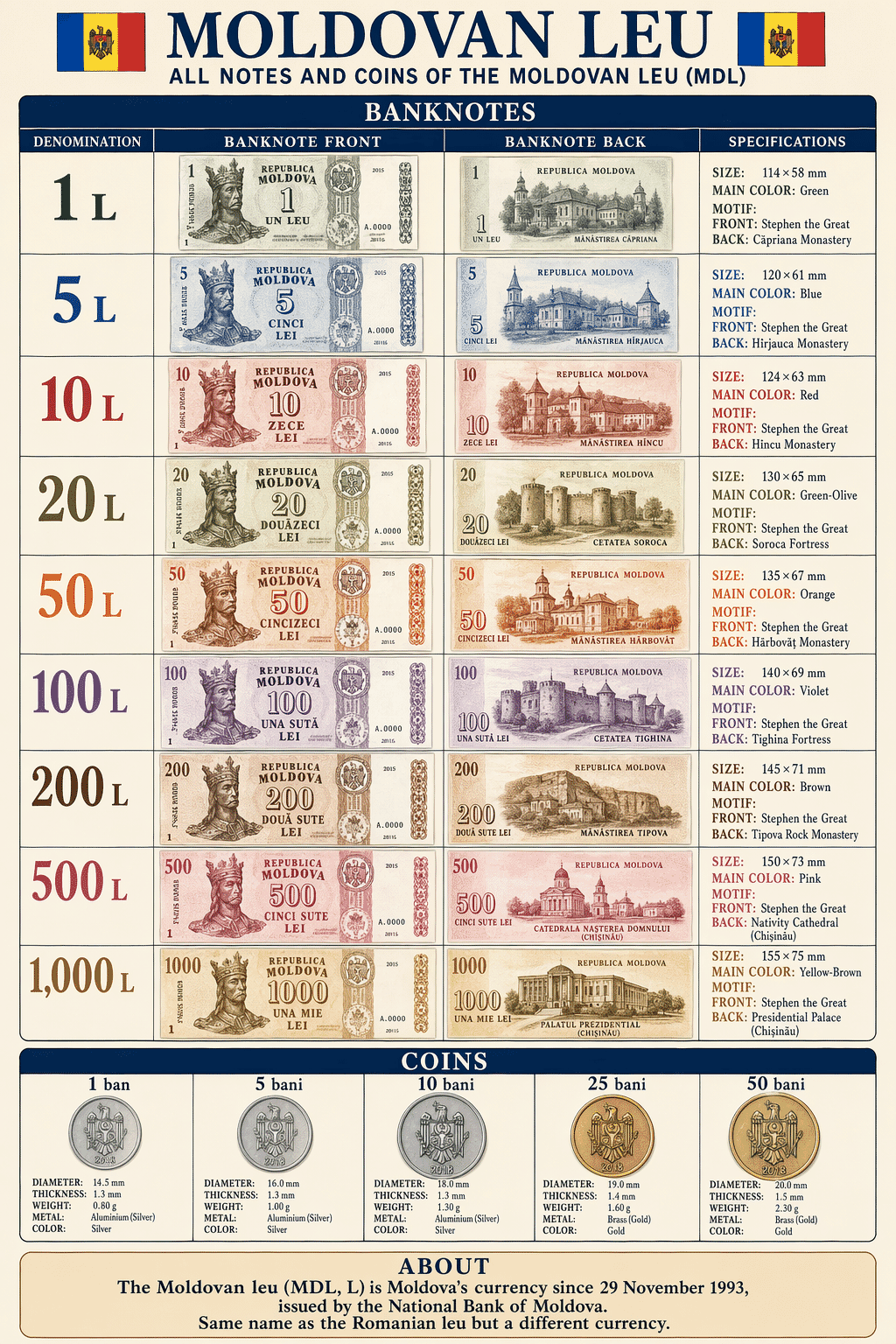
Every single Moldovan banknote features the same figure on the obverse: Stephen the Great (Ștefan cel Mare), the 15th-century Prince of Moldavia who defended the principality against Ottoman expansion. The reverse of each denomination shows a different Moldovan monastery, fortress, or landmark.
| Denomination | Figure / Motif | Context | Colour |
|---|---|---|---|
| 1 L | Stephen the Great / Căpriana Monastery | Oldest Moldovan monastic centre | Green |
| 5 L | Stephen the Great / Hîrjauca Monastery | — | Blue |
| 10 L | Stephen the Great / Hîncu Monastery | — | Red |
| 20 L | Stephen the Great / Soroca Fortress | 15th-century Dniester-facing fortress | Green |
| 50 L | Stephen the Great / Hârbovăț Monastery | — | Orange |
| 100 L | Stephen the Great / Tighina Fortress | — | Violet |
| 200 L | Stephen the Great / Tipova Monastery | Rock-cut cave monastery | Brown |
| 500 L | Stephen the Great / Nativity Cathedral | Chișinău’s main cathedral | Pink |
| 1,000 L | Stephen the Great / Presidential Palace (Chișinău) | Highest-denomination note | Yellow-brown |
Coins circulate in modest denominations. Note: the bani subunit is still used in everyday transactions, unlike in many peer post-Soviet states.
| Denomination | Composition & Design | Notes |
|---|---|---|
| 1 ban | Aluminium | Smallest denomination |
| 5 bani | Aluminium | Common in change |
| 10 bani | Aluminium | Common in change |
| 25 bani | Brass | Common |
| 50 bani | Brass | Common |
| 1 leu, 2 lei, 5 lei, 10 lei | Bi-metallic (newly added 2018–2019) | Higher-denomination coins |
History of The Leu
The Moldovan leu’s history begins in 1993 — a young currency by European standards. Its backdrop: the collapse of the Soviet Union, Moldova’s 1991 independence declaration, the 1992 Transnistria War, post-Soviet hyperinflation, and eventually a stabilisation that has held ever since. The NBM formally adopted inflation targeting in 2010 and has achieved steady disinflation through successive shocks.
| Year | Event |
|---|---|
| 1991 | Moldovan SSR declares sovereignty; NBM founded on 4 June. |
| 1991 | Moldova declares full independence on 27 August. |
| 1992–1993 | Transitional Moldovan cupon circulates alongside the Soviet then Russian rouble. |
| 1993 | Moldovan leu introduced on 29 November, replacing the cupon at 1:1,000 (initial) and the Russian rouble at 1:1,000 (second round). |
| 1994 | Hyperinflation of 1992–93 brought under control; leu stabilises. |
| 2006 | Russian wine embargo shocks Moldovan economy; NBM supports leu with FX sales. |
| 2010 | NBM formally adopts inflation targeting at 5% (±1.5 pp). |
| 2014 | EU Association Agreement signed. |
| 2022 | EU candidate status granted 23 June, three months after Russia invaded Ukraine. |
| 2023 | Anca Dragu appointed NBM Governor on 19 December — first woman to lead the bank. |
| 2024 | EU accession negotiations formally opened on 25 June. |
| 2025–2026 | Rate-cutting cycle; NBM cuts 100 bp in December 2025 to 5.00%, held in February 2026. |
The Moldovan Economy and the Leu
Moldova is one of Europe’s poorest countries by GDP per capita, though its economy has grown rapidly as EU trade has expanded. The 2025 economy leans on agriculture (grapes and wine are signature exports), light manufacturing (textiles, electronics, auto parts), and crucially remittances — roughly 18% of GDP comes from Moldovans working abroad, among the highest ratios of any country globally. The EU (especially Romania) is now Moldova’s dominant export market, overtaking Russia after the 2014 Association Agreement.
NBM targets CPI inflation at 5% (±1.5 percentage points), a higher target than most European peers reflecting Moldova’s still-emerging status. After CPI peaked at 34.3% in October 2022 driven by Russian gas-price shocks, inflation has fallen sharply — 6.8% in December 2025 and on track to return to target in Q1 2026. The policy rate is 5.00%, held through the February 2026 meeting after a 100 bp cut in December 2025.
Using Lei in Moldova
Card acceptance has grown rapidly in Chișinău, Bălți, and other larger cities — Visa, Mastercard, and contactless work in most supermarkets, restaurants, and hotels. Rural Moldova is still largely cash-based. Many Moldovan merchants will informally accept euros or Romanian lei, especially in border regions.
Typical prices in Moldovan lei (2026): espresso in Chișinău 25–40 L; a substantial meal 150–280 L; Moldovan wine at a restaurant 300–600 L per bottle (local production is excellent); a pint of beer 45–85 L; a mid-range Chișinău hotel room 1,200–2,200 L. ATMs at Moldova-Agroindbank, Moldindconbank, and Victoriabank are reliable for foreign cards.
The Leu in Regional Context
Moldova sits between Romania (EU, now in ERM II and moving toward euro) and Ukraine (at war with Russia). The unresolved Transnistria region uses its own unrecognised ‘Transnistrian rouble’. Moldova’s monetary arrangements are most similar to other aspiring EU members in the Western Balkans.
| Country | Code | Regime | Inflation | Policy rate |
|---|---|---|---|---|
| 🇲🇩 Moldova | MDL | Managed float | 5–6% (2026) | 5.00% |
| 🇷🇴 Romania | RON | Managed float | 3.9% (2026f) | 6.50% |
| 🇺🇦 Ukraine | UAH | Managed float | 7.5% (2026f) | 15.00% |
| 🇷🇸 Serbia | RSD | Managed float | ~3–4% | 5.75% |
| 🇦🇱 Albania | ALL | Managed float | 2.4% | 2.50% |
| 🇬🇪 Georgia | GEL | Managed float | ~4% | ~8% |
Frequently Asked Questions
What is the currency of Moldova?
Moldova’s currency is the Moldovan leu (plural lei, symbol L, ISO 4217 code MDL). It has been Moldova’s currency since 29 November 1993. Do not confuse it with the Romanian leu (RON) — the two are completely separate currencies with different exchange rates.
Is Moldova in the Eurozone?
No. Moldova is not an EU member; it is an EU candidate country since 23 June 2022, with accession negotiations formally opened on 25 June 2024. There is no target date for euro adoption.
Who manages Moldovan monetary policy?
The National Bank of Moldova (NBM), founded 4 June 1991. Its current Governor is Anca Dragu, who took office on 19 December 2023 — the first woman to lead the NBM. Before her NBM appointment Dragu was a senior IMF economist.
What is the current NBM policy rate?
The NBM base rate is 5.00%, held through the February 2026 meeting after a 100-basis-point cut in December 2025.
How many lei is one US dollar worth?
At the latest daily close, 1 USD ≈ 17.15 MDL. The leu has been essentially flat against the dollar over the past 12 months.
Is the Moldovan leu the same as the Romanian leu?
No. They share the same name (both mean ‘lion’) because Moldova and Romania share Latin linguistic and cultural heritage, but the Moldovan leu (MDL) and Romanian leu (RON) are fully separate currencies issued by different central banks. At current rates, 1 RON ≈ 4 MDL.
What currency does Transnistria use?
The breakaway Moldovan region of Transnistria (officially the Pridnestrovian Moldavian Republic) is not under NBM’s authority. It issues its own Transnistrian rouble (PRB), which is not internationally recognised. Within Moldova’s internationally recognised territory, only the Moldovan leu is legal tender.
Data current to April 2026 — NBM releases.

