
Key Facts: The Hungarian Forint
- ISO 4217 code: HUF · Symbol: Ft. Subdivided formally into 100 fillér (withdrawn 1999). Named after the medieval Florentine gold florin.
- Central bank: Magyar Nemzeti Bank (est. 1924). Budapest-based. Governor Mihály Varga since 4 March 2025 (22nd governor). Inflation-targeting mandate at 3% (±1 pp).
- Base rate: 6.25% · Inflation: 2.1% (Feb 2026). MNB cut 25 bp to 6.25% in February 2026 — the first cut in 18 months. Inflation has fallen below the 3% target for the first time in 5 years.
- 1 USD ≈ 309.55 HUF. The forint has strengthened a notable 14.3% against the dollar over the past 12 months — one of the best-performing emerging-market currencies.
- EU member since 2004, outside the Eurozone. Treaty-bound to adopt the euro eventually; no target date set. Current government opposes near-term adoption.
What Is the Currency of Hungary?
Hungary’s currency is the forint (symbol Ft, ISO 4217 code HUF). Named after the medieval Florentine gold fiorino d’oro, the modern forint was introduced on 1 August 1946 to end one of history’s most spectacular hyperinflations — the 1945–1946 pengő crisis, in which prices doubled every 15 hours at peak. Formally subdivided into 100 fillér, but fillér coins were withdrawn from circulation in 1999.
The forint is issued by Magyar Nemzeti Bank (MNB), founded in 1924. Hungary has been an EU member since 1 May 2004 and is legally bound to eventually adopt the euro, but successive governments have declined to set a target date. The forint floats freely.
Hungarian Forint to US Dollar — 1-Year Chart
The chart tracks USD/HUF daily close over the past year. The forint is one of the more volatile major emerging-market currencies — sensitive to MNB–ECB rate spreads, EU-fund disbursements, and domestic political developments including the government’s repeated confrontations with the MNB and the European Commission.
Line chart. Daily close, HUF per USD · Source: Yahoo Finance · Updated nightly. Data table with 2 rows and 132 columns follows.
| Oct 21 | Oct 23 | Oct 28 | Oct 30 | Nov 03 | Nov 05 | Nov 07 | Nov 11 | Nov 13 | Nov 17 | Nov 19 | Nov 21 | Nov 25 | Nov 27 | Dec 01 | Dec 03 | Dec 05 | Dec 09 | Dec 11 | Dec 15 | Dec 17 | Dec 19 | Dec 23 | Dec 26 | Dec 30 | Jan 02 | Jan 06 | Jan 08 | Jan 12 | Jan 14 | Jan 16 | Jan 20 | Jan 22 | Jan 26 | Jan 28 | Jan 30 | Feb 03 | Feb 05 | Feb 09 | Feb 11 | Feb 13 | Feb 17 | Feb 19 | Feb 23 | Feb 25 | Feb 27 | Mar 03 | Mar 05 | Mar 09 | Mar 11 | Mar 13 | Mar 17 | Mar 19 | Mar 23 | Mar 25 | Mar 27 | Mar 30 | Apr 01 | Apr 05 | Apr 07 | Apr 09 | Apr 13 | Apr 15 | Apr 19 | Apr 21 | Apr 23 | Apr 27 | Apr 29 | May 03 | May 05 | May 07 | May 11 | May 13 | May 17 | May 19 | May 21 | May 25 | May 27 | May 31 | Jun 02 | Jun 04 | Jun 08 | Jun 10 | Jun 14 | Jun 16 | Jun 18 | Jun 22 | Jun 24 | Jun 28 | Jun 30 | Jul 02 | Jul 06 | Jul 08 | Jul 12 | Jul 14 | Jul 16 | Jul 20 | Jul 22 | Jul 26 | Jul 28 | Jul 30 | Aug 03 | Aug 05 | Aug 09 | Aug 11 | Aug 13 | Aug 17 | Aug 19 | Aug 23 | Aug 25 | Aug 27 | Aug 31 | Sep 02 | Sep 06 | Sep 08 | Sep 10 | Sep 14 | Sep 16 | Sep 20 | Sep 22 | Sep 24 | Sep 28 | Sep 30 | Oct 04 | Oct 06 | Oct 08 | Oct 12 | Oct 14 | Oct 18 | Oct 20 | Oct 22 | |
|---|---|---|---|---|---|---|---|---|---|---|---|---|---|---|---|---|---|---|---|---|---|---|---|---|---|---|---|---|---|---|---|---|---|---|---|---|---|---|---|---|---|---|---|---|---|---|---|---|---|---|---|---|---|---|---|---|---|---|---|---|---|---|---|---|---|---|---|---|---|---|---|---|---|---|---|---|---|---|---|---|---|---|---|---|---|---|---|---|---|---|---|---|---|---|---|---|---|---|---|---|---|---|---|---|---|---|---|---|---|---|---|---|---|---|---|---|---|---|---|---|---|---|---|---|---|---|---|---|---|---|---|
| HUF per USD | 335.32 | 335.65 | 333.16 | 334.85 | 336.35 | 337.85 | 334.05 | 331.47 | 331.41 | 330.36 | 331.29 | 331.15 | 331.45 | 329.09 | 328.62 | 327.4 | 328.7 | 330.24 | 326.8 | 326.86 | 327.98 | 330.48 | 330.07 | 329.54 | 328.12 | 326.77 | 327.68 | 329.08 | 331.4 | 331.38 | 331.49 | 331.04 | 328.87 | 321.64 | 315.61 | 317.58 | 322.61 | 321.48 | 318.85 | 317.76 | 318.92 | 318.38 | 321.25 | 320.58 | 320.89 | 317.97 | 324.29 | 330.12 | 342.56 | 332.74 | 339.31 | 339.43 | 342.19 | 338.8 | 335.16 | 334.57 | 338.9 | 329.99 | 333.85 | 322.45 | 321.48 | 307.96 | 306.99 | 307.6 | 309.52 | 312.72 | 310.07 | 312.44 | 308.36 | 307.92 | 302.91 | 300.97 | 305.17 | 309.92 | 310.83 | 308.26 | 305.32 | 304.89 | 303.08 | 304.62 | 304.19 | 308.11 | 308.15 | 302.48 | 300.52 | 307.15 | 307.86 | 312.6 | 310.47 | 311.11 | 309.13 | 308.82 | 313.46 | 312.37 | 313.52 | 315.67 | 316.84 | 318.31 | 315.86 | 315.62 | 314.27 | 315.92 | 312.66 | 314.14 | 315.78 | 314.57 | 313.79 | 311.74 | 310.14 | 308.9 | 312.44 | 314.24 | 317.02 | 311.19 | 312.47 | 314.3 | 315.86 | 318.08 | 317.12 | 315.41 | 321.22 | 322.77 | 323.17 | 326.64 | 323.78 | 325.53 | 326.78 | 324.65 | 323.3 | 323.99 | 324.38 |
Over the past 12 months the forint has strengthened significantly from about 353 to 310 HUF per USD — a 14.3% move in the forint’s favour, among the best emerging-market performances globally. MNB’s late 2024 / early 2025 hawkish hold plus improved EU-fund flows have been the main drivers.
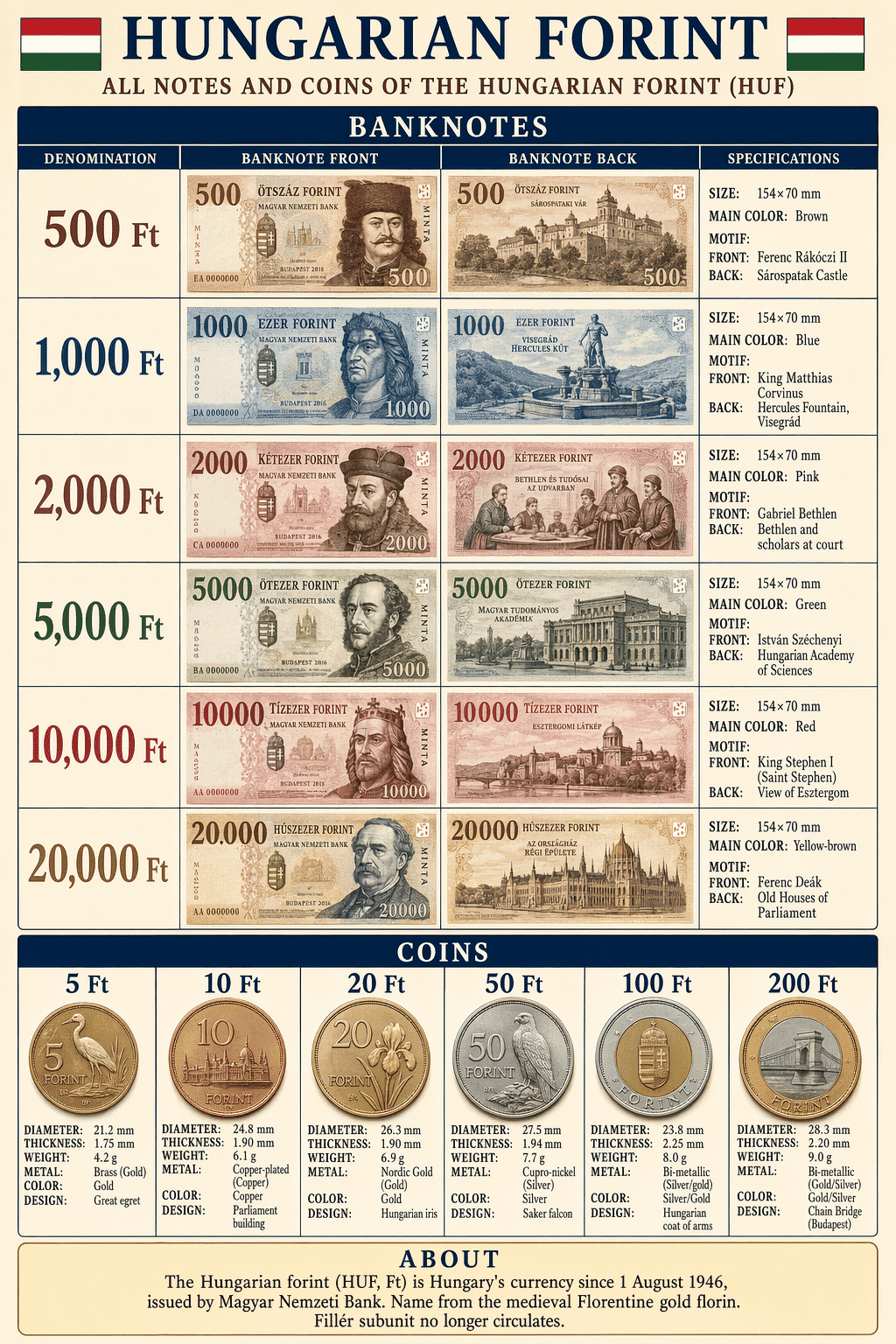
Banknotes and Coins
Current Hungarian banknotes feature a rotating cast of monarchs, statesmen, and a single 20th-century figure — all chosen for their role in Hungarian political or economic history. The series has been progressively upgraded with new security features and redesigned in 2014–2017.
| Denomination | Figure / Motif | Context | Colour |
|---|---|---|---|
| 500 Ft | Ferenc Rákóczi II | Transylvanian prince, leader of 1703–1711 war of independence | Brown |
| 1,000 Ft | King Matthias Corvinus | Renaissance king (1458–90), founder of the Corvina Library | Blue |
| 2,000 Ft | Gabriel Bethlen | Prince of Transylvania (1613–29) | Pink |
| 5,000 Ft | Count István Széchenyi | ‘The Greatest Hungarian’, reform-era statesman (1791–1860) | Green |
| 10,000 Ft | King Stephen I (Saint Stephen) | First king of Hungary, crowned AD 1000 | Red |
| 20,000 Ft | Ferenc Deák | ‘The Wise Man of the Nation’, architect of 1867 Compromise | Yellow-brown |
Coins come in six denominations from 5 to 200 forints. Bimetallic 100 Ft and 200 Ft are the highest-denomination circulating coins.
| Denomination | Composition & Design | Notes |
|---|---|---|
| 5 Ft | Brass; Great Egret | Since 2012 |
| 10 Ft | Copper-plated steel; Hungarian Parliament building | Since 1992 |
| 20 Ft | Nordic gold; Hungarian iris flower | Since 1992 |
| 50 Ft | Cupro-nickel; Saker falcon | Since 1992 |
| 100 Ft | Bi-metallic; Hungarian coat of arms | Since 1998 |
| 200 Ft | Bi-metallic; Chain Bridge in Budapest | Since 2009 |
History of The Forint
The forint’s history is book-ended by two hyperinflations: it was born to end the 1946 pengő collapse, and its most recent peak inflation (25.7% in January 2023) was among the highest in the EU. In between, the forint survived the collapse of communism, the 2008 financial crisis (which hit Hungary especially hard due to widespread CHF-denominated household mortgages), and the 2022 lira-mirror episode when HUF briefly traded at record lows.
| Year | Event |
|---|---|
| 1924 | Magyar Nemzeti Bank founded after the collapse of the Austro-Hungarian krone. |
| 1927 | Pengő introduced, pegged to gold. |
| 1945–1946 | Hungarian pengő collapses in history’s worst-ever hyperinflation; prices double every ~15 hours at peak. |
| 1946 | Forint introduced 1 August at 400 quadrillion pengő = 1 forint. |
| 1989 | Communism ends; transition-era high inflation (28% peak in 1991). |
| 2001 | Forint fully convertible; trading band widens to ±15%. |
| 2004 | Hungary joins the EU on 1 May. |
| 2008–2009 | Global financial crisis hits Hungary severely; HUF falls ~20% against EUR as CHF-denominated household debt becomes unmanageable. |
| 2013 | Central-bank legislation change centralises power under new Governor György Matolcsy; unconventional easing cycle begins. |
| 2022–2023 | Post-pandemic inflation peaks at 25.7% in January 2023; MNB hikes base rate to 13% defending the forint. |
| 2024–2026 | Cutting cycle lowers base rate to 6.25% by February 2026; inflation falls below the 3% target. |
| 2025 | Mihály Varga replaces Matolcsy as MNB Governor on 4 March. |
The Hungarian Economy and the Forint
Hungary is a small, heavily export-oriented Central European economy deeply integrated into German manufacturing supply chains. Motor vehicles, electronics, and machinery dominate the export mix; Mercedes, Audi, BMW, and Suzuki all operate major production facilities in Hungary. Exports account for roughly 80% of GDP, among the highest ratios in the EU.
MNB runs a 3% CPI inflation target (±1 pp tolerance). After inflation peaked at 25.7% in January 2023, the bank undertook aggressive tightening — peak base rate of 13% in late 2022. The cutting cycle began mid-2023 and has brought the base rate down to 6.25% (cut 25 bp in February 2026, the first cut in 18 months). February 2026 CPI printed at 2.1%, below the 3% target for the first time in five years.
Using Forints in Hungary
Card acceptance is strong in Budapest, Debrecen, Szeged, and tourist hubs — Visa, Mastercard, and contactless mobile wallets all work in chain cafés, supermarkets, tram-ticket machines, and most restaurants. Cash persists in small-town Hungary, outdoor markets, and some taxi companies. Tipping (10%) is often paid in cash even when the bill is card-paid.
Typical prices in forints (2026): espresso in a Budapest café 600–900 Ft; lunch special 2,500–3,800 Ft; a pint of beer 1,200–1,800 Ft; a meal in a mid-range restaurant 5,500–8,500 Ft; a single Budapest metro ticket 450 Ft; a mid-range Budapest hotel room 28,000–55,000 Ft. OTP Bank, K&H, and Erste Bank operate the largest free ATM networks. Avoid Euronet machines — their conversion rates are notoriously poor.
The Forint in Regional Context
Hungary sits in the Central European non-euro group with Poland and the Czech Republic. All three run inflation-targeting regimes with materially different rates. Slovakia, Slovenia, and Austria on the other side of the border are all in the euro.
| Country | Code | Regime | Inflation | Policy rate |
|---|---|---|---|---|
| 🇭🇺 Hungary | HUF | Free float (MNB inflation target) | 2.1% (Feb 2026) | 6.25% |
| 🇵🇱 Poland | PLN | Free float | ~2.5% | 4.00% |
| 🇨🇿 Czech Republic | CZK | Free float | 1.9% | 3.50% |
| 🇷🇴 Romania | RON | Managed float | 3.9% (2026f) | 6.50% |
| 🇦🇹 Austria | EUR | Eurosystem | 2.7% | 2.00% |
| 🇸🇰 Slovakia | EUR | Eurosystem | 2.9% | 2.00% |
Frequently Asked Questions
What is the currency of Hungary?
Hungary’s currency is the forint (symbol Ft, ISO 4217 code HUF). Introduced on 1 August 1946 to end the 1945–1946 pengő hyperinflation — the worst in recorded history. Named after the medieval Florentine gold florin.
Is Hungary in the Eurozone?
No. Hungary is an EU member (since 1 May 2004) and is legally bound to eventually adopt the euro, but successive governments have declined to set a target date. The current government explicitly opposes near-term euro adoption.
Who manages Hungarian monetary policy?
Magyar Nemzeti Bank (MNB), founded 1924, headquartered in Budapest. Its Governor is Mihály Varga, who took office on 4 March 2025 — the 22nd governor in MNB’s history. Before his central-bank appointment, Varga was finance minister from 2013 to 2025.
What is the current MNB base rate?
The MNB base rate is 6.25% as of February 2026, after a 25-basis-point cut. It was the first cut in 18 months, following an earlier hiking cycle that peaked at 13% in 2022.
How many forints is one US dollar worth?
At the latest daily close, 1 USD ≈ 310 HUF. The forint has strengthened a remarkable 14.3% against the dollar over the past 12 months — one of the best 12-month performances among emerging-market currencies.
Can I use euros in Hungary?
Some Budapest tourist shops, hotels, and larger restaurants will accept euros, but the exchange rate offered is typically poor and change comes in forints. For everyday spending, use an ATM or a multi-currency card. Euros are not legal tender in Hungary.
Who are on Hungarian banknotes?
Six historical figures: Ferenc Rákóczi II (500 Ft), King Matthias Corvinus (1,000 Ft), Gabriel Bethlen (2,000 Ft), István Széchenyi (5,000 Ft), King Stephen I / Saint Stephen (10,000 Ft), and Ferenc Deák (20,000 Ft). All are central figures in Hungarian political and national-awakening history.
Data current to April 2026 — MNB and KSH (Hungarian Central Statistical Office) releases.

