Key Takeaways
- 2,056 nuclear tests in 72 years. Between 1945 and 2017, eight countries detonated 2,056 nuclear test explosions. The United States (1,030) and the Soviet Union (715) account for about 85% of them all.
- A handful of remote places absorbed the blasts. Two-thirds of every test in history happened at just two sites: the Nevada Test Site (928) and Semipalatinsk in today's Kazakhstan (456). Pacific atolls, the Algerian Sahara, the Australian outback and the Arctic took most of the rest.
- The date behind the day. The International Day against Nuclear Tests falls on 29 August because of one place: Semipalatinsk. The Soviet Union's first bomb was tested there on 29 August 1949, and Kazakhstan shut the site down on 29 August 1991.
- Only one country has tested this century. The US last tested in 1992, France and China in 1996, India and Pakistan in 1998. Since then, every nuclear test on Earth, six of them, has been North Korea's, the last in September 2017.
On 29 August, the world marks the International Day against Nuclear Tests. The date is not arbitrary: it is the anniversary of both the Soviet Union’s first nuclear test in 1949 and the closure, 42 years later to the day, of the site where it happened. Between those bookends lies one of the strangest datasets of the 20th century: 2,056 nuclear explosions, set off by just eight countries. Here is where they all happened.
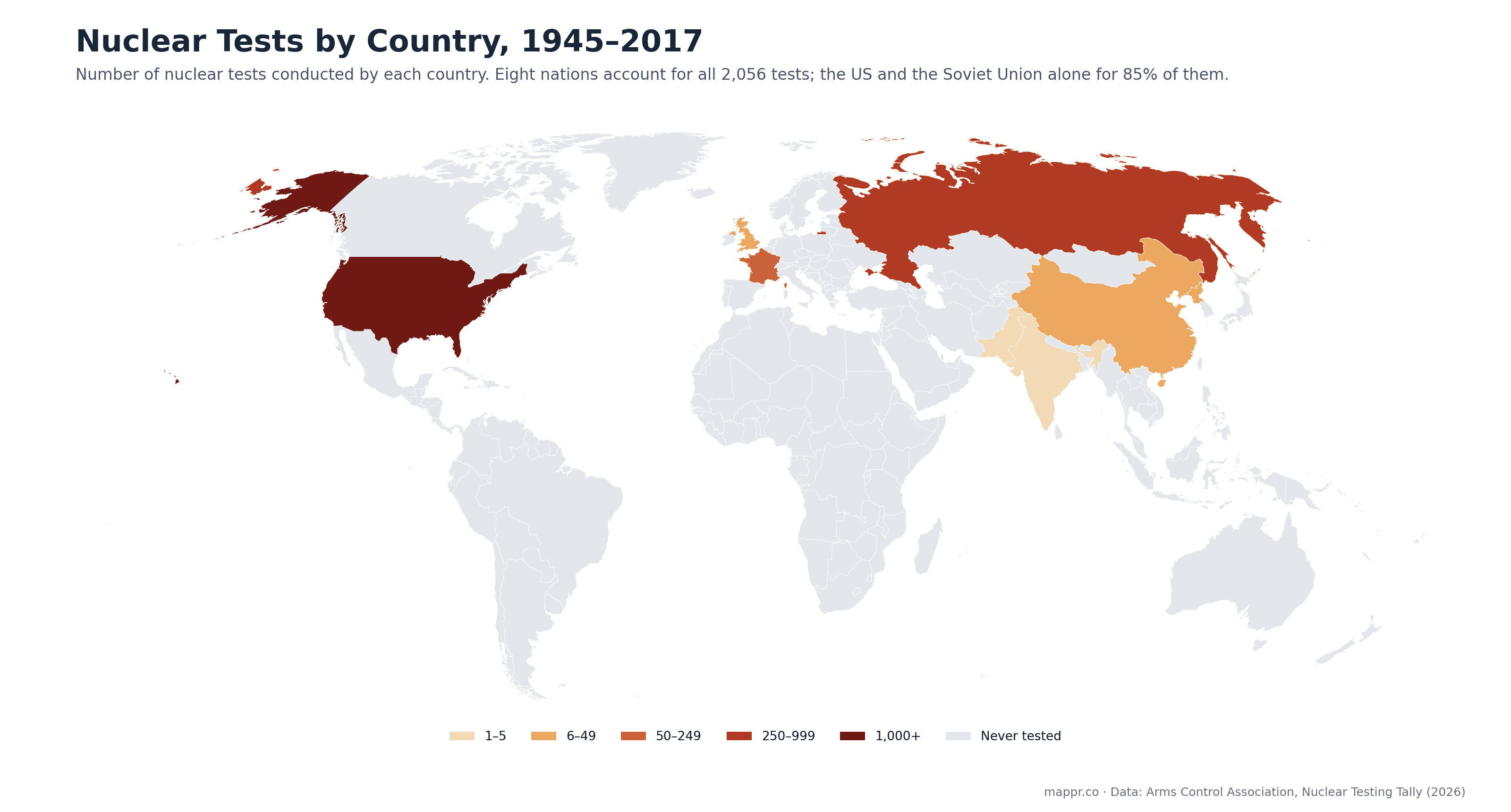
The map is dominated by the Cold War’s two protagonists. The United States conducted 1,030 tests, more than every other country combined, and the figure rises to 1,054 if you count the 24 joint US-UK tests it hosted. The Soviet Union carried out 715. Behind them come France (210), then the United Kingdom and China with 45 each, and far behind, the three latecomers: North Korea (6), India (3) and Pakistan (2).
| Country | Tests | First test | Last test | Main test sites |
|---|---|---|---|---|
| 🇺🇸 United States | 1,030 | 16 Jul 1945 | 23 Sep 1992 | Nevada, Marshall Islands, Amchitka |
| 🇷🇺 Soviet Union / Russia | 715 | 29 Aug 1949 | 24 Oct 1990 | Semipalatinsk, Novaya Zemlya |
| 🇫🇷 France | 210 | 13 Feb 1960 | 27 Jan 1996 | Algerian Sahara, Mururoa & Fangataufa |
| 🇬🇧 United Kingdom | 45 | 3 Oct 1952 | 26 Nov 1991 | Australia, Pacific, Nevada (with US) |
| 🇨🇳 China | 45 | 16 Oct 1964 | 29 Jul 1996 | Lop Nur |
| 🇰🇵 North Korea | 6 | 9 Oct 2006 | 3 Sep 2017 | Punggye-ri |
| 🇮🇳 India | 3 | 18 May 1974 | 13 May 1998 | Pokhran |
| 🇵🇰 Pakistan | 2 | 28 May 1998 | 30 May 1998 | Chagai Hills |
Where the bombs actually went off
A tests-by-country map hides the most striking part of the story: the testing states mostly did not detonate the bombs at home, or at least not near anyone with a vote. The explosions were pushed to deserts, atolls, the Arctic and colonial territories, a geography of remoteness that the second map makes visible.
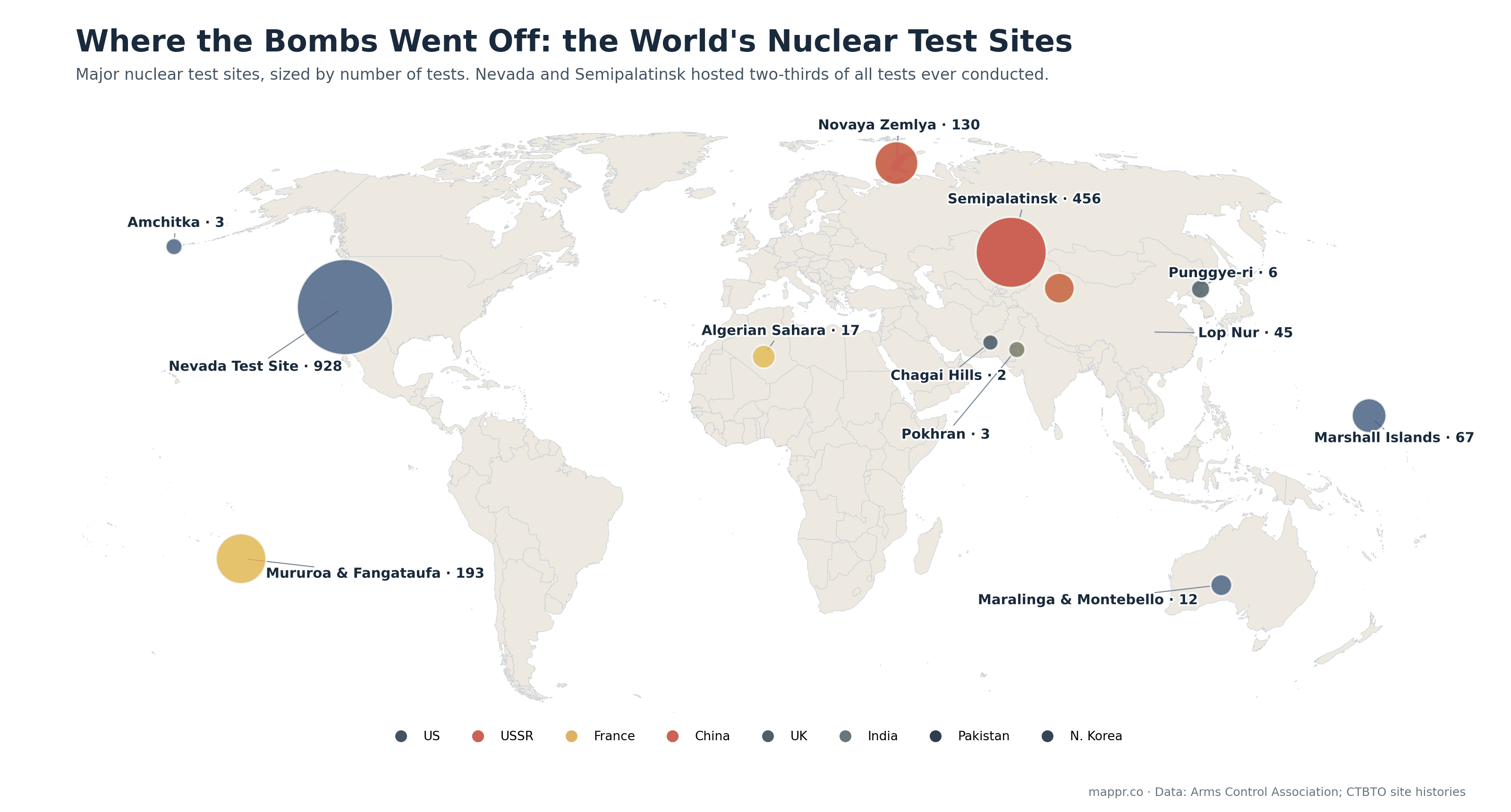
Two sites absorbed two-thirds of everything. The Nevada Test Site northwest of Las Vegas hosted 928 tests, and Semipalatinsk in the steppe of eastern Kazakhstan hosted 456. The Soviets sent their biggest blasts further north: Novaya Zemlya, an Arctic archipelago, absorbed 130 tests including the 1961 Tsar Bomba, at around 50 megatons the largest explosion humans have ever produced.
France tested first in the Algerian Sahara (17 tests, continuing even after Algerian independence negotiations began) before moving to the Pacific atolls of Mururoa and Fangataufa in French Polynesia, which took 193 tests over three decades. Britain used Australia (Maralinga, Emu Field and the Montebello Islands) and Pacific islands before moving its programme to Nevada with the Americans. The US, beyond Nevada, devastated the Marshall Islands: 67 tests at Bikini and Enewetak atolls, including the 1954 Castle Bravo shot whose fallout contaminated inhabited atolls downwind. China kept its 45 tests at Lop Nur in Xinjiang; India and Pakistan tested within days of each other in 1998 at Pokhran and the Chagai Hills; and North Korea has tunnelled all six of its tests under Punggye-ri.
Why 29 August belongs to Semipalatinsk
No place on Earth carries more of the testing era’s legacy than Semipalatinsk. The Soviet programme detonated bombs there, in the open air until 1963, upwind of villages that were never evacuated. Around 1.5 million people in Kazakhstan are estimated to have been affected by the fallout, with elevated cancers and birth defects documented for decades afterwards. When Kazakhstan gained control of the site, closing it on 29 August 1991 was one of the new republic’s first sovereign acts, and it went further, voluntarily giving up the world’s fourth-largest nuclear arsenal. The UN chose the anniversary as the International Day against Nuclear Tests in 2009, at Kazakhstan’s initiative.
The testing era is (almost) over
The Comprehensive Nuclear-Test-Ban Treaty, opened for signature in 1996, has never formally entered into force, but it created one of the strongest taboos in international politics. The US has not tested since 1992, Russia since 1990, France and China since 1996. Only North Korea has broken the silence this century, six times between 2006 and 2017. The world has now gone almost a decade without a single nuclear test explosion, the longest pause since 1945. Which countries still hold the weapons themselves is a different map, and we keep it updated separately: see our map of the countries with nuclear weapons, and for the broader context, military spending by country.