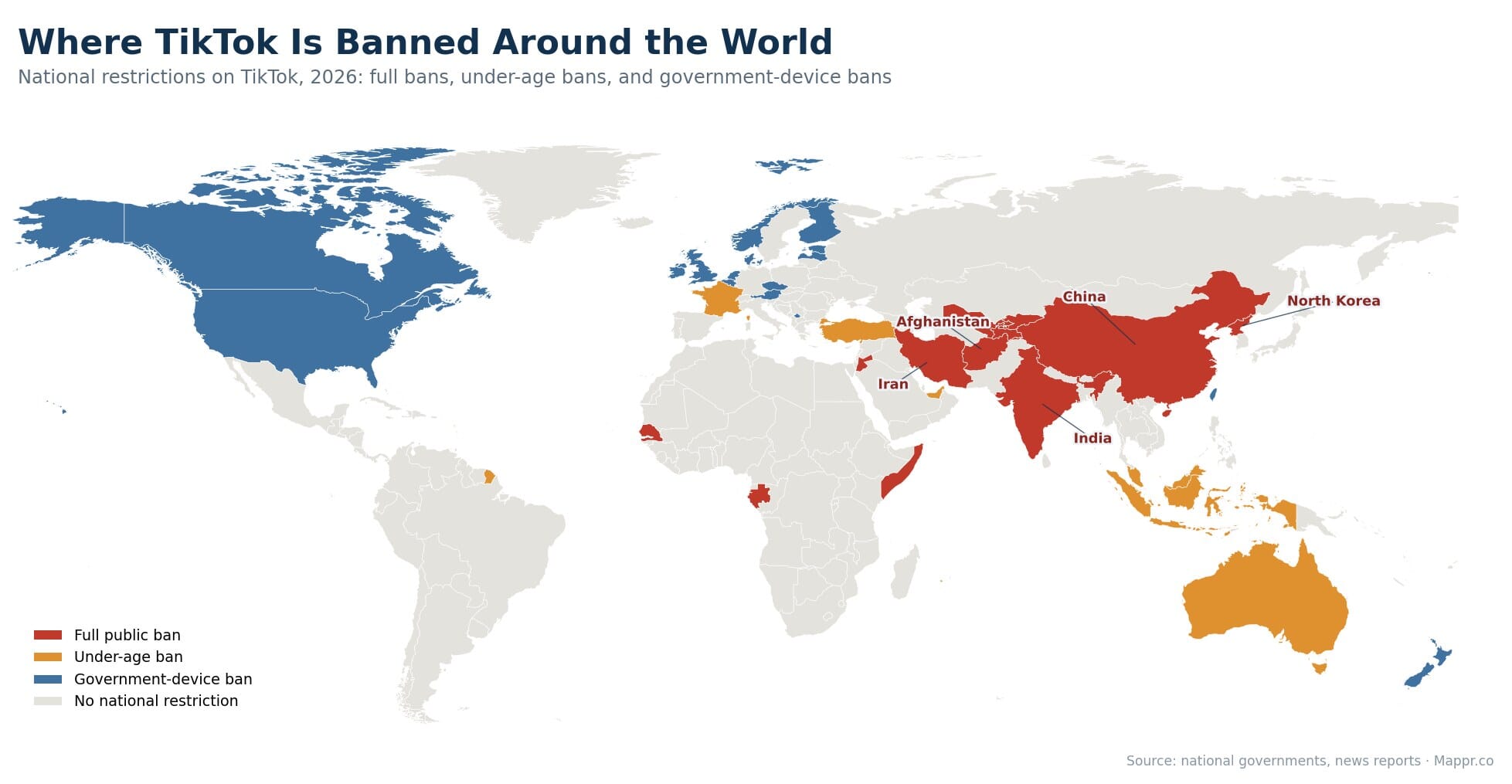
TikTok is used by more than a billion people, but a growing number of governments have decided it is a problem. Some block it outright. Some bar it for children. Many quietly ban it from official phones. We mapped every national restriction on TikTok as of 2026.
The picture shifted a lot in the last year. The United States pulled back from a nationwide ban in January 2026 by forcing a sale of its local operations, while Nepal and Albania lifted their bans entirely. At the same time, a fresh wave of under-age bans arrived.
Key Takeaways
- 12 countries ban TikTok completely. India, China, Iran, Afghanistan and North Korea are joined by Uzbekistan, Jordan, Somalia, Senegal, Tajikistan, Kyrgyzstan and, newly in 2026, Gabon.
- The US ban was averted. In January 2026 the US forced a divestiture of TikTok's local operations to a US-led investor group, so the app stays live for Americans.
- A new wave of under-age bans. Australia (under 16) is already enforcing one; France, Turkey, Indonesia, Malaysia and the UAE have passed or are phasing in bans on social media for minors.
- The West bans it on official phones. Around 17 countries, including the US, Canada, the UK, Taiwan and much of Europe, ban TikTok on government devices while leaving the public free to use it.
- Some bans were reversed. Nepal lifted its ban in 2024 and Albania's one-year ban lapsed and was ruled unconstitutional in early 2026.
Twelve countries ban TikTok completely
In these countries TikTok is blocked for everyone, citizens and tourists alike. The two heavyweights are India, which banned it in 2020 in the world’s largest permanent block, and China, where the international app has never been available and ByteDance runs the domestic twin, Douyin, instead.
The rest fall into two clusters. In Central Asia, Uzbekistan, Tajikistan and Kyrgyzstan have all blocked it, mostly citing data rules or child protection. Across the Middle East and Africa, Iran and Afghanistan censor it on political and religious grounds, while Jordan, Somalia, Senegal and, since February 2026, Gabon have blocked it during periods of unrest. North Korea, where almost no foreign internet is reachable, completes the list.
The new wave: under-age bans
The fastest-moving trend is not aimed at TikTok alone but at children on all social media. Australia led the way, barring under-16s from major platforms including TikTok from December 2025. Indonesia and Malaysia followed in 2026.
Europe is joining in. France passed a law on 21 July 2026 banning under-15s, the first in the EU, phasing in from September. Turkey and the UAE have enacted similar age limits. Several more countries, including the UK, Greece and Spain, have announced plans that are not yet law. We track that wider trend in our guide to where social media is being banned for minors.
The quiet Western restriction: government devices
Most Western democracies never banned TikTok for the public. Instead, starting in 2023, they banned it on government-issued devices, treating it as a data-security and espionage risk. The United States (federal plus most states), Canada, the United Kingdom, Australia, New Zealand and Taiwan all did so.
So did much of Europe, including Belgium, Denmark, Norway, Austria, Estonia, Latvia, Finland, Malta, Ireland, the Netherlands and Czechia, alongside the EU’s own institutions. These range from formal bans to official advisories to remove the app, but the message is the same: fine for citizens, not for civil servants.
What changed in 2026
The biggest story is the one that did not happen. After years of threats, the United States did not ban TikTok nationwide. In January 2026 it forced ByteDance to hand its US business to a US-led group of investors, keeping the app alive for its American users.
Two full bans also fell away. Nepal lifted its block in 2024, and Albania, which imposed a one-year ban in 2025, saw it lapse and then be ruled unconstitutional in early 2026. The trend line is not simply toward more restriction; it moves in both directions.
Every country’s TikTok restriction
All 35 countries with a national TikTok restriction in 2026, grouped by type, with when it took effect and the detail. Search for a country or filter by restriction type.
| Country | Restriction | Since | Detail |
|---|---|---|---|
| Afghanistan | Full public ban | 2022 | Banned by the Taliban government in 2022 for ‘misleading’ the young and un-Islamic content. |
| China | Full public ban | ongoing | International TikTok is unavailable behind the Great Firewall; ByteDance runs the domestic twin Douyin instead. |
| Gabon | Full public ban | 2026 | Regulator suspended TikTok in February 2026 amid election-related unrest, ‘until further notice’. |
| India | Full public ban | 2020 | Banned in June 2020 with dozens of other Chinese apps after a border clash; still fully blocked, the world’s largest permanent ban. |
| Iran | Full public ban | ongoing | Blocked as part of Iran’s broad censorship of foreign social media, tightened after the 2022 protests. |
| Jordan | Full public ban | 2022 | Banned in December 2022 after unrest spread on the app; still in effect pending compliance talks. |
| Kyrgyzstan | Full public ban | 2024 | Blocked in April 2024 over child-protection concerns; a 2026 proposal to lift it is unresolved. |
| North Korea | Full public ban | ongoing | Inaccessible under near-total state control of the internet; the public has no access. |
| Senegal | Full public ban | 2023 | Suspended in 2023 over ‘subversive’ content amid political unrest; not yet lifted. |
| Somalia | Full public ban | 2023 | Banned in 2023 over extremist content and misinformation, though enforcement is patchy. |
| Tajikistan | Full public ban | 2023 | Banned in 2023 citing harm to children’s development; still blocked. |
| Uzbekistan | Full public ban | 2021 | Blocked since 2021 over non-compliance with the country’s data-protection law. |
| Australia | Under-age ban | Dec 2025 | Under-16s barred from holding accounts on TikTok and other major platforms; adults unaffected. World-first, effective 10 Dec 2025. |
| France | Under-age ban | Jul 2026 | Under-15s banned; law passed 21 Jul 2026 (first in the EU). New accounts age-verified from Sep 2026, existing accounts suspended from Jan 2027. |
| Indonesia | Under-age ban | Mar 2026 | Under-16s banned from high-risk social platforms including TikTok; effective 28 Mar 2026. |
| Malaysia | Under-age ban | Jun 2026 | Under-16s cannot open accounts on large platforms including TikTok, under the Online Safety Act; enforcement from 1 Jun 2026. |
| Turkey | Under-age ban | 2026 | Under-15s banned from social media; published in the Official Gazette 1 May 2026, taking effect around Nov 2026 after a compliance window. |
| United Arab Emirates | Under-age ban | 2026 | Restricts social-media access for minors under 15; enacted, phased in through 2026-2027. |
| Austria | Government-device ban | 2023 | Banned on federal officials’ work devices in 2023. |
| Belgium | Government-device ban | 2023 | Banned on federal government devices in 2023 over data and security concerns. |
| Canada | Government-device ban | 2023 | Banned on government-issued devices in 2023 over data-security concerns. |
| Czechia | Government-device ban | 2023 | Cyber-security agency warned against TikTok on state devices and critical infrastructure in 2023. |
| Denmark | Government-device ban | 2023 | Ministries urged staff to remove TikTok from work phones in 2023. |
| Estonia | Government-device ban | 2023 | Restricted on state officials’ work phones in 2023. |
| Finland | Government-device ban | 2024 | Parliament banned TikTok on all parliament-issued devices in 2024 on security grounds. |
| Ireland | Government-device ban | 2023 | Advised off official devices by the national cyber-security centre in 2023. |
| Kosovo | Government-device ban | 2024 | Government ordered all public institutions to block TikTok on state networks and official devices in June 2024, citing cyber-threats. |
| Latvia | Government-device ban | 2023 | Removed from foreign-ministry and other official devices in 2023. |
| Malta | Government-device ban | 2023 | The government IT agency blocked TikTok on all government electronic devices in 2023. |
| Netherlands | Government-device ban | 2023 | Discouraged and restricted on central-government work devices from 2023. |
| New Zealand | Government-device ban | 2023 | Removed from devices with access to the parliamentary network in 2023. |
| Norway | Government-device ban | 2023 | Barred from devices with access to ministry and parliament systems in 2023. |
| Taiwan | Government-device ban | 2022 | Banned across the public sector in 2022, treating TikTok as a national-security risk. |
| United Kingdom | Government-device ban | 2023 | Banned on government devices in 2023 on security advice; a separate under-16 social-media ban has been announced but is not yet in force. |
| United States | Government-device ban | 2022 | Banned on federal devices (2022) and across 30-plus states; the threatened nationwide ban was averted in January 2026 when US operations were divested to a US-led investor group. |