Key Takeaways
- Election Day is Tuesday, November 3. Americans vote for all 435 House seats, 35 of the 100 Senate seats, and 36 governorships. Control of Congress for the second half of Donald Trump’s term is on the line.
- Republicans hold both chambers, narrowly. The House is 218-214 and the Senate 53-47. Democrats need a net gain of three seats in the House and four in the Senate to take control.
- The Senate is the harder climb. Democrats must hold all 13 of their seats and flip four of the 22 Republican-held ones. A 50-50 tie keeps Republicans in charge, because Vice President Vance breaks ties.
- History favours the out-party. Since 1946 the president’s party has lost an average of about 27 House seats in the midterms, and current polls give Democrats a generic-ballot lead.
On Tuesday, November 3, 2026, Americans decide who controls the United States Congress for the second half of Donald Trump’s presidency. Trump is not on the ballot, but every seat in the House of Representatives, a third of the Senate, and 36 governorships are. The results will shape whether the president can keep passing his agenda, or spends his next two years facing a Congress that can block him and investigate his administration.
This is a map-first guide to what is up for grabs: the Senate seats that decide control of the upper chamber, the governor’s races, and where the real battlegrounds are. We will update it with the results on election night.
What is at stake
Republicans currently hold both chambers, but only just. In the House, they have 218 seats to the Democrats’ 214, with one independent sitting with the Republicans and two seats vacant; 218 is the number needed for a majority. In the Senate, Republicans have 53 seats to a 47-seat Democratic bloc. To take control, Democrats need a net gain of three seats in the House and four in the Senate. The new Congress is sworn in on January 3, 2027.
If Democrats flip even one chamber, they gain the power to block legislation, launch investigations, and, in the House, open impeachment proceedings. A Democratic Senate could also reject the president’s nominees, including federal judges and Supreme Court justices, who serve for life. In short, one chamber is enough to change what is possible in Washington for two years.
The Senate: 35 seats, control on a knife’s edge
A third of the Senate is up each cycle. This year that means 35 seats: 33 regular contests plus two special elections in Florida and Ohio to fill the seats vacated by Secretary of State Marco Rubio and Vice President JD Vance. Of the 35, Republicans are defending 22 and Democrats 13, so Democrats have less margin for error but more Republican targets to aim at.
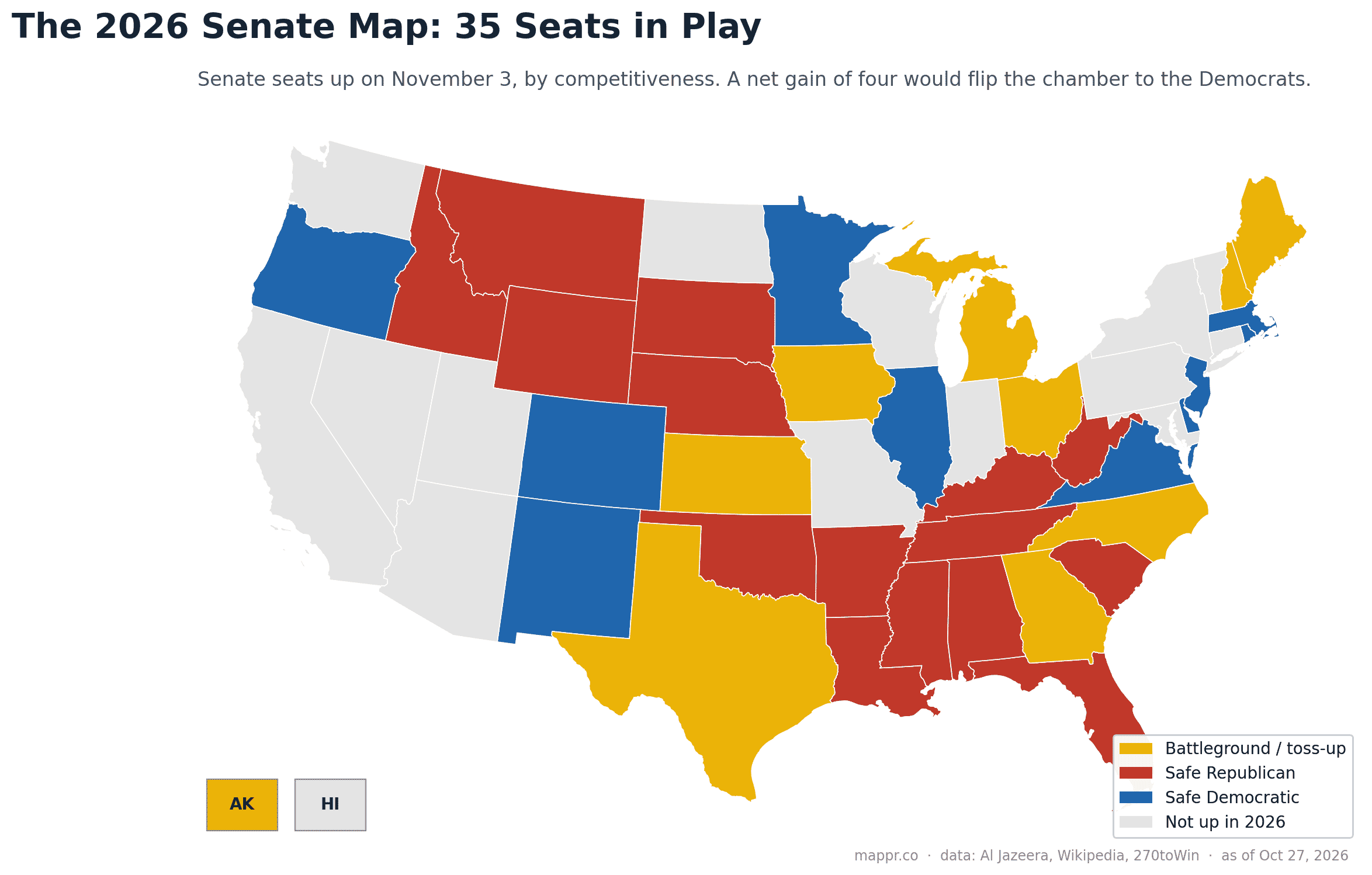
Democrats must hold all 13 of their own seats and flip four Republican-held ones. The marquee contests include Georgia (Jon Ossoff versus Mike Collins), the open seats in Michigan (Abdul El-Sayed versus Mike Rogers) and New Hampshire (Chris Pappas versus John Sununu), Maine (Susan Collins versus Troy Jackson), and an open North Carolina seat (Roy Cooper versus Michael Whatley). Ohio, Alaska and Iowa are also competitive, and Democrats are even eyeing longer shots in Texas and Kansas. Because a 50-50 Senate leaves Vice President Vance casting tie-breaking votes, Democrats need to reach 51, not 50.
The governors: 36 states choose their leaders
Beyond Congress, 36 states elect governors in 2026. Nationwide the split is almost even, 26 Republican governors to 24 Democratic ones, and 17 of this year’s incumbents are term-limited, creating a wave of open-seat contests.
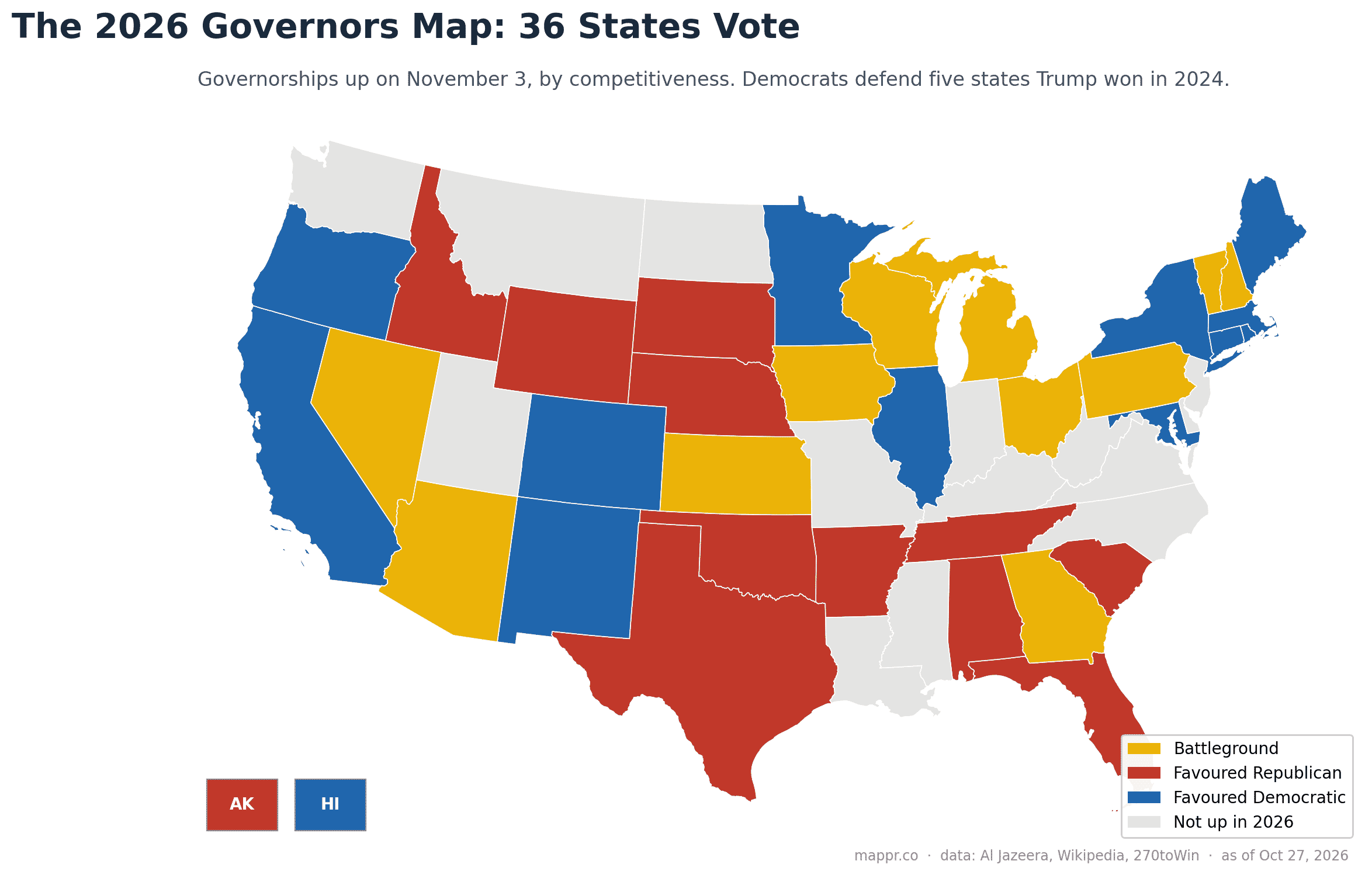
The most competitive races sit where the parties are defending hostile turf. Democrats are defending five states that Trump won in 2024: Arizona, Kansas, Michigan, Pennsylvania and Wisconsin. Republicans, in turn, are defending two states that Kamala Harris won: New Hampshire and Vermont. Open seats in Georgia, Nevada, Ohio and Iowa round out the battlegrounds.
The House: a few districts decide everything
All 435 House seats are contested every two years, divided among the states by population, from California’s 52 down to single seats in Wyoming and Vermont. With the chamber split 218-214, only a handful of close races actually decide the majority. Analysts estimate about 35 districts are genuinely in play, and Republican redistricting has given the party an edge in roughly nine additional seats. Even so, the out-party usually gains ground: since 1946 the president’s party has lost an average of about 27 House seats in a midterm.
The backdrop: cost of living and a foreign war
Two themes dominate the campaign. The first is the cost of living, with petrol prices, housing and healthcare squeezing household budgets; a Pew Research survey in early October gave Democrats a 44 percent to 36 percent lead on the generic ballot, with a notable gender gap as women favoured Democrats by 45 to 31. The second is foreign policy, after the US-Iran confrontation over the Strait of Hormuz pushed national security back into the headlines. How voters weigh their wallets against the world will shape the result.
We will refresh this page with the results map once polls close on November 3, showing which seats flipped and who ends up controlling the House, the Senate, and the governor’s mansions.
Figures and race ratings in this article are drawn from the following sources.