The Quick Answer
- Yes, the clocks go back tonight, across Europe. At 01:00 UTC overnight into Sunday, October 25, the UK, EU, Switzerland, Norway and the Balkans all turn their clocks back one hour. You get an extra hour in bed.
- North America does NOT change tonight. The US and Canada fall back a week later, on Sunday, November 1. If you're in New York or Toronto, your clocks stay put this weekend.
- Iceland never changes at all. Along with most of Africa, Asia and South America, Iceland stays on one fixed time year-round and ignores the whole ritual.
- Fewer than 70 countries still do this. Daylight saving is now a mostly European and North American habit. The majority of the world's countries have never adopted it or have scrapped it.
If you’re in Europe, enjoy the extra hour: the clocks go back one hour tonight. At 01:00 UTC overnight into Sunday, October 25, 2026, summer time ends across the United Kingdom, the European Union, and most of the rest of the continent, and the clocks fall back to standard time. Here is exactly who changes tonight, who waits, and who never bothers at all.
The Map: Who Changes the Clocks Tonight
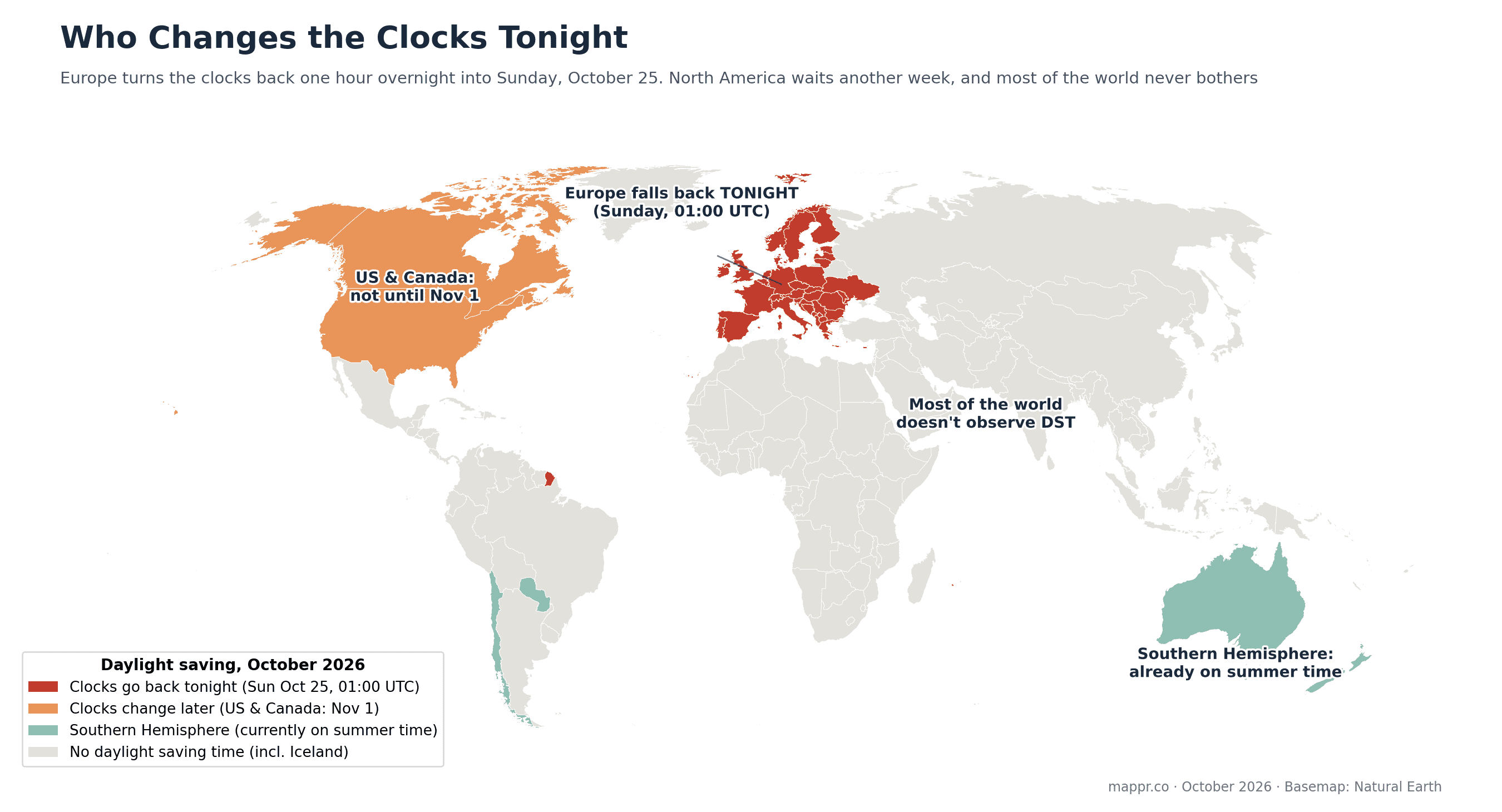
The red band is tonight’s club: every European country that observes daylight saving changes at the same instant, 01:00 UTC. That means 2:00 AM becomes 1:00 AM in the UK, Ireland and Portugal; 3:00 becomes 2:00 across Central Europe; and 4:00 becomes 3:00 in Greece, Finland and the Baltics, all at once. Switzerland, Norway, and the Western Balkans go with them.
Why America Isn’t Changing Tonight
A common confusion: the US and Canada are not on the same schedule. North America follows a different rule (the first Sunday in November), so its clocks fall back on Sunday, November 1, a week after Europe. For eight days each autumn, the time difference between, say, London and New York shrinks by an hour, catching out travelers and anyone scheduling a transatlantic call.
Who Doesn’t Change at All
For most of the planet, tonight is just a night. Iceland, nearly all of Africa and Asia (including China, India and Japan), most of South America, and the Gulf states keep one fixed time all year. A handful of places run the opposite way: in the Southern Hemisphere, Australia, New Zealand and parts of South America are heading into summer and recently moved their clocks forward. Even within countries there are holdouts, from Arizona in the US to Queensland in Australia.
The direction of travel is toward scrapping the switch entirely. The EU voted to abolish seasonal clock changes back in 2019 but has never implemented it; the US has debated making daylight time permanent. For now, though, the ritual survives, and tonight, in Europe, it means one more hour of sleep. For the full picture of where the practice stands worldwide, see our map of daylight saving time by country.