Key Takeaways
- The World Wrestling Championships open today in Astana. The 2026 UWW Senior Worlds run October 24 to November 1 at Barys Arena in Kazakhstan, after being moved from Bahrain. Greco-Roman, women's and freestyle unfold across the week.
- Japan, the US and Russia lead the all-time table. Since 1951, Japan has 316 medals, the US 313 and Russia 271. But the single biggest haul belongs to a country that no longer exists: the Soviet Union, with 415.
- Per capita, the map flips to small mountain nations. Divide by population and Bulgaria (41 medals per million), Georgia (23), Mongolia and Armenia (16 each) run the table. The US and China fall off entirely.
- Wrestling's heartland is the old Soviet and Balkan belt. From the Caucasus to the steppe to the Balkans, a band of countries treats wrestling as a national sport, and the medal map proves it.
The 2026 World Wrestling Championships open today in Astana, Kazakhstan, the sport’s marquee annual event, moved from Bahrain to Barys Arena and running through November 1. It is the perfect moment to map the obvious question: which countries actually own this sport? The answer, once you divide by population, is not the one the medal table first suggests.
The Map: All-Time World Championship Medals
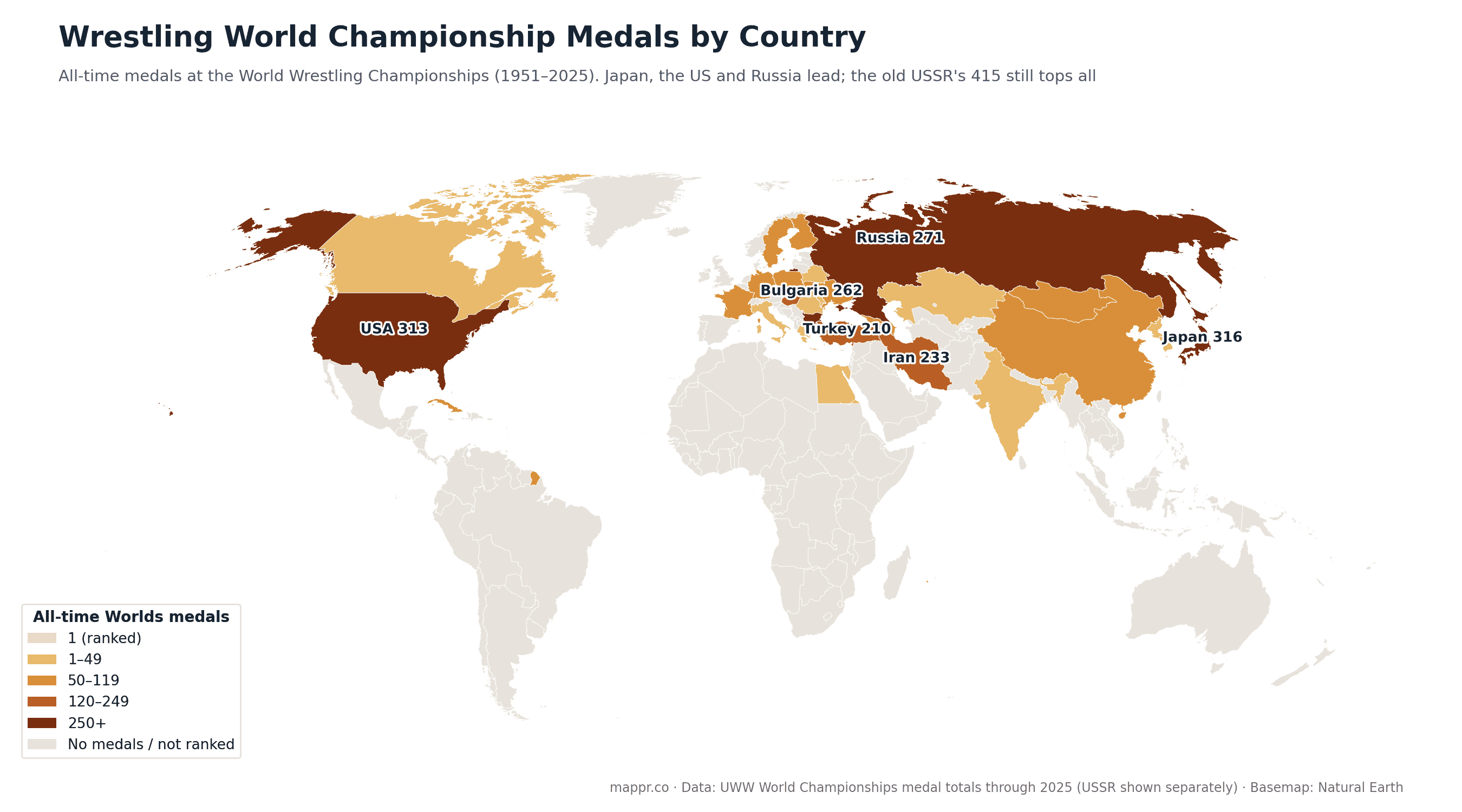
By raw totals, three nations tower over the rest: Japan (316 medals), the United States (313) and Russia (271), trailed by the deep European wrestling cultures of Bulgaria (262), Iran (233) and Turkey (210). Japan’s surprise #1 is built on its extraordinary women’s program; the US ranks high on a mountain of silver and bronze; Iran is the freestyle superpower and Cuba a Greco-Roman specialist. Looming over all of them is a ghost: the Soviet Union won 415 medals before 1991, a total no existing country has approached, and one whose successor states (Russia, Georgia, Azerbaijan, Armenia, Ukraine, Kazakhstan) now fill the medal table in their own right.
The Per-Capita Flip
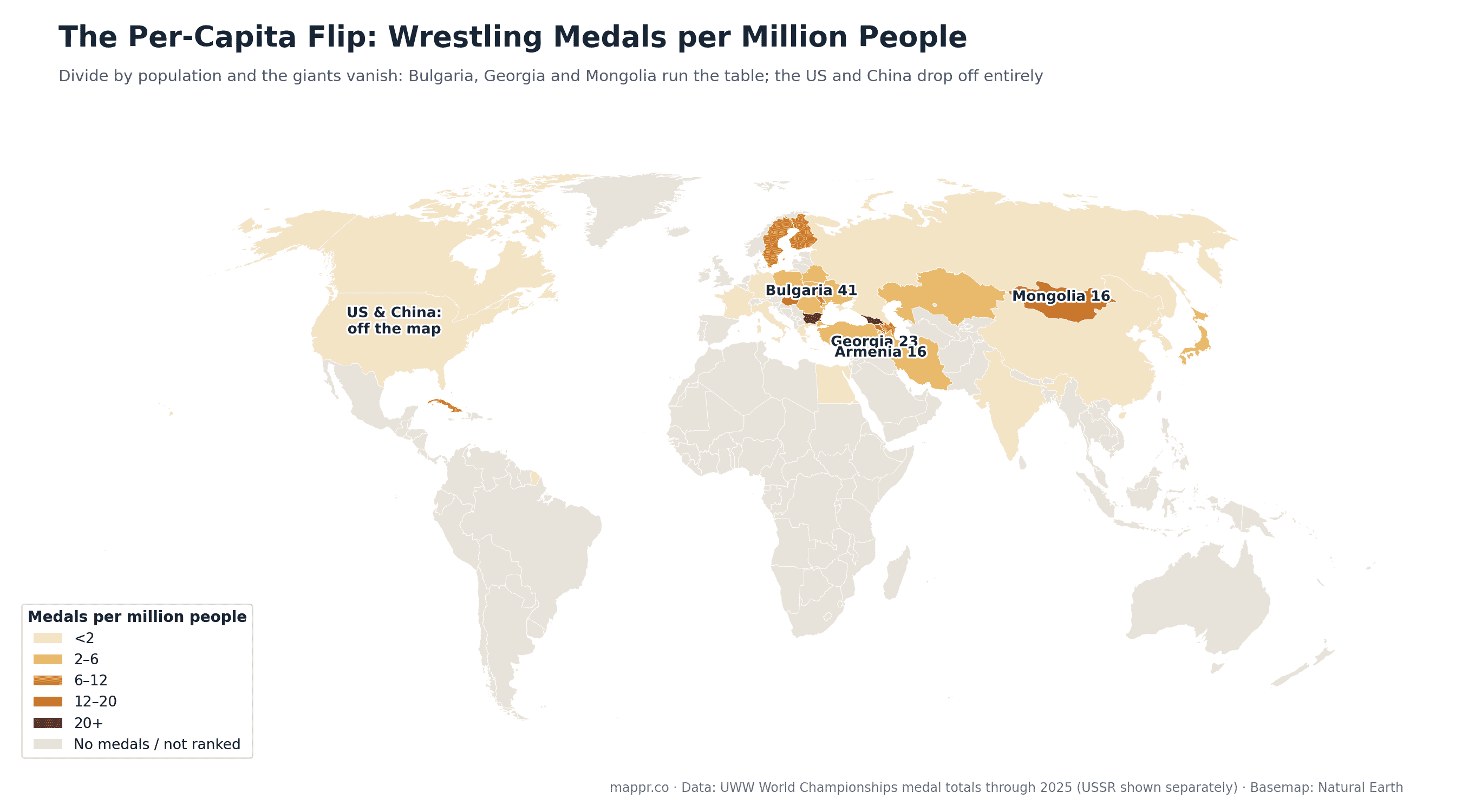
Here is wrestling’s real geography. Divide medals by population and the superpowers evaporate: Bulgaria leads the world at nearly 41 medals per million people, followed by Georgia (23), Mongolia (16) and Armenia (16), with Hungary, Finland, Sweden, Cuba and Azerbaijan close behind. The United States, at under one medal per million, and China don’t register at all. This is the same inversion we’ve mapped for Nobel laureates and other achievements: absolute counts measure size, per-capita counts measure culture, and wrestling’s culture lives in a belt of small mountain and steppe nations from the Balkans through the Caucasus to Mongolia.
The Ranking
Ranked
World Wrestling Championships: the all-time top 20
Total medals since 1951 (freestyle, Greco-Roman and women’s combined), with medals per million people.
| Country | Medals | Per million | Note |
|---|---|---|---|
| 🇯🇵 Japan | 316 | 2.5 | Powered by a historic women's-wrestling record |
| 🇺🇸 United States | 313 | 0.9 | Third on totals, more silver and bronze than gold |
| 🇷🇺 Russia | 271 | 1.9 | Post-1991 only; the USSR's 415 is listed separately |
| 🇧🇬 Bulgaria | 262 | 40.9 | 41 medals per million: the per-capita king |
| 🇮🇷 Iran | 233 | 2.6 | Freestyle superpower |
| 🇹🇷 Turkey | 210 | 2.5 | |
| 🇭🇺 Hungary | 138 | 14.4 | |
| 🇸🇪 Sweden | 114 | 10.9 | |
| 🇨🇺 Cuba | 110 | 10.0 | Almost all from Greco-Roman |
| 🇦🇿 Azerbaijan | 103 | 10.0 | |
| 🇺🇦 Ukraine | 103 | 2.7 | |
| 🇨🇳 China | 95 | 0.1 | |
| 🇵🇱 Poland | 93 | 2.5 | |
| 🇬🇪 Georgia | 84 | 22.7 | 84 medals from 3.7 million people |
| 🇫🇷 France | 76 | 1.1 | |
| 🇫🇮 Finland | 61 | 10.9 | |
| 🇩🇪 Germany | 60 | 0.7 | |
| 🇲🇳 Mongolia | 55 | 16.2 | 55 medals from 3.4 million |
| 🇷🇴 Romania | 48 | 2.5 | |
| 🇦🇲 Armenia | 45 | 16.1 |
Why the Mountains and the Steppe
The pattern is not an accident. Folk-wrestling traditions run deep across this belt: Mongolia’s bökh is a pillar of the Naadam festival, Georgia has chidaoba, Iran its ancient varzesh-e pahlavani, Turkey its oil wrestling. Where a nation already wrestles for ceremony and status, the pipeline to Olympic-style mats is short, and a small population can produce world-beaters generation after generation. Add the Soviet sports-school system, whose legacy still shapes the Caucasus and Central Asia, and you get a map where 3-million-person Georgia out-medals most of Western Europe combined. Astana, this year’s host, sits right in the middle of it.
Data and reporting for this article come from the following sources: