Key Takeaways
- Restrictions are near record highs. Pew Research's June 2026 study found 58 countries with high or very high government restrictions on religion in 2023, close to the record set the year before. Restrictions affect every major faith, from Muslims and Christians to Jews, Hindus, Baha'is and the non-religious.
- 29 governments singled out for 2026. The US Commission on International Religious Freedom named 18 Countries of Particular Concern and 11 on its Special Watch List in its 2026 report, adding Libya and Syria to the worst tier and keeping Nigeria there.
- North Korea is worst for Christians, again. Open Doors' World Watch List 2026 ranks North Korea (97/100) the most dangerous place to be a Christian for a 23rd year, followed by Somalia (94) and Yemen (93). More than 380 million Christians face high persecution worldwide.
- Syria is the big mover. After the fall of the Assad government, Syria's persecution score jumped from 78 to 90, one of the sharpest rises on the 2026 list, and it was added to USCIRF's worst tier.
- One belt, three lenses. A single arc through the Middle East, the Sahel and Central and South Asia dominates every measure, whether you count government policy, all-faith restrictions or violence against Christians specifically.
Religious persecution is back near the top of the global agenda. In the space of a few weeks in mid-2026, three of the most watched trackers all landed at once: the US government’s religious-freedom watchdog published its 2026 report, Pew Research released its annual analysis of restrictions worldwide, and campaign groups put out fresh indexes of where believers face the gravest danger. The picture they paint is consistent and sobering. Here is what the data shows, mapped three ways.
Before diving in, one thing to get straight: there is no single “religious freedom score.” Different trackers measure different things, and they do not always agree, so it helps to read them together rather than pick one.
Three ways to measure religious freedom
The broadest, most neutral measure comes from Pew Research Center, which scores almost every country on two 0-to-10 indexes: a Government Restrictions Index (laws, bans and official harassment) and a Social Hostilities Index (violence and intimidation by groups and individuals). Crucially, Pew counts restrictions on all faiths, and on the non-religious too. In its June 2026 report, covering 2023, Pew found 58 countries with high or very high government restrictions, near the record high, with China, Iran, Afghanistan, Indonesia, Syria and Uzbekistan among the most restrictive.
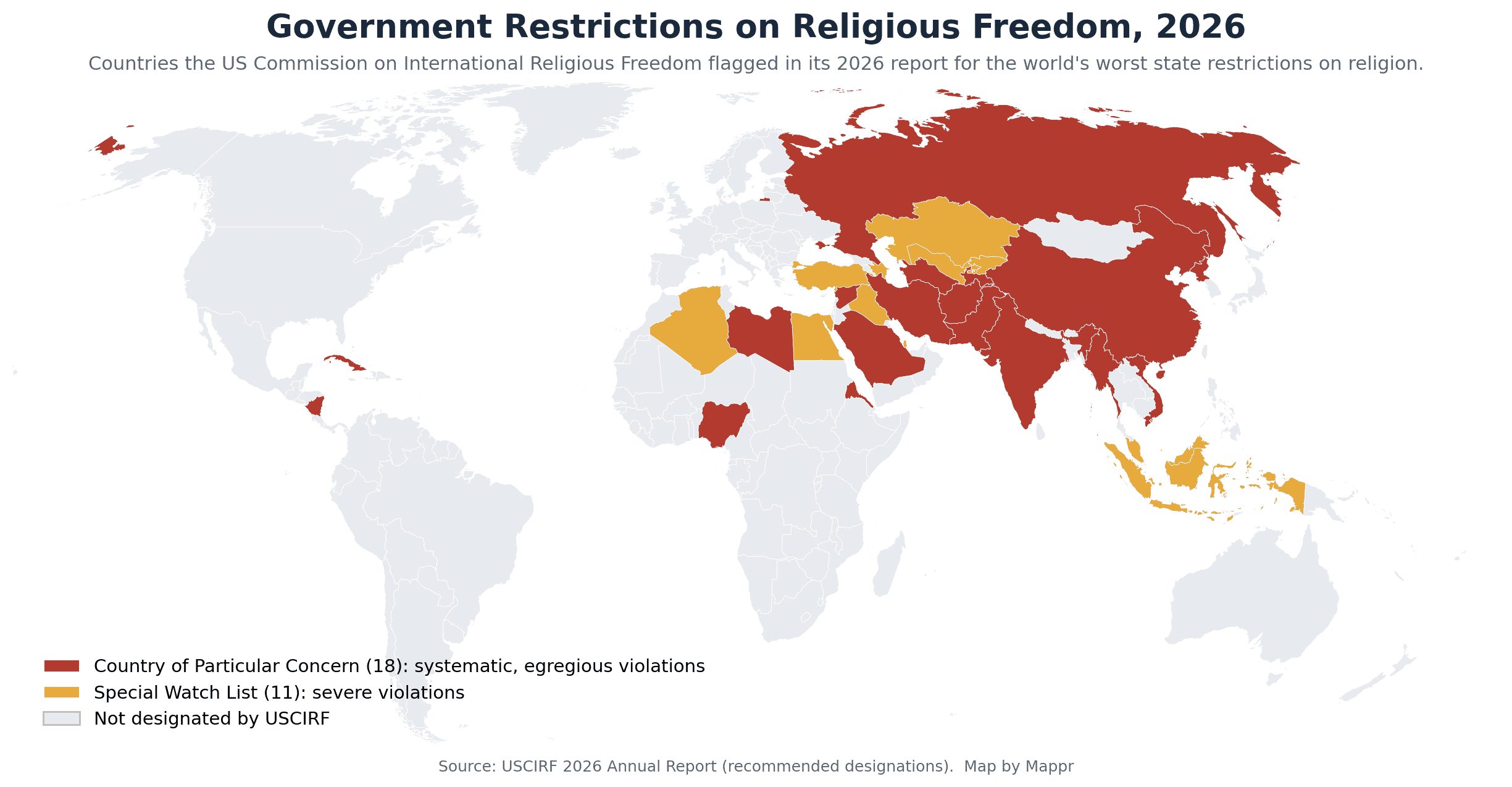
The second lens is governmental. Each year the US Commission on International Religious Freedom (USCIRF) recommends which states the US should formally label. The worst offenders become Countries of Particular Concern (CPC) for systematic, egregious violations; a second tier goes on a Special Watch List (SWL). That is what the map above shows.
The third lens is severity for a specific group. Open Doors, a Christian charity, scores the 50 countries where it is hardest to be a Christian on a 0-to-100 scale in its annual World Watch List. It is the most precise on numbers, but, unlike Pew, it tracks one faith rather than all of them, which is worth keeping in mind.
The governments that restrict religion the most
USCIRF’s 2026 report named 18 Countries of Particular Concern: Afghanistan, Burma (Myanmar), China, Cuba, Eritrea, India, Iran, Libya, Nicaragua, Nigeria, North Korea, Pakistan, Russia, Saudi Arabia, Syria, Tajikistan, Turkmenistan and Vietnam. It added Libya and Syria to that worst tier this year. A further 11 countries went on the Special Watch List: Algeria, Azerbaijan, Egypt, Indonesia, Iraq, Kazakhstan, Kyrgyzstan, Malaysia, Qatar, Turkey and Uzbekistan.
As the map makes clear, this is not a story about one religion or one region persecuting another. The list runs from officially atheist states like North Korea, China and Cuba, to theocracies like Iran and Saudi Arabia, to nominally secular democracies. What they share is the use of state power, whether laws, security services or neglect, to control or crush religious life.
Where persecution is most severe
For sheer severity, the sharpest numbers come from Open Doors’ World Watch List 2026. North Korea tops it once again, for the 23rd year, with a near-maximum score of 97 out of 100. Somalia (94) and Yemen (93) follow. The charity estimates that more than 380 million Christians worldwide now live in places with high levels of persecution, and the combined score of its top 50 reached its highest level in the list’s history.
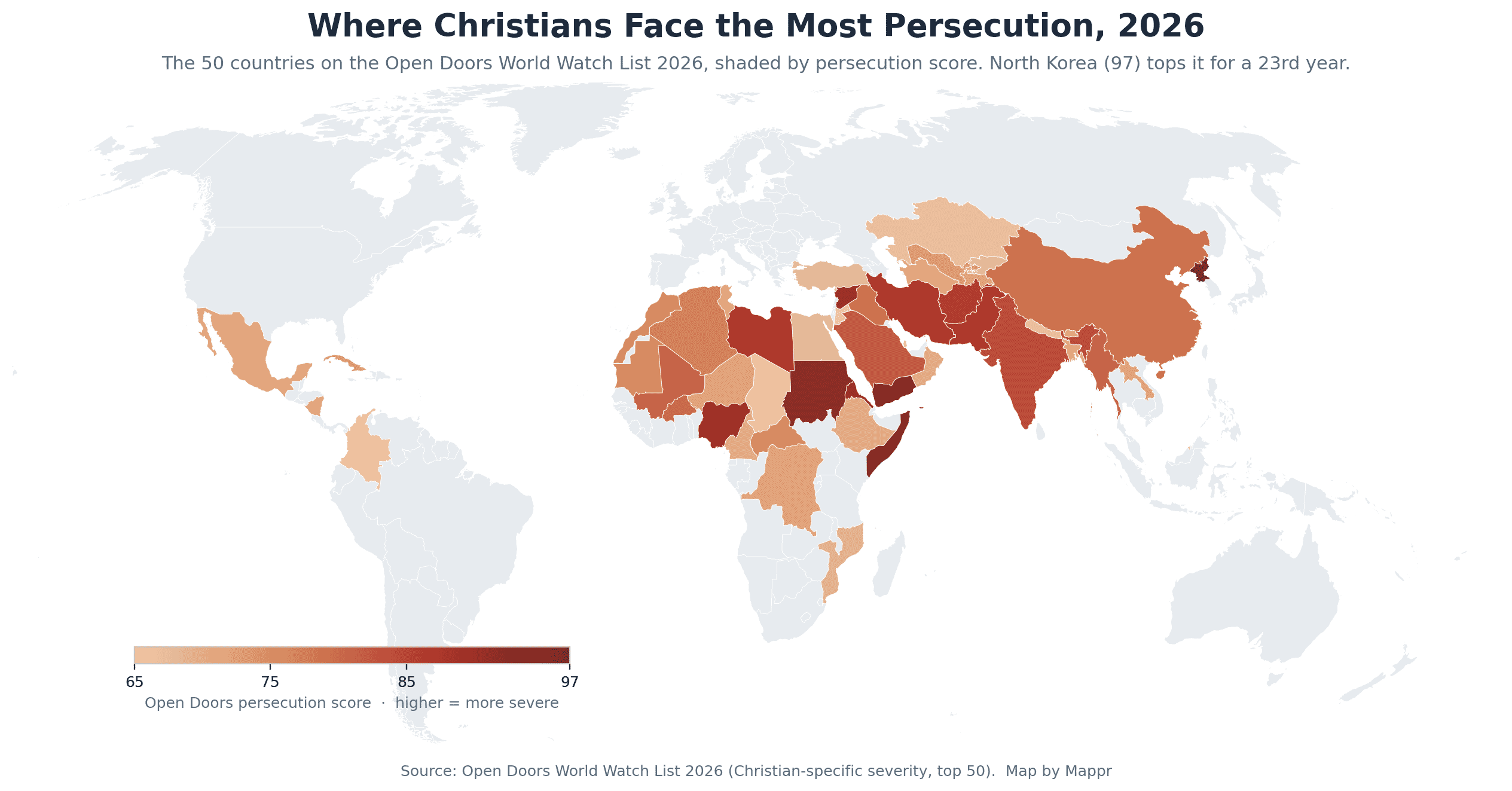
The most striking single move belongs to Syria, whose score leapt from 78 to 90 after the collapse of the old government left minorities exposed to armed factions. The table below shows the 15 worst-scoring countries, alongside whether the US government’s watchdog also flags them. The gaps are telling: Somalia, Yemen, Sudan and Mali rank among the very worst for violence against Christians, yet sit outside USCIRF’s designations, because much of the danger there comes from armed groups and collapse rather than deliberate government policy.
| Rank | Country | Open Doors score (/100) | USCIRF 2026 status |
|---|---|---|---|
| 1 | North Korea | 97 | Country of Particular Concern |
| 2 | Somalia | 94 | Not designated |
| 3 | Yemen | 93 | Not designated |
| 4 | Sudan | 92 | Not designated |
| 5 | Eritrea | 90 | Country of Particular Concern |
| 6 | Syria | 90 | Country of Particular Concern |
| 7 | Nigeria | 89 | Country of Particular Concern |
| 8 | Pakistan | 87 | Country of Particular Concern |
| 9 | Libya | 87 | Country of Particular Concern |
| 10 | Iran | 87 | Country of Particular Concern |
| 11 | Afghanistan | 86 | Country of Particular Concern |
| 12 | India | 84 | Country of Particular Concern |
| 13 | Saudi Arabia | 82 | Country of Particular Concern |
| 14 | Myanmar (Burma) | 81 | Country of Particular Concern |
| 15 | Mali | 81 | Not designated |
Why religious freedom is back in the headlines
The timing is not a coincidence. The International Christian Concern released its 2026 Global Persecution Index on 7 July, spotlighting Nigeria, Nicaragua, Syria, India and Russia, and a wave of coverage followed through mid-July. Together with the USCIRF report and Pew’s June study, it has pushed the subject back into political debate, including renewed calls in Washington to act on Nigeria, where mass killings of rural Christians and Muslims alike have made it one of the deadliest countries in the world for faith communities.
Step back and the trend lines point the same way. Government restrictions sit near their highest level since Pew began measuring, social hostilities are climbing, and the severity scores at the top of the World Watch List keep breaking records. Whichever lens you use, the map of religious freedom in 2026 is getting darker, and the same belt of countries keeps lighting up in red.
Data and designations are drawn from the following sources:
Image Sources