
Key Takeaways
- Keflavik is Iceland's only international gateway. Keflavik International Airport (KEF) serves around 83 regularly-served nonstop destinations, more than ten times any other Icelandic airport. It handles essentially all of Iceland's international and intercontinental flights, and it is the home hub of the flag carrier Icelandair.
- A hub that punches far above its weight. Iceland sits exactly between Europe and North America, and Icelandair built a transatlantic connecting hub on that geography with a free stopover model. The result is that a nation of fewer than 400,000 people runs an airport that handled more than 8 million passengers in 2024.
- More than a dozen US cities, all through Keflavik. Keflavik connects nonstop to a long list of US cities, from New York and Boston to Seattle and Denver, flown by Icelandair plus Delta, United and, from 2026, Alaska Airlines. No other Icelandic airport has scheduled flights to the United States.
- Reykjavik has two airports. International flights land at Keflavik, about 50 km from the capital. Domestic flights, plus links to Greenland and the Faroe Islands, use the small Reykjavik city airport (RKV) right in town. Visitors connecting between the two transfer by road.
- We rank by regularly-served routes, not raw counts. Iceland's traffic is seasonal and tourism-driven, so raw nonstop counts can mislead. Ranking by regularly-served destinations, routes flown often enough to count as scheduled service, gives a truer picture of which airports fly the same routes week in, week out.
Iceland has one of the most lopsided airport maps in Europe. A country of fewer than 400,000 people, sitting alone in the middle of the North Atlantic, runs a single international airport that connects two continents, plus a handful of small domestic airfields that keep remote towns linked to the capital. Almost everything that flies abroad does so from one place: Keflavik, on the Reykjanes peninsula south-west of Reykjavik.
Below we map and rank Iceland’s airports by the number of nonstop destinations each one serves, drawn from live route data on AirportRoutes. We rank by regularly-served destinations, routes flown often enough to count as scheduled service, rather than raw nonstop totals. The figures come from observed flight data, a large sample rather than a complete published timetable, so treat them as a guide to relative connectivity rather than official totals. One pattern is impossible to miss: Keflavik towers over every other airport in the country.
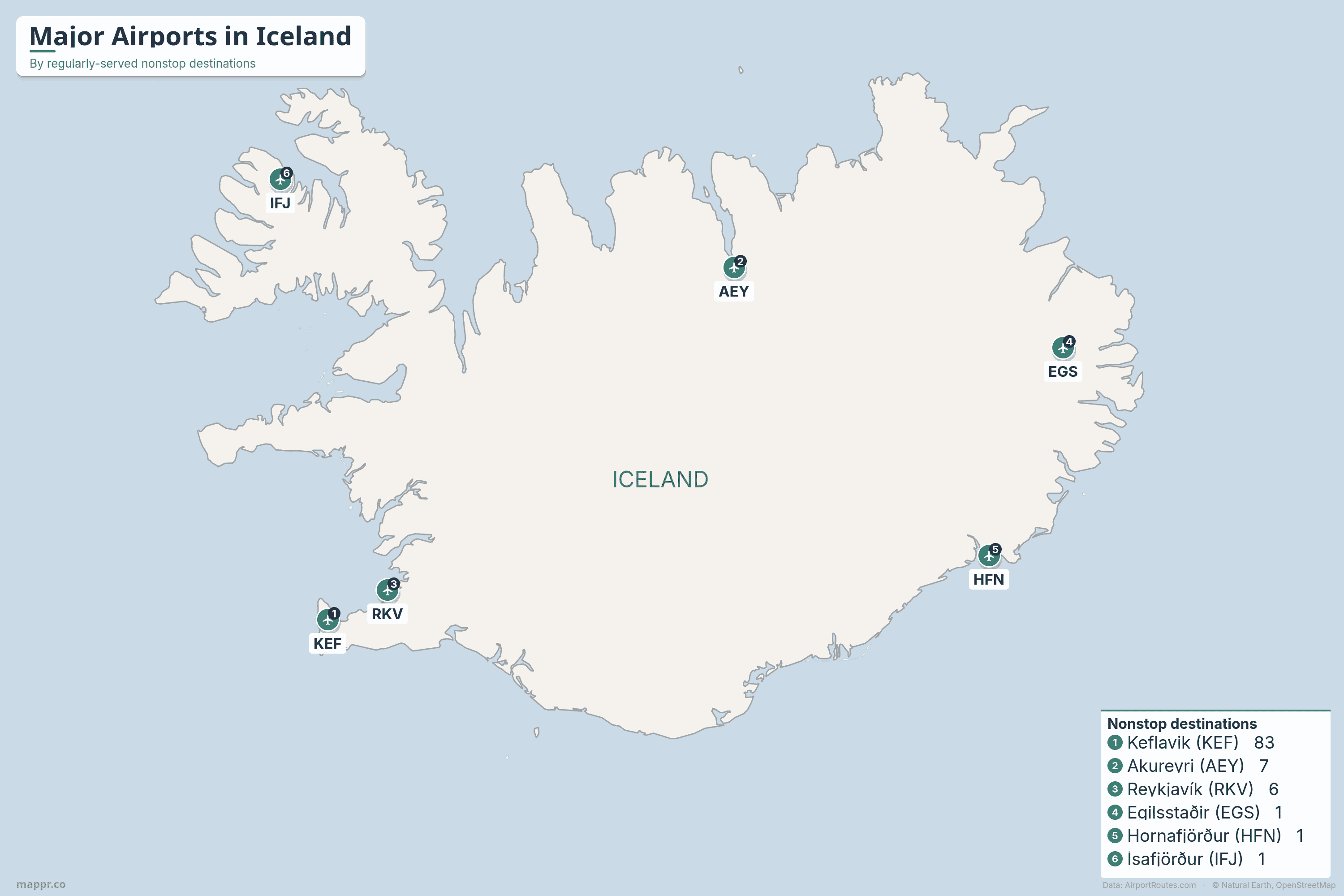
Ranked
Major Airports in Iceland by Nonstop Destinations
Ranked by regularly-served nonstop destinations, busiest first.
| Airport | IATA | Nonstop | Region |
|---|---|---|---|
| 1. Keflavík | KEF | 83 | Capital region, Reykjanes (international) |
| 2. Akureyri | AEY | 7 | North Iceland (seasonal international) |
| 3. Reykjavík | RKV | 6 | Capital city airport (domestic) |
| 4. Egilsstaðir | EGS | 1 | East Iceland (domestic) |
| 5. Höfn | HFN | 1 | Southeast Iceland (domestic) |
| 6. Ísafjörður | IFJ | 1 | Westfjords (domestic) |
A closer look at Iceland’s airports
✈️ Keflavík (KEF)
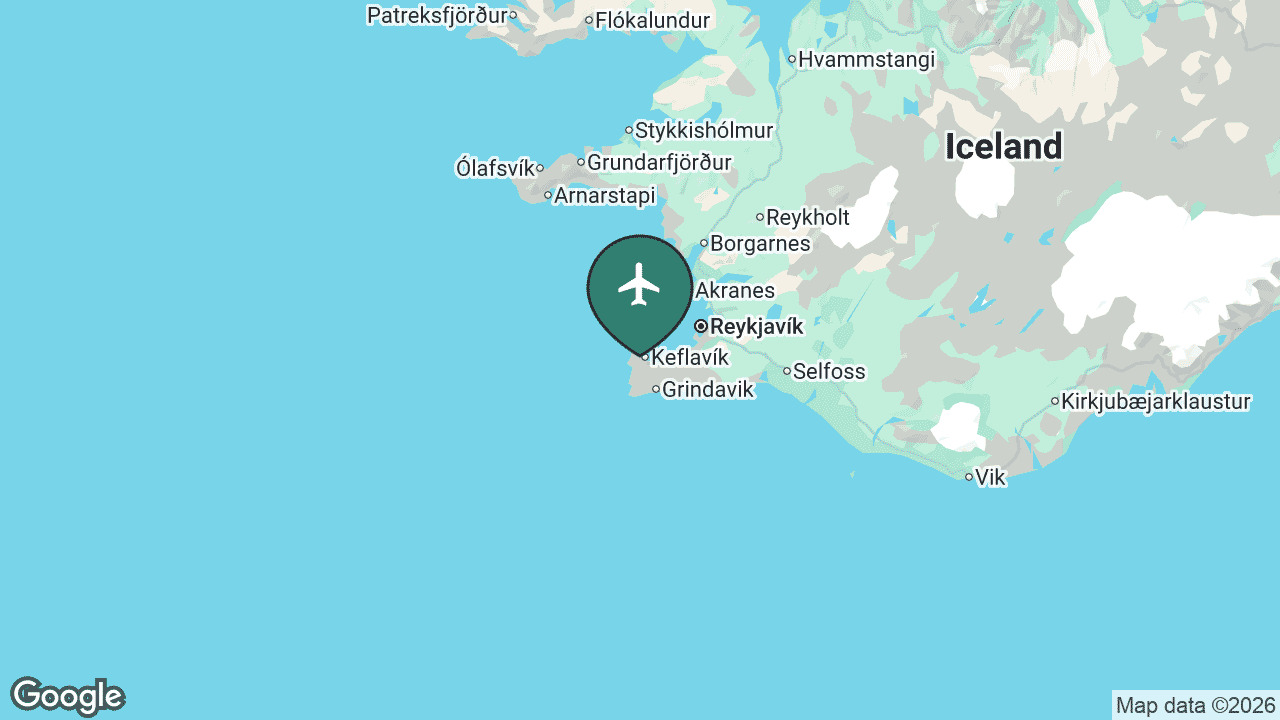
Keflavik International Airport sits on the Reykjanes peninsula about 50 km south-west of Reykjavik, beside the town of Keflavik. It began life as a US and NATO airbase during the Second World War and is now Iceland’s only international airport, the gateway through which almost every visitor to the country arrives.
With around 83 regularly-served nonstop destinations, Keflavik is in a league of its own. It is the home hub of Icelandair, which turned Iceland’s mid-Atlantic position into a business model, routing passengers between Europe and North America with a free stopover. The airport handled more than 8.3 million passengers in 2024, and in May 2026 Alaska Airlines launched daily flights from Seattle, becoming the fifth long-haul foreign carrier on the field. Keflavik has also been the stage for two failed low-cost transatlantic experiments, WOW air (collapsed 2019) and PLAY (collapsed 2025), leaving Icelandair holding roughly 62 percent of available seats.
Main airlines: Icelandair, easyJet, Wizz Air, Jet2, SAS, Delta, United, Alaska Airlines. See the full route map on AirportRoutes →
🌅 Akureyri (AEY)
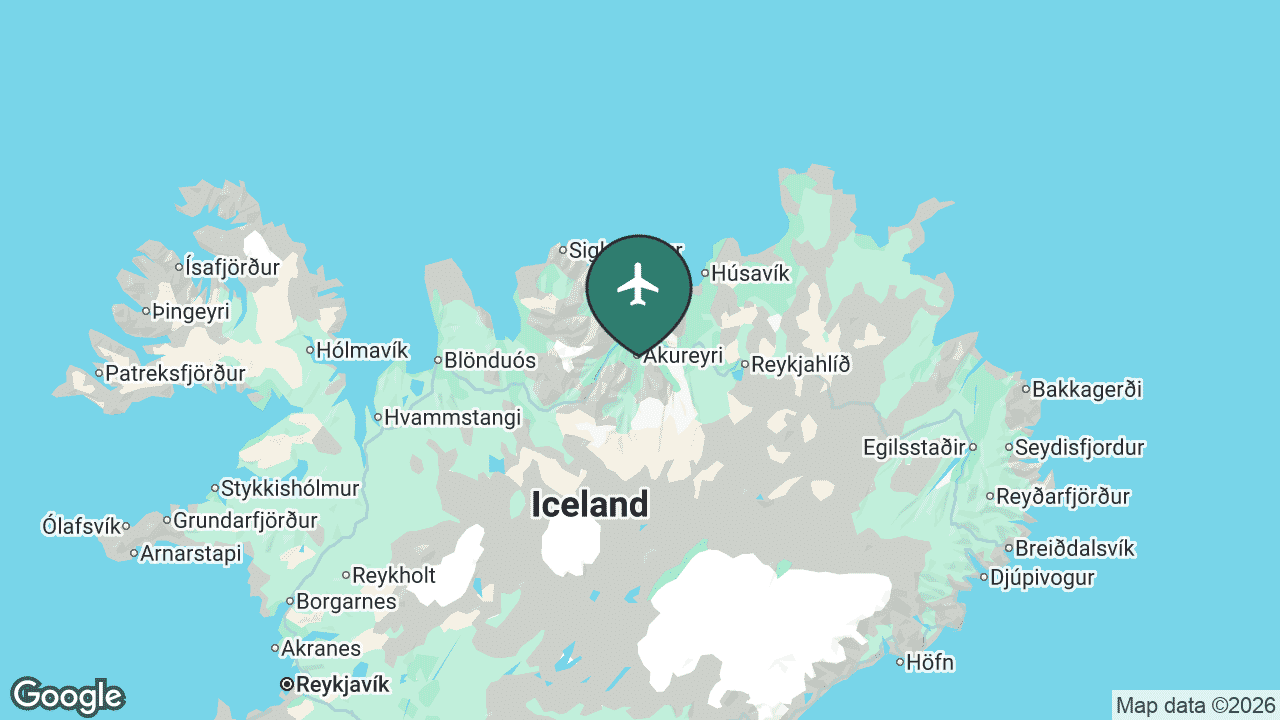
Akureyri is the capital of the north, set at the head of the long Eyjafjordur fjord roughly 390 km by road from Reykjavik. Its airport is the main hub for flying around northern Iceland and serves as the country’s principal backup airport when weather closes Keflavik to the south-west.
Akureyri is also the focus of a deliberate push to bring tourists straight to the north rather than funnelling everyone through Reykjavik. International service here is seasonal: easyJet flies from London Gatwick and Manchester in winter, Edelweiss runs a summer link from Zurich, and winter charters arrive from Switzerland and elsewhere. A locally based startup, Niceair, tried scheduled international flights from Akureyri in 2022 but went bankrupt the following year. Year-round, Norlandair connects Akureyri to east Greenland.
Main airlines: Icelandair, Norlandair, easyJet, Edelweiss Air. See the full route map on AirportRoutes →
🏙️ Reykjavík (RKV)
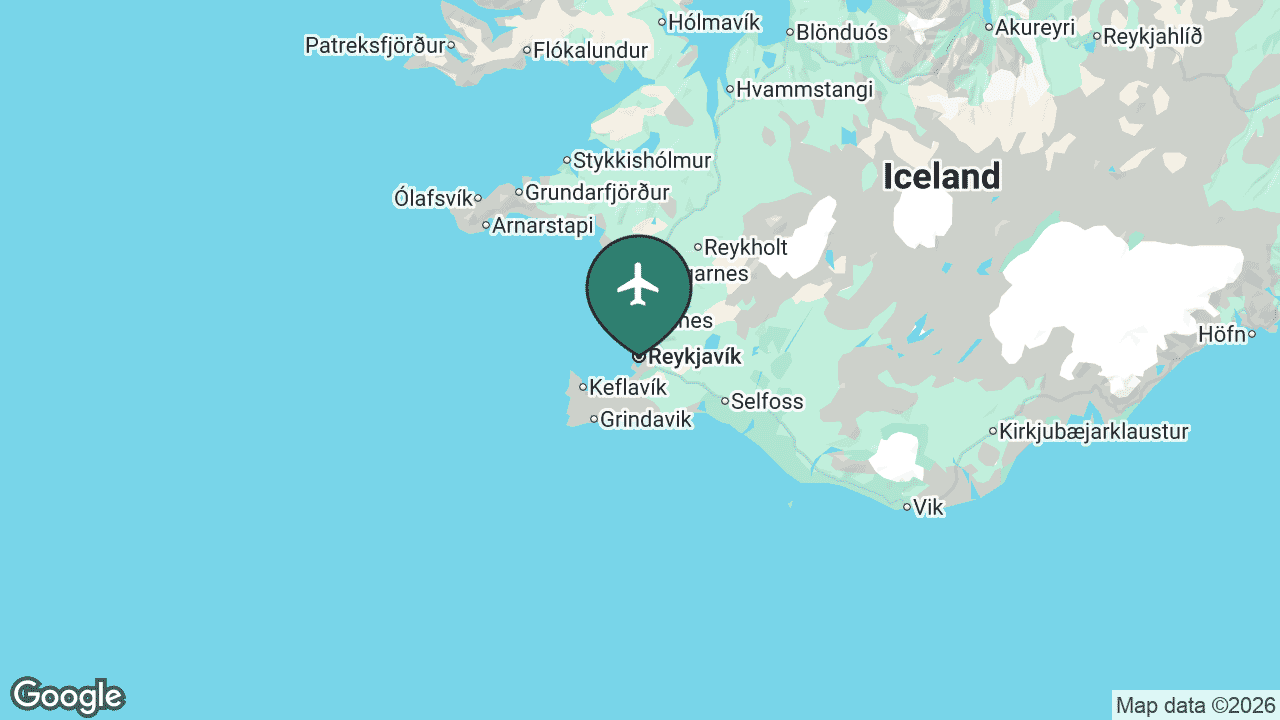
Reykjavik Airport sits right inside the capital, a couple of kilometres from the city centre in the Vatnsmyri area. It is easy to confuse with Keflavik, but the two do very different jobs: Reykjavik handles Iceland’s domestic flights, not its international ones.
RKV is the hub for Icelandair’s domestic network to Akureyri, Egilsstadir and Isafjordur, and the springboard for flights to Greenland (Nuuk, Ilulissat and Kulusuk) and historically the Faroe Islands. Its prime in-city location has fuelled a long-running debate about moving it to free up the land for housing, but for now it stays put and remains the everyday airport for Icelanders flying within their own country.
Main airlines: Icelandair, Norlandair. See the full route map on AirportRoutes →
🏔️ Egilsstaðir (EGS)
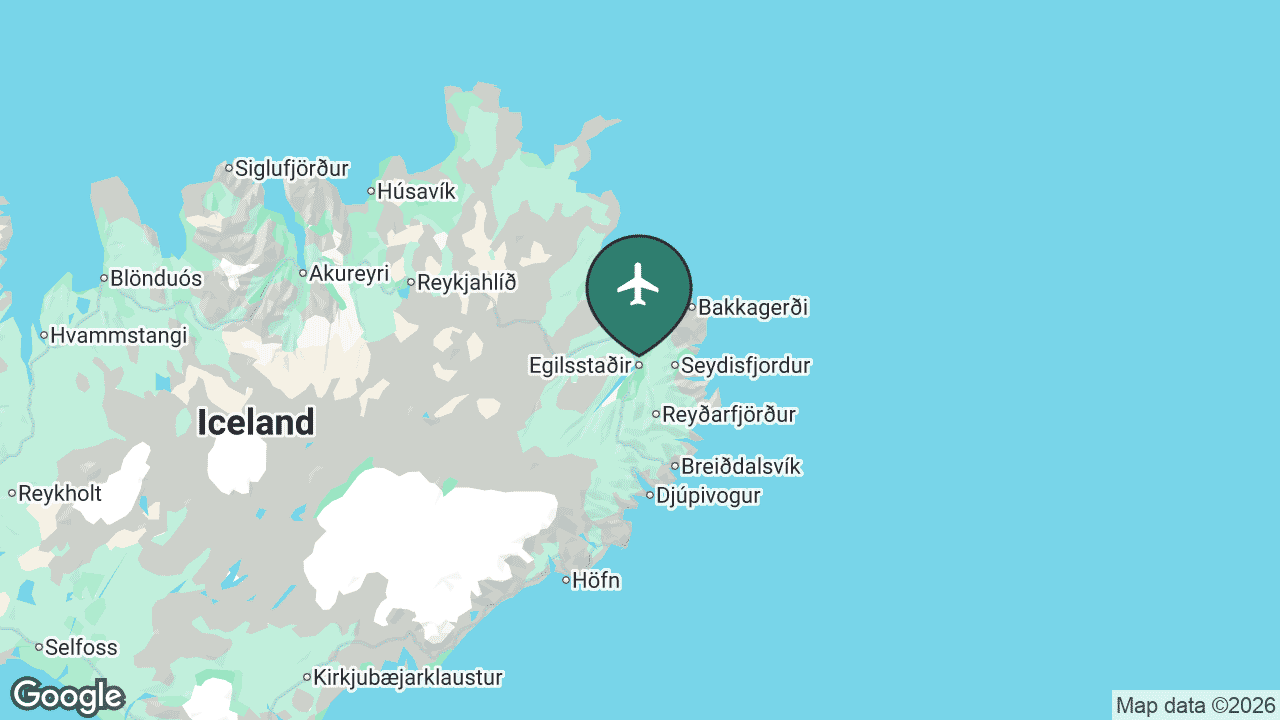
Egilsstadir Airport serves the largest town in east Iceland and is the gateway to the Eastfjords, a remote region of steep inlets and fishing villages far from the capital. Its scheduled service is a domestic link to Reykjavik, flown by Icelandair.
Egilsstadir matters out of proportion to its size for one reason: it is one of Iceland’s designated transatlantic alternate airports, able to take wide-body jets that need to divert away from Keflavik. That long runway has kept alive periodic talk of developing Egilsstadir into a second international gateway for the east of the country.
Main airlines: Icelandair. See the full route map on AirportRoutes →
🧊 Höfn (HFN)
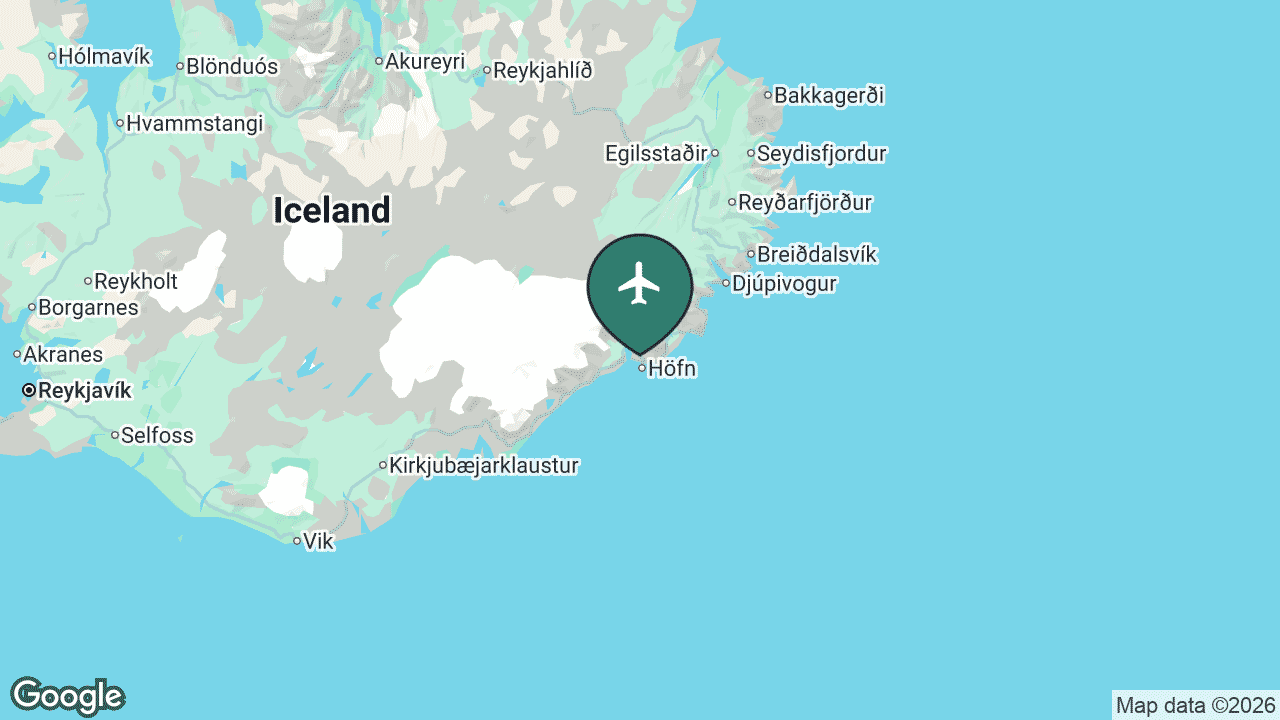
Hornafjordur Airport sits beside the town of Hofn on Iceland’s south-east coast, in the shadow of Vatnajokull, the largest glacier in Europe. It is the nearest airport to the famous Jokulsarlon glacier lagoon and the surrounding national park, making it a useful entry point for travellers heading to the south-east.
The airport runs a small domestic service to Reykjavik. Like the other regional fields, it exists mainly to keep a remote community connected across a country where winter road travel can be slow and unpredictable.
Main airlines: Icelandair, Norlandair. See the full route map on AirportRoutes →
🌊 Ísafjörður (IFJ)
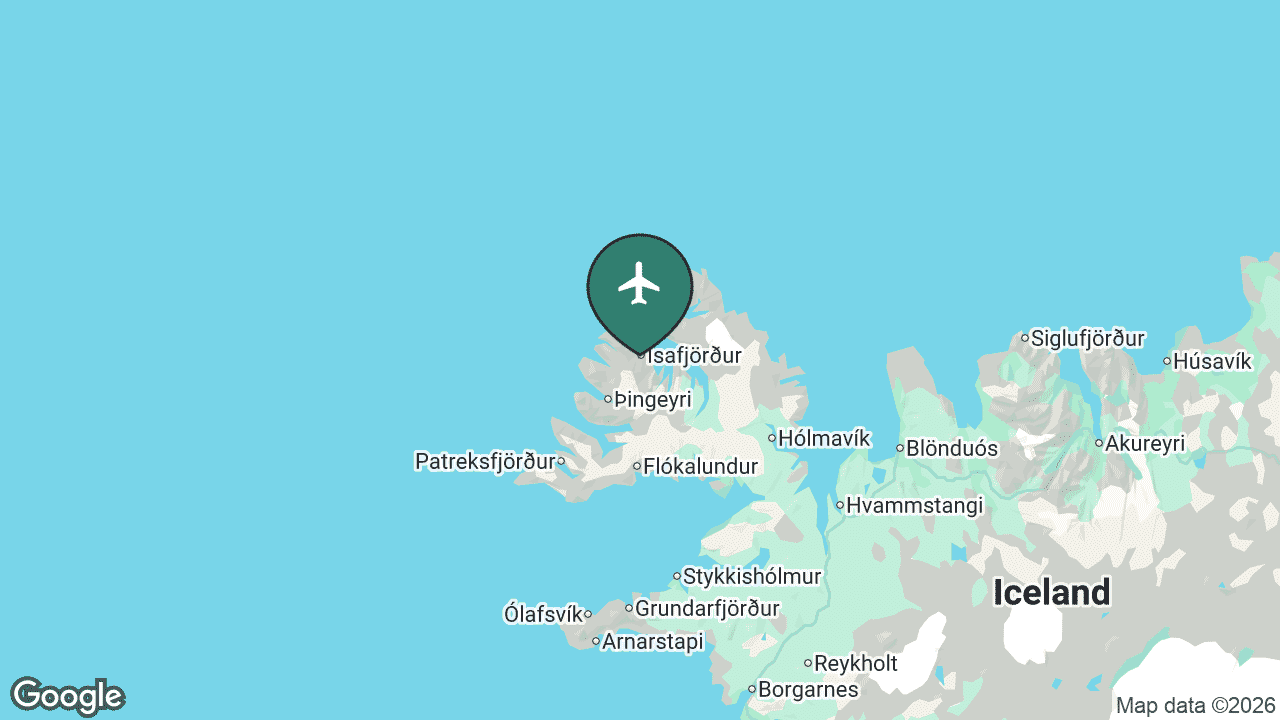
Isafjordur is the main town of the Westfjords, the rugged peninsula in Iceland’s far north-west, and its airport sits at the head of a narrow, mountain-walled fjord. The approach is one of the most demanding in Europe: pilots fly down the fjord between steep slopes, then make a sharp turn close to the ground before landing, a manoeuvre that only specially trained crews are cleared to perform.
Service is a domestic link to Reykjavik, the lifeline that keeps the isolated Westfjords connected to the rest of the country when the long mountain roads are snowed in.
Main airlines: Icelandair. See the full route map on AirportRoutes →
Two airports for Reykjavik: Keflavik versus the city airport
One quirk catches many first-time visitors off guard: Reykjavik is served by two completely separate airports that do different jobs. Keflavik (KEF), about 50 km south-west of the city on the Reykjanes peninsula, handles every international flight. The small Reykjavik Airport (RKV), right in the city, handles domestic flights and the links to Greenland and the Faroe Islands.
That means a traveller flying in from abroad and on to, say, Akureyri or Egilsstadir has to transfer between the two airports by road, a journey of around 45 minutes by coach or car. It is the same split you see at a handful of European capitals, but in Iceland the distance and the weather make planning the connection worth a little extra care.
Which Iceland airports fly nonstop to the US?
Only Keflavik. Every scheduled flight between Iceland and the United States departs from KEF, and no other Icelandic airport has any intercontinental service at all. What makes Keflavik unusual is how deep that US network runs for such a small country.
Thanks to Icelandair’s hub-and-spoke model and Iceland’s position on the great-circle path between Europe and North America, Keflavik connects nonstop to more than a dozen US cities, among them New York, Boston, Washington, Chicago, Minneapolis, Denver, Seattle, Detroit, Portland, Orlando, Miami and Raleigh-Durham. These are flown by Icelandair alongside US carriers Delta and United, with Alaska Airlines adding Seattle from 2026. The collapsed low-cost carriers WOW air and PLAY once added further cities such as Baltimore and Stewart in New York State, but both airlines have since shut down, leaving Icelandair firmly in charge of the transatlantic market.
Iceland as a North Atlantic stepping stone: Greenland and the Faroe Islands
Iceland’s geography makes it a natural connector for the rest of the North Atlantic. Greenland and the Faroe Islands are both far from any other landmass, and for decades the easiest way to reach them by air has been through Iceland. Reykjavik and Akureyri are the main gateways to Greenland, with flights to Nuuk, Ilulissat, Kulusuk and the east-coast strip at Constable Pynt, while Keflavik and Reykjavik handle the hops to the Faroes.
Because Greenland (GL) and the Faroe Islands (FO) have their own country codes, their airports do not appear in Iceland’s data, but the air links between them run squarely through Iceland. That role is now shifting: Greenland opened a new international runway at Nuuk in late 2024 and has begun direct links to Europe and North America, so Iceland’s monopoly as the stepping stone is loosening even as Reykjavik and Akureyri stay central to the network.
Airport rankings, nonstop-destination counts, served regions, airline lists and connections are drawn from live AirportRoutes route data (observed AeroAPI flight data, a sample rather than a complete published schedule; we use the regularly-served figure, which filters one-off observations). Airport history, current routes and notable facts are cross-checked against the cited references. The ranked map is a Mappr original.
Primary Data Source:
- AirportRoutes: major airports and routes, Iceland – Live route data: per-airport nonstop destinations, served cities, airlines and connections.
Reference:
- Wikipedia: Keflavik International Airport – Airport history, passenger figures, location and notable facts referenced in the sections above.
- Isavia (Iceland's airport operator) – Operator of Keflavik and Iceland's domestic airports; background on traffic and the airport network.
- Icelandair – Iceland's flag carrier; background on the transatlantic hub model and domestic network.
- Locator maps: Google Maps / Google Static Maps – Per-airport location maps with airplane markers, generated via Google Static Maps.
Image Sources:
- Map by Mappr – Map of major airports in Iceland, a Mappr original built from AirportRoutes data and Natural Earth boundaries.
🌍 More maps & data for Iceland
Browse more: All airports by country


